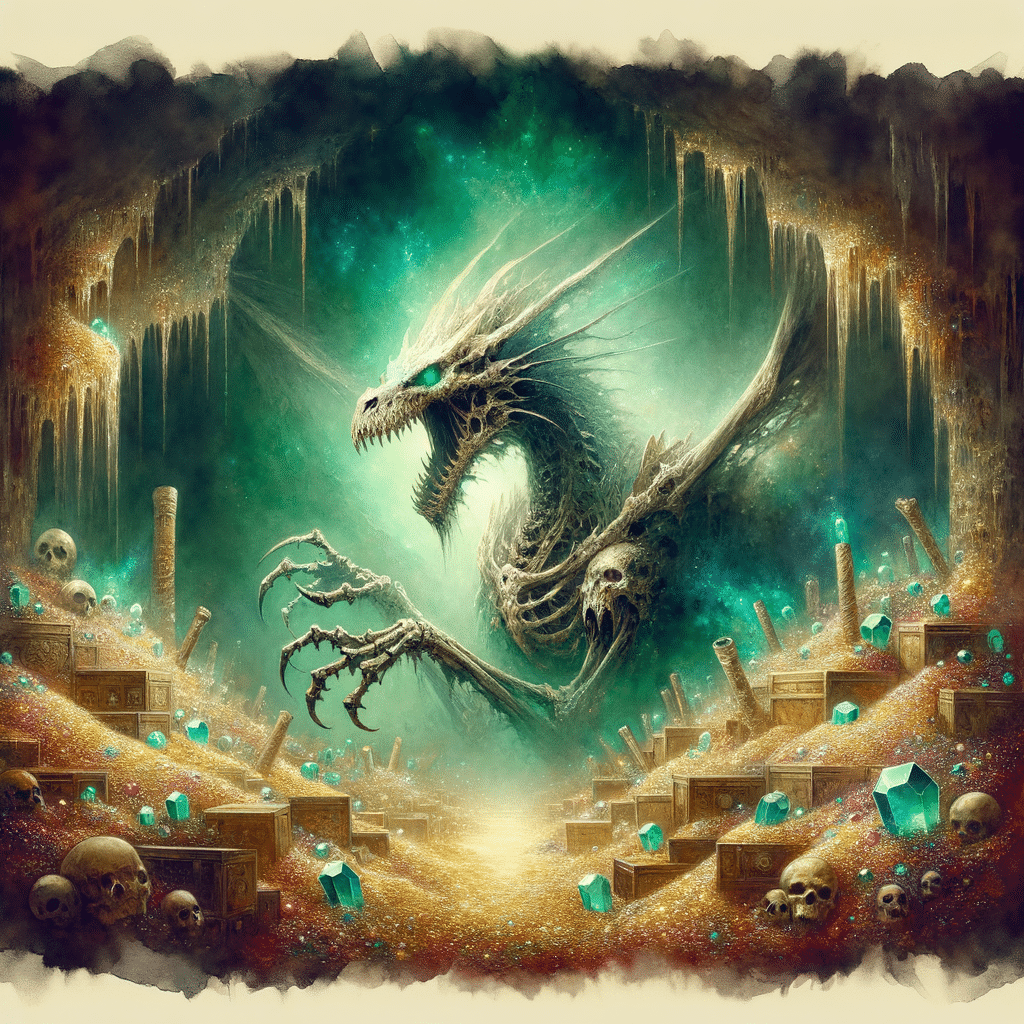
Undead Dracolich: Key Points
-
The dracolich is an undead dragon that achieved immortality through necromantic transformation, combining draconic power with undead persistence.
-
Physically, it appears as a skeletal dragon with bleached bones, tattered wings, glowing eye sockets, and an aura of corruption.
-
Dracoliches are patient, immortal schemers who surround themselves with undead servants and inhabit places saturated with necromantic energy.
-
The transformation requires creating a soul phylactery and consuming a deadly potion that kills the dragon, allowing its spirit to return and inhabit its skeletal remains.
-
Their evil stems from draconic pride so extreme they reject natural death, leaving only pure malevolence untempered by any connection to life.
-
The dracolich debuted in the 1981 D&D Fiend Folio and has remained a staple high-level antagonist in fantasy role-playing games.

Introduction
The dracolich is a truly fearsome fusion of might and undeath, a testament to the dark aspirations of dragons who won’t go quietly. These beings are born from the necromantic arts, powerful dragons trading their flesh for the unyielding embrace of undeath, and the allure of endless plots. In the worlds of fantasy games and stories, few creatures evoke such a potent blend of respect and dread as the dracolich. It marries the elemental wrath of dragons with the unending drive of the undead. Their very presence upends the natural order, a deep corruption that goes far beyond a simple change of form, reaching into the soul itself.
Physical Form and Terrifying Presence
A dracolich, in its physical form, is a chilling echo of the dragon it once was, its skeletal remains exuding both threat and an otherworldly strength. The bones, often a stark white or a sickly yellow, sometimes still hint at their former hues, illuminated by a ghostly glow or the pulsing energy of necromancy that dances across the bones. Where flesh persists, it’s a patchwork of dried strips or leathery hide clinging to the skeletal frame, frequently marred by the ravages of time and death, with exposed tendons and gaps where decay has taken hold. The wings, a particularly disturbing feature, are mere skeletal structures with tattered membranes stretched between them, yet these beings soar with a disquieting elegance that seems to defy the natural order. The eye sockets, once filled with the gaze of a sentient reptile, now emit pinpricks of chilling light. These lights, frequently described as blue, green, or violet, burn with a sinister intelligence, cutting through both shadow and deceit. The skull itself, still bearing the formidable teeth and horns of a living dragon, is now marred by age, cracked and stained, yet still capable of inflicting deadly harm. An aura of corruption clings to the dracolich, a tangible sense of wrongness that chills the air, causing plants to die, and instilling a primal fear in the living.
Behavior and the Transformation Ritual
Dracoliches are among the most dreaded undead in fantasy role-playing games, merging the dragon’s might with the lich’s unending life. In the 3rd Edition of the Forgotten Realms Campaign Setting, a dracolich is defined as a dragon that has willingly bound its soul to a phylactery, thereby achieving freedom from death; the dracolich’s spirit can then inhabit any deceased reptilian form, typically its original body, while preserving all the powers and capabilities of its previous form. This transformation endows the dracolich with the supernatural fear aura, spells, and breath weapon it possessed in life, in addition to the formidable strength of the undead (Greenwood et al., 2001). The conduct of a dracolich is markedly distinct from that of living dragons, a consequence of the fundamental alteration in its relationship with time and mortality. These undead dragons are no longer preoccupied with the immediate pleasures of hunting, feeding, or even sleeping; instead, they dedicate their eternal existence to long-term plans that can extend over centuries. A dracolich typically becomes more patient and calculating than it was in life, willing to wait decades or even generations for plans to come to fruition or for enemies to make fatal mistakes. They tend to establish lairs in places suffused with necromantic energy or in ancient tombs and ruins where the boundary between life and death grows thin, rather than the natural caverns and mountain peaks favored by living dragons. Most dracoliches surround themselves with undead servants—skeletons, zombies, wraiths, and other unliving minions—who serve without question, complaint, or the possibility of betrayal. The creature’s interactions with the living are characterized by cold manipulation and contempt, viewing mortal beings as temporary annoyances at best or potential resources at worst. Even in their undead state, dracoliches retain their sharp minds, and they frequently keep gathering knowledge and magical might. They become even more formidable dark arts scholars than they were in life.
Becoming a dracolich involves a complicated and perilous ritual. It demands vast magical understanding and the willing aid of potent necromantic forces. The dragon aiming for this transformation must first create or obtain a phylactery. This is a deeply personal object, magically altered to safeguard the dragon’s soul after death. The phylactery needs specific necromantic rituals to be prepared, often requiring rare materials. These can include exceptionally fine gems, metals touched by death magic, or artifacts already infused with undead power. The dragon’s next step is to secure or create the Dracolich Transformation potion. This is no ordinary brew; it’s a foul mixture. It includes the blood of sentient undead, the essence of shadows made tangible, and other ingredients so rare and malevolent that simply gathering them is a plunge into darkness. Drinking this poison is a painful death. The dragon suffers in agony as the toxin annihilates its living essence, while necromantic magic simultaneously begins the reanimation. If the ritual works, the dragon’s spirit moves to the phylactery, then returns to its own skeletal remains. These are now animated by negative energy and bound to the phylactery, the anchor of its new existence. The process is perilous. Failure means true, permanent death. Even success demands the dragon’s complete faith in the phylactery’s preparation and the ritual’s precision.
In the Forgotten Realms fantasy setting, the process of becoming a dracolich was discovered by Sammaster the Mad, a fallen Chosen of Mystra, who was inspired after reinterpreting The Chronicle of Years to Come by the prophet Maglas (Donovan, 1998). Sammaster’s first success occurred in the Year of the Queen’s Tears, 902 DR, with the powerful red wyrm Shargrailar the Dark, and since then, Sammaster and his followers, the Cult of the Dragon, have created many more dracoliches in preparation for an apocalypse they believe will come (Donovan, 1998). Greenwood’s novel Spellfire: Shandril’s Saga provides a narrative example of this transformation, explaining how the great and evil red dragon Rauglothgor became a dracolich through the Art of the Cult of the Dragon (Greenwood, 2011). The text describes the terrifying nature of the creature, noting that the dracolich was dead yet not dead, consisting only of bones and magic, and that it grew moody and lonely due to its eternal existence (Greenwood, 2011).

The Nature of Draconic Evil and Origins in Gaming
The essence of draconic malevolence is significantly illuminated by an investigation into the motivations behind a dragon’s transformation into a dracolich. Dragons, particularly those of chromatic lineage, are intrinsically characterized by considerable pride and self-importance, perceiving themselves as inherently superior to almost all other beings and regarding the world as existing primarily for their own advantage. This inherent arrogance, coupled with the avarice that compels dragons to accumulate wealth and magical prowess, fosters a psychological state where the inevitability of death is not merely undesirable but entirely intolerable. Consequently, the choice to become a dracolich embodies a distinct form of evil—not the impulsive cruelty of rage, but the calculated and utterly self-serving coldness of absolute selfishness. A dragon’s choice to become a dracolich shows a willingness to go against the natural order, to corrupt its own impressive form, and to exist forever as a monster, rather than accepting the natural cycle of life and death that all living things follow. This choice reveals a deep evil, one that values its own survival above everything else, even the basic nature of its existence. Moreover, the dracolich’s evil is made worse by its greater ability to be cruel, since the undead dragon no longer has any biological needs or natural instincts that might sometimes control its actions, leaving only pure malice, unhindered by any connection to the living world.
Any dragon that has reached old age or older can become a dracolich, with specific details about this transformation found on page 146 of Draconomicon (Collins, Williams, & Wyatt, 2003). The transformation fundamentally alters dragons, which are described as mythical creatures, the first intelligent race, and keepers of vast knowledge and ancient secrets (Collins et al., 2003). Like other liches, a dracolich can only be completely destroyed by destroying its phylactery (Greenwood et al., 2001). The dracolich has the unusual ability to inhabit any reptilian corpse after death, though it is most powerful in a dragon’s body. When its physical form is destroyed, the dracolich’s spirit escapes and hides in the phylactery, waiting for a new body to animate and inhabit (Boyd & Bernstein, 2006).
The dracolich first appeared in tabletop role-playing games, specifically in the first edition of Advanced Dungeons & Dragons, introduced in the 1981 Fiend Folio supplement. The concept resonated immediately with game masters and players because it took the already fearsome challenge of facing a dragon and elevated it to an even more terrifying level by adding the relentless nature and magical immunities of undead creatures. Throughout subsequent editions of Dungeons & Dragons, the dracolich has remained a fixture of the game’s monster repertoire, appearing in various campaign settings, adventure modules, and tie-in novels, often serving as major antagonists or final bosses for high-level campaigns. The creature has also influenced other fantasy role-playing games and media, with similar undead dragon concepts appearing in video games, fantasy literature, and other gaming systems. The dracolich’s appeal lies partly in its rarity—it is explicitly described as an uncommon creature even within fantasy worlds, making encounters with one truly memorable and significant—and partly in its combination of intelligence and power, which allows it to serve as both a physical threat and a scheming mastermind.
In practical gaming contexts, dracoliches function as potent adversaries, compelling players to exercise strategic acumen and resource management. Sullivan’s account details a Dungeons & Dragons session in which players faced a dracolich, highlighting the difficulties it presented stemming from its capacity to repeatedly inhabit the corpses of deceased dragons (Sullivan, 2010). The dracolich’s emergence, followed by a brief pursuit of the players’ airship upon their exit, served to establish its role as a significant antagonist within the game’s storyline (Sullivan, 2010). Players, anticipating a confrontation with a dracolich due to the pervasive undead presence in the vicinity, demonstrated their understanding and foresight within the game’s narrative (Sullivan, 2010). Furthermore, the ecological and behavioral characteristics of dracoliches have been examined in dedicated publications, including “The Ecology of the Dracolich” in Dragon magazine, which offers comprehensive insights into these beings’ behaviors, objectives, and their role within the fantasy world’s ecosystem (Pett & Vaughan, 2006).
Conclusion
The dracolich, therefore, serves as a powerful emblem within fantasy gaming, representing ambition’s corruption and the relentless pursuit of power. These entities epitomize the zenith of draconic arrogance and the extreme measures these beings undertake to evade mortality, metamorphosing into abominations that transgress natural order. The dracolich functions as a potent narrative element within fantasy realms, encapsulating concepts of corruption, the cost of eternal life, and the perils of unchecked ambition. Serving as both an adversary to be vanquished and a cautionary example of evil’s nature, the dracolich persists in captivating audiences and testing heroes within role-playing games, thereby demonstrating the lasting fascination with creatures that merge the known with the unsettling in ways that are simultaneously horrifying and captivating.
References
Boyd, E. L., & Bernstein, E. (2006). Dragons of Faerûn (B. Griese, C. Rice, & K. Mohan, Eds.). Wizards of the Coast.
Collins, A., Williams, S., & Wyatt, J. (2003). Draconomicon. Wizards of the Coast.
Donovan, D. (1998). Cult of the Dragon (J. Martin, Ed.). TSR, Inc.
Greenwood, E. (2011). Spellfire: Shandril’s Saga (Vol. 1). Wizards of the Coast.
Greenwood, E., Reynolds, S. K., Williams, S., & Heinsoo, R. (2001). Forgotten Realms Campaign Setting 3rd edition. Wizards of the Coast.
Pett, R., & Vaughan, G. A. (2006). The ecology of the dracolich. In E. Mona (Ed.), Dragon (Issue 344, pp. 84-90). Paizo Publishing, LLC.
Sullivan, S. (2010). Players in control: Narrative, new media, and Dungeons and Dragons [Doctoral dissertation, University of Missouri-Columbia]. ProQuest Dissertations and Theses Global.



Leave a Reply