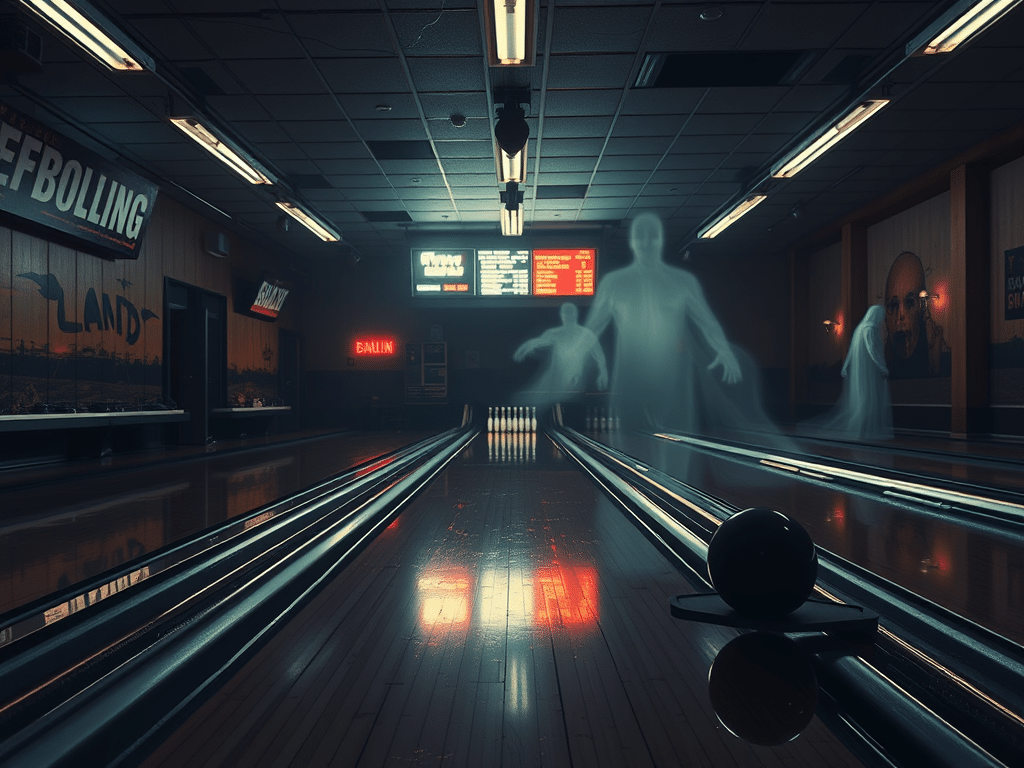
Ghosts and Bowling Alleys: Key Points
-
Bowling alleys function as liminal spaces that exist between categories like past and present, public and private, creating ideal psychological conditions for supernatural interpretation through their retro aesthetics, peculiar acoustics, and transitional architecture.
-
Ghost sightings in bowling alleys typically involve peripheral apparitions, unexplained mechanical activity like pins falling or balls rolling without cause, and phantom sounds of bowling echoing through empty buildings.
-
Famous haunted bowling alleys like the Crest in New York, Spare Time in Maine, and Gable House Bowl in California share common features including consistent apparitions at specific lanes, equipment malfunctions, and manifestations during late-night or early-morning hours.
-
Theories explaining these hauntings range from skeptical interpretations involving misidentified machinery sounds and pareidolia to supernatural explanations suggesting psychic residue from repeated human activity or electromagnetic field effects.
-
The cultural significance of haunted bowling alleys has grown as bowling declined from its mid-twentieth-century peak, with ghost stories multiplying as these spaces aged and closed, reflecting nostalgia for fading community gathering places.
-
These ghost narratives ultimately serve as a way for communities to process loss, maintain connections with the past, and preserve the memory of important social spaces, with the ghosts themselves often portrayed as melancholy figures eternally engaged in the activity they loved.

Introduction
The fluorescent lights hum above, throwing a strange glow across the smooth lanes that go on forever until it gets dark. Stories of the supernatural have grown somewhere between the sound of the pins hitting the board and the silence that follows. Bowling alleys are a unique part of American culture because they are right on the edge between fun and trite, between the lively energy of competition and the eerie quiet of empty lanes after the game is over. Because these places look like they were frozen in time between the 1950s and 1980s, have strange acoustics that make some sounds louder than others, and tend to be in commercial dead zones, they have become unexpectedly excellent places to find ghost stories and paranormal encounters. When bowling culture and supernatural folklore meet, it shows us something deep about how we make sense of empty places and how the architecture of fun can become the architecture of ghosts.
Bowling alleys are liminal places in more than one way; they exist on the edges of many cultural and temporal categories at the same time (Davies, 2019). They are neither completely mainstream nor completely fringe in American entertainment. They are usually found in strip malls or buildings that stand alone and don’t seem to fit in with the normal flow of urban growth. The long, narrow shape of the inner spaces creates corridors of activity punctuated by moments of waiting. These are the transitions from the bright carnival atmosphere of the arcade and snack bar to the darker, more focused environment of the lanes.
Time seems to move more slowly in bowling alleys, where the retro decor is often not meant to be old but just original features that have never been updated, making it feel like you’re stuck in the past. The approach, the release, the waiting, and the reset are all rhythmic and repetitive parts of bowling that can make you feel removed from the outside world. These spaces are neither quite public nor quite private, neither purely athletic nor purely social, and this categorical ambiguity creates the perfect psychological conditions for supernatural interpretation.
Ghost Manifestations and Cultural Symbolism
Ghosts are common in many cultures and represent societal fears, memories, and problems that haven’t been fixed. They can take on the form of the past and reflect people who haven’t finished their journeys on earth yet. This ghostly imagery often leads to conversations about death and the future. This idea has been captured in many ways in literature and folklore. Phillips pointed out that ghosts are often shown in a way that mixes story and personal experience to make people feel things related to memory and loss (Phillips, 2009).
Bowling alleys are places where people often see ghosts. The way these places are built and the people who use them can be seen in the patterns that ghosts appear in. People who have seen these things often say they see apparitions in their peripheral vision, like figures they can see at the far end of dark lanes or mirrored in the smooth surfaces of the approach areas that disappear when they look at them directly. Because bowling alleys are mechanical, strange things can happen there. For example, automatic pinsetters that start moving balls around for no reason, balls that come back when no one has bowled, or score systems that record phantom games can all be seen as supernatural activity.
Many stories say that the rumble of balls, the crash of pins, and the voices of ghost bowlers can be heard in buildings that are meant to be empty late at night or in the hours before they open. Bowling lanes are small and straight, which makes them ideal passageways for ghosts, who are said to walk from one end to the other, maybe forever replaying their last games. Some witnesses say that certain lanes or areas are cold, while others say that they can smell cigarette smoke in places that are now smoke-free, which could mean that bowlers from the past were there (Hendricks, 2020).

Famous Haunted Bowling Alleys and Theoretical Explanations
The Crest Bowling Alley in New York is known as one of the most haunted bowling alleys in the United States. Over the years, many employees and customers have reported seeing ghosts there. Employees have said that they felt watched as they closed up at night, heard the sound of bowling balls running down lanes when the building was locked and empty, and saw pins fall for no apparent reason. The ghostly activity at the Crest seems to have something to do with the building’s long past and the many people who spent countless hours there over many generations. This suggests that haunting may have less to do with specific deaths and more to do with the presence of many people over time.
Spare Time Bowling Alley in Maine has its own collection of ghost stories. For example, people say they see a ghostly woman dressed in old clothes near lane thirteen and hear children laughing in places where there are no children. Because witnesses have named individual lanes and said they have seen the same ghosts over and over, Spare Time has become a popular place for paranormal investigators to go. The Gable House Bowl in California has a reputation for being haunted. Employees say that doors open and close on their own, equipment breaks down in strange ways, and they can’t shake the feeling that someone is watching them during late shifts. These three examples only show a small part of the haunted bowling alleys that have been reported across America, but they show some themes that are common: the link between repeated human activity and the presence of the supernatural; the fact that manifestations tend to happen at odd times, like late at night or early in the morning; and the way that the architecture of bowling alleys seems to focus and amplify paranormal experiences.
There are many ideas, ranging from the psychological to the supernatural, that try to explain why bowling alleys may be especially prone to hauntings or other supernatural events. If you’re skeptical, bowling alleys are full of chances to get natural events wrong. The complicated machinery of the pinsetters and ball returns makes strange noises, and the strange acoustics can make sounds seem to come from places they can’t be. The lighting in bowling alleys, with its mix of dark and bright spots, is perfect for pareidolia. This is when our brains see patterns or figures in shadows and reflections.
People who are emotionally and socially invested in bowling teams and regular games may leave behind a kind of psychic residue, which some people think can be picked up by sensitive people. Some supernatural explanations say that the repetitive and ritualistic nature of bowling makes grooves in reality, which lets past events play back like a recording, or that the strong feelings that come with competition, friendship, and sometimes sadness become imprinted on the spot. Some people who study the supernatural say that bowling alleys, as liminal places, make it easier for supernatural things to happen because they are so close to our world. Bowling alleys have a lot of electrical systems that create electromagnetic fields. These fields might also be involved, either by changing how people see things or by working with the energies that make up a haunting.
Believing in ghosts might be a way for people to deal with the unknowns that come with death. These things show up in ways that make you feel both scared and connected. According to research in the field of social psychology, similar fears can bring people together and help them form bonds with each other (Garg et al., 2021). In this way, studying ghost stories is a way to look at how different cultures deal with death and psychological fears.
Cultural Impact and Community Meaning
Over time, stories about haunted bowling alleys have had different effects on culture, showing changes in how people feel about both bowling and the supernatural. In the middle of the 20th century, when bowling was popular and bowling alleys were important places for people to get together, ghost stories about these places were not common or not widely known. As bowling slowly lost fame and many bowling alleys closed or got worse, the number of ghost stories seemed to rise. This may be because people loved these places that were no longer around. Bowling alleys that are empty or old have become very popular in modern culture, showing up in horror movies, photography projects, and stories about urban adventure. The ghost stories that surround these crumbling monuments to old leisure add another layer of meaning to them.
A number of bowling alleys have been featured on paranormal investigation TV shows, bringing these local tales to the attention of people across the country and sometimes attracting paranormal tourists who help struggling businesses make money. Bowling alley ghost stories can now be gathered, compared, and studied thanks to the internet. This has shown patterns in stories from different places and times. People are quick to share stories about supposedly ghostly experiences on social media. Employees post about their strange experiences and make up stories about how their workplaces are haunted.
Bowling lanes, which are usually thought of as places to relax, are also places where people can meet and compete in a friendly way. They are places that encourage people to interact with each other, letting players enjoy fair competition while also getting away from the stresses of everyday life. These places are culturally important for more than just entertainment; they represent community and culture in the area. Zinger and O’Reilly (2010) cite research that shows how sports partnerships and local businesses can work together to strengthen community ties. This is a theme that fits with bowling alleys’ focus on community (Zinger & O’Reilly, 2010).
The fact that ghosts and bowling alleys often go together is a sign of bigger problems in culture. For example, the stories about ghosts that are said to haunt bowling alleys can be used as a metaphor for unfulfilled lives, reflecting the problems of the people who go there. Such themes are especially relevant in places where the economy has been going down, linking the supernatural to the everyday (Parncutt et al., 2019).
Conclusion
The fact that ghost stories keep happening in bowling alleys shows that they are more than just for fun or myth. Some ways that communities deal with losing important social places are through stories. They also use old commercial buildings to find meaning and stay connected to the past even as the present changes. Many times, the ghosts that are said to haunt bowling alleys aren’t described as scary but as sad or persistent, continuing to do what they loved. This suggests that these stories are really about loyalty, community, and the need to leave our mark on the places we live. No matter if you believe in ghosts or think that these experiences are just psychological, cultural, or natural events that were mistakenly thought to be something else, the haunted bowling alley is a fascinating figure in American myth. Bowling alleys are closing down or changing into other types of venues, and the ghost stories may be all that’s left to remember the rolling balls, falling pins, and the unique feeling of being in those long, liminal spaces where the real world seemed just a little out of sync with itself.
References
Davies, C. (2019). Bowling alleys and playhouses in London, 1560–90. Early Theatre, 22(2), 39-66.
Garg, N., Garg, R., Anand, A., & Baths, V. (2022). Decoding the neural signatures of valence and arousal from portable EEG headset. bioRxiv. https://doi.org/10.1101/2021.07.23.453533
Hendricks, N. (2020). Haunted Histories in America: True Stories Behind the Nation’s Most Feared Places. Bloomsbury Publishing USA.
Parncutt, R., Sattmann, S., Gaich, A., & Seither‐Preisler, A. (2019). Tone Profiles of Isolated Musical Chords: Psychoacoustic Versus Cognitive Models. Music Perception an Interdisciplinary Journal, 36(4), 406-430. https://doi.org/10.1525/mp.2019.36.4.406
Phillips, J. (2009). Closure through Mock-Disclosure in Bret Easton Ellis’s Lunar Park. M/C Journal, 12(5). https://doi.org/10.5204/mcj.190
Zinger, J. and O’Reilly, N. (2010). An examination of sports sponsorship from a small business perspective. International Journal of Sports Marketing and Sponsorship, 11(4), 14-32. https://doi.org/10.1108/ijsms-11-04-2010-b003

Leave a Reply