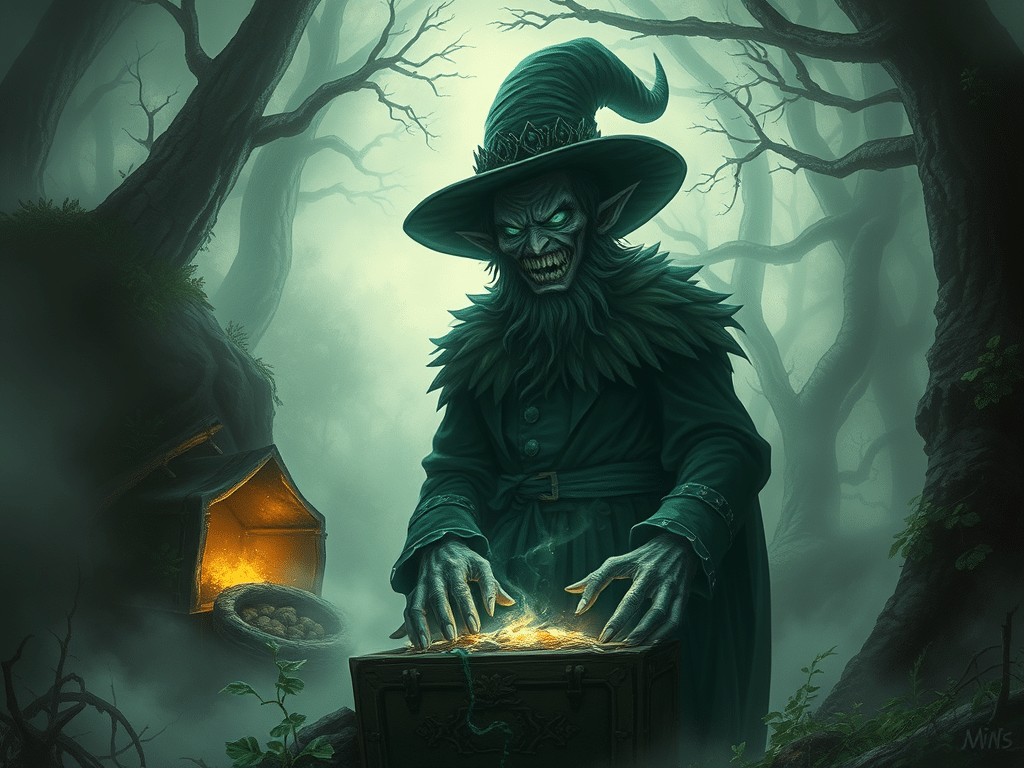
Dark Leprechauns and the Unseelie Court: Key Points
-
The traditional leprechaun was not a jolly gift-giver but a cunning, vindictive trickster capable of cursing enemies, leading travelers into bogs, and visiting misfortune on entire households, far removed from his commercialized modern image.
-
The Unseelie Court is the “unblessed” faction of fairy tradition, representing supernatural beings who are inherently hostile to humans and associated with the Wild Hunt, abduction, illness, and genuine supernatural evil.
-
Leprechauns belong to the category of solitary fairies, which in both Irish and Scottish tradition tend to align with the Unseelie end of the moral spectrum due to their isolation, possessiveness, and deceptive nature.
-
One major theory holds that the leprechaun descends from pre-Christian chthonic spirits tied to buried wealth and the underworld, comparable to dangerous treasure-guarding dwarves in Norse and Germanic tradition.
-
Another theory suggests the leprechaun was once a far more fearsome supernatural entity whose power was gradually diminished by Christianity and later by nineteenth-century romanticization of Irish folklore for Western audiences.
-
Recognizing the darker, Unseelie-adjacent nature of the leprechaun corrects centuries of cultural distortion and restores the genuine complexity of Irish mythology, where the supernatural was always morally ambiguous and inherently dangerous.

Introduction
Celtic mythology is much bigger, more complicated, and darker than the cheerful, green-hatted characters that you see in pop culture. In Irish and wider Gaelic folklore, the fairy world is not just a place of fun. It is a complicated supernatural realm with forces that are mostly good and ones that are really dangerous. The Unseelie Court, the darker version of the more well-known Seelie Court in fairy tales, has some of the most interesting connections to the darker parts of leprechaun lore. Looking into this link shows a deep and sometimes scary part of Celtic mythology that has been hidden for a long time because Irish mythology has been romanticized and made more marketable.
The word “dark” in tradition often refers to beings that are morally gray or clearly evil. It is not always used to refer to things that are clearly undesirable. In Strange and Secret Peoples, Silver (1999) stresses how common cruel and morally unclear fairies and other similar beings are in folklore, not just in clean Victorian versions of stories. Folklore studies in general show that fairies and other magical beings are not always helpful and friendly. They can be dangerous, cause trouble, and cross boundaries. The academic discussion about transformation and otherworldly beings positions the fairy tale world as a realm where people encounter beings that either break or circumvent human limits. Such an interpretation helps us see leprechauns and other Unseelie Court figures as people who cross lines in a dreamlike or mythical world (Classen, 2021).
The True Nature of the Leprechaun
To grasp dark leprechauns, you must first discard the Western view of them as goods since the 1800s. In its older, less clean form, the leprechaun wasn’t a joyful little baker who guarded pots of gold as gifts for lucky people. Instead, the leprechaun—whose name comes from the Old Irish word luchorpán, which means “small body”—was a joker who was sometimes good and sometimes evil. He was very protective of his treasure, and the “wish granting” that came with it was always coercive. The creature would use any trick possible to get away, often leaving those who thought they had figured him out with useless leaves, shame, or worse. According to the darkest versions of the story, the leprechaun wasn’t just mischievous; he was actively mean, able to lead tourists astray into bogs, curse those who hurt him, and bring long-lasting bad luck to whole families. These darker traits make the leprechaun more akin to the darker side of the fairy spectrum than the adorable image we typically associate with them.
On the other hand, pan-Gaelic practices found in both Scotland and Ireland give rise to the Unseelie Court. The term “Unseelie” refers to a group of malevolent fairies and comes from a Scots word that means “unholy” or “unblessed.” It is mostly a Scottish folkloric idea, though. The Unseelie Court is made up of all the harmful fairies who don’t care about humans and can hurt them for no reason. People thought that the Seelie Court, which included the “blessed” or “holy” fairies, could both reward and punish humans depending on the situation. On the other hand, the Unseelie Court was considered naturally dangerous, linked to the Wild Hunt, night terrors, sudden illness, and the taking of human souls. The Scottish sluagh were restless ghosts of the dead that rode the night winds. The baobhan sith were dangerous female vampire fairies, and the nuckelavee was a scary skinless creature that lived on land and sea. The Unseelie Court wasn’t just a group of bad fairies; it was a real court of magical evil that showed the otherworld as cold, uncaring, and dangerous.
Researchers who study magical verbalizers and ontologies in English fairy tales say that the way beings like fairies are named and characterized is closely linked to their role in the story and the power dynamics they represent. Kolesnyk and Zhurba (2026) argue that the Unseelie Court, a play about evil fairy rule, serves as a powerful language and idea that balances order and chaos in the fairy-tale world. This concept elucidates the use of dark characters, resembling leprechauns and Unseelie ones, to challenge the main characters and scrutinize social rules.

The Leprechaun’s Connection to the Unseelie Court
Classical folklore often obscures the connection between leprechauns and the Unseelie Court. However, it becomes clear when you look closely at the basic classification of fairy beings that Celtic mythology experts have put together. Older Irish stories divide the fairy world into two groups, akin to the Seelie and Unseelie groups in Scottish stories. The Tuatha Dé Danann, the ancient divine race pushed underground to become the fairy folk, were not always good. Many of the lone fairy creatures, rather than the trooping fairies of fairy mounds, were considered more dangerous and less responsible to humans. The leprechaun is definitely a lone fairy, and many researchers have found that lone fairies in both Irish and Scottish mythology tend to be more on the Unseelie side of things. He is cut off from fairy society, very possessive, dishonest, and willing to curse, all of which make him seem like a character who is more morally connected to the Unseelie Court than to any good supernatural protector.
Folklorists and mythologists have come up with several ideas to try to explain the leprechaun’s darker sides and his possible ties to the Unseelie world. One popular way of looking at it is that the leprechaun is based on a folk memory of pre-Christian chthonic spirits, which were earthbound beings linked to hidden wealth and the underworld. These spirits were neither good nor evil in the eyes of Christians, but they were dangerous in the same way that natural forces are. This idea is based on similarities between the dvergr (or dwarf) and similar characters in Germanic and Norse mythology. These two characters are skilled magicians who guard hidden riches but don’t care about others’ welfare. Another way to look at the leprechaun’s moral ambiguity that has only recently been developed in academic Celtic studies is that it shows how the Irish view the supernatural in general: as a place where power and danger are always present, and where any fairy being, no matter how small or unimportant it seems, can do terrible harm if not treated with respect and care. According to the research of scholars like W.Y. Evans-Wentz, who wrote about fairy beliefs in the early 1900s, a third theory says that many fairy figures that aren’t very important in Irish tradition used to be much more important and scary supernatural beings. Their power slowly faded in oral tradition as Christianity changed the mythological landscape, leaving dangerous elements in what became more humorous figures.
What happens when you realize the leprechaun has darker sides and is linked to the Unseelie Court? It has big effects in many areas. This discovery corrects a long-standing error in the study of folklore and comparative mythology. The error was partly caused by antiquarians in the 1800s who softened Irish fairy tales for British and American readers and partly by the huge commercial machinery of Irish-American cultural identity that made the leprechaun into a harmless mascot. In Irish mythology, the supernatural was never safely separated into “good” and “bad.” Instead, it was an ever-present, morally ambiguous force that needed to be respected and navigated carefully. By bringing back this figure’s darker sides, both scholars and readers can understand the mythology on its own complex terms. Dark leprechauns and their links to the Unseelie have already started to have a noticeable effect on popular culture and modern fantasy literature. Their influence can be seen in works that purposely take back the over-sanitized versions of Celtic mythology to make the stories more psychologically complex and culturally true.
Modern Interpretations and Cultural Significance
Some sources emphasize the continued presence of medieval or pre-modern themes in contemporary fairy tales. This implies that folklore and medieval literature retain a core set of old meanings for fairies and their courts. Others stress modernization or reinterpretation through feminist or postmodern glasses, saying that modern stories often change the way these beings are portrayed to question or change older social or gender norms. There are clear tensions in the literature. For example, Classen talks about Grimms’ fairy tales’ medieval past and how they have mythic resonances. However, the modern era constantly reinterprets consent and agency through fan fiction and gender-focused studies (Classen, 2021; Roots, 2021). Situations where the people involved are not Irish also differ in how clearly they deal with Irish traditional figures like leprechauns. There are different ways that paratexts, translations, and writers can change the leprechaun’s personality. Depending on the story and what the audience expects, they can keep the trickster charm or make him more dangerous and courtly (Minina, 2024).
Recent research on fairy-tale fan fiction, gendered power relations, and mythic transformations shows that readers and writers often change how dark fairies are portrayed to reflect modern values, such as giving disadvantaged characters more power or turning traditional rescue tropes on their heads. This is important to know when talking about leprechauns or Unseelie Court characters in modern stories and media as possible symbols of resistance, independence, or social criticism (Roots, 2021; Talairach-Vielmas, 2023; Classen, 2021).
Conclusion
In the end, the debate between dark leprechauns and the Unseelie Court shows us something important about Celtic mythology and how we think about myths in general. When myth systems are robust and comprehensive, they not only convey moral allegories or tales of helpful magical beings, but they also depict the entirety of reality, complete with its inherent dangers, ambiguities, and the terrifying disregard for people’s comfort and safety by supernatural powers. When you look at the leprechaun in his fullest folkloric context, he is not a good guy who is waiting to give away his gold to the smart and lucky. Instead, the leprechaun is a potentially evil being whose malevolence is subtle, whose tricks are genuine, and whose connection to the dark courts of fairy tradition is evident in the structure of the oldest stories, but their significance is only clear if you know how to interpret them. If you really believe these traditions, you’ll respect the creative and spiritual depth of the cultures that made them. You’ll also know that behind every positive cultural image may be something much older, stronger, and much more dangerous.
References
Classen, A. (2021). The fairy tales by the Brothers Grimm and their medieval background. The German Quarterly, 94(2), 165–175. https://doi.org/10.1111/gequ.12173
Kolesnyk, O. S., & Zhurba, K. M. (2026). Peculiarities of supernatural creature’s verbalizers in English fairy-tales. In Proceedings of the 7th International Scientific and Practical Conference “Modern Perspectives on Global Scientific Solutions” (pp. 174–178). European Open Science Space. https://doi.org/10.70286/eoss-26.01.2026.005.174-178
Minina, I. D. (2024). Borrowing and historical evolution of tales and fables about the wonderful hero in the folklore traditions of Vietnamese peoples. The Russian Journal of Vietnamese Studies, 8(1), 110–124. https://doi.org/10.54631/vs.2024.81-626077
Roots, J. (2021). Fairy-tale fan fiction and questions of women’s consent. The German Quarterly, 94(2), 240–255. https://doi.org/10.1111/gequ.12180
Silver, C. G. (1999). The faces of evil: Fairies, mobs, and female cruelty. In Strange and secret peoples: Fairies and Victorian consciousness (pp. 149–183). Oxford University Press. https://doi.org/10.1093/oso/9780195121995.003.0006
Talairach-Vielmas, L. (2023). Fairy tales and folklore. In Oxford Bibliographies in Victorian Literature. Oxford University Press. https://doi.org/10.1093/obo/9780199799558-0186
Leave a Reply