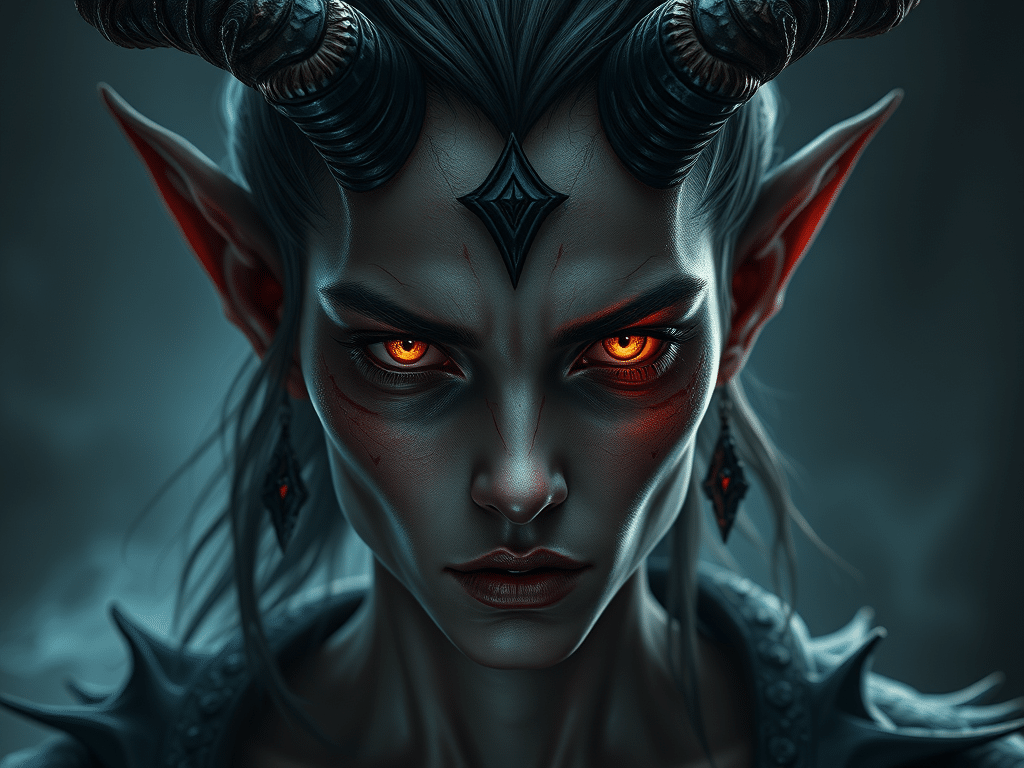
Half-Demons and Tieflings: Key Points
-
Half-demons are hybrid beings born from demons and humans, appearing across global mythologies as embodiments of the struggle between good and evil.
-
Physically, they possess uncanny beauty mixed with demonic features like horns, glowing eyes, or unusual skin tones, with their ambiguous appearance reflecting their uncertain moral status.
-
Behaviorally, they exhibit internal conflict between human compassion and demonic impulses while possessing supernatural abilities like enhanced strength or shadow manipulation.
-
Examples include the Nephilim from Judeo-Christian tradition, cambions from European folklore, hanyo from Japanese mythology, and figures like Ravana from Hindu epics.
-
In Dungeons and Dragons, tieflings carry distant infernal ancestry with physical markers like horns and tails, but their morality is determined by personal choice rather than heritage.
-
Theories suggest half-demon mythology represents anxieties about cultural boundaries, symbolizes psychological struggles between civilization and primitive urges, or defines humanity’s borders through beings existing outside them.

Introduction
For a very long time, people from all over the world have had a hard time with the idea of beings that reside between the human and demonic realms. Half-demons are beings that were made when demons and humans had sex. They are an interesting blend of good and evil, life and death, and life beyond death. This has interested storytellers and theologians for thousands of years. People are highly scared of these hybrids because they are a symbol of their worst worries about evil, temptation, and the possibility that evil may spread through human blood. People have always been curious about how the lines between the sacred and the profane, the natural and the supernatural, can be crossed. This is still shown in the prevalence of half-demon legendary characters like tieflings in Dungeons & Dragons.
There are characters who are half-demon in a lot of myths and folktales. They frequently have qualities of both people and demons, and their main job in stories is to be a threat, test morality, or stand between realms. There are a lot of stories about people who are part demon and part human in numerous civilizations. You can find them in Iranian, East Asian, Slavic, Baltic, Indo-European, Caucasian, Central Asian, and other cultures. A lot of these myths are about possession, shapeshifting, or going from the living world to the underworld (Yuyukin, 2024; Jacobsen, 1959; Ivanković, 2019; Трефилова, 2020; Goff et al., 2011).
Half-demons look quite different in different myths, but there are several things that are always the same. A lot of myths suggest that these creatures are demons, yet they look strange and beautiful. Their skin is very pale or dark, their eyes flash with a light from another realm, or they have small horns, pointed ears, or tails that don’t work. Some people think that half-demons can look just like people. They only display their true nature through supernatural means or when they’re exceedingly angry, when their demonic traits swiftly show. Some people have more obvious traces of their ancestry, including hands with claws, teeth with fangs, or skin that feels cold or heated when touched. People often say that they are ethherically weak since they don’t look entirely human or completely evil.
Psychological and Behavioral Characteristics of Half-Demonic Beings
People who are half-demons act and feel in ways that indicate their dual nature. This makes them feel like they have to choose between different wants and values. In a lot of mythologies, these animals are represented to be fighting a genetic predisposition to be violent, cruel, or dishonest that goes against any compassion or values they may have as humans. People often say that they have superhuman power, speed, or endurance that is too much for people to manage. They also have powers that they inherited from their demonic parent, such as being able to feel fear, control shadows, or cast curses. Half-demons often operate in ways that are hard to foresee or control since they are fighting with themselves. Some people fight hard against their darker desires, while others fully accept their evil background. They are interesting mythological figures because they show how everyone fights their worst desires.
The Nephilim are the most well-known example of a half-demonic entity in Christian and Jewish demonology. Genesis says they were the children of the “sons of God” and the “daughters of men.” These giant animals were thought to be renowned fighters, but their existence was so hated that many theological beliefs link them to God’s choice to flood the Earth. The cambion, a child of an incubus or succubus and a human, contributed to these ideas in medieval European folklore. People thought they were naturally malevolent and often employed them as witches’ familiars or servants of bad energies. People felt that the cambion’s demonic parent gave it its magical powers and that it nevertheless had enough human features to thrive freely in human society. This makes it a great way to propagate bad things.
The hanyo, who were born when yokai (supernatural beings like demons) and humans got together, provide us a different glimpse of Japanese tradition. Many folk stories and modern versions of the story feature characters that are both human and demonic. This is the most well-known example. You can usually tell these characters apart because they have fangs, pointed ears, or hair that is a different color from their natural hair. In European myths, cambions are invariably nasty. In Japanese legend, hanyo are not as good or bad as they seem. A lot of how they act has to do with how they are reared and whether or not people accept them. The fact that Japanese and Westerners have different cultures demonstrates that they also have quite different ideas about demons. People in Japan think of yokai as more than just malevolent things; they are also natural forces.
Islamic stories regarding jinn interacting with humanity tell about beings that are like half-demons. The Islamic religion says that jinn and demons are not the same. They are beings from another world that can accomplish good and harmful things. Some people think that they can turn into people and have children with them. Islamic scholars have discussed a lot about the possible repercussions of such unions, but these kids would be distinct from other kids because they would have specific skills and features. The Quran and hadith both warn people about jinn seeking to fool or corrupt them. There are also a lot of legends in Islamic mythology about people who had children with jinn and lived in a space between the human and supernatural worlds.
In Hindu and Buddhist myths, there are elaborate social structures of supernatural beings like rakshasas and asuras. Sometimes these beings have children with humans. When these two races join together, they frequently become extraordinarily strong beings that are vital to epic stories like The Ramayana and The Mahabharata. People with varied backgrounds often have to choose what they believe and who they are in these stories. Ravana, the main bad person in The Ramayana, was born to a rakshasa mother and a sage father. By combining demonic strength with Brahminical wisdom, he became one of the most powerful figures in Hindu legend. Mythology from South Asia treats these kinds of characters in a more complex way than Western mythology does. For instance, people from mixed backgrounds can sometimes be saved or made heroes by what they do instead of just being judged by their genealogy.

The Evolution of Tieflings in Dungeons & Dragons
A lot of current fantasy books and games have created and reinvented half-demons. For instance, Dungeons and Dragons added the tiefling race as a playable race. Tieflings are not necessarily the children of demons. Some are actually people whose ancestors made a pact with demons or devils, leaving behind offspring who are physically corrupted by this deal. They usually have little horns, solid-colored eyes without pupils or sclera, tails without claws, and skin that can be any hue from human to red, blue, or purple. In traditional D&D, half-demons were thought to be nasty by nature. In current D&D, tieflings are presented as regular humans whose looks are based on their lineage but whose moral decisions are their own.
The tiefling race has become an essential means to explore themes of exclusion, otherness, and queer identity since it was initially incorporated into Dungeons & Dragons (D&D) in its second incarnation. In D&D, tieflings are a one-of-a-kind race. The second edition of the Planescape campaign setting was the first time they were encountered (McIntyre, 2025; White, 2022). They are not like other fantasy races because they originate from hell and have a bad reputation that comes with them.
People think that tieflings are the children and grandchildren of humans who made deals with devils. This changed them into a different race with demonic features (Premont & Heine, 2021). Their skin tones in Fifth Edition (5e) range from a reddish tan to a brick red, and their hair hues include the complete range of human colors as well as some magical ones (Cote & Saidel, 2024)… People in the game world think they are outsiders because they appear different. Official game materials term them “swindlers, thieves, or crime lords” with “infernal heritage” who live in slums and other bad parts of cities (Garcia, 2021, p. 10).
The changes in tieflings over the years in D&D editions reflect how the game has changed how it deals with race and identity in general. The Fourth Edition Player’s Handbook, which had tieflings and other non-traditional races like dragonborn, shardminds, and wilden, gave people an opportunity to get away from real-life racial prejudices. But by the Fifth Edition, most of these experimental races had been taken out, leaving only dragonborn and tieflings as the last traces of this effort to make the game more diverse (Cote & Saidel, 2024). Tieflings are still impacted by their infernal lineage in 5e, even though they are still allowed in the core rules. The game materials, on the other hand, say that their features are more molded by stereotypes than by anything bad in them (Premont & Heine, 2021).
Because of this conflict between heredity and prejudice, tieflings are especially important to players who are on the outside, especially those who are queer. White (2022) argues that a lot of queer players have chosen the tiefling as a way to feel more powerful, show that they are free to be who they are, take back demon iconography, and take charge of their otherness in the story. Players find the game “fun” because the tiefling is a “reviled race” (Garcia, 2021, p. 15), but this way of looking at it illustrates how racial conflict is a “playful affordance” in the game system (Garcia, 2021, p. 16). McIntyre (2025) highlights this connection in events like Dungeons and Drag Queens, where performers dress up as tieflings to explore what it means to be a bad guy. This is analogous to how drag and LGBT performance styles are pushed to the edges.
But the way tieflings are treated is another example of how D&D doesn’t do a good job of handling races. Clements (2019) adds that calling entire species bad or dangerous, like D&D does with Tieflings and Half-Orcs, makes them easy targets for violence and is like racism in the real world, even though the game is set in a fantasy environment. Garcia (2021) talks about how these racial descriptors affect actual gaming by giving examples of players who chose tiefling characters and were not trusted or were trusted by other players because of their race. This shows how fake racial hierarchies can show actual discrimination in settings where individuals work together to tell stories.
So, the tiefling is in a tough situation in D&D’s changing discussion about identity and how to show it. The race allows players powerful possibilities to explore issues of exclusion and being different, especially LGBT players who desire to embrace and reclaim their diversity (White, 2022). But the way tieflings are treated in the game encourages bad assumptions about racial qualities that come naturally and acceptable bias (Clements, 2019; Garcia, 2021). This difference illustrates that D&D has bigger difficulties with race and identity that keep coming up even though people are trying to be more open and inclusive.
People get the features and skills of tieflings in D&D from both common conceptions about demons and worries about how the game should be fair. They are resistant to fire damage, which is a tribute to the old connection between demons and hellfire. They can also do small magical things like cast spells or make darkness appear. In the game, demons earn a boost to their Charisma because they are often linked to temptation and persuasion. This can look like actual beauty, a scary presence, or a skill that deceives people, depending on the character. Because of how they look and where they come from, tieflings are often regarded badly and not trusted in D&D. This gives characters who have to prove themselves even though other people don’t think they can an opportunity to roleplay. With this plot framework, players can look into issues like racism, identity, and the question of whether a person’s background determines their future.
Theoretical Interpretations and Contemporary Significance
Different psychological and anthropological theories try to explain why half-demon forms keep appearing in different societies. Some scholars believe that these entities represent societal worries about marrying someone from a different race, religion, or social group and mixing genes. They utilize demonic ancestry as a way to talk about marriages or interactions between these groups. People may have sought to keep people apart by labeling them truly dreadful, which is why half-demons are often shown as bad or deadly. From this point of view, half-demon mythology is a technique to keep people in line by warning them about connections that potentially break societal or cultural rules.
Some individuals think that half-demons are psychological symbols that demonstrate how people deal with features they get from their parents and the nature vs. nurture issue. People sometimes question if a half-demon can get over its bad side. This is like how people worry about their genetics, family history, and how much our lineage shapes us compared to our choices. Half-demons are a clear example of Carl Jung’s “shadow self.” They stand for the dark drives and socially unacceptable needs that everyone has but tries to hide. The half-demon’s struggle with its nature is like the fight people face in their brains between civilized behavior and untamed urges.
A third way to think about half-demon mythology is in terms of what it means to be human and how to retain faith boundaries. Cultures develop myths about entities that are half human but not totally human to make it simpler to understand what it is to be human and what lies beyond its bounds. People appear to think that human goodness is weak and may be easily damaged or destroyed because evil attributes are always presented as corrupting. These stories might also be based on genuine events in history when people from different communities met. The demonic other could be a foreigner whose looks, customs, or actions were unusual or threatening. The kids from these marriages would naturally be in the middle, not truly belonging to either group.
Conclusion
People have always been fascinated by half-demons because they make us think about who we are, what is right and wrong, and what it is to be human. These are significant questions in all cultures and ages. Whether they are cambions that can’t be saved, hanyo with complicated morals, or modern tieflings who select their own paths, these beings make us ponder about the link between heritage and fate. They make us wonder if wickedness is something that runs in families or if everyone, no matter where they came from, may choose between good and evil. Half-demon characters in modern literature have gone from being wholly evil to having the ability to be heroic. This suggests that people are getting smarter about how they think about differences, bias, and the chance to grow beyond where they came from. As long as people are trying to find out who they are, where they belong, and what good and evil are, half-demons will probably always be interesting in our myths and legends.
References
Antonov, D. (2025). Conflations in Russian iconography of the 16th – 17th centuries: A game of contexts. Визуальная Теология, 7(1), 10-23. https://doi.org/10.34680/vistheo-2025-7-1-10-23
Асатрян, Г. (2013). Armenian Demonology: A critical overview. Iran and the Caucasus, 17(1), 9-25. https://doi.org/10.1163/1573384x-20130103
Bobrova, M., & Русинова, И. (2020). Demononyms in Russian mythological texts of the Perm Region. Вопросы Ономастики, 17(3), 83-103. https://doi.org/10.15826/vopr_onom.2020.17.3.036
The Sháhnáma of Firdausí. (1910). (Vol. 5). Kegan Paul, Trench, Trübner & Co.
Clements, P. J. (2019). Dungeons & discourse: Intersectional identities in Dungeons & Dragons [Doctoral dissertation, Bowling Green State University]. ProQuest Dissertations and Theses Global.
Cote, A., & Saidel, E. (2024). “Race” and race: Longitudinal trends in Dungeons & Dragons character creation. In Fifty years of Dungeons & Dragons (pp. 231-258). MIT Press Direct.
Dungeons and Drag Queens [Television series]. (n.d.).
Dungeons & Dragons. (1974-present). [Tabletop role-playing game]. Wizards of the Coast.
Garcia, A. (2021). Chapter 1: “I piss a lot of people off when I play dwarves like dwarves”: Race, gender, and critical systems in tabletop role-playing games. Teachers College Record, 123(13), 1-26.
Genesis [Biblical book].
Goff, M., Jurgens, B., & Olsen, E. (2011). Demons. https://doi.org/10.1093/obo/9780195393361-0013
Ivanković, M. (2019). New insights on Slavic god Volosъ / Velesъ from a Vedic perspective / Novi uvidi o staroslovenskom bogu Volosu / Velesu iz vedske perspektive. Studia Mythologica Slavica, 22, 55-81. https://doi.org/10.3986/sms20192203
Jacobsen, W. (1959). Nepalesiske bloktryk. Kuml, 9(9), 146-165. https://doi.org/10.7146/kuml.v9i9.103047
The Mahabharata [Epic poem].
McIntyre, K. (2025). Roll for initiative: Role playing & playing a role—Queer representations in D&D [Doctoral dissertation, University of British Columbia]. UBC Open Collections.
Неклюдов, С. (2022). From myth to ballad: The ‘feminine version’ of plot type AaTh 485А. Традиционная Культура, (3), 71-85. https://doi.org/10.26158/tk.2022.23.3.005
Planescape [Campaign setting]. (1994-1998). TSR, Inc.
Player’s Handbook (4th ed.). (2008). Wizards of the Coast.
Premont, A., & Heine, S. (2021, August). The human fantasy: Exploring race and ethnicity through Dungeons & Dragons. In Proceedings of the 16th International Conference on the Foundations of Digital Games (pp. 1-11). Association for Computing Machinery.
The Quran [Religious text].
The Ramayana [Epic poem].
Tolstaya, S. (2024). A brief outline of Polish folk demonology. II. Slavianovedenie, (2). https://doi.org/10.31857/s0869544x24020064
Трефилова, О. (2020). Bulgarian folk demonology: A brief overview. Slavic World in the Third Millennium, 15(3-4), 160-181. https://doi.org/10.31168/2412-6446.2020.15.3-4.11
White, T. (2022). A spark of shared creation: A review and analysis of Dungeons and Dragons, its history, and its impact on marginal identities [Undergraduate thesis, New College of Florida]. Digital Commons. https://digitalcommons.ncf.edu/cgi/viewcontent.cgi?article=7315&context=theses_etds
Yuyukin, M. (2024). On the mythological background of the bylina “Ilya Muromets and Nightingale the Robber”. REF/JEF, 2024(1-2), 20-31. https://doi.org/10.59277/jef.2024.1-2.02
Leave a Reply