Gnolls in Fantasy: Key Points
-
Gnolls are hyena-headed humanoid creatures in fantasy that embody savagery and chaos, lacking deep mythological roots as a relatively modern invention.
-
The term originated from Lord Dunsany’s 1912 story about “gnoles,” though modern gnolls developed their hyena-like characteristics primarily through gaming.
-
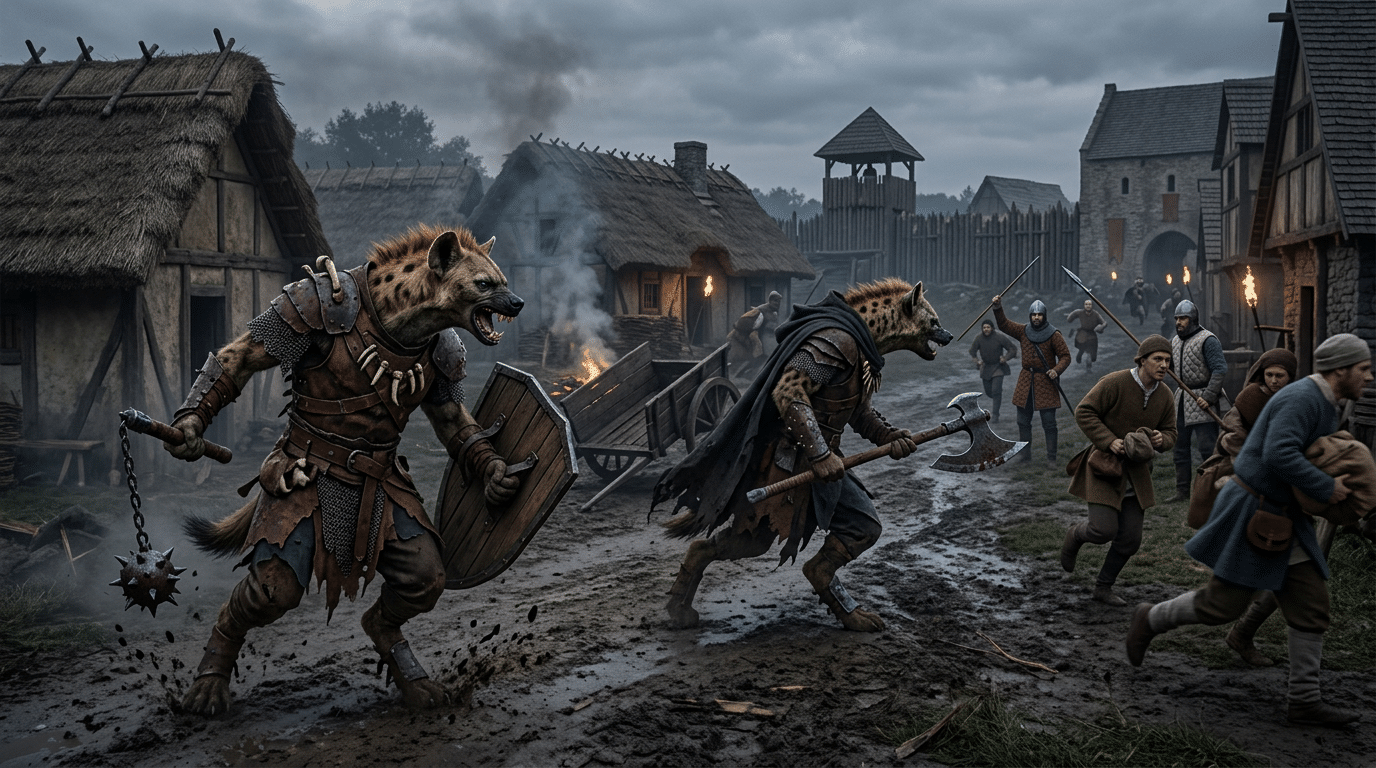
Gnolls are seven- to eight-foot-tall bipedal humanoids with hyena heads, muscular builds, and fur-covered bodies that blend human and animal features.
-
They are savage nomadic raiders driven by insatiable hunger with primitive societies, typically portrayed as irredeemably evil, unlike some sympathetic fantasy humanoids.
-
Gnolls debuted in Dungeons & Dragons in 1974 and evolved through editions to gain demon lord connections and spread to numerous fantasy games and media.
-
They serve as mid-tier threats players can fight without moral complexity, demonstrating how gaming can establish new archetypes with cultural permanence in fantasy.

Introduction
The term “gnoll” appears to have originated from Lord Dunsany, an Irish author, in his 1912 short story How Nuth Would Have Practised His Art upon the Gnoles. Dunsany didn’t explain much about how the gnoles looked, but in this myth, they were odd and dangerous beasts that kept costly jewels safe. The word may have come from “gnome” or other folktales about gnomes, although Dunsany’s gnoles didn’t look anything like the hyena-headed creatures we know today. The connection between these literary gnolls and modern gnolls is still tenuous because the idea changed largely through games and not through a long history of literature. Gnolls don’t have as much mythology as dragons, elves, or goblins have. There is only one source for them from the early 1900s.
Physical and Behavioral Characteristics
Gnolls are generally a mix of hyena-like creatures and others. They have the rage of animals and the intelligence of humans. Many fantasy realms regard them as a different species with a pack mentality, a predisposition to plunder, and a lack of fear when raiding. This overarching pattern is evident in various works and gaming systems, as illustrated by discussions on the mythopoetic and folkloric transformations that shape “beast-folk” or “hyena-people” motifs in global literature and games (Shaydulloyevna & Ravshanovna, 2020; El-Shamy, 2024; Leerssen, 2016). Myth and folklore literature frequently portray animal-people as archetypal figures that embody cultural anxieties around predation, social structure, and otherness, thus creating a theoretical basis for Gnoll-like animals as narrative constructs. This cross-cultural framework substantiates gnolls as a distinct classification within fantasy, reflecting entrenched legendary motifs of predatory adversaries in both daylight and nocturnal settings (Shaydulloyevna & Ravshanovna, 2020; Leerssen, 2016).
Most of the time, gnolls are represented as bipedal humanoids with hyena heads, muscular bodies, and fur-covered bodies that are between seven and eight feet tall. Their faces have big muzzles with sharp teeth, round ears, and eyes that gleam with either predatory intelligence or mindless hunger, depending on how they are portrayed. Usually, they are seen with bent backs and legs that finish in clawed feet. Such morphology makes them look more like animals, but they still retain enough human qualities to utilize weapons and tools. Their fur is usually the same color as that of spotted or striped hyenas, with sandy brown or gray fur and darker patterns. The combination of hyena features and hands that seem human and can handle weapons makes for a scary mix that lives in the space between human and animal.
Many stories about gnolls depict them as living in tribes or clans with a social system based on hierarchy. This organizational inclination aligns with the broader mythological and folkloric classification of non-human civilizations into kin-based groupings that mirror human social dynamics, often utilized to explore themes of leadership, loyalty, and intergroup conflict. The concept of “mythological space” and the manner in which civilizations construct social realms around mythical beings elucidate the frequent portrayal of gnolls as tribal and bellicose rather than as solitary entities (Ķencis, 2011).
Gnolls usually do things in fantasy worlds that indicate how terrible and destructive they are. Usually, they are represented as nomadic raiders that attack travelers, caravans, and settlements with enormous rage and violence. Many myths about gnolls indicate that they eat a lot of meat and that they are not simply predators but also creatures with an insatiable appetite that is almost otherworldly. Many people argue that their social structure is simple and based on a hierarchy, with the strongest people employing violence and fear to keep others in line. Unlike orcs or goblins, who occasionally exhibit complex cultures or sympathetic features, people often perceive gnolls as evil and chaotic. Their cackles and howls resemble those of hyenas, giving them an even more mocking, cruel, and strange appearance to civilized people.

Evolution Through Gaming and Theoretical Interpretations
In 1974, the additional material for the original Dungeons & Dragons game introduced gnolls for the first time. Players may encounter a variety of monsters, and gnolls are one of those types. In the first several versions of D&D, gnolls were just mean humanoid monsters that were stronger than orcs but not substantially different from other savage humanoids. As D&D proceeded through different versions, gnolls acquired more attention and new qualities. The game made their hyena-like appearance more real, connected them to demon lords (particularly Yeenoghu), and added to their story to indicate that they are vicious because of demons. In third edition D&D and succeeding ones, gnolls became more unique in terms of their culture and mechanics, but they still acted like evil, chaotic marauders. They appeared in other fantasy games and settings, where they usually had the same attributes but sometimes received new ones that made them less evil or came from different places, such as being portrayed as misunderstood creatures with their own struggles or as allies in certain narratives.
Generally, gnolls act as enemies or foes, challenging the main character and the party. They can stand for turmoil, hunger, and the desire to hunt, which can make it challenging to make moral choices and prepare ahead. This role corresponds with the “mythopoetic paradigm,” which holds that monsters are not merely threats but also representations of cosmological or existential tensions in a fantasy world (for example, the fight between civilization and nature, order and chaos) (Lešková, 2016). In some stories, gnolls are shown with sympathy or moral depth. This is part of a larger tendency in fantasy toward villains who aren’t clearly good or bad and non-human civilizations that are rich in culture. This trend illustrates the scholarly transition from simplistic “monster” categorization to a mythologically informed portrayal of non-human cultures (gnollish religions, rituals, and social norms) in reaction to calls for more intricate representation in world-building and literature (Altybayeba & Comutstsi, 2018).
People have come up with different notions about what gnolls mean in fantasy games and literature. Some historians of fantasy literature claim that gnolls are emblems of sheer predation and anarchy, depicting how wildness can destroy society. Some individuals think that gnolls are an excellent enemy for gamers to fight since they are blatantly wicked, which is different from how other humanoid monsters have been addressed in the past. Choosing hyenas as their animal base is essential because many cultures have associated them with cowardice, evil, and scavenging, even though they are actually quite adept at hunting in groups. Some cultural critics are afraid about what may happen if we make humanoid beings who are always cruel. People claim that these kinds of creatures can keep people from thinking that physical features are linked to inherent ferocity. The demonic birth story added to D&D lore later provides a supernatural explanation for the gnolls’ terrible behavior, suggesting that their bad nature results from demonic corruption rather than being inherent.
Some studies on myths and folktales examine the utilization of anthropomorphic animals and mythical creatures to represent national or cultural identity inside fantastical realms. The depiction of gnolls as representations of “the other” or “the savage” is a common trope; however, authors are increasingly complicating this by ascribing to gnolls distinct cultures, ethical systems, or internal political structures in their interactions with other races. This trend aligns with the overarching academic insight that mythical discourse has evolved from rigid stereotypes to more intricate cultural ecologies in contemporary literature and gaming (Zharylgapov et al., 2023).
Cultural Impact and Contemporary Significance
Gnolls were only recently made up, yet they have had a huge impact on fantasy games and novels. Besides D&D, they are a common form of monster that appears in a lot of fantasy books, video games, adventure modules, and other media. Many fantasy role-playing games, such as World of Warcraft and Pathfinder, contain gnolls or monsters that look like gnolls. Each game changes the animals in their own way while preserving their core qualities. In real life, gnolls are important mid-level threats that are more dangerous than goblins but not as strong as giants or dragons. Because of how they seem and act, players will remember them. Gnolls first appeared in games, where they still live, but they also show up in fantasy literature and paintings.
Conclusion
Gnolls are a wonderful illustration of how modern fantasy creates new mythology instead of just utilizing old ones. They began with a short literary mention and grew largely through gaming, not folklore. Now they are part of fantastical subcultures that will last. Their transition from Dunsany’s hidden gnoles to the hyena-headed raiders of modern fantasy shows how working together to develop a world in games can produce new archetypes. Gnolls may never be as well-known as dragons or elves, but they have made a name for themselves in the fantasy bestiary as uniquely vicious humanoids that mix the worst of human cruelty with the appetite of predatory animals. Fantasy still loves many different monsters, as shown by the fact that they keep coming up in new games, novels, and locations. It also shows that new ideas can become traditions if they are useful for both the story and the mechanics in the worlds we create for fun and fantasy, such as the incorporation of unique creatures like gnolls that enhance gameplay and narrative depth.
References
Altybayeba, S., & Comutstsi, L. (2018). Myth as a conventionally metaphoric narrative form. Bulletin of the National Academy of Sciences of the Republic of Kazakhstan (the Bulletin), 5(375), 76-84. https://doi.org/10.32014/2018.2518-1467.10
Dunsany, L. (1912). How Nuth would have practised his art upon the gnoles. In The Book of Wonder. Heinemann.
El-Shamy, H. (2024). Ego involvement and the law of exercise: Memorization as a function of ego involvement in folklore scholarship and anthropology. Chron Behav Psychol, 1(1), 004-008. https://doi.org/10.17352/cbp.000002
Leerssen, J. (2016). Gods, heroes, and mythologists: Romantic scholars and the pagan roots of Europe’s nations. History of Humanities, 1(1), 71-100. https://doi.org/10.1086/685061
Lešková, T. (2016). Conversion of traditional mythologemes in the symphonic music by Nikolai Mentser. Journal of Siberian Federal University Humanities & Social Sciences, 9(6), 1381-1390. https://doi.org/10.17516/1997-1370-2016-9-6-1381-1390
Oschepkova, A. (2019). Transformation of traditional culture in the literary text: Typology of folklore works. European Proceedings of Social and Behavioural Sciences, 2544-2549. https://doi.org/10.15405/epsbs.2019.12.04.341
Repciuc, I. (2019). Fairy-tales and father Freud: Is psychoanalysis the right tool to understand folk imaginary? Bulletin of Integrative Psychiatry, 25(3), 91-101. https://doi.org/10.36219/bpi.2019.03.09
Shaydulloyevna, K., & Ravshanovna, B. (2020). Positive and negative features of mythological images in the epics Beowulf and Alpomish. International Journal on Integrated Education, 3(11), 196-200. https://doi.org/10.31149/ijie.v3i11.887
Vaitkevičius, V., & Vaitkevičienė, D. (2011). Preface. Archaeologia Baltica, 15, 7-13. https://doi.org/10.15181/ab.v15i1.47
Zharylgapov, Z., Syzdykova, B., Kaiyrbekova, A., Babashov, A., & Shakirova, K. (2023). Myth and mythological discourse in literary studies. Bakhtiniana Revista De Estudos Do Discurso, 18(4). https://doi.org/10.1590/2176-4573e63680
Leave a Reply