Pig Lady of Cannelton: Key Points
- Barbara Davidson was a young woman murdered and decapitated in July 1795 at her family’s Beaver County farm, and neither her head nor her killer was ever found.
- Her father, Samuel McCaskey, was a South Carolina rice planter and Revolutionary War veteran who resettled the family on cheap Depreciation Lands near the Little Beaver River after the British drove him off his property.
- Reported sightings of her headless ghost apparition began around 1800 and have continued for more than two centuries, often described as a figure forming slowly out of mist and sometimes accompanied by sobbing.
- The pig head detail appears to be a twentieth century addition created by teenagers legend tripping at the site, and it eventually became so popular that the ghost is now known mainly as the Pig Lady.
- Local historian Rich Oswald documented the case and built a recurring middle school play around it, while a Lions Club haunted barn and hayride on Cannelton Road turned the legend into a charity fundraiser that generated fresh reported encounters from its own volunteers.
- The story has moved from anonymous local whispers into public commemoration through an annual folklore celebration and a state recognized Legends and Lore roadside marker, which keeps the memory of a forgotten murder victim alive.

Introduction
While most American ghost stories lack the ability to captivate an entire community for nearly two centuries, the legend of the Pig Lady of Cannelton does. For almost two generations, people living in the rural area of northern Beaver County, Pennsylvania, have reported a headless lady walking the fields and woods along a rural road that goes toward the north fork of the Little Beaver River. Occasionally she comes with nothing on her shoulders. Occasionally she appears with a pig’s grinning head. According to local custom (White, 2014), her name was said to be Barbara Davidson, a young woman slain and decapitated in 1795, whose head and killer were never located. It is not just the horrible images that make the narrative extraordinary, but the way a documented tragedy has been passed around by schoolteachers, trolley operators, Lions Club volunteers, and youths on dares. The Pig Lady legend survives because it merges real local history with a developing folk performance and, through doing so, preserves the memory of a woman who may have otherwise been lost to history.
Hauntology and the Returning Dead
Ghosts are not just otherworldly beings throughout the corpus but revenants that return to reveal histories, injustices, and unsettled futures. In Derrida’s Specters of Marx (and comparable passages quoted in various works), the specter is defined as the future emerging from the past, a revenant that interrupts linear temporality and demands responsibility toward what is inherited (Lincoln & Lincoln, 2015; Connolly, 2015; Edwards, 2012). This hauntological paradigm grounds analyses of ghostly figures as instruments for political memory, trauma, and justice rather than simple frights (Rascaroli, 2024; O’Brien, 2007; Lorek‐Jezińska & Więckowska, 2017; Connolly, 2015).
The Historical Core: Barbara Davidson and the Murder of 1795
The American Revolution is the historical nucleus of the mythology. Barbara was born in 1777 in South Carolina, the daughter of a rice planter, Samuel McCaskey, who fought for the rebels and was driven from his plantation when the British attacked. After the war, McCaskey moved his family to what is today Darlington Township, purchasing a tract in the Depreciation Lands, frontier land sold at low prices to veterans as restitution for the almost valueless Continental currency they had been paid (White, 2014). The family farm was situated near present-day Cannelton Road and the Little Beaver River. Barbara grew up there raising pigs and other livestock and was apparently well regarded among her Scotch-Irish neighbors. She sang beautifully, she could shoot, and she drew suitors. She married a soldier, Nathan Davidson, in 1791 when she was fifteen and went with him to Virginia. By 1794, for reasons no document explains, she was back on her parents’ farm without him.
The legend was formed the following summer, after the event occurred. In July 1795, Barbara’s family drove to Pittsburgh for a few days to purchase livestock and poultry, leaving Barbara home to tend the property. She was gone when they got back. A few days later, with neighbors helping with the search, the family discovered her body stuck in the crawl area under their own home. She had been decapitated and her head was missing (White, 2014; Wagoner, 2023). She was buried some two miles away, under a wooden tombstone, long lost, with the inscription, in part, “A headless form neath this mold doth lie / Murdered most foul / Loved by all…save one” (White, 2014). That last line is important. It confirms that the community felt the killer was one of their own and it presents the story as an unsolved true crime rather than a straightforward ghost story.
Much of what is known today about the case has been compiled by Rich Oswald, a former teacher, local historian, and director of the Blackhawk School District, who first occurred in 2010 when the Little Beaver Lions Club sought a fundraiser to support those interested in the case after listening to his students narrate their ghost encounters. Oswald investigated the family, the property, and the earliest documented reports and transformed his discoveries into a yearly middle school play that recounts Barbara’s narrative and the local history around it (White, 2014). The play has altered as new material has come to light. But its longevity shows something fundamental about the role of the legend: it is a vehicle for teaching community history, not only for scaring children.

Sightings, the Missing Head, and the Emergence of the Pig
The sightings have been reported from early on and haven’t really ceased. Accounts range from about 1800 to the present, over at least a square mile of woodland, fields, roads, and burial area. Witnesses will typically tell the same story. A column of mist thickens, then resolves into the form of a headless woman who walks like a young girl, her hands sometimes touching non-existent hair. At times, witnesses report hearing sobbing even when no figure is present (White, 2014). By 1935 the story was so well known that the Negley Traction Company, then in financial difficulty, marketed tickets to “Barbara Davidson’s Midnight Excursion,” charging fifty cents for a ride on a trolley out to the graveyard and past the reputed haunts. Along went 43 passengers. The headless figure was said to have taken shape out of the mist near the Fennel House and remained visible for almost fifteen minutes as distant cries were heard (White, 2014). Whatever truly transpired that night, the episode shows how fast the mythology became a commodity as well as a belief.
When you think of Pennsylvania hauntings, you think of coal mining, steel manufacture, and labor struggles. In hauntology, these specters might be understood as the return of the repressed, industrial-age misery and communal memory calling for accountability. This haunting has nothing to do with work, but it falls within the same Pennsylvania hauntology. The work on hauntology cited here argues that specters are not only historical occurrences but also active urgencies that “haunt” existing social formations and political imaginaries (Lincoln & Lincoln, 2015; Lorek‐Jezińska & Więckowska, 2017; Edwards, 2012).
Other versions concentrate on the missing head. No one ever discovered the body, which led to suspicion being linked to an abandoned mine on the slope above Cannelton, along the road that leads up to the Evergreen Orchards. Travelers have long claimed seeing a glowing head drifting from the mine entrance after dark. The most dramatic of these legends, initially published by Ira Mansfield in his memories of childhood along the Little Beaver Creek, tells of a man bringing apples down the hill at night, known in various tellings as Bertram Drummond or Dick Gray. There shot a ball of light from the mineshaft, which attached itself to his lead horse and turned to show long hair and fiery red eyes. He kicked his squad into a wild gallop, sending apples scattering all over the road, and never used that path at night (Mansfield, as cited in White, 2014). The setting is not incidental. The legend seems to have functioned at least partially as a warning to keep youngsters away from the dangerous cannel coal mines of Cannelton, providing the story with a practical, protective logic beneath the terror (William G. Pomeroy Foundation, n.d.).
The pig’s head, which now dominates the plot, looks to be a relatively recent addition. Oswald claims it was created in the twentieth century, when the teens went to search for the ghost, and that the observers of the custom locate it within the last roughly fifty years (White, 2014; Wagoner, 2023). The regular version is straightforward and effective. A young woman is seen at a distance. When someone comes up, she turns around and shows the face of a pig, sometimes accompanied by grunting. Sightings are concentrated on the wooden footbridge across the north fork of the Little Beaver River, which locals refer to as the Hippie Bridge. Tellers offer two explanations. Barbara, who grew up raising pigs on her father’s farm, is believed to have selected a new head from an animal she knew well. The alternative is that she wandered for decades without a head until she found a slaughtered or dead pig and took what was available (White, 2014). Neither of these explanations is historical, and that is the point. The pig head is the fingerprint of adolescent legend-tripping, the ritual of driving out to a haunted spot at night to test a narrative and one’s courage, a practice folklorists describe as a fundamental engine of legend transmission (Ellis, 2001).
Public Commemoration and the Legend Read Hauntologically
The next chapter in the legend’s existence occurred in 2010 when the Little Beaver Lions Club sought a fundraiser to support services for blind and disadvantaged citizens. Dave O’Neill, then the club’s vice president, offered that instead of the usual Halloween scares, they do a haunted attraction based on Barbara’s true story. O’Neill died before the attraction opened but John Gishbaugher and other volunteers converted a donated barn on Cannelton Road into a recreation of the legend with a hayride that took visitors through the fields where the ghost was said to have appeared (White, 2014; Woodall, 2010, as cited in White, 2014). Then, an unexpected twist occurred. The participants began reporting their encounters. Maddison McKeel, who has played Barbara, reported seeing a headless woman in a black dress in the room set up as the murder scene, and on another night, she felt something hit the back of her knees in the field, waking up from a brief blackout in a different position than where she had fallen. At the graveside, Mara Rooney felt a touch on her hip while no one was around and a crimson handprint was apparent when the light was put on it. Also, volunteers have reported missing tools, lights traveling over the fields and a figure with a candle (White, 2014).
One event is especially striking as it relates back to the unsolved crime. One volunteer observing a campfire saw mist and smoke coalesce into a headless female figure and heard a woman’s voice say, “Tell them re-no,” before the figure disappeared. He finally settled on the word being the French surname Renault. Oswald’s investigation revealed that a half-French, half-Native trapper named Renault had been living in the area around the time of Barbara’s death and had a reputation for questionable character among the local farmers (White, 2014). The assertion is unverifiable and should not be considered as evidence. But it’s a testament to how a living legend keeps generating new tales and how the basic question of the community—who killed her?—keeps and how the basic question of the community, who killed her, keeps dragging the story forward.
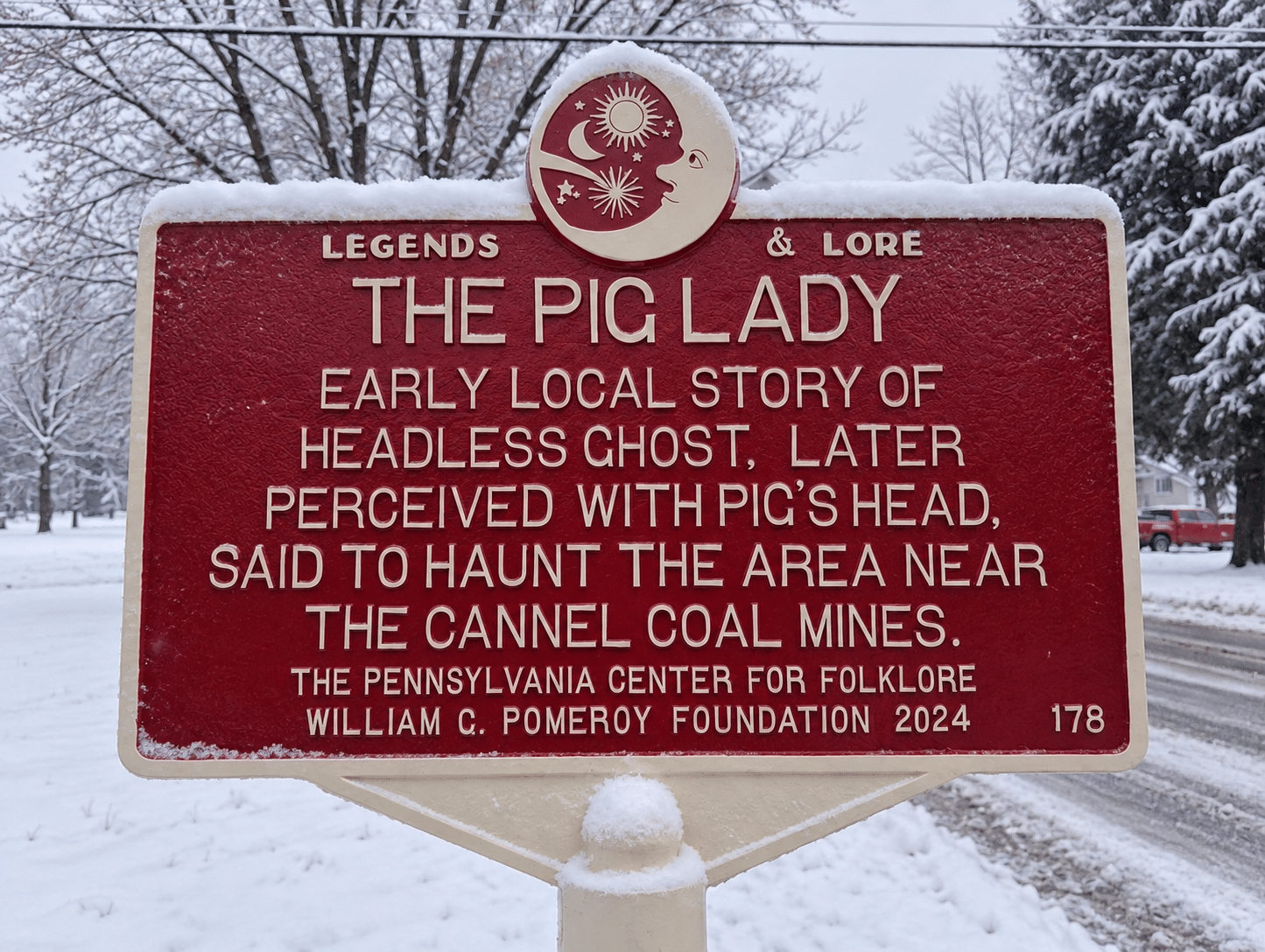
Since then, the legend has evolved from secret whispers to public celebration. Since 2019, residents have gathered each year for the Pig Lady Fall Folklore Celebration, an event reimagined by oral historian Kevin Farkas and the Social Voice Project to showcase Appalachian storytelling, music, and folkways in Beaver County as well as the retelling of Barbara’s story (Wagoner, 2023; William G. Pomeroy Foundation, n.d.). In 2024, the Pennsylvania Center for Folklore and the William G. Pomeroy Foundation erected a Legends and Lore historical marker for the Pig Lady at the intersection of Ridge and Cannelton Roads, officially acknowledging the story as part of the state’s recorded folk heritage (William G. Pomeroy Foundation, n.d.). Once whispered by neighbors, too afraid to be ridiculed, but now it is, now cast in metal at a crossroads.
Several authors clearly link Derridean hauntology to literary and cultural works via the concept of haunting as a social and political force. O’Brien addresses hauntology in reference to Guests of a Nation and the specter of Ireland’s history haunting the national memory (O’Brien, 2007). Topçu uses hauntology to read colonial narratives and the revenants in Lesley Blanch’s The Sabers of Paradise (Topçu, 2024). Both frames reveal the Pig Lady of Cannelton, in which the returning figure cannot be disentangled from an undetermined crime. Barbara Davidson’s murder was never solved, and her head was never found. The original grave inscription for Davidson ended with a barb aimed at the community itself, “Loved by all…save one” (White, 2014).
Read hauntologically, the headless woman who emerges from the mist along Cannelton Road is less a supernatural trespasser than a debt yet to be paid by the society, a revenant whose recurrent appearances prevent an act of violence from slipping unpunished into the past. The legend’s changes further bolster this view, if anything: the addition of the pig’s head in the twentieth century, created mostly by young legend trippers to the location, reveals a ghost constantly being remade by each generation that sees it (White, 2014). What remains through these modifications is not a solid image but an unsolved question of who killed her, which is the very structure of demand that hauntology defines. The 2024 Legends and Lore marker at Ridge and Cannelton Roads then signifies a formal gesture of acknowledgment, the community finally responding to the call by naming the victim in public and in permanent form (William G. Pomeroy Foundation, n.d.).
Conclusion
The Pig Lady of Cannelton represents two intertwined aspects, and her endurance relies on both. It is a ghost story that evolves with each generation, first taking the form of a phantom head in the nineteenth century and later transforming into a pig’s head in the twentieth. Additionally, it serves as a memorial for a real eighteen-year-old woman who was murdered alongside her family and denied justice. This dual purpose may be the legend’s most profound aim: to keep alive the memory of a young life cut short and a brutal death that conventional history might overlook. White (2014) suggests that the figure in the mist—whether seen as a spirit, a trick of fog and expectation, or a narrative recounted so often that it has gained its own shape—barely alters the story’s conclusion. Each time a student performs in Oswald’s play, each time a volunteer walks through the field behind the barn, and each time a visitor stops at the marker on Ridge Road, Barbara Davidson is invoked once more. Even when shrouded in the guise of a pig, this tale that clings to its victim is engaged in essential cultural work.
References
Blanch, L. (1960). The sabres of paradise. John Murray.
Connolly, K. H. (2015). Spirits and those living in the shadows: Migrants and a new national family in Biutiful. Revista Canadiense de Estudios Hispánicos, 39(3), 545–563. https://doi.org/10.18192/rceh.v39i3.1623
Derrida, J. (1994). Specters of Marx: The state of the debt, the work of mourning and the new international (P. Kamuf, Trans.). Routledge.
Edwards, K. A. (2012). The history of ghosts in early modern Europe: Recent research and future trajectories. History Compass, 10(4), 353–366. https://doi.org/10.1111/j.1478-0542.2012.00840.x
Ellis, B. (2001). Aliens, ghosts, and cults: Legends we live. University Press of Mississippi.
Lincoln, M., & Lincoln, B. (2015). Toward a critical hauntology: Bare afterlife and the ghosts of Ba Chúc. Comparative Studies in Society and History, 57(1), 191–220. https://doi.org/10.1017/s0010417514000644
Lorek‐Jezińska, E., & Więckowska, K. (2017). Hauntology and cognition: Questions of knowledge, pasts and futures. Theoria et Historia Scientiarum, 14, 7–23. https://doi.org/10.12775/ths.2017.001
O’Brien, E. (2007). Guests of a nation; Geists of a nation. New Hibernia Review, 11(3), 114–130. https://doi.org/10.1353/nhr.2007.0046
O’Connor, F. (1931). Guests of the nation. Macmillan.
Rascaroli, L. (2024). Voicing the border: On some spectral essay films. Comparative Cinema, 12(22), 13–35. https://doi.org/10.31009/cc.2024.v12.i22.02
Topçu, K. B. (2024). The hauntologic imagination of Lesley Blanch: The exotic other, mission civilisatrice and lost objects in The Sabres of Paradise. Journal of Caucasian Studies, 9(15), 19–38. https://doi.org/10.21488/jocas.1473208
Wagoner, R. (2023, October 10). The Pig Lady and other folk tales show why recording stories matters. Farm and Dairy. https://www.farmanddairy.com/news/the-pig-lady-and-other-folk-tales-show-why-recording-stories-matters/795127.html
White, T. (2014). The Pig Lady of Cannelton. In T. White (Ed.), Supernatural lore of Pennsylvania: Ghosts, monsters and miracles. History Press Library Editions.
William G. Pomeroy Foundation. (n.d.). The Pig Lady. https://www.wgpfoundation.org/historic-markers/the-pig-lady/

Leave a Reply