The Beast of Bray Road: Key Points
- In 1989, a driver near Elkhorn, Wisconsin encountered a large upright furry creature along Bray Road, launching one of America’s most persistent cryptid legends.
- Local journalist Linda Godfrey collected dozens of reports from unconnected witnesses who described the same animal in nearly identical terms, turning rumor into a documented case file.
- The description stayed remarkably consistent across decades: six to seven feet tall, broad-shouldered, amber-eyed, with hand-like paws and a habit of kneeling to feed at the treeline.
- The Dogman figure has deep historical roots, from Great Lakes Indigenous shape-shifter traditions to European werewolf trials and the ancient dog-headed Cynocephali.
- Explanations range from misidentified bears and wolves, to hoaxes and rumored occult activity, to an undiscovered species or an outright supernatural manifestation, with no physical evidence settling the matter.
- Similar sightings across Michigan, Ohio, Appalachia and beyond suggest Bray Road did not create the creature but gave it a location, and its staying power likely reflects a primal human fear of intelligent upright predators in deep woods.

Introduction
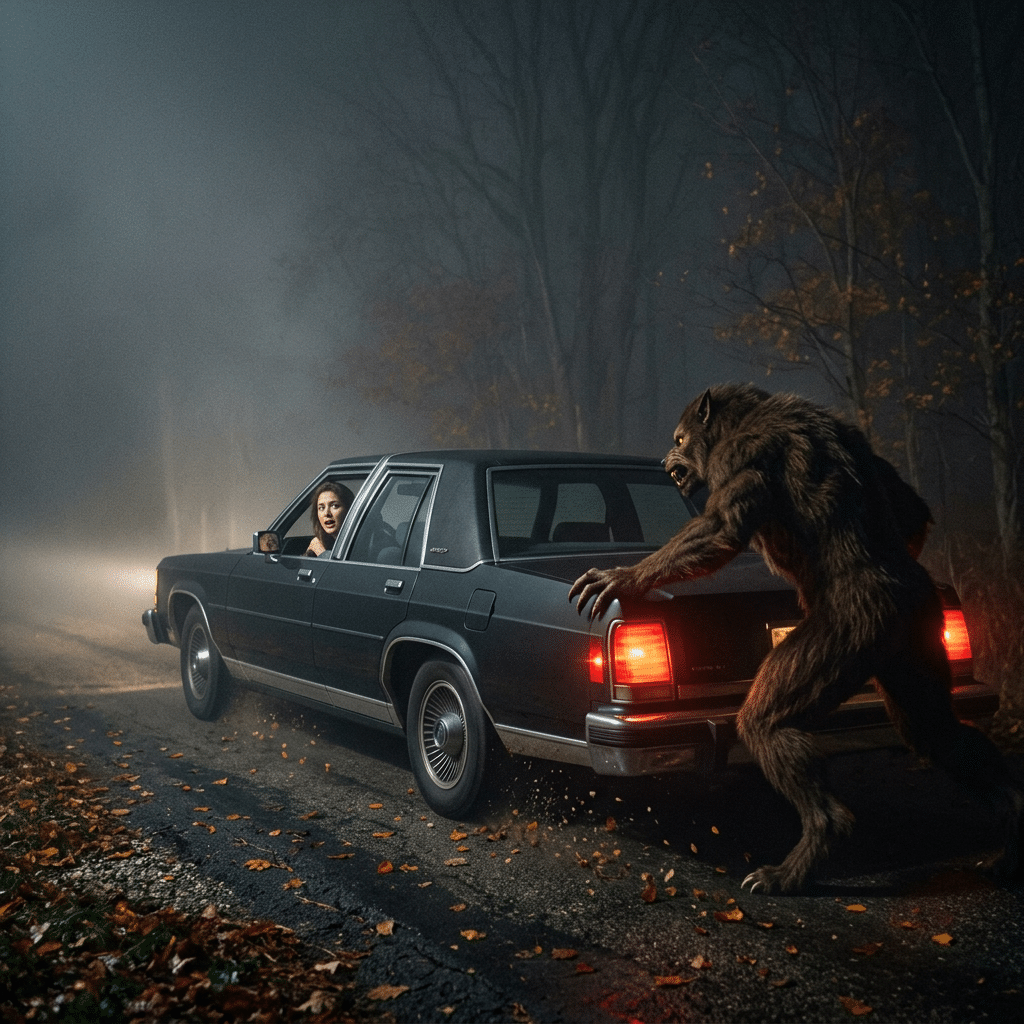
It was a foggy autumn night in 1989. Doristine Gipson, a young lady, was driving down a lonely stretch of blacktop outside Elkhorn, Wisconsin, when her tire hit something heavy in the road. She slowed and got out and saw nothing at first. Then something came up out of the dark at the shoulder, broad across the chest and shaggy furred, walking on two legs toward her car. She scrambled back inside and sped up and as she stared into the mirror, she saw the creature lunge for her trunk. The story was the kind of narrative that seems to watch us with intelligence and may observe from the treeline when we cannot see it. It would ordinarily die in a kitchen talk, laughed off as nerves and lousy light. Instead, it grew into the seed of one of the most enduring cryptid stories in American mythology, a creature known ever since as the Beast of Bray Road, and a template for hundreds of similar reports that continue to arise from wooded areas across the Midwest and beyond.
Bray Road and the Reporter Who Wrote It Down
Bray Road is not a street that impresses. It is a two-lane rural road that winds its way through farmland and tree lines in Walworth County. It became notable for the number of sightings that were reported there in the late 1980s and early 1990s and the fact that a local journalist took them seriously enough to write them down. Linda Godfrey, who was then working for a small county newspaper, started gathering accounts almost as a novelty task. What she found upset her. Witnesses unrelated to one another, who had every social reason to stay silent, were describing the same animal in almost identical words. Farmers, commuters, a school bus driver, and youths parked on the gravel shoulders. Her reporting transformed a rumor into a case file, and her later publications established the phrase dogman as an American horror staple.
A Consistent Description Across Decades
Overall, the Bray Road corpus describes the creature as a hairy, bipedal animal with a humanoid shape that stares back with intelligence and may watch from the treeline when it is not visible, which aligns with the broader traditions of beast-figures in monster and beast-faith legends from various cultures. In academic discourse on modern animals, scholars have noted that these entities serve as cultural symbols, staring back with intelligence and potentially watching from the treeline when they are not visible, as they embody communal concerns, curiosity, and explanations for unusual phenomena in familiar settings (e.g., rural Wisconsin) (Puglia, 2023). The place-based tale is read via monster-studies lenses that understand the monster as a social-discursive and not strictly biological construct (Puglia, 2023).
What keeps skeptical readers engaged is the consistency of the physical description. When standing, the creature is six to seven feet tall and has abnormally broad shoulders and a deep chest. It is covered with thick fur, which can be gray to reddish brown in color, and has a long muzzle with obvious teeth, pointed ears placed high on the skull and eyes that reflect amber or yellow-green in headlights. Its legs flex in a manner that witnesses find difficult to describe, often resembling a dog’s rear legs rather than a man’s. Several accounts highlight the hands. Not paws, but hands, with lengthy fingers to grab. People claim to see it crouched over a cadaver or roadkill, squatting at the edge of a field, or with food in hand to mouth like a person holding a sandwich. This fact continues to emerge, decades apart, in the testimonies of individuals who likely never read each other’s accounts. Later, some drivers reported seeing severe parallel gouges on fenders and trunk lids. Others said nothing but a scent, a sound, and weeks of sleeplessness.
Popularly and folklorically, the Bray Road monster is described as a fur-clad bipedal humanoid. This sort of creature is presented in the surveyed literature as a legible character within the tradition of werewolf- and shapeshifter-tinged lore, though often without the canonical transformation theme of classic werewolves. Various sources highlight how such creatures are representations of fears about the unknown and the other and are symbolizations of social or existential worries rather than accurate biological representations. This interpretative posture aligns with monster-theory methods that conceive cryptids as culturally created entities rather than strictly empirical subjects (McCarty, 2023; Bakewell, 1998; Macunber, 2015).
Read the accounts in order and a rhythm develops. Encounters tend to cluster near dusk or after midnight. They come together by the water, by the cornfields growing brown, and by the torn seams where woodlot joins pasture. The beast has never been shown attacking outright. It is watching. It approaches vehicles with what witnesses describe as curiosity or arrogance rather than fear, then vanishes under cover with a speed that people find more frightening than hostility. Local cops treated these calls the way small-town cops treat anything unfalsifiable—with courteous notes and private jokes—though more than one deputy recognized that the reports were coming from sober, credible people who were terribly frightened. That’s the suspense at the heart of the case. Not a body, not a bone but a pattern that will not dissolve.

Deeper Roots in Folklore
And the folkloric setting is older and wilder than Wisconsin. Indigenous tales throughout the Great Lakes region spoke of creatures able to shift between human and animal form long before European settlement, beings who foretold trespass, starvation, and the limits of the village. These traditions differ from one another and should not be conflated into a single monster; instead, they highlight an important point: the wooded interior of our continent was once recognized as a place where the boundaries between human and animal could blur. Europe also had its own version of this concern. The sixteenth-century werewolf trials, from Gilles Garnier in France to Peter Stumpp in the Rhineland, elicited confessions under torture that nevertheless depicted the identical silhouette people currently see on rural roadways. Go further back and you come upon the Cynocephali, the dog-headed men of classical geography, put by ancient writers on the fringes of the known world and repeated by visitors for well over a thousand years. At present, the evidence cannot settle the question of whether the Dogman is an old oddity being finally captured by dashboard cameras or a hereditary image that the human mind routinely constructs out of fear and darkness. Both readings are intriguing. One just needs a new species.
Interpreting the Beast: Theory and Competing Explanations
Two major approaches for studying Bray Road-type phenomena are monster theory and phenomenology. Monster narratives are viewed as the experiences recounted by experiencers, which allows us to look at the theological and moral frameworks that develop from such accounts (McCarty, 2023); thus, the stories of Bray Road become meaningful cultural events rather than just curiosities.
A wider interpretative framework places Bray Road within the context of the history of European and North American werewolf and shapeshifter motifs and notes the various social and regional circumstances. Many discussions focus on the werewolf and other shapeshifter stories as allegories of morality, politics, or society. This angle can be adapted to Bray Road by looking at the response of the local community and the media (George, 2019; Summers, 2017; DiGioia, 2016; Lima et al., 2015).
There are usually three kinds of explanations. The most conservative is misidentification; Wisconsin has recovering wolf populations, enormous coyotes, and the occasional bear, and a black bear standing on its hind legs in a headlight beam is a truly striking sight that fits much of the description. A disease, an accident, or an odd posture can turn a familiar animal into an unidentifiable one, and human memory is notoriously eager to refine a hazy shape into a distinct monster. A second camp points to human activity in the nearby forests, from costume-wearing hoaxers to stories of ritualistic gatherings and animal mutilations in remote groves that could explain the bizarre carcasses and the feeling of fear without resorting to biology. The third camp is that of something undiscovered, a relict population of an unknown great predator. The lack of remnants, scat, hair samples, or clear images after decades of study is a serious challenge for that view. Additionally, there is the genuinely supernatural interpretation, which goes beyond all three previous views. This interpretation sees the creature not as an organism but as a manifestation, something that arises near thin areas and then departs, leaving no mass behind. That interpretation is not subject to testing, and that’s why it persists.
What is not in doubt is the geographical reach. Michigan has its own Dogman tradition, popularized in part by a 1987 radio song that took on a life far beyond its author’s intent, with sightings reported for generations across the northern Lower Peninsula. Similar accounts come out of Ohio, Illinois, Minnesota, Missouri, Kentucky, and the wooded ridges of Appalachia. The Defiance Werewolf of Ohio has taken on recent fame. The details vary in the way regional folklore always varies, but the core figure is stable: an upright canine, tall, muscular, unafraid, encountered at the margin of the trees by someone alone. Bray Road did not create this thing. It gave the creature direction.
Conclusion
The Beast of Bray Road symbolizes the notion that humans are victims of evolutionary history, specifically as prey for large predators. The unique dread of a predator that stands up, stares back with intelligence, and might watch from the treeline when we cannot see it is deeply ingrained in our psyche. Now Elkhorn sells shirts and entertains curious tourists, and the story is as much a local industry as it is a mystery. Commercialization has not diluted the accounts. Sightings: People continue to report seeing the creature, describing its golden eyes and preposterous shoulders, and these individuals claim they will never drive that route at night again. The Beast—whether a bear, a hoax, a hallucination, a product of inherited nightmares, or some monster that science has not yet named—is real in the same way that folklore is always real. It shows us what we still fear when the street ends and the forest begins, and it reminds us that the shadowy edge of a field is one of the few locations where modern confidence quietly fails.
References
Bakewell, S. (1998). Illustrtions from the Wellcome Institute Library: Images of Bodily Transformation. Medical History, 42(4), 503–517. https://doi.org/10.1017/s0025727300064371
DiGioia, A. (2016). A cry in the dark: The howls of wolves in horror and heavy metal music. Horror Studies, 7(2), 293–306. https://doi.org/10.1386/host.7.2.293_1
George, S. (2019). Wolves in the Wolds: Late Capitalism, the English Eerie, and the Weird Case of ‘Old Stinker’ the Hull Werewolf. Gothic Studies, 21(1), 68–84. https://doi.org/10.3366/gothic.2019.0008
Lima, E. S. de, Furtado, A. L., & Feijó, B. (2015). Storytelling Variants: The Case of Little Red Riding Hood. 286–300. https://doi.org/10.1007/978-3-319-24589-8_22
Macumber, H. (2015). A Monster without a Name: Creating the Beast Known as Antiochus IV in Daniel 7. Journal of Hebrew Scriptures, 15. https://doi.org/10.5508/jhs.2015.v15.a9
McCarty, R. (2023). On the Phenomenological Reality of Monsters. The Journal of Gods and Monsters, 4(1). https://doi.org/10.58997/jgm.v4i1.32
Puglia, D. J. (2023). The (Mostly) Unseen World of Cryptids: Legendary Monsters in North America. Humanities, 13(1), 1. https://doi.org/10.3390/h13010001
Summers, T. (2017). Opera Scenes in Video Games: Hitmen, Divas and Wagner’s Werewolves. Cambridge Opera Journal, 29(3), 253–286. https://doi.org/10.1017/s0954586718000046


Leave a Reply