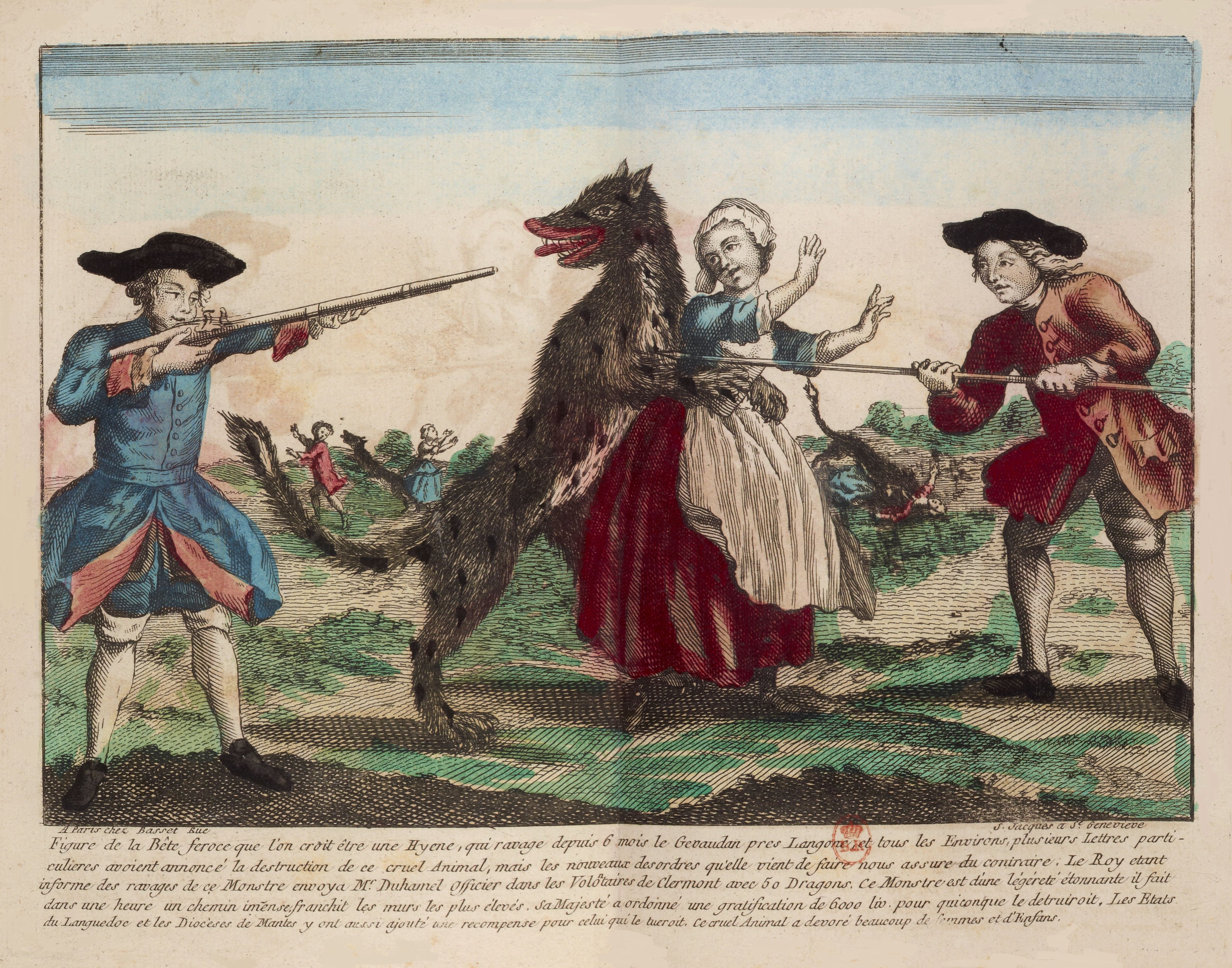
The Beast of Gévaudan: Key Points
- Between 1764 and 1767, the Beast of Gévaudan terrorized rural France, killing scores of people and becoming one of Europe’s most famous unexplained animal mysteries.
- Witnesses described an unusually large, powerful canine-like creature with reddish fur, strange markings, remarkable agility, and, in some accounts, an ability to rise or move on its hind legs.
- King Louis XV became involved in the crisis and sent professional hunters to kill the Beast. François Antoine killed a large wolf in 1765, but attacks resumed, suggesting that more than one animal may have been responsible.
- Jean Chastel killed another large wolf-like animal in June 1767, after which the attacks ended. Later legends claimed he used silver ammunition, but contemporary evidence does not firmly support this detail.
- Proposed explanations include ordinary wolves, multiple wolves, wolf-dog hybrids, an escaped exotic animal such as a hyena, or a deliberately trained attack animal.
- European werewolf traditions, including historical cases from Franche-Comté and modern canine-creature stories from places such as Cannock Chase, show that mysterious humanlike or unusual canine beings have deep roots in European folklore.

Introduction
The current Dogman is most closely related to North American cryptid lore, where witnesses report the existence of a gigantic canine creature that can stand or walk on two legs. But tales of terrifying beasts with both human and doglike features have existed in Europe for generations. Werewolf trials, tales of magical wolves, and more recent stories of upright dog-like creatures show the concept is much older than the present Dogman name. But one enigma in history looms above the rest, not just because it’s part of tradition, but because it was a documented series of terrible attacks. Between 1764 and 1767, an animal, or possibly multiple beasts, plagued the French province of Gévaudan, collectively known as the Beast of Gévaudan. Historians are prone to look for natural explanations, yet several of the features ascribed to the Beast have led modern-day cryptid enthusiasts to compare it to accounts of Dogman. This comparison presents a fascinating link between eighteenth-century history, earlier European werewolf legends, and modern-day cryptid belief.
The Beast of Gévaudan and the Historical Attacks
Histories describe the Beast as a large abnormal canid, often being described as wolf-like or lion-like, depending on the writer or witness. Many sources stress the early press and eyewitness accounts that portrayed the beast as a lone predator, creating an atmosphere of fear. Dramatic reports sometimes depicted the kills as decapitations and blood consumption. Though these accounts varied in the details, the underlying theme was a terrifying, anomalous canid that stretched the limits of accepted European ideas on predator behavior of the period (Dubey, 2022; Smith, 2015; Eberhardt, 2021).
Gévaudan was a wild region in the highlands of south-central France, roughly corresponding to the modern department of Lozère and surrounding areas. The landscape consisted of mountains, forests, isolated farms, and open grazing lands. Many of the inhabitants were poor rural families whose children and young people worked as shepherds. Both people and livestock inhabited territory that was also home to wolves. In 1764, 14-year-old Jeanne Boulet became the first widely recognized victim of the Beast, killed near Saint-Étienne-de-Lugdarès. More attacks followed, and women and children were disproportionately represented among the victims (Sánchez Arreseigor, 2021).
Contemporary reports were varied, and some common wolf attacks may have been attributed to the Beast; therefore, the number of victims is contested. But the scale of the brutality was exceptional. Over the three years, the creature was accused of dozens of deaths and many more attacks. Some estimates put the death toll close to or beyond 100 (Sánchez Arreseigor, 2021). Sometimes, survivors described an animal that was enormous and did not resemble the wolves typically found in the area. Descriptions varied throughout reports, but common details included a reddish or russet hue, strange markings, a giant head, strong physical stature, and incredible speed or agility. Stories also grew up about the monster standing or moving on its hind legs. These descriptions served to create a tale of a monster out of a succession of animal attacks.
But soon, the Beast became more than a local issue. Sensational news accounts filled newspapers across France, helping to make the attacks the national focus. François Morénas, editor of the Courrier d’Avignon, gave them wide publicity. The animal was described as possessing extraordinary intelligence, speed, and ferocity, with even similarities drawn to creatures from classical mythology (Sánchez Arreseigor, 2021). The growing press coverage indicates an important difficulty in viewing the situation today. As the attacks happened, history and folklore were colliding. Some of the more bizarre qualities attributed to the Beast may therefore be hyperbole rather than true eyewitness observation.

Royal Hunts and the End of the Terror
The news of the catastrophe finally reached the ears of King Louis XV. Professional hunters and soldiers were called in after local efforts to kill the animal failed. François Antoine, a veteran soldier and the king’s arquebus bearer, was one of the most significant royal participants. On Sept. 21, 1765, Antoine’s party killed an unusually huge wolf. The animal was identified as the Beast, and its remnants were collected and conveyed to the royal court. Antoine was credited for presumably halting the fear (Sánchez Arreseigor, 2021).
But there was one big difficulty. The attacks had started anew. Two months after Antoine’s famous kill, the people of Gévaudan faced renewed attacks. Between the end of 1765 and June 1767, reports indicated approximately 30 additional deaths (Sánchez Arreseigor, 2021). This obviously shows that Antoine’s wolf could not have been responsible for all of the attacks. It also lends credence to one of the simplest answers of the whole mystery: there may never have been a single Beast of Gevaudan. It may have been a pack of wolves or other animals, and panicked villagers and newspapers have blended separate attacks into the myth of one supposedly indestructible creature.
The final act was in 1767. Local hunter Jean Chastel shot a giant animal near Mont Mouchet on June 19. It seems the attacks halted after that. Contemporary depictions depicted Chastel’s animal as wolf-like but strange, with a giant head and an unknown mix of red, gray, and white colors (Sánchez Arreseigor, 2021). This happenstance made Chastel the classic hero of the tale.
Later folklore made his victory more dramatic. One of the most famous stories is that Chastel killed the Beast using silver ammo produced from blessed or religious things. It is more a tale than a historical truth. The silver-bullet account corresponds so closely with later popular beliefs about werewolves that it is easy to project modern werewolf mythology backward into the eighteenth-century example. Chastel did shoot the animal that ended the assaults, but the mystical aspects of his shot got ever more intricate in later tellings.
Theories About the Beast
It is still not known what exactly assaulted the inhabitants of Gevaudan. The most traditional interpretation is that it was wolves. There were plenty of wolves in eighteenth-century France, and they really did attack humans. There may have been several wolves, which would explain the differing appearances, the wide geography of the attacks, and the continued kills after Antoine shot his beast. Human terror, dramatic journalism, false identification, and the slow amalgamation of unrelated attacks could then have created the image of one extraordinary animal.
Discussions often mention the event of the Gévaudan when exploring how Enlightenment scientists addressed unknown or poorly documented occurrences. Some researchers saw the affair as illustrative of the era’s hunger for uncertainty and the sublime in natural history, demonstrating how data may be marshaled to support opposing narratives about the natural world. The Beast thus functions as a window into broader currents in eighteenth-century science, mythology, and popular theorizing about animal life and taxonomy (Smith, 2015; Eberhardt, 2021). Related scholarship situates the Gévaudan case within the evolving genre of cryptozoology and the boundary work between science and folklore. These conversations emphasize the persistence of the mythic dimension even in the face of efforts to establish a zoological identity, highlighting a productive tension between empirical inquiry and cultural storytelling about monsters (Schembri, 2011; Foxon, 2024).
Other explanations have suggested an exotic creature. Some historical portrayals seem to be irreconcilable with an average European wolf; hence, often a hyena is mentioned. Eighteenth-century Europe was not immune to escaped exotic creatures. Other possibilities include a giant dog or wolf-dog hybrid. Some more sophisticated versions envision a mastiff or similar animal intentionally trained to attack humans. There are even conspiracy claims that someone was controlling the Beast and directing its attacks on purpose. These are tantalizing ideas, but none has been definitively demonstrated.
The current interpretation of the Dogman takes the riddle in a different direction. Contemporary dogman legends typically describe an animal having canine characteristics but with a human-like capacity to stand or walk erect. Reports often emphasize their size, muscular shoulders, intellect, speed, and conduct that witnesses feel is distinct from that of typical wolves or dogs. Taking the most bizarre depictions of the Beast of Gévaudan seriously, some obvious connections stand out. Both traditions feature gigantic doglike beasts, exceptional sapience, incredible physical strength, and at least sporadic assertions of bipedalism.
These similarities make Gévaudan an enticing area for cryptid researchers looking for historical precursors to present Dogman encounters. In that sense, one could view the Beast as an early European encounter with the same unknown being now referred to as Dogman. However, this hypothesis faces a significant historical challenge. Dogman is a modern designation. The people of eighteenth-century Gévaudan did not have that understanding, and their evidence exists in documents made up of folklore, journalism, religion, and their telling. Descriptions separated by centuries are not proof that witnesses saw the same biological monster. So the comparison should be treated as a cryptozoological hypothesis, not a historical conclusion.
European Werewolves and Modern Dogman Traditions
Gévaudan also was part of a much longer tradition of French belief in werewolves. The Franche-Comté region of France became especially known for werewolf claims in the early modern period. Historical research reveals that the courts convicted dozens of people in Franche-Comté for acts related to werewolves during the sixteenth and seventeenth centuries (Oates, 1993). In Franche-Comté and the Jura, werewolf trials were notably important compared to many other parts of Europe. They developed in the wider religious, judicial, and cultural context that also gave rise to witch hunts (Schulte, 2015).
The Franche-Comté instances suggest that Europeans developed a cultural framework for understanding frightening encounters with wolves in supernatural terms long before the Gévaudan attacks. Wolves were not simply predators. They were emblems of the wilderness, of violence, of metamorphosis, of evil. Historical evidence has suggested that werewolf allegations were caused by ecological conditions, actual difficulties with wolves, religious conflict, judicial practices, and local customs (Oates, 1993; Schulte, 2015). So an unknown wolf-like predator in eighteenth-century France arrived in a culture already familiar with myths in which the line between people and wolves may be severely blurred.
Stories of odd upright canine animals have persisted in European folklore into modern times. For example, Cannock Chase in Staffordshire, England, has collected tales of purported werewolves and other bizarre animals. Some modern reports speak of big canine animals; others of creatures said to walk on two legs. These accounts are not the same as the historical data regarding Gévaudan, and the evidence for a cryptid at Cannock Chase remains purely anecdotal. Nevertheless, such tales indicate that the upright dog image persists into modern British paranormal mythology.
Ordinary means can also explain some of the modern sightings. Darkness, distance, terrified witnesses, large domestic dogs, escaping animals, and expectations based on existing legend can transform equivocal encounters into seemingly unusual ones. For example, husky training has been taking place on Cannock Chase, which could explain some of the tales of wolf-like animals and weird howling in the vicinity (Sutherland, 2025). A big dog standing on its hind legs for a moment can look oddly human, especially if you don’t see it clearly. These options suggest some witnesses could be mistaken, highlighting why eyewitness testimony alone is insufficient to prove the existence of an undiscovered canine species.
The link between Dogman and ancient European werewolf legends may in the end tell us more about folklore than zoology. Individuals use notions that are available in their society to interpret unusual events. A French villager of the sixteenth century, whether it pertained to werewolves, demonic metamorphosis, or witchcraft, may describe a terrible canine resembling a person. The eighteenth-century witness could term an unusual predator a monster or a beast. A twenty-first-century witness versed with cryptozoology would describe a similar encounter as Dogman. The lexicon may be different, but other traits are hauntingly similar.
That is not to imply that all reports may be rejected. The Beast of Gévaudan is a true historical mystery, with real individuals assaulted and killed. Something was at fault. What was that something? And did all of the attacks have the same cause? That is the uncertainty. Modern Dogman accounts create a different evidentiary challenge, however, because they have not produced similar physical or zoological evidence. Thus, you have to be careful when you connect the two. It is intriguing to note similarities across stories, but resemblance is not evidence for a biological relationship.
Conclusion
The Beast of Gévaudan inhabits the odd space between recorded history and cryptid lore. There is no question that people perished in a frightening series of assaults between 1764 and 1767, that royal authorities arranged hunts, that François Antoine killed a wolf thought to be the Beast, and that Jean Chastel killed another just before the attacks ceased. Stories about a huge, clever, oddly colored beast capable of exploits beyond those expected of an average wolf evolved around these historical facts. The stories now can be compared with contemporary descriptions of Dogman. Taken alongside the werewolf myths of Franche-Comté and contemporary accounts from sites such as Cannock Chase, Gévaudan forms part of a much broader European heritage of weird canine animals. Currently there is no scientific evidence to indicate that the Beast was a Dogman or that Dogman represents an undiscovered species. The analogy is nevertheless useful in illustrating how persistent the picture of the abnormal canine predator has been. From werewolf trials to royal hunts to modern cryptid accounts, Europeans have continually imagined, dreaded, and sometimes claimed to have encountered something lurking at the ambiguous boundary between human and wolf.
References
Dubey, S. (2022). Factual origins of myths. International Journal of Social Science and Human Research, 5(10), 4491–4493. https://doi.org/10.47191/ijsshr/v5-i10-11
Eberhαrt, G. M. (2021). Mystery cats of the world revisited: Blue tigers, king cheetahs, black cougars, spotted lions, and more by Karl P. N. Shuker. Journal of Scientific Exploration, 35(2), 433–443. https://doi.org/10.31275/20212011
Foxon, F. (2024). Heuvelmans the heretic and hidden animals. Interdisciplinary Science Reviews, 49(3–4), 332–348. https://doi.org/10.1177/03080188241233107
Oates, C. F. (1993). Trials of werewolves in the Franche-Comté in the early modern period [Doctoral dissertation, University of London].
Sánchez Arreseigor, J. J. (2021, October 21). Did a “werewolf” really terrorize France in the 1700s? National Geographic.
Schembri, E. (2011). Cryptozoology as a pseudoscience: Beasts in transition. Surg Journal, 5(1), 5–10. https://doi.org/10.21083/surg.v5i1.1341
Schulte, R. (2015). “She transformed into a werewolf, devouring and killing two children”: Trials of she-werewolves in early modern French Burgundy. In H. Priest (Ed.), She-wolf: A cultural history of female werewolves (pp. 41–58). Manchester University Press. https://doi.org/10.7228/manchester/9780719089343.003.0003
Smith, J. M. (2015). Dreadful enemies: The “beast,” the hyena, and natural history in the Enlightenment. Modern Intellectual History, 13(1), 33–61. https://doi.org/10.1017/S1479244315000050
Sutherland, D. V. (2025, August 27). Werewolf Wednesday: Cannock Chase explained? Doris V. Sutherland.


Leave a Reply