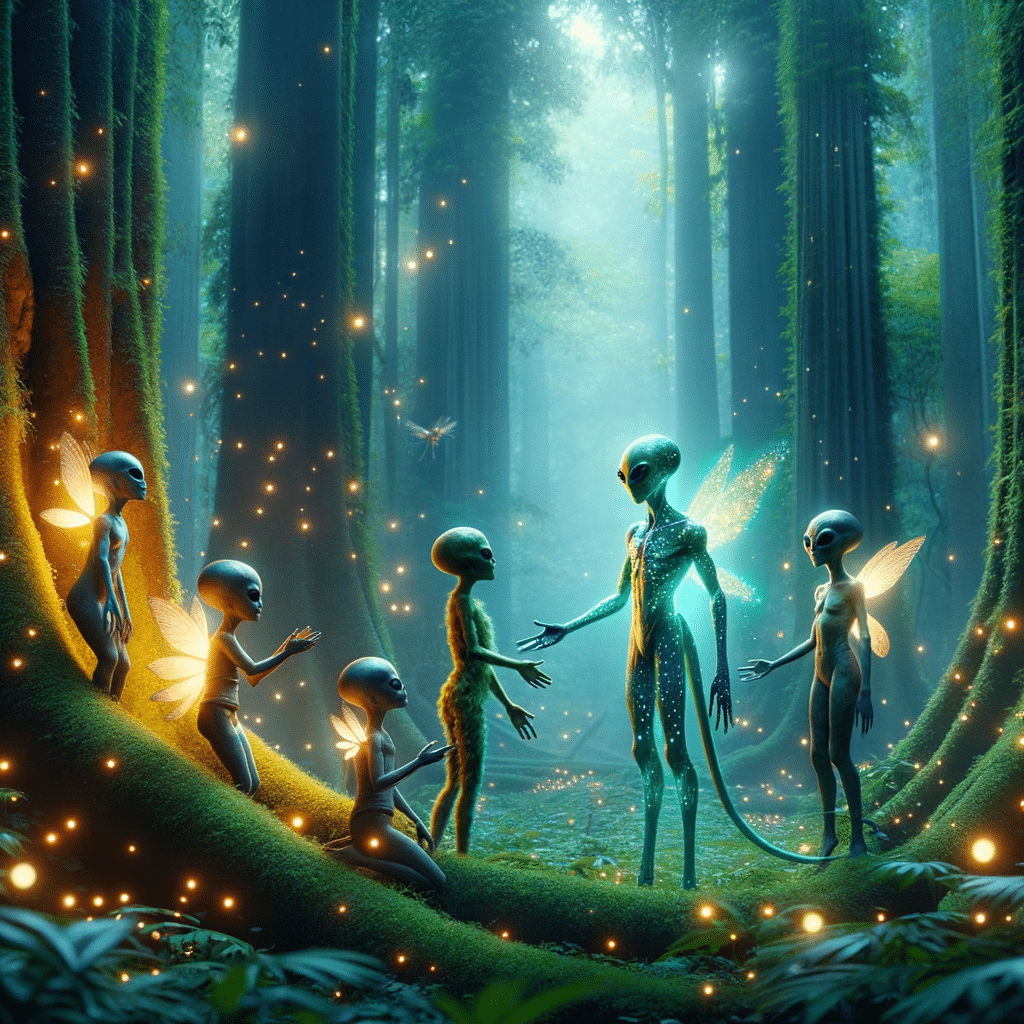
It’s been suggested that faeries, angels, and aliens are all descriptions of the same beings. Is this possible to be true?
Stories about supernatural creatures have captured the attention of people all throughout history and in a variety of cultural contexts. Religious literature depict angels, folklore depicts faeries, and contemporary science fiction presents aliens as separate entities with distinct characteristics and stories. However, upon closer inspection, these seemingly disparate entities exhibit startling affinities. This implies that there could be multiple interpretations of the same object, each shaped by the cultural, historical, and contextual factors surrounding it. This fascinating notion will be explored in this essay, which will look at the traits of these entities, how similar they are, and the problems with the theory.
Angels
Angels are recurring supernatural figures in religious texts from many different cultures, including Islam, Judaism, and Christianity. These celestial beings, who are revered as God’s messengers or servants, are well known for having amazing abilities. Angels are frequently described as ethereal beings that radiate a bright radiance and a pervasive feeling of kindness and tranquility. Furthermore, they are often connected to the spiritual world or Heaven itself.
Angels are thought to interact meaningfully with humanity as a middleman between the heavenly and the material world. They are not merely observers; rather, they actively engage in human affairs by imparting messages from higher planes and offering crucial assistance. Such heavenly interventions have been characterized as essentially supernatural.
The general idea of angelic appearances and roles in religious stories is universal, even though different cultures may interpret them differently. These celestial beings represent unmatched goodness and purity and act as messengers between the divine and the human world.
It becomes clear from investigating the world of celestial beings that not all angels are messengers of goodness and light. Demons, who represent evil and darkness, prowl in the shadows alongside their celestial counterparts. Our knowledge of these otherworldly beings is hauntingly complicated by the occurrence of this dualism inside angelic worlds.

Faeries
The folklore of many different cultures has a rich and varied history regarding faeries, with Celtic traditions having a particularly noteworthy influence on how they are portrayed. These enchanted entities are frequently portrayed as fanciful, mischievous creatures possessing amazing magical abilities. Their resemblance to natural elements highlights their intimate relationship with the surroundings and strengthens their tie with the magical worlds they live in.
Faeries, who go by a variety of names in different cultures, are thought to live in a magical place called Faeryland. Many people describe this ethereal region as a place of unmatched beauty and wonder, where nature grows in its most alluring form and time seems to stop. Faeries live in this enchanted sanctuary, hidden from view but sometimes coming into contact with people.
Faeries, like angels on the other side of the heavenly realm, can converse with people from time to time. Faeries, in contrast to angels, exhibit a range of motivations, from innocent mischief to more malevolent actions. While some people might be helpful or friendly to others they encounter, others might get pleasure from playing practical jokes or even resorting to devious tactics for their own entertainment.

Aliens
Alien culture has become a popular theme in the wide world of contemporary science fiction literature and multimedia. These extraterrestrial creatures, originating from different planets or universes, have captivated numerous readers and viewers. Interestingly, we often portray these entities as possessing technology that surpasses our understanding. This portrayal frequently connects them to the fascinating realm of abduction stories and UFO encounters.
It’s amazing how different extraterrestrial representations can be from one another. On the one hand, we can portray them as kind entities who generously impart their superior wisdom to humans. They act as mentors or guides for the common people, providing us with knowledge of philosophical concepts or scientific discoveries that are now beyond our current grasp.
However, these compelling stories portray aliens as hostile invaders, poised to take over or dominate Earth. These compelling stories pit humanity against these evil beings who seek to exploit our resources or establish their power over us weak humans.
It is important to note that both of these scenarios have one thing in common: these mysterious creatures come from more developed civilizations than our own, from far-off planets full of mysteries we can’t begin to imagine, or from other realms that are secret but exist nonetheless.
Analysis
Despite coming from quite different civilizations, you can see that these mystical beings—angels, faeries, and aliens—have a lot in common when you explore their fascinating worlds. They possess remarkable powers that surpass human limitations, which is one of their most notable similarities. Whether depicted as possessing magical talents from old legends, supernatural powers, or far-reaching technological advancements, angels, faeries, and aliens all exhibit otherworldly capability.
The fact that these mysterious creatures seem to like interacting with people is yet another fascinating similarity. Frequently portrayed as meddling in our world’s affairs in ways that appear amazing or puzzling to us simple mortals, These experiences leave people amazed and confused as they blur the lines between the remarkable and the commonplace.
Moreover, worlds or realms that exist in parallel to but separate from our own physical reality are inextricably tied to angels, faeries, and aliens. These phantom realms either provide comfort or have an impact on humanity. People typically think of angels as existing in heavenly realms infused with divine light and goodness, faeries as living in magical places hidden among the natural world where magic is abundant, and aliens as originating from far-off planets spread across vast cosmic stretches.
The stunning similarities between these beings are evident despite their diverse cultural roots spanning time and place, whether derived from myths passed down through generations or religious beliefs established through millennia.
Parallels
Despite their excellent portrayals, all three of these creatures possess a dark side. It is evident that these beings—from demons to dark faeries to invading aliens—do not view the world like humans do and hold distinct moral beliefs about it.
Examining the idea of faraway realms—like Heaven, Faeryland, and alien worlds—makes it impossible to ignore the fascinating parallels between these seemingly unrelated concepts. These otherworldly spaces have captured people’s imaginations for millennia because they provide a window into a world apart from our own.
For a very long time, people have imagined heaven to be a place of peace and exquisite beauty beyond our comprehension. People frequently portray it as a utopia where spirits can live in perpetual harmony and serenity. An overwhelming sensation of tranquility and spiritual fulfillment transcends mortal concerns here in the heavenly realm. The attraction of heaven is its capacity to take believers to a place free from the conflict and suffering of this world.
Similarly, Faerieland evokes fantasies of magic and wonder. Mysticism envelops this magical place, home to supernatural beings possessing abilities beyond human comprehension. This fantastical place suspends natural rules, where sparkling waterfalls tumble from high cliffs with an incomprehensible elegance and flowers bloom in hues unseen on Earth’s canvas. Faeriel’s entire nature invites us into a world where magic reigns supreme, challenging our understanding of reality.
However, tales of distant realms frequently conjure up ideas of great civilizations that are technologically far superior to our own. These extraterrestrial environments feature landscapes and communities that challenge the accepted notions about life forms elsewhere in the cosmos, pushing the bounds of scientific possibility.
Conclusion
Despite these commonalities, there is serious debate over the idea that angels, faeries, and aliens are all the same. The main problem is that these experiences and the narratives surrounding them are subjective. These experiences often lack objectively confirmed empirical support and possess a subjective and/or personal essence. Furthermore, the wide variations in descriptions of these entities, influenced by cultural and historical circumstances, make it challenging to conclude with certainty that they are the same phenomena. It’s also critical to take into account the significance of human symbolism and imagination, which can make connections and patterns where none might otherwise exist.
It’s an intriguing theory that suggests angels, faeries, and aliens are all aspects of the same reality seen through many cultural perspectives. It presents a cohesive viewpoint on our persistent obsession with the paranormal, emphasizing the universal human experience that transcends space and time. Despite encountering numerous challenges, this theory encourages us to expand our perspectives and consider the possibility of a greater number of connections in the universe than we currently acknowledge. Whatever the reality, these stories will always hold our attention because they capture our shared anxieties, hopes, and never-ending search for knowledge about the unknown.
References
Brown, R. A. (2008). Angels and elves, archetypes and aliens: Anomalous encounter experiences viewed through a depth psychological lens. Pacifica Graduate Institute.
Doctor, A. (1999). Of Aliens and Angels: Mythic Identity. Blutopia: Visions of the Future and Revisions of the Past in the Work of Sun Ra, Duke Ellington, and Anthony Braxton, 44.
Flaherty, R. P. (1990). Flying saucers and the new angelology: Mythic projection of the Cold War and the convergence of opposites. University of California, Los Angeles.
Lewis, B. (2012). Angels, Aliens and Prophecy. AuthorHouse.
Masson, S. (1996). Angels, Fairies and Aliens. Quadrant, 40(3), 54-58.
Rowland, A. (2020). Finding faeries: Discovering sprites, pixies, redcaps, and other fantastical creatures in an urban environment. Simon and Schuster.
Leave a Reply