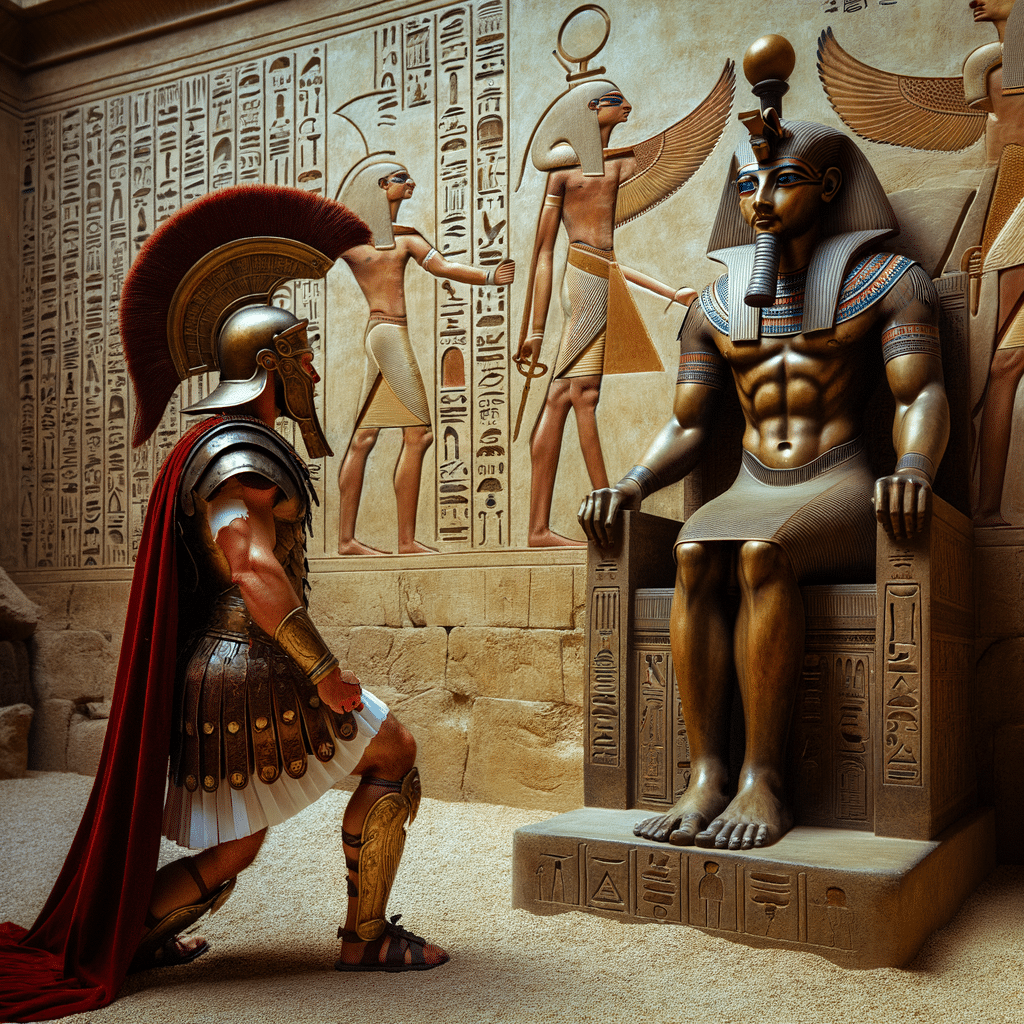
The Romans greatly admired ancient Egypt. They took up numerous Egyptian deities to worship across the empire.
For more than three millennia, people revered the gods of ancient Egypt, and their pantheon was extraordinarily intricate and rich. When the Romans conquered Egypt in 30 BCE and brought the country under Roman authority, they introduced these gods to them.
Egyptian Religion
Egyptian religion and gods were among the numerous elements of Egyptian civilization that the Roman Empire took up. The Roman Empire’s acceptance of Egyptian gods was a complicated phenomenon involving syncretism, or the merging of many religious practices and beliefs.
It is impossible to overstate the impact of the Egyptian gods on Roman religion and culture. The Egyptians left a lasting impression on the religious beliefs of the Romans by introducing them to their fascinating pantheon through trade, travel, and cultural exchanges.
The Romans were renowned for being open to assimilating and modifying alien gods into their own pantheon.
Egyptian deities frequently shared characteristics or purposes with their Roman counterparts. For instance, people associated Osiris with the Roman god Bacchus and compared Isis to the Roman goddess Venus.
Syncretism
Thanks to syncretism, the Romans were able to include Egyptian gods in their religious rituals without entirely renunciating their own customs.
The Isis cult’s popularity was one of the main factors in the Roman Empire’s acceptance of Egyptian gods. Magic, childbirth, and fertility were associated with the Egyptian goddess Isis. They also revered her as a defender of oppressed people and seamen. Isis’s worship gained popularity in Rome and expanded throughout the Mediterranean region. The Roman goddess Ceres was frequently associated with Isis in that region. The Roman government accepted and even promoted Isis’ worship, and they built numerous temples for her.
In the Roman liturgical calendar, the celebration of Isis, also known as the Isia, honoring her husband Osiris’s death and resurrection rose to prominence. The story of Osiris’s death and rebirth was a feature of the Isiac cult, making it similar to other mystery religions.
Before the Romans took control of Egypt, the Ptolemaic dynasty founded Serapis, a syncretic god. He was essentially a combination of Greek gods like Zeus and Dionysus, with aspects of Osiris and the holy Apis bull. The Ptolemies encouraged Serapis’s unification of Greek and Egyptian religious traditions, which made Serapis especially appealing to the syncretistic Roman mindset.
During the Roman era, the Serapeum, a temple to Serapis in Alexandria, continued to be a significant religious hub. Greek-speaking people, in particular, worshipped Serapis across the empire. People frequently pictured Serapis with a grain measure on his head, symbolizing fertility and abundance.
Osiris was another god who captivated the Roman people’s interest. Ancient Egyptians revered Osiris as a divinity associated with death, rebirth, and agriculture. The tale of Osiris captured the attention of both commoners and nobility. For many Romans who were apprehensive about their own fate beyond this world, his confidence in his authority over life after death offered comfort in the face of mortality.
Horus was also instrumental in establishing a bridge between Roman society and Egyptian religious customs. Horus, the falcon-headed god of Egyptian mythology, represented attributes greatly prized by the Roman ruling class, including sovereignty and divine protection. He was popular with emperors who saw themselves as guardians of their empires because of his associations with power and authority.

The jackal-headed god of mummification and the afterlife, Anubis, and the cat-headed goddess of fertility and protection, Bastet, were among the other Egyptian deities that the Romans took up as their own. Roman literature and art frequently portrayed these gods in their religious rituals.
These supernatural creatures did not only reside within isolated pockets of worship, but rather infiltrated numerous aspects of Roman life through cultural contacts between both civilizations.
To justify their authority and fortify their ties to the conquered lands, the Roman emperors—especially those of the Julio-Claudian dynasty—actively encouraged the worship of Egyptian deities.
Temples honoring Egyptian gods, such as Rome’s Temple of Serapis and Isis, symbolized imperial might and dignity.
Imperial Cult
The emperors possessed unmatched power and authority at the height of the Roman Empire. In addition to being powerful politicians, their subjects revered them as gods. The emperors’ deification led to the development of an intricate network of religious activities and beliefs known as imperial cults.
A wide variety of religions served as inspiration for the imperial cults, with Egyptian beliefs being one particularly significant source. People long regarded the pharaohs of ancient Egypt as semi-divine entities with immense power and influence. The Romans, who aimed to provide their rulers with a similar degree of respect, found resonance in this idea.
Egyptian religious components gradually made their way into Roman emperor worship ceremonies. For instance, in temples devoted to imperial cults, images of Roman rulers began to coexist with representations of Egyptian deities like Serapis or Isis. The goal of these syncretic representations was to combine Roman and Egyptian traditions to produce a distinctive combination that highlighted the emperor’s celestial status.
The Roman emperor Hadrian constructed a temple complex in Antinoopolis, Egypt, dedicated to the Egyptian deity Antinous. Hadrian was especially enthralled by Egyptian culture.
Mystery Cults
Mystery cults, sectarian religious communities that followed initiation rites and other hidden practices, frequently connected Egyptian deities. The Romans were fascinated by these enigmatic cults and gladly adopted their activities, assimilating them into their own religious customs.
The Romans couldn’t deny the attraction of the Egyptian gods and the mystery cults that surrounded them. They flocked to these private societies, excited by stories of enlightenment, revelations from God, and hidden knowledge, to experience the deep secrets they promised.
Members of these mystery cults would take part in complex initiation rites and rituals designed to help them establish a connection with the divine. People engaged in these holy rituals in the hopes of learning more about the nature of life, changing themselves, or receiving special favors from the gods.
In addition to showing a sincere curiosity about other faiths, the Roman acceptance of Egyptian mystery cults also represented a desire for more profound spiritual experiences than what Roman religion had to offer. The enigmatic and exotic nature of Egyptian culture gave these covert societies an air of mystery.
Roman religious traditions included parts of Egyptian mythology and ceremonies, which the people thought would allow them to access supernatural powers and ancient wisdom. The combination of Roman and Egyptian ideas led to the blending of religious customs, thereby deepening the understanding of divinity in both societies.
The Roman Empire saw the expansion of Egyptian religious practices and beliefs, in part due to the popularity of Egyptian mystery cults.

Cultural
Roman expansion and cultural absorption are the reasons for the appearance of Egyptian gods in Roman art. The Romans came across new religious customs and belief systems during their conquest of several lands, including those of ancient Egypt. Egyptian deities captivated Roman painters, who began incorporating these characters into their own artistic creations because of their unique iconography and rich mythology.
Sculptures were an important way to demonstrate the blending of Roman and Egyptian cultures. Throughout the empire, ornate statues of well-known Egyptian deities like Horus, Osiris, and Isis graced temples, public areas, and private homes. For affluent people looking to display their worldly interests, these sculptures functioned as status and power symbols in addition to being ornamental objects.
The Romans also had the option of interacting visually with Egyptian deities through paintings. The mythological themes depicted in frescoes frequently included well-known Greco-Roman characters alongside deities like Ra or Anubis. These colorful portrayals piqued viewers’ curiosity about other religious traditions while aiding in the bridging of two disparate pantheons.
Mosaics were another way that Roman visual culture incorporated Egyptian gods. Exquisite tile murals adorned walls and floors in opulent homes located throughout Italy and other countries. Meticulously made mosaics displayed a variety of holy characters, including goddesses like Bastet and sacred animals like the sphinx and serpent-like Ouroboros.
Roman authors, especially well-known ones like Plutarch, Apuleius, and Juvenal, have left us with priceless insights into the fascinating world of Egyptian deities and their worship. Through their writings, these gifted writers illuminated the complex subtleties of Roman vision and comprehension of ancient Egyptian religion.
Plutarch’s vast corpus of writing explores a variety of subjects pertaining to Egypt’s diverse religious traditions. His painstaking investigation and in-depth explanations provide readers with a thorough grasp of the many Egyptian gods and their places in the pantheon. In addition to delving into the works of venerated gods such as Osiris, Isis, and Horus, Plutarch also wrote about lesser-known characters who played important roles in Egyptian mythology.
Another great Roman author, Apuleius, provides an interesting viewpoint on Egyptian religion in his well-known book, The Golden Ass. The engrossing story of magic and metamorphosis explores the various cults practiced in ancient Egypt to honor specific gods. Through colorful storytelling and exquisitely detailed religious rituals, Apuleius transports readers to the mysterious world where both Egyptians and Romans passionately revered these gods.
Juvenal’s satirical poetry approaches the topic of Roman attitudes toward Egyptian gods in a distinct way. Juvenal, who is well-known for his scathing social commentary presented through absurdly exaggerated stories of ordinary life, offers insights into how different societal groups perceive alien religions, such as those followed by Egyptians.
Conclusion
There was some debate concerning the Roman Empire’s embrace of Egyptian deities. Some Romans considered the worship of the Egyptian gods a threat to ancient Roman ideals because it was strange and exotic to them. The growth of superstition and the corrupting influence of Egyptian culture were the main concerns. The worship of Egyptian gods was, nevertheless, usually accepted by the Roman government as long as it did not conflict with the official religion or the Roman populace’s allegiance.
Long after the Roman Empire officially converted to Christianity, the Isiac cult persisted as one of the last pagan groups to challenge Christianity in terms of worship of Egyptian deities. The imagery and ceremonial components of early Christian worship, such as the idea of resurrection and the image of the Madonna and Child, which echoes the imagery of Isis and her son Horus, bear witness to the legacy of Egyptian worship traditions.
The Roman Empire’s embrace of Egyptian gods was a convoluted process that involved mingling various religious rituals and ideas with syncretism. The worship of Isis and Serapis, often associated with Roman goddesses, was particularly popular. Despite occasional hostility, the Roman rulers mainly accepted the worship of Egyptian gods. The Roman Empire’s acceptance of Egyptian gods is an intriguing example of cross-cultural interchange and merging of traditions.



Leave a Reply