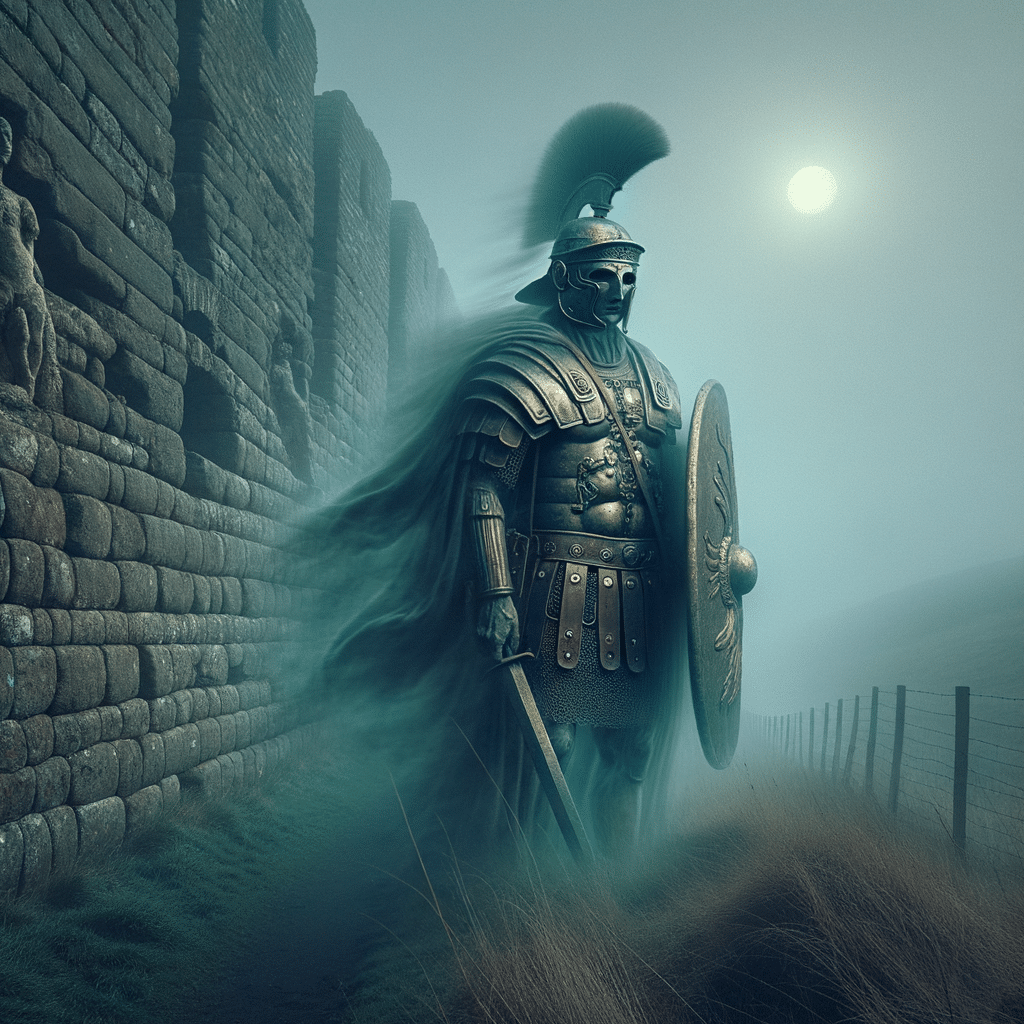
Rising over the untamed northern boundary of Roman Britain, Hadrian’s Wall has been a monument to Roman architecture and imperial ambition for almost two millennia. From the banks of the Tyne to the Solway Firth, this ancient fortification—now a UNESCO World Heritage site—cuts sharply across the uneven terrain of northern England. Beyond its historical and archeological importance, Hadrian’s Wall has gathered a rich tapestry of paranormal stories, ghostly encounters, and strange events that still captivate both tourists and scientists. Passed down through centuries, these magical stories reveal a distinct view of this ancient boundary—one in which the veil separating the living from the dead, between past and present, looks shockingly thin.

History of Hadrian’s Wall
Emperor Hadrian ordered the construction of Hadrian’s Wall around 121 AD to mark the northernmost limit of Roman civilization and restrict migration between the Roman province and the unconquered areas beyond. Originally towering up to 20 feet (ca. 6 m) high and 10 feet (ca. 3 m) broad in certain areas, the wall ran over 73 miles (ca. 117 km) across the narrowest portion of Britain. With a sophisticated system of forts placed every five Roman miles, milecastles at one-mile intervals, and two observation turrets between each milecastle, this remarkable construction created an extensive defense network housing thousands of troops from all throughout the Roman Empire. The wall was more than just a military post; it was a sophisticated customs barrier and emblem of Roman authority, showing the northern tribes the might and stability of Roman control as well as the local populace (Hodgson, 2017).
The wall was the northwest boundary of the Roman Empire for almost three centuries, subject to periods of massive military activity, rebuilding, and sporadic abandonment as imperial policies changed. With much of the stone used for local homes, churches, and agricultural projects, the wall deteriorated following the Roman departure from Britain in the early 5th century. Though systematic archaeology didn’t start until the 19th century, the Venerable Bede noted the wall’s historical importance as early as the 8th century. Particularly in the center segments, where the tough terrain hindered later stone stealing, allowing modern tourists to follow in the footsteps of Roman troops who formerly patrolled this far-off frontier, significant portions of the wall remain visible today (Collins, 2012).
Paranormal Activity
With innumerable accounts of spectral events spanning millennia, Hadrian’s Wall’s paranormal past is as significant as its physical presence on the earth. Among the most often mentioned symptoms are phantom marching sounds, in which guests describe the clear beat of hobnailed sandals striking stone paths and the distant echoes of Roman military instructions carried by the breeze. At the best-preserved fort along the wall at Housesteads (Vercovicium), nighttime visitors have reported seeing ghostly legionnaires traversing the ruins. Their forms are partly transparent but clearly bear the distinctive armor and carry the weapons of Rome’s imperial forces. Usually disappearing when approached, these apparitions leave onlookers with a wonderful impression of having momentarily seen across time to the active military period of the wall (Shanks, 2012).
With regular stories of a centurion patrolling the western gate, occasionally interacting with guests by beckoning for them to stop before disappearing, the Birdoswald Fort (Banna) sector has become especially infamous for paranormal activity. Local legends tell of a specific area close to Sewingshields where, on some evenings, especially around the anniversary of known conflicts between Romans and northern tribes, the eerie cries of combat can be heard. With cameras failing inexplicably and battery-operated devices draining rapidly in areas linked with violent historical events or mass burials, visitors and archaeologists have recorded unexplained cold spots, sudden atmospheric pressure changes, and equipment failures in specific locations along the wall.
Beyond the Roman specters, the long history of the wall has gathered layers of paranormal claims from later years. Built from stones removed from the wall, Lanercost Priory has seen the documentation of medieval spirits; monks have been seen gliding across the ruins at dusk. Characterized by violent attacks between English and Scottish families, the Border Reivers period has produced many apparitions of mounted warriors who apparently materialize from within the wall’s construction before dashing north or south. More recently added are Victorian-era archaeologists, sometimes seen painstakingly measuring and recording portions of the wall that have subsequently been excavated; their phantom forms continue work long after their deaths.

Theories
Several ideas try to explain the ongoing paranormal activity around Hadrian’s Wall; among paranormal researchers, the “stone tape” notion is especially well-known. According to this view, the limestone and sandstone employed in the building of the wall could be a recording medium, catching the emotional energies of powerful events and reproducing them under specific climatic conditions. Proponents cite the geological makeup of the wall and the fact that many recorded events happen in relation to temperature or humidity, which would influence the stone’s potential capacity to store and release energy imprints. Others point out that many claimed events center on sites of known trauma or extreme emotional intensity, such as hospitals, execution grounds, or sites of major conflicts (Sexton, 2024).
There are different psychological theories that explain this. Some say that the wall’s historical importance, dramatic setting, and cultural importance to British identity make it a perfect place for people to experience pareidolia and other perception phenomena. Many areas of the wall are isolated, and combined with fast-shifting weather patterns typical of northern England, the structure provides an environment where natural sounds might be misconstrued and glimpsed movements in peripheral vision attributed to supernatural origins. Archaeological studies indicate that many recorded events match seasonal variations in acoustics along the wall corridor; some wind patterns create sound channels that can carry noises for miles, occasionally giving the impression of voices or marching when it may be distant cattle or modern hikers.
Some academics see the paranormal reputation of Hadrian’s Wall from a cultural perspective, pointing out how ghost stories have been quite beneficial for society throughout British history. While border ghosts can symbolize the centuries of conflict between England and Scotland, the spectral Romans might reflect Britain’s complicated connection with her colonial past. Through tourism literature, documentaries, and guidebooks emphasizing the wall’s enigmatic features, these stories are constantly reinforced and changed, generating a feedback loop whereby guests arrive expecting supernatural experiences and so become more likely to interpret ambiguous stimuli in paranormal terms. This approach does not discount the experiences of witnesses; rather, it implies that cultural background impacts our interpretation of rare events (Witcher, 2010).
Conclusion
Entering the third millennium, Hadrian’s Wall’s stones remain mute reminders of Britain’s complicated past while also harboring echoes of its violent past. The paranormal events that have been recorded along the wall’s length have become an important part of its cultural significance, whether they are seen as real spiritual manifestations, natural events that were misunderstood, or psychological responses to a very spooky environment. These ghostly stories remind us that history is not just a live, breathing entity that still influences people who come into contact with it; they also provide our knowledge of this old border another perspective. Roman sentries once watched in the windswept stretches; the past and present entwine to invite each visitor to wonder what might linger in these old stones and what echoes of our time might soon join the spectral guards of Hadrian’s Wall.
References
Collins, R. (2012). Hadrian’s Wall and the End of Empire: The Roman Frontier in the 4th and 5th Centuries. Routledge.
Hodgson, N. (2017). Hadrian’s Wall: Archaeology and history at the limit of Rome’s empire. The Crowood Press.
Sexton, J. (2024). Producing Paranormal Sounds: Electronic Music, Projection, and Blurred Boundaries in The Legend of Hell House (1973) and The Stone Tape (1972). Haunted Soundtracks: Audiovisual Cultures of Memory, Landscape, and Sound, 63-64.
Shanks, M. (2012). Let me tell you about Hadrian’s Wall…. Heritage, Performance, Design.
Witcher, R. (2010). The fabulous tales of the common people, part 2: encountering Hadrian’s Wall. Public Archaeology, 9(4), 211-238.

Leave a Reply