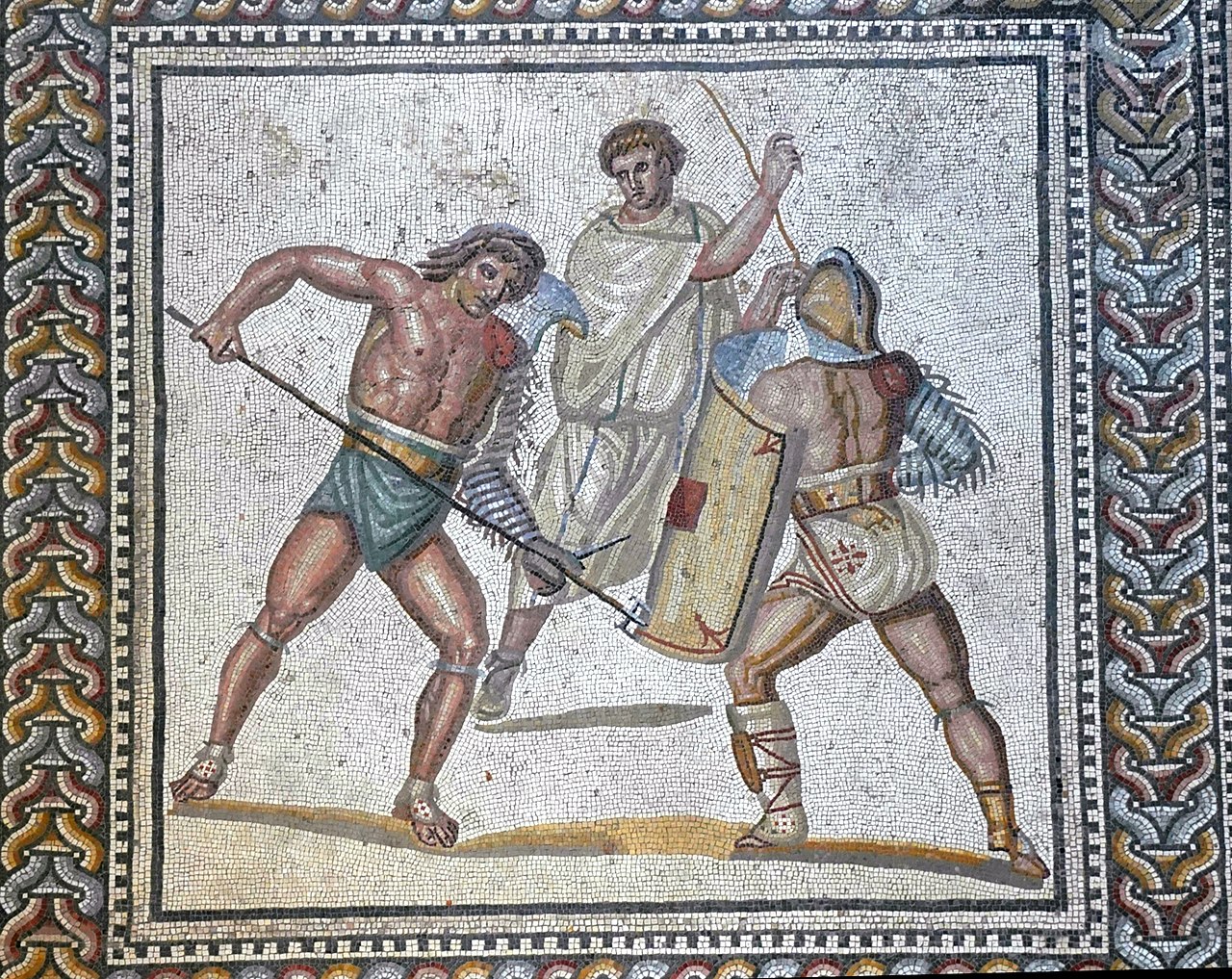
One of the most famous historical characters are the Roman gladiators, who represent a stunning fusion of spectacle, culture, and human tenacity. Because becoming a gladiator was dangerous and unpredictable, superstition and paranormal beliefs were common in the atmosphere. In order to shed light on the gladiators’ attitude and analyze the cultural setting that supported their ideas, this film investigates the significance of these components in the lives and perspectives of Roman gladiators.
Two of the most significant political systems in human history, the Roman Republic and Empire, existed for more than eight centuries. At this time, gladiators were a major factor in the development of ancient Rome’s culture. As slaves or prisoners of war, onlookers frequently forced these expert fighters to battle to death for their amusement. Many Romans loved gladiators despite the brutality of their occupation, and they gained popularity both inside and outside of the arena.
Roman Gladiators
For the most part of Roman history, gladiator bouts were a popular kind of entertainment; at their peak, there may have been up to 5000 contests annually, according to some estimations. The breadth and nature of the games themselves varied widely; some had two warriors engaging in single combat, while others pitted entire teams against each other. Whatever their format, these gatherings attracted sizable attendance from a wide range of socioeconomic backgrounds, including affluent patricians and destitute plebeians.
Gladiatorial fights had a certain superstitious quality to them, despite being very popular among Roman inhabitants. Many people thought that supernatural forces or divine intervention were responsible for their victory in combat. Before attending fights, some even went so far as to contact astrologers or other diviners in an attempt to predict which fighter would win.
It is crucial to first situate superstition within the larger framework of Roman society in order to comprehend the significance of superstition in the lives of Roman gladiators. The Romans, like many other ancient civilizations, were deeply religious, believed in divine intervention and the supernatural, and woven a vast array of customs and superstitions into their everyday lives.
These varied from small customs, such as tossing spilled salt over one’s shoulder to ward off misfortune, to elaborate public rituals intended to win the gods’ favor. These more general cultural standards inevitably impacted gladiators, given their membership in this culture. One could argue that the risks associated with their profession underscore the necessity of these viewpoints.
In the realm of gladiators, a single sword stroke may mean the difference between life and death. Naturally, the constant threat of death heightened people’s awareness of their own mortality and motivated them to employ all available strategies to alter their fate. Superstition gave them some measure of control over their unstable existence as a psychological haven.
The training that gladiators received is among the most remarkable illustrations of the relationship between gladiators and the paranormal. People believed that gladiators could summon supernatural forces to bolster their combat skills, often instructing them in the application of magic and ritual.

Paranormal Aspects
Gladiators would perform rituals before entering the arena in an effort to ward off bad luck or bring good fortune. In an attempt to win heavenly favor, they would pray to gods like Fortuna, the goddess of luck, or Nemesis, the god of retribution and balance. Other superstitions included wearing charms or amulets and following particular pre-battle customs that differed greatly from person to person.
The general public perceived gladiators as individuals who were closer to death than life. This was partly due to the fact that gladiators were frequently convicted felons or death-row inmates. Therefore, people viewed them as on the periphery of society, often inspiring both terror and reverence in equal measure. The general populace also thought gladiators could see into the future and had a unique bond with death. Gladiators themselves frequently took advantage of this concept, using it to their advantage in order to gain an advantage over their rivals.
The arena was a place where death was a constant, which is another reason why superstition and the paranormal influenced how people saw Roman gladiators. Gladiators frequently met their demise in the arena, and their demises were often graphic and gory. Because of this, the arena came to be associated with the paranormal, and many started to think that the ghosts of the fallen gladiators might still be there.
In addition to these superstitions, gladiators also believed in the paranormal, particularly in relation to death and the afterlife. Gladiators frequently held the belief that the afterlife persisted in the world of the living, especially in locations connected to death, such as the arena and gladiatorial barracks.
This idea could have a significant impact on a gladiator’s mental condition. A spiritual experience could give an upcoming conflict more psychological significance and a stronger sense of destiny. It may also offer some solace in knowing that fallen allies were never far from one another and served as a continual reminder of the greatness that could be attained in death.
The way they died also represented the relationship between gladiators and the paranormal. People frequently viewed gladiators who lost their lives in combat as martyrs, viewing their demise as a sacrifice to the gods. This conviction was particularly powerful when it came to gladiators slain in the emperor’s honor. People revered the emperor as the personification of the gods, considering his gladiators to be on a holy mission.
Conclusion
Superstition and paranormal beliefs significantly shaped the mentality of Roman gladiators. These ideas offered a sense of control and psychological solace in a world where death was a constant danger. They provided valuable insight into the larger Roman society and its beliefs, and they were an essential component of the gladiatorial identity.
Superstitions and the paranormal protected gladiators from the harsh realities of their vocation, much like the armor they put on before entering the arena. They provided them with a coping strategy and a type of mental toughness that enabled them to face their fate with dignity and courage. Superstition and the paranormal played an equally important role in the perilous world of Roman gladiators, as did the actual weapons they used in combat.
References
Ingersoll, R. G. (2018). The Ghosts. BoD–Books on Demand.
Matthews, R. (2005). The Age of Gladiators. Arcturus Publishing.
Rose, H. J. (1925). A Suggested Explanation of Ritual Combats. Folklore, 36(4), 322-331.
Stepney, E. M. (2013). Violence, Pleasure, Civilization: Roman Gladiators and the Writing of History. University of Alberta (Canada).
Thompson, L. L. (2002). The martyrdom of Polycarp: death in the Roman games. The journal of religion, 82(1), 27-52.



Leave a Reply