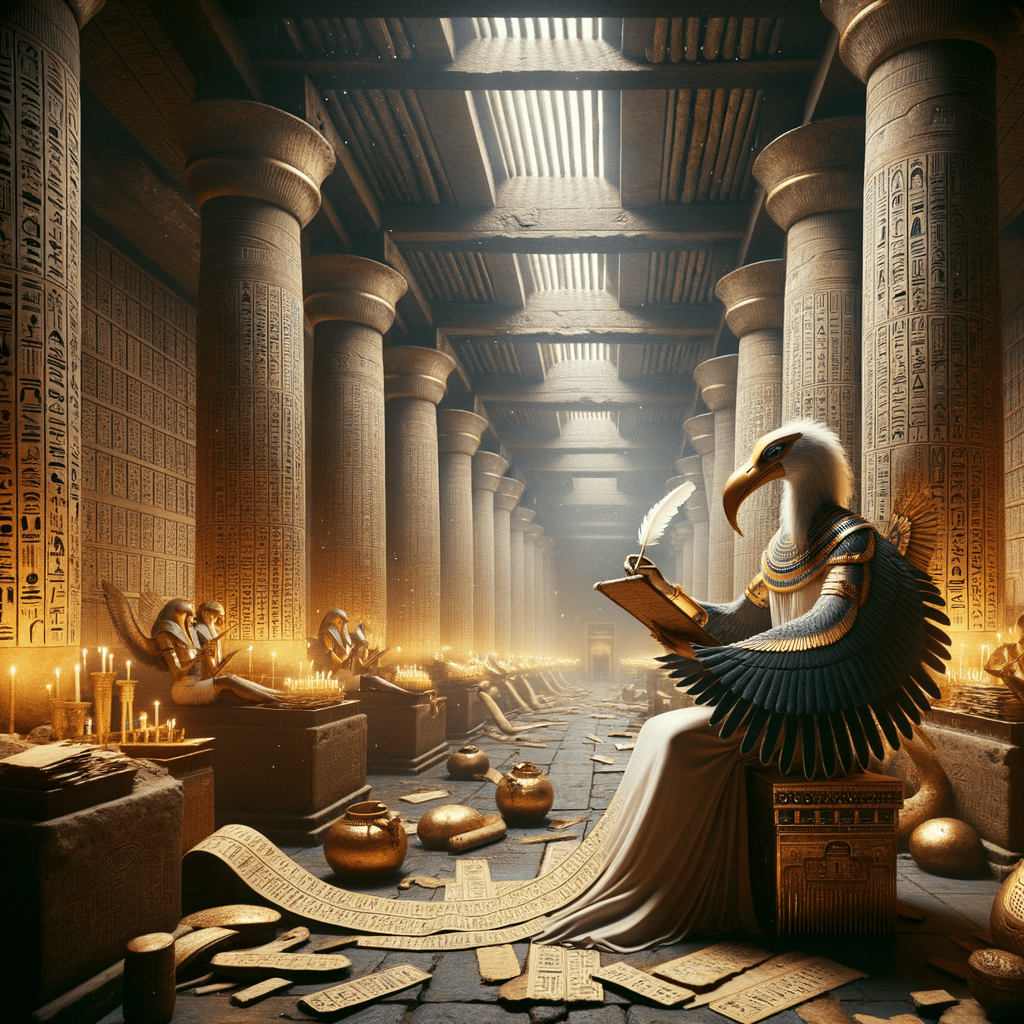
One of the most well-known gods in the pantheon of ancient Egypt, Thoth, is proof of the depth and diversity of Egyptian mythology. For thousands of years, Thoth—also known as the god of knowledge, writing, and wisdom—played a significant part in the religious and intellectual life of ancient Egypt. This essay will discuss the many facets of Thoth, including his qualities, abilities, historical significance, worship, and ongoing influence on contemporary culture.

Description
Usually depicted as a man with an ibis’ head, Thoth also occasionally assumed the form of a baboon, symbolizing the logical and cerebral aspects of both the divine and human realms. His baboon form indicated his wisdom and skill as a scribe, while his ibis head represented his keen brain and capacity to navigate the streams of knowledge. Frequently, depictions of him in human form with a writing palette and reed pen highlighted his role as the creator of hieroglyphs and benefactor of scribes (Griffiths, 1980).
Thoth’s wide and varied talents reflect his prominence in Egyptian cosmology. People revered Thoth as the god of wisdom, believing him to be the source of all knowledge. Scholars and scribes revered him as the patron saint, crediting him with the creation of writing, mathematics, and all fields of science. In the afterlife, Thoth served a dual role as judge and mediator, documenting the outcomes of the heartweighing ritual in the Hall of Two Truths. Gods and mortals alike frequently called upon Thoth due to his unmatched magical powers to resolve difficult issues or heal illnesses.
The history of Thoth contains the origins of Egyptian civilization. Over the years, Thoth’s function as a lunar deity connected to timekeeping has significantly increased. He became a key figure in creation tales, frequently appearing as the creator deity Ra’s tongue and heart, speaking Ra’s will into being. Throughout the Old Kingdom, Thoth’s significance increased, and by the New Kingdom, he had solidified his position as one of the most important gods in the Egyptian pantheon (Boylan, 1922).
Ancient Egypt widely worshipped Thoth, with his primary cult center being Hermopolis Magna in Middle Egypt. Thoth-dedicated temples were staffed by a trained priesthood that oversaw sacred texts and performed daily ceremonies. These priests, who carried on Thoth’s legacy of learning and knowledge, were frequently scholars themselves. His yearly festival was a time of immense joy, especially for the scribes who would make presents to the deity, hoping to win his expertise and favor.
The fabled Book of Thoth is a significant part of the god’s mythology. Ancient texts claimed that this book held the keys to all of the universe’s secrets, as well as potent magic spells. It was said that anyone who read the book would learn a great deal, be able to control the elements, and comprehend animals. However, there was also a belief that the book could cause harm and drive the reader insane. For millennia, scholars and mystics have been enthralled with the quest for the Book of Thoth, which has spawned a plethora of literary works and mystical activities.
Thoth’s impact on modern society is enduring, reaching far beyond the realm of ancient Egypt. Esoteric and occult traditions frequently connect Thoth to Hermes Trismegistus, the supposed author of the Hermetic books. This relationship has included Thoth in various mystical and magical systems, such as ceremonial magic and Thelema. Popular culture has featured Thoth in numerous books, movies, and video games. People frequently portray him as a mysterious source of magical power or old wisdom.

Thoth Mythology
The mythology portrays Thoth as a knowledgeable negotiator, problem-solver, and magician. Several ages-old myths underscore Thoth’s cunning and his role in establishing cosmic order. These stories not only amuse us, but they also shed light on the ancient Egyptians’ beliefs about divine intervention in human affairs and their worldview (Ellis & Scully, 2015.)
In a well-known tale, Thoth shows off his cunning by taking a bet with the moon god in order to earn five more days each year. With this deft move, the sky goddess can give birth to her offspring without going against a heavenly command. In addition to demonstrating his rapid thinking, the story links cosmic occurrences to divine intervention and explains the origin of the five epochs in the Egyptian calendar.
An example of Thoth’s diplomacy and wisdom is the long-running struggle between two gods for the Egyptian throne. Thoth frequently serves as a counselor and mediator in this intricate story, offering suggestions and aiding in the resolution of disputes. Ancient Egyptian culture highly regarded his role as a god’s peacekeeper, highlighting his capacity to control the erratic emotions of celestial creatures.
Another myth illustrates Thoth’s power of persuasion and his ability to pacify even the fiercest gods. Thoth receives the task of tracking the eye of Ra as it departs from Egypt. Through storytelling and diplomacy, he persuades the eye to return, averting possible disaster. This story emphasizes Thoth’s function as a heavenly mediator and his command of language.
Thoth plays a pivotal role in the afterlife’s weighing of the heart ceremony, underscoring his link with truth, judgment, and the afterlife. In his role as the scribe of the gods, he inscribes the outcome of measuring the deceased’s heart against the feathers of justice and truth. This myth, in which Thoth is the unbiased chronicler of cosmic justice, emphasizes the value of moral behavior and the trust in divine judgment (Goebs, 2002).
In one myth, the god demonstrates his magical and medicinal prowess by restoring the eye of a wounded deity torn out in battle. This story depicts Thoth’s healing abilities as well as his role as the other gods’ defender. The story portrays him as the pinnacle of both magic and healing, mirroring the ancient Egyptian conviction in their amalgamation.
The idea that Thoth gave humans the ability to write and created hieroglyphs is central to his persona, even if it is not a particular tale. It is believed that this supernatural gift makes it possible to preserve information and carry out religious rites correctly. According to Egyptian mythology, his greatest contribution to human civilization may have been the development of writing, which highlights the god’s function as a mediator between the divine and mortal realms of knowledge and study.
Conclusion
Thoth remains one of the most fascinating and significant gods of ancient Egypt. His significance in both the hereafter and the afterlife, together with his responsibilities as the god of magic, writing, and wisdom, made him an essential component of Egyptian religion and culture. The popularity of the Book of Thoth and the god’s recurring appearance in popular culture and esoteric traditions demonstrate the ongoing influence of this ancient god. Thoth represents the never-ending human search for knowledge and comprehension as we try to solve the secrets of ancient Egypt.
References
Boylan, P. (1922). Thoth, the Hermes of Egypt: a study of some aspects of theological thought in ancient Egypt. H. Milford, Oxford University Press.
Ellis, N., & Scully, N. (2015). The Union of Isis and Thoth: Magic and Initiatory Practices of Ancient Egypt. Simon and Schuster.
Goebs, K. (2002). A functional approach to Egyptian myth and mythemes. Journal of Ancient Near Eastern Religions, 2(1), 27-59.
Griffiths, J. G. (1980). The Original Myth. In Origins of Osiris and his cult (pp. 1-40). Brill.
Stadler, M. A. (2012). Thoth. UCLA Encyclopedia of Egyptology, 1(1).




Leave a Reply