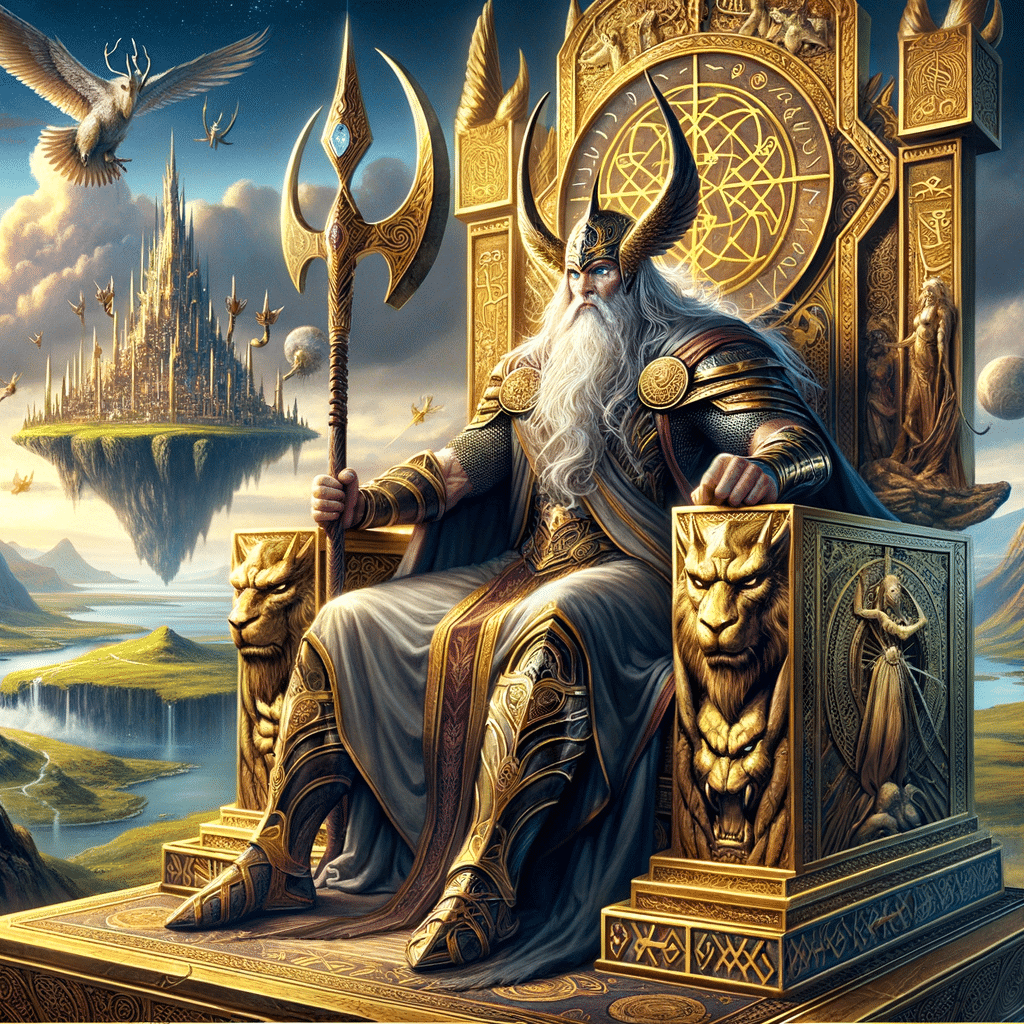
Podcast about Norse mythology including Odin can be accessed above. This episode was part of several podcasts generated with Google NotebookLM and is the product of AI.
This podcast deals with a classic book that retells Norse myths. It’s a classic volume first published in 1920 that reimagines the adventures of Norse gods and goddesses, like Odin, Thor, and Freya. The book introduces the reader to Asgard, the home of the gods, and its inhabitants. It delves into the complex relationships between the gods and giants, highlighting themes of power struggles, trickery, and the cyclical nature of life and death. The book aims to inspire a new generation of readers with the wonder and majesty of Norse mythology through its engaging storytelling and beautiful illustrations.

[Joe]
Today we’re journeying into the heart of Norse mythology, with gods and giants and epic tales and all that good stuff.
[Tammy]
Sounds exciting.
[Joe]
It is. And to guide us on this adventure, we’re turning to Pedraic Column’s The Children of Odin.
[Tammy]
It’s a classic.
[Joe]
It really is. Now for anyone who hasn’t had the chance to dive into Column’s work, what can they expect from this book?
[Tammy]
Well, it’s more than just a simple retelling of these old myths.
[Joe]
Right.
[Tammy]
Column had a way of really capturing the grandeur, the sort of epic sweep of these stories, but also the humor and the tragedy. And he doesn’t shy away from the really big questions either.
[Joe]
Like what kind of big questions?
[Tammy]
Oh, you know, the nature of creation and destruction, the power of fate, the weight of choices, even for gods. These are themes that have resonated with people for centuries, and they still feel incredibly relevant today.
[Joe]
Absolutely. It’s like these myths tap into something fundamental about the human experience. You know, those big questions about who we are and where we come from and what it all means.
And Column’s retelling really brings those questions to life.
[Tammy]
I agree. And he does it with such vivid language and imagery. Reading The Children of Odin is like stepping into a world where anything is possible.
Where gods walk among us and giants roam the earth.
[Joe]
Okay, so before we get lost in the world of Norse mythology, let’s set the stage for our listeners. Sure. Where do we even begin with a mythos as rich and complex as this one?
[Tammy]
Well, like most good stories, I think we should start at the beginning with the creation myth.
[Joe]
Okay, so how does the world begin according to the Norse?
[Tammy]
Picture this. A primordial being, Mir. A giant so vast he makes mountains look like pebbles.
[Joe]
Okay, I’m picturing it.
[Tammy]
Now this giant, he’s not just big. He’s the source of everything.
[Joe]
Wait, you’re saying this giant made the world from his body?
[Tammy]
Exactly. It’s wild, right? But that’s where Odin and his brothers enter the scene.
[Joe]
All father king of the gods that Odin- That’s the one. Okay, so what do Odin and his brothers have to do with a giant who’s also the world?
[Tammy]
Well, imagine these powerful gods emerging in this primordial soup, confronting Ymir, and in an act as epic as the universe itself, they slay him.
[Joe]
Okay, that’s pretty metal.
[Tammy]
It is. And it’s just the beginning.
[Joe]
So the gods slay the world giant. Where do we go from there? How do we get from giant guts to like trees and oceans?
[Tammy]
Well, from Ymir’s body, the world is born. His flesh becomes the earth, his bones the mountains, his blood, the vast churning oceans. Can you imagine believing this was how the world came to be?
[Joe]
It’s both beautiful and brutal, isn’t it? This idea of creation arising from such a primal act.
[Tammy]
It’s pure Norse mythology. And from this giant anatomy lesson, the nine worlds are born.
[Joe]
Nine worlds, each with its own unique landscape and inhabitants.
[Tammy]
You got it. Midgard, where we humans dwell. Asgard, the shining city of the gods.
And Jotunheim, the often fearsome yet surprisingly complex land of the giants.
[Joe]
Okay, hold on. Nine worlds. This is already blowing my mind.
But are they just floating out there in isolation? Or what connects these worlds?
[Tammy]
That’s where Yggdrasil comes in.
[Joe]
Yggdrasil. That rings a bell.
[Tammy]
The world tree. Its branches reach into every corner of existence, connecting everything.
[Joe]
Hold on, this is where it gets really good. Yggdrasil, the world tree. It’s such a powerful image.
I can almost see it. A giant oak stretching up to the sky. Its branches holding the stars like twinkling ornaments.
Yeah. But it’s more than just a pretty picture, right? It speaks to something fundamental about Norse mythology.
[Tammy]
Absolutely. Yggdrasil represents the interconnectedness of everything. Just like the roots of a tree bind the soil, everything in this Norse universe is linked.
What happens in Asgard with the gods doesn’t stay in Asgard. It ripples out, affecting every corner of existence. Even us here in Midgard.
You could say it’s a bit like our internet. Or maybe even the delicate balance of the global ecosystem. Everything influences everything else.
[Joe]
So what you’re saying is that in this epic tapestry of Norse mythology, we’re all connected. I like it. But enough about trees.
Let’s meet the characters. We’ve got to start with Odin, right? He’s the all-father, king of Asgard, god of wisdom, war, poetry.
He’s got a lot going on.
[Tammy]
Odin is a fascinating figure. He’s not content with simply ruling from on high. He’s driven by an insatiable thirst for knowledge.
A willingness to sacrifice anything, even part of himself, for a deeper understanding of the universe.
[Joe]
Wait, back up. What do you mean part of himself? What did Odin sacrifice?
[Tammy]
Remember Mimir’s, well, the source of profound wisdom we talked about? Well, Odin wasn’t given a free pass. He yearned for a single drink from that well.
A taste of its potent knowledge. But the price. He had to trade one of his eyes to Mimir, the well’s guardian.
[Joe]
He gave up an eye for knowledge. Talk about commitment. What does that tell us about how the Norse viewed knowledge?
[Tammy]
It shows us that wisdom wasn’t just some passive thing you stumbled upon. It was a prize. Something to be actively sought, even at great personal cost.
But Odin’s pursuit of knowledge wasn’t limited to mystical wells and gruesome trades. He actually went head to head with Vafnir, the wisest of the giants, in a battle of wits. A riddle contest with the highest possible stakes.
[Joe]
A riddle contest with a giant. That’s my kind of party. It seems like Odin was always up for a challenge.
Always pushing the boundaries of what he knew. Kind of like what we’re doing with this deep dive, right? Except, you know, less eye-gouging, thankfully.
[Tammy]
Thankfully, yes. But what’s fascinating is that Odin’s quest for knowledge wasn’t just for his own benefit. It directly impacted humankind.
Through his cunning and sacrifice, he acquired the Mead of Poetry, a magical elixir that granted eloquence and creative inspiration, a gift he brought back to Asgard to share with mortals.
[Joe]
So, thanks to Odin’s adventures, we have poetry slams and Shakespearean sonnets. That’s one way to explain it. But enough about Odin’s thirst for knowledge.
Let’s shake things up a bit. We can’t forget about the most infamous Norse god, the ultimate trickster Loki. Where does he fit into all of this?
[Tammy]
Ah, Loki, god of mischief, chaos, and surprisingly, sometimes a bit of helpfulness, too.
[Joe]
Okay, I like where this is going. He’s kind of the wild card of Norse mythology, isn’t he? Always shaking things up, keeping the other gods on their toes.
[Tammy]
Exactly, and his stories, they’re always entertaining, but they also highlight something really important about this whole interconnectedness thing we were talking about.
[Joe]
Okay, remind me about that.
[Tammy]
So, remember how Yggdrasil, the world tree, connects everything in the nine worlds? Well, Loki’s actions are a perfect example of how even a seemingly small act can have huge ripple effects throughout the cosmos.
[Joe]
Okay, I’m intrigued. Give me an example. A classic Loki moment where his brand of chaos throws everything out of whack.
[Tammy]
All right, let’s talk about the curse of Anvari’s gold. So, Anvari, he was a dwarf.
[Joe]
Okay, and what do dwarves love more than anything?
[Tammy]
Gold, and Anvari had a lot of it, a whole horde of the shimmering treasure. But this wasn’t just any gold.
[Joe]
Oh, there’s always a catch, right?
[Tammy]
You know it. This gold was special. It was imbued with powerful magic prosperity, but also this nasty curse for anyone who dared to steal it.
[Joe]
And that’s where Loki comes in. I’m sensing a heist.
[Tammy]
You know, Loki can’t resist shiny things. And long story short, he found himself in a situation where he needed to replace a very valuable magical otter pelt that kind of got destroyed in a prank gone wrong. Let’s just say a certain king wasn’t too happy about losing his son’s favorite pelt.
[Joe]
So Loki, being Loki, decides to steal from a dwarf. Bold move.
[Tammy]
It was a desperate move. More like it. He figured, hey, Thor’s gold, problem solved.
Right. But Anvari, being quite attached to his treasure, placed a curse on that gold. A curse that would bring nothing but misfortune to whoever possessed it.
[Joe]
OK, but seriously, stolen gold leads to the end of the world. Seems a tad dramatic, even for a myth.
[Tammy]
Remember how we were talking about that interconnectedness?
[Joe]
Right. Everything’s connected, Yggdrasil.
[Tammy]
Exactly. Loki’s actions, they might have seemed like a quick solution at the time, but they unleashed this chain reaction of greed and betrayal and tragedy that would echo throughout generations. And it all started with stealing some dwarf gold.
[Joe]
Wow, talk about unintended consequences. So basically, Loki accidentally kicked off Ragnarok by stealing some gold. I’m starting to think this Loki guy might be bad news.
[Tammy]
Let’s just say he keeps things interesting. But speaking of Loki’s knack for causing trouble, we can’t forget about that whole incident with the wall around Asgard.
[Joe]
Oh, yeah. Didn’t he get Freya caught up in that mess?
[Tammy]
He did. Remember after the whole world creation from a giant’s body thing, the gods decided they needed a safe haven?
[Joe]
Makes sense. You just created the world from scratch. Gotta protect your investment.
[Tammy]
Right. So they hire this master builder to construct a wall around Asgard to keep out all the giants and the forces of chaos. Seems straightforward enough.
[Joe]
And I’m guessing if Loki’s involved, it’s anything but straightforward.
[Tammy]
What can I say? The guy’s a walking plot twist. See, the builder, this wasn’t just any contractor.
He was a giant. And his price for this wall was steep. He demanded the sun and the moon.
[Joe]
Hold on. They were gonna pay for a wall with the SCN and the moon. What were they thinking?
[Tammy]
And to make matters even more complicated, he also wanted Freya as his payment.
[Joe]
Freya, the goddess of love and beauty. Okay, I get that they wanted a nice wall, but that seems a bit extreme.
[Tammy]
Tell me about it. The gods were freaking out, of course. No sun and moon.
Hello, darkness, my old friend. And without Freya, Asgard would lose a lot of its sparkle. And not to mention her powers are pretty essential.
[Joe]
So what did they do? Did they try to negotiate a payment plan? Maybe offer the giant some frequent flyer miles to Asgard?
[Tammy]
You’d think they would have learned by now. Dealing with giants always comes with a catch. So Loki steps in with a classic Loki solution.
[Joe]
Let me guess. He tricked the giant.
[Tammy]
Oh, you know it. He convinces the gods to make this deal with the giant. He can have what he wants, but he has to finish the wall before the first day of summer.
[Joe]
Okay, that’s cutting it a bit close. Don’t you think?
[Tammy]
It seemed impossible. The wall was massive and the giant only had a limited time to finish it. The gods thought they were so clever.
They figured, hey, we outsmarted the giant Freya’s safe.
[Joe]
And I’m guessing they celebrated a little too soon. Because we’re talking about Loki here.
[Tammy]
Exactly. Always a trick up his sleeve. See, Loki knew the giant relied on his powerful horse to haul the stones needed for the wall.
So what does Loki do?
[Joe]
Don’t tell me. He let the horse loose.
[Tammy]
Close. He transformed himself into a mare.
[Joe]
He did what? Okay, I have to hand it to him. Loki’s commitment to chaos is truly impressive.
[Tammy]
So picture this. Loki as this beautiful mare lures the giant’s horse away from the building site. And of course, the giant being completely distracted by this lovely lady horse completely loses track of time.
[Joe]
And misses his deadline. I knew it.
[Tammy]
He got it! The first day of summer arrives, the wall’s unfinished, and the giant is furious. But rules are rules, even in the land of gods and giants.
[Joe]
So the gods get to keep Freya the sun and the moon. And they get a sweet new wall. All thanks to Loki’s trickery.
[Tammy]
It’s the Loki paradox. Sometimes his chaos actually saves the day, or at least postpones the apocalypse a little longer. But this whole incident with the wall, it makes you think though, doesn’t it?
The gods were so quick to offer up Freya to save themselves.
[Joe]
Again. It’s like they see her as this bargaining chip.
[Tammy]
It’s an interesting dynamic to say the least. But it’s not just the wall incident. Remember the whole Iduna and the apples situation?
That was a close one.
[Joe]
Okay, refresh my memory. Who are Iduna and the apples again? It’s a lot to keep track of.
[Tammy]
Right. So Iduna, she’s the goddess of youth, and she had this magical grove of apple trees. And these weren’t your average apples.
[Joe]
Magical apples. Okay, now you have my full attention. Were these like the Norse equivalent of the fountain of youth?
[Tammy]
Pretty much. The gods, they ate these apples to stay young and immortal. But guess who came along and messed it all up?
[Joe]
I’m gonna take a wild guess and say Loki.
[Tammy]
Bingo. I swear the guy’s a magnet for trouble.
[Joe]
So what happened? Did he create a batch of bad applesauce? Did he eat all the good ones?
[Tammy]
This time he wasn’t directly responsible for the theft, but he definitely played a part. He was tricked by the giant Thiasi into luring Iduna and her apples outside of Asgard.
[Joe]
Oh no, outside the protective walls. That never ends well.
[Tammy]
You said it. Thiasi swooped in, disguised as a giant eagle, snatched Iduna and her apples, and left the gods to their own rapidly aging devices.
[Joe]
Wait, the gods started aging? Like actually getting older?
[Tammy]
It was rough. Wrinkles, gray hair, the whole nine yards. Asgard went from a lively party to a retirement home practically overnight.
[Joe]
I’m picturing Odin with a walker and Thor trying to remember where he put his dentures.
[Tammy]
It was a powerful reminder that even gods weren’t immune to the passage of time. But they couldn’t just sit around and let themselves wither away. They needed those apples.
[Joe]
So what do they do?
[Tammy]
Who do you think they called? The god of last minute rescues.
[Joe]
Loki to the rescue. Did he dress up as a giant apple this time?
[Tammy]
Not this time. He transformed into a falcon, battled that giant eagle, and rescued Iduna and those precious apples.
[Joe]
Way to go, Loki. Crisis averted. So the gods got their youth back, Asgard went back to its usual lively self, and everyone lived happily ever after.
[Tammy]
Well, in Norse mythology, happily ever after is a relative term.
[Joe]
True enough. There’s always another adventure. Another giant to outsmart another apocalyptic prophecy looming on the horizon.
[Tammy]
You’re starting to understand how things work around here. But we focused a lot on Loki’s shenanigans, and there are other key players in this Norse drama we should talk about.
[Joe]
Yes, let’s give the other gods their due. Who should we talk about next?
[Tammy]
Well, we can’t talk Norse mythology without mentioning Thor, the god of thunder, protector of Asgard and Midgar.
[Joe]
Oh, Thor. Everyone’s favorite hammer-wielding hero. But speaking of his hammer, didn’t we want to talk about that story?
The one where he has to dress up as a bride?
[Tammy]
Oh, we have to. It’s a classic. It’s got everything.
Humor, action, a giant with a thing for Freya. Pure Norse mythology gold.
[Joe]
Okay, so set the scene for us. How does Thor end up in a wedding dress? It’s not exactly his usual look.
[Tammy]
So picture this. Thor wakes up one morning, reaches for his hammer Mjolnir, and it’s gone.
[Joe]
Stolen.
[Tammy]
Vanished. Nowhere to be found.
[Joe]
Okay, I’d be freaking out if I lost my phone, but imagine misplacing a hammer that can level mountains. Asgard must have been in chaos.
[Tammy]
It was not a good day being Asgard. Let’s just say that without Mjolnir, the gods were vulnerable. And Thor, well, he was not a happy camper.
[Joe]
So, who was the cosmic culprit this time? Another giant with a taste for mischief and godly weapons.
[Tammy]
You guessed it. It was Thrym, a giant known for his interesting taste in women. It seems he developed a bit of a crush on Freya.
[Joe]
Oh no, not again. Poor Freya. She’s like the ultimate catch in the nine realms.
Everyone wants to either marry her or steal her stuff. But come on, did Thrym really think he could just steal Thor’s hammer and demand Freya’s hand in marriage as a ransom?
[Tammy]
It was a bold strategy. And to everyone’s surprise, it kind of worked. The gods were in a tough spot.
They needed that hammer back. But starting a war with the giants over a case of unrequited love, not ideal.
[Joe]
So, who do they turn to?
[Tammy]
Loki, the god of desperate plans. Okay, I need to hear this. How did Loki plan to get Mjolnir back?
And more importantly, how does Thor end up in a wedding dress?
[Joe]
Well, Loki, he comes up with this crazy plan. He convinces Thor to disguise himself as Freya.
[Tammy]
Hold on. Thor, the god of thunder, dressed as a bride. Okay, someone needs to make this into a movie because I need to see this.
[Joe]
Right. It’s pure comedic gold. But Thor, being the brave soul that he is, agrees to it.
He puts on the dress, the veil, even a wig.
[Tammy]
I’m picturing it now. I can’t even. Did it work?
Did Thrym buy it? Thrym, completely oblivious to the fact that his bride-to-be was actually a very buff, very grumpy god in disguise. He falls for the whole act.
He showers Freya with compliments, completely missing the thunderous looks Thor’s giving him from under the veil.
[Joe]
This is too good. Was there a feast? I bet Thor worked up an appetite in that dress.
[Tammy]
There was a feast. And let’s just say Thor’s appetite did not go unnoticed.
[Joe]
Please tell me Thor went full Thor at the wedding feast.
[Tammy]
He showed incredible restraint. But then they brought out the hammer.
[Joe]
They brought Mjolnir to the wedding. Talk about a memorable reception.
[Tammy]
Thrym thought he was being romantic, presenting it to Freya as a gift.
[Joe]
Oh, honey, no, that’s not how you woo a goddess. Especially not one who’s secretly a very annoyed god of thunder. Okay, what happened next?
[Tammy]
The moment that hammer was within Thor’s reach, the jig was up. He let out a roar, grabbed Mjolnir, and tore off that veil.
[Joe]
And the wedding? Was it officially on?
[Tammy]
Let’s just say the reception ended a little early and a little bit explosively.
[Joe]
I bet it did. With Thor wielding Mjolnir, talk about an exit.
[Tammy]
It was a clean getaway. Thor got his hammer back. The giants learned a valuable lesson about messing with the gods.
And I’m sure Loki had a few good stories to tell.
[Joe]
It’s classic. But all these stories, they make me wonder, knowing what we know about Norse mythology, about the ever-looming threat of Ragnarök, did these little victories even matter?
[Tammy]
That’s the big question, isn’t it?
[Joe]
Because we know how this all ends, Rey. Ragnarök. The twilight of the gods.
The ultimate battle. The end of the world as we know it.
[Tammy]
It’s not just the end of the world. It’s the end of everything. The cosmos unraveling.
A final epic confrontation between the gods and the forces of chaos.
[Joe]
So everything we’ve talked about, all these epic myths, the creation of the world, the adventures of the gods, they all lead up to this one cataclysmic event.
[Tammy]
That’s the thing about Norse mythology. It’s cyclical. It’s not just about the end.
It’s about what comes after the end.
[Joe]
Oh, there’s something after Ragnarök. I thought it was curtains for everyone and everything.
[Tammy]
Not quite. See, from the ashes of the old world, a new world is born. A fresh start.
A chance for things to be different.
[Joe]
A glimmer of hope amidst the cosmic wreckage. I like it. It’s a powerful message, even today.
[Tammy]
It’s a story that’s been told and retold for centuries. And I think it still has something to teach us about resilience, about hope, about the cyclical nature of, well, everything.
[Joe]
Absolutely. And maybe that’s the real magic of Norse mythology. It reminds us that even in the face of overwhelming odds, even when it seems like everything’s lost, there’s always a chance for renewal.
For a new beginning. And that’s something worth remembering.
[Tammy]
I couldn’t agree more.
[Joe]
This has been an incredible journey. We’ve delved into the heart of Norse mythology, explored the creation of the world, met gods and giants, and even glimpsed the end of days. And we couldn’t have asked for a better guide than Padreacolum and his book, The Children of Odin.
[Tammy]
It’s been my pleasure.
[Joe]
And for our listeners out there, if this deep dive has sparked your curiosity, I encourage you to seek out Colum’s book and explore the world of Norse mythology for yourselves.
[Tammy]
There’s a whole universe of stories waiting to be discovered.
[Joe]
Absolutely. Until next time, keep exploring, keep questioning, and keep that sense of wonder alive.

Leave a Reply