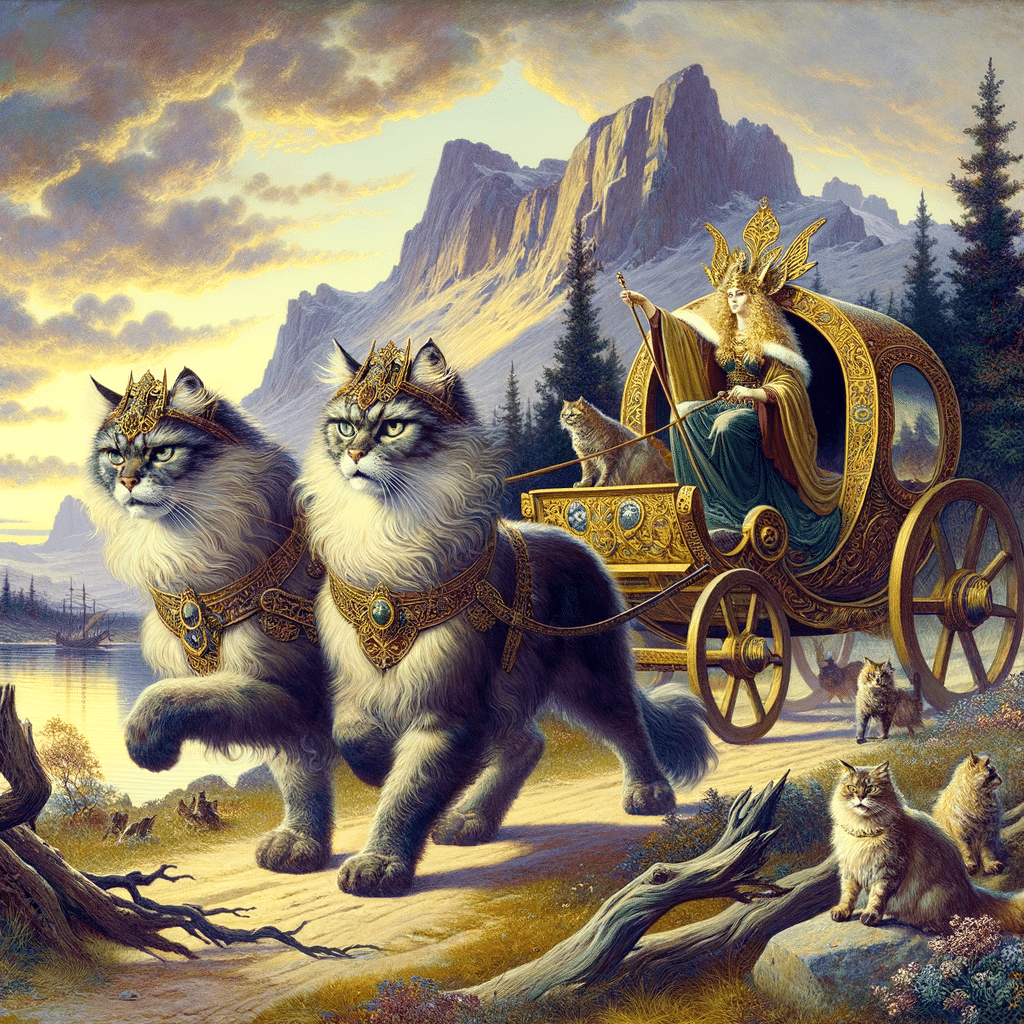
Embodying apparently conflicting qualities of femininity, might, and mysticism, Freyja is one of the most complicated and respected gods in the Norse pantheon. Though she also oversees war, death, and seiðr—the Norse practice of magic—she is mostly regarded as the goddess of love, fertility, beauty, and gold. Perhaps most notably, she has a deep and symbolic connection with cats, who drag her chariot and are her holy creatures. Her many-sided character and cat connections turned her into something both loved and fascinating during the Viking Age and thereafter. Over the years, her impact and her link to these mysterious beings have spread from ancient religious rites to contemporary cultural depictions.

Overview
People described Freyja’s physical attributes as remarkably lovely, reflecting the Norse notion of female appeal. The sagas and eddic songs say she had golden hair that sparkled like the riches she desired and eyes some academics say had the same piercing, bright quality as those of her cherished cats. She often traveled in her chariot, pulled by two huge gray or blue cats—believed by some studies to represent Norwegian Forest cats, a breed native to the Nordic areas—while wearing the magical necklace Brísingamen, a strong emblem of fertility and femininity. Unique among the gods, this feline-drawn vehicle emphasized the particular bond between the goddess and these enigmatic, autonomous creatures (Näsström, 1999).
Freyja’s actions and character mirrored many cat-like traits the Norse valued—independence, unpredictability, and a mix of sensuality and violence. Like the cats who served her, she was famed for her self-determination, taking lovers from both gods and other beings according to her wishes. Her passage between realms with her falcon-feather cloak reflected the agility and grace of her cat companions. The Norse especially observed how cats, like Freyja herself, seemed to roam between worlds—comfortable in human homes yet keeping their wild essence. This duality—the domestic and the wild—reflects Freyja’s own complicated character as both a goddess of life-giving love and battlefield death, as well as her collection of fallen soldiers for her hall, Fólkvangr (Mazza, 2017).

Worship
Archaeological data indicates that ceremonies honoring Freyja frequently included feline features in their worship. Norse homes kept cats as both useful mousers and spiritual friends, believing their presence would attract Freyja’s blessing to the home. Often including gifts that would satisfy both Freyja and her cats—milk, honey, and sometimes fish or other treats cats would enjoy—the goddess’s worshipers performed ceremonies centered on fertility, love, and prosperity. Women looking for the goddess’s protection in childbirth or marriage may wear amulets including cat fur or depictions of cats—spheres where Freyja’s influence was most desired.
Often with cats present, the practice of seíðr—a kind of magic linked to Freyja—involved divination, curse-casting, and spirit activity. Norse magical practitioners thought cats improved spiritual activities because they believed they could detect energy invisible to people. Some academics claimed cats were familiars or spiritual aides in this magical knowledge transfer, thereby implying she had taught this magic to Odin himself. Practitioners of seíðr, who also wanted to travel between seen and invisible domains, found cats to be ideal symbolic partners because of their silent mobility, night vision, and erratic behavior reflecting Freyja’s own magical powers.
Worship of Freyja was largely prohibited as Christianity swept across Scandinavia beginning in the late Viking Age, but the cultural link between women, cats, and enigmatic powers remained. Though Christian missionaries aimed particularly at devotion to Freyja, the link between cats and female spirituality turned out to be quite tenacious. Rather than vanishing entirely, this link changed—sometimes unfavorably, as medieval Christian leaders linked cats to witchcraft and diabolic power. From revered creatures of a goddess to suspect companions of those practicing illegal magic, this development maybe reflects one of the most fundamental shifts in European ideas regarding cats, showing how Freyja’s feline connotations persisted, albeit in modified form (Ingham, 1985).
Modern Impact
Freyja’s association with cats has notably increased in modern times, possibly becoming her most recognized trait in contemporary society. Neo-pagan religious groupings sometimes stress this link; followers keep cats as familiars in deliberate respect of the goddess. Modern Ásatrú and Heathen followers celebrate this side of Freyja as reflecting the intuitive, autonomous female divine that treasures autonomy and enigmatic knowledge. Popular culture, literature, and art rarely depict Freyja without her cat companions, whose presence instantly identifies the goddess. This facet of Norse mythology has found particular resonance in the internet era, with its plentiful cat pictures and memes, therefore spreading Freyja’s feline links to larger audiences (Heath & Lafayllve, 2021).
Freyja’s affinity with cats from a psychological perspective reveals reasons for the strength of this specific divine-animal link. Cats embody many psychological paradoxes: they are both domestic and wild, loving and independent, and playful and predacious. These dualities reflect Freyja’s own synthesis of love and battle, pleasure and power. Jungian psychologists say the goddess-cat bond reflects the feminine psyche’s capacity to preserve sovereignty even as she connects with others, a balance many find pertinent in modern debates on partnerships and self-determination. The cat’s reputation for shifting between visible reality and enigmatic areas fits Freyja’s magical powers, hence representing the travel between conscious and unconscious spheres (Frasin, 2022).
From old Norse religion to modern spiritual activities, Freyja’s cat connections have greatly shaped modern pagan and witch aesthetics, hence generating a cultural legacy. Partly because of this historical link with Freyja, modern witchcraft commonly uses cat iconography. Jewelry design has been affected by the association; Norse-inspired accessories include cat-themed pendants and Freyja’s chariot. Though filtered through centuries of cultural change and Christian demonization, even the common idea of witches having cat familiars may be traced back to Freyja’s celestial feline pets. Although sometimes used negatively, the contemporary cat lady caricature may unintentionally allude to this old custom of women forming close ties with these creatures under Freyja’s influence.
Conclusion
Ultimately, Freyja’s connection with cats is a key component of her heavenly identity that has endured with extraordinary tenacity over generations and cultural change. From dragging her chariot across the Norse heavens to motivating contemporary pagan respect for cats, these creatures have stayed inexorably connected to her multifaceted portrayal of feminine power, mystery, and independence. Although official worship of Freyja ceased with the Christianization of Scandinavia, her connections to cats evolved instead of disappearing, reappearing in folklore, superstition, and eventually in revived spiritual practices. Freyja’s ancient link to these creatures provides a historical viewpoint on our ongoing love for felines, as cats enjoy unmatched appeal in media and culture today. Her tale serves as a reminder that the link between women and cats is not only a modern one but an ancient spiritual legacy with a strong mythological background—a relationship that still represents independence, enigma, and the smooth blending of the domestic and the wild.
References
Frasin, I. (2022). Of Cats and Women: A Cultural History of a Relationship. Animal Life and Human Culture Anthrozoology Studies, 158.
Heath, C., & Lafayllve, P. M. (2021). Elves, Witches & Gods: Spinning Old Heathen Magic in the Modern Day. Llewellyn Worldwide.
Ingham, M. F. (1985). The Goddess Freyja and Other Female Figures in Germanic Mythology and Folklore. Cornell University.
Mazza, S. (2017). Cats in Context.
Näsström, B. M. (1999). Freyja: The Trivalent Goddess. Comparative Studies in History of Religions, 57-74.


Leave a Reply