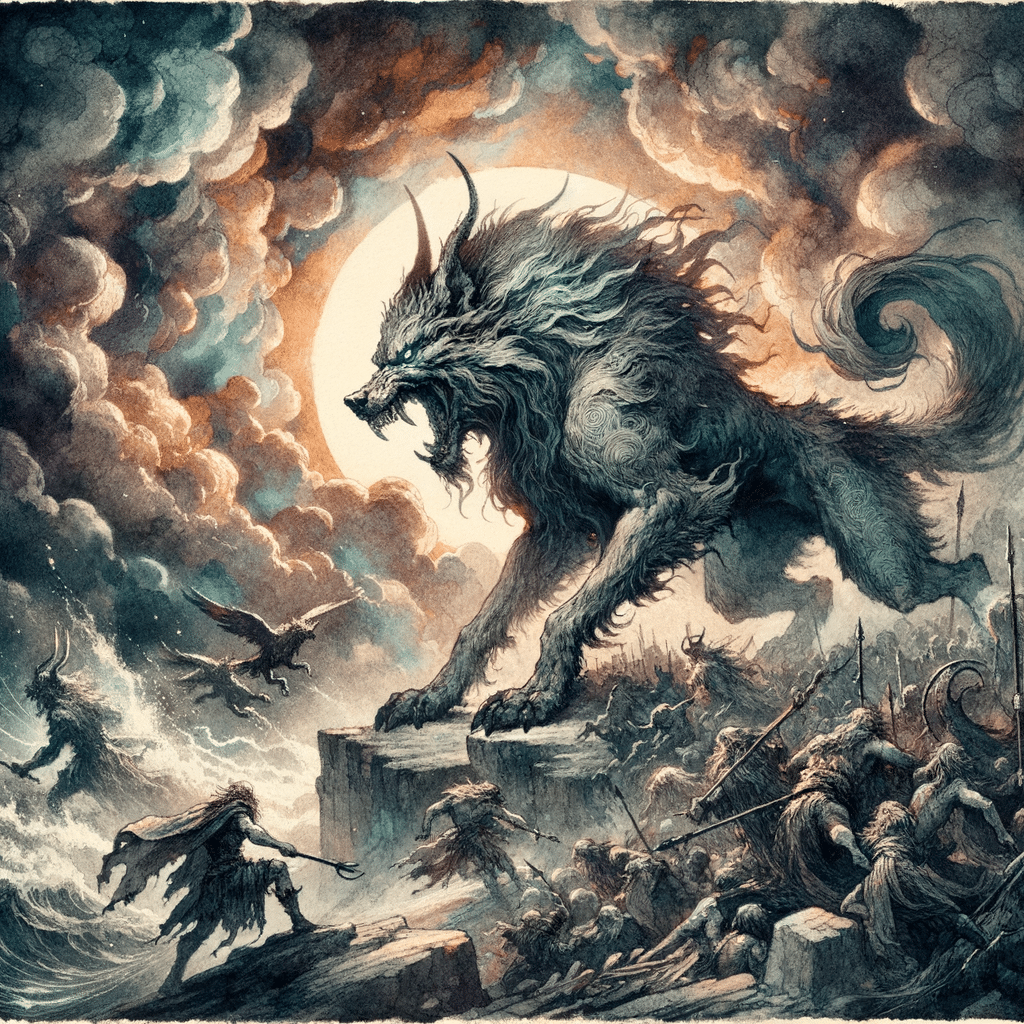
The Norse wolf Fenrir stands as one of the most fearsome and significant creatures in Norse mythology, a monstrous being whose destiny is interwoven with the fate of the gods themselves. Born of the trickster god Loki and the giantess Angrboða, Fenrir represents the untamable forces of chaos that constantly threaten the cosmic order established by the Æsir gods. His story culminates in the prophesied Ragnarök, where he fulfills his destiny as an instrument of destruction against the divine hierarchy.
This terrible wolf embodies the Norse understanding of fate, consequences, and the inevitable cycle of creation and destruction that governs their cosmology. In the poetic and prose Eddas, the primary sources of Norse mythology compiled by Snorri Sturluson in the 13th century, Fenrir’s tale serves as a warning about the consequences of betrayal and the inescapable nature of wyrd, or fate, that governs even the gods themselves. His legend persists as one of the most chilling examples of how fate in Norse mythology operates as an immutable force that even divine beings cannot escape (Lindow, 2001).

Description
Physically, Fenrir is described as a wolf of monstrous proportions, growing larger and more fearsome with each passing day of his existence. His massive jaws were said to stretch from the ground to the sky when fully opened, capable of swallowing gods and men alike without effort. His fur is often depicted as black as the darkest night, with eyes that gleam with malevolent intelligence and cunning.
The physical descriptions of Fenrir in the Eddas emphasize not just his enormous size but also his supernatural strength, which eventually became so great that only the magical fetter Gleipnir could contain him, though at terrible cost to the god Týr, who sacrificed his hand in the process. When he struggles against his bonds, it is said that Fenrir’s slavering jaws drip venom that forms rivers, and his howls shake the foundations of the world itself, causing earthquakes and tremors that reach even into Asgard, the realm of the gods. Ancient skalds described his appearance with both fear and awe, recognizing in this monstrous wolf a power that rivaled that of the gods themselves.
Fenrir’s behavior in the myths reflects both bestial ferocity and an uncanny intelligence that makes him all the more dangerous. Initially raised among the gods in Asgard, Fenrir’s rapid growth and increasingly threatening demeanor eventually convinced the gods to restrain him. His intelligence is demonstrated in his suspicion of the gods’ intentions when they attempted to bind him, and he agreed to the test of the final binding only if one of the gods would place their hand in his mouth as a gesture of good faith (Teichert, 2020).
This cunning, combined with his savage nature, establishes Fenrir not merely as a mindless beast but as a calculating entity aware of his own power and destiny. The sagas describe how only the war god Týr had the courage to approach Fenrir, feeding him by hand when others dared not come near, creating a complex relationship of trust that made the eventual betrayal all the more significant and contributed to Fenrir’s unquenchable hatred for the divine pantheon. His ability to speak and reason, unusual for an animal in Norse mythology, further sets him apart as a being of unique and terrible potential.
In the broader Norse mythological cycle, Fenrir plays a pivotal role as one of the three monstrous children of Loki destined to bring about the destruction of the gods. While bound by the magical fetter Gleipnir, Fenrir awaits Ragnarök, when he will break free from his chains and devour Odin, the Allfather himself. His siblings, the Midgard Serpent Jörmungandr and the half-dead ruler of Helheim, Hel, similarly contribute to the cosmic catastrophe.
The gods’ treatment of Fenrir—their decision to raise him in Asgard, then betray and bind him when he grew too powerful—reflects the complex Norse understanding of fate, where even the gods’ attempts to prevent prophecy ultimately ensure its fulfillment. This paradoxical relationship between free will and predetermined destiny permeates Norse cosmology, with Fenrir serving as perhaps its most powerful embodiment. The prophecies concerning his role in Ragnarök created a self-fulfilling cycle, as the gods’ preemptive actions against him guaranteed the hatred that would one day consume them (Groeneveld & Doepler, 2021).

Fenrir’s Destiny
The binding of Fenrir represents one of the most dramatic episodes in Norse mythology, demonstrating both the cunning of the gods and the terrible price of their deception. After two failed attempts with conventional chains, the dwarves forged Gleipnir from six impossible ingredients: the sound of a cat’s footsteps, the beard of a woman, the roots of a mountain, the sinews of a bear, the breath of a fish, and the spittle of a bird. This seemingly fragile ribbon held power beyond its appearance, yet Fenrir, suspicious of magic, refused to be bound unless one of the gods placed a hand in his mouth as assurance.
Only Týr was brave enough to make this sacrifice, knowing he would lose his hand when the deception was revealed. When Fenrir discovered he could not break free of Gleipnir, he bit off Týr’s hand in revenge, creating a blood feud that would find its resolution only at Ragnarök. The gods then anchored Fenrir to a massive rock called Giöll with a magical cord called Gelgja and thrust a sword into his mouth to keep his jaws propped open, leaving him to suffer in isolation until the end of days.
The gods’ treatment of Fenrir raises profound moral questions within the Norse mythological framework, challenging simplistic notions of good and evil. While Fenrir is undoubtedly portrayed as a monster destined to bring destruction, the gods’ preemptive binding of him before he committed any crime complicates the narrative. The wolf becomes both victim and villain, his eventual role as destroyer partially justified by the betrayal he suffered.
This moral ambiguity is characteristic of Norse mythology, where even the noblest gods act with self-interest and deception when necessary, and monsters often have legitimate grievances. Fenrir’s fate becomes a meditation on justice, preemptive punishment, and the consequences of breaking sacred bonds of hospitality and trust, themes that resonated deeply in Norse society, where oath-breaking was considered among the most serious of crimes. The binding story thus serves as both a practical tale about containing threats and an ethical exploration of where responsibility truly lies when fate dictates conflict.
While bound, Fenrir is said to remain in a remote location, with a sword placed between his jaws keeping them painfully open, from which rivers of saliva flow to form a river called Ván (“expectation” or “hope”). This image of the bound wolf, suffering yet patient, waiting for his inevitable moment of vengeance, creates one of the most potent symbols in Norse mythology. His binding is not permanent but a temporary measure that delays the inevitable confrontation at Ragnarök.
This suspended state of anticipation creates dramatic tension within the mythological cycle, with Fenrir’s eventual release serving as one of the first and most significant signs that the twilight of the gods has begun. Some interpretations suggest that the binding itself, rather than preventing Ragnarök, actually ensures it, as Fenrir’s suffering transforms what might have been merely a dangerous creature into an implacable enemy sworn to destroy the divine order. His enforced patience becomes a countdown to catastrophe, with each moment of his imprisonment adding to the fury that will eventually consume the world.
At Ragnarök, Fenrir’s role reaches its apocalyptic conclusion when he breaks free from his bonds and joins the forces of chaos against the gods. The Völuspá, one of the most important poems in the Poetic Edda, describes how “the wolf shall run free” as the world tree Yggdrasil shudders and the cosmos begins to collapse. Fenrir’s final confrontation with Odin represents the culmination of their long-standing enmity, with the wolf fulfilling his destiny by swallowing the Allfather whole.
This act symbolizes the collapse of divine authority and wisdom before primal chaos. Yet even in this moment of triumph, Fenrir’s victory is short-lived, as Odin’s son Víðarr immediately avenges his father by killing the wolf, either by stepping on his lower jaw with a magically strengthened boot and tearing his upper jaw apart or by stabbing him through the heart with a special spear, depending on the version of the myth. This final battle completes the cycle of vengeance between the wolf and the gods, with neither side truly emerging victorious as the old world ends and a new one begins to emerge from the destruction.
Analysis
The cultural impact of Fenrir extends well beyond the ancient Norse world, influencing modern literature, art, film, and popular culture in profound ways. In fantasy literature, enormous wolves often draw inspiration from Fenrir, such as the wargs in J.R.R. Tolkien’s works or various werewolf mythologies that incorporate elements of his uncontrollable savagery. The 2011 Marvel film Thor and its sequels, while taking significant creative liberties with Norse mythology, nevertheless draw upon the complex family dynamics between Loki and his monstrous offspring, including visual references to Fenrir.
Video games like God of War (2018) and Assassin’s Creed Valhalla have introduced new generations to Norse mythology, including the fearsome wolf bound until the end of days. Contemporary fantasy series like Neil Gaiman’s American Gods and Rick Riordan’s Magnus Chase and the Gods of Asgard reinterpret Fenrir for modern audiences, often maintaining his terrifying nature while exploring the moral complexities of his imprisonment and predestined role. His image appears in countless works of art, from traditional illustrations to modern digital creations, usually depicted either in his bound state or in the moment of breaking free to fulfill his destiny.
The symbolic significance of Fenrir continues to resonate in modern interpretations, where he often represents primal forces that civilization attempts to control but ultimately cannot. Environmental narratives sometimes cast Fenrir as nature’s revenge against those who would chain and exploit it, while psychological readings view him as representing repressed aspects of human nature that eventually break free with destructive consequences. His story of binding and inevitable release speaks to contemporary anxieties about forces we attempt to contain—whether technological, environmental, or social—that may ultimately prove beyond our control.
This adaptability of Fenrir’s symbolism ensures his continued relevance in cultural discourse. Post-apocalyptic fiction frequently utilizes the imagery of Ragnarök, utilizing Fenrir as a powerful symbol for destructive forces that humanity has foolishly unleashed through its own actions. Climate change narratives particularly resonate with the Fenrir myth, as humanity faces consequences of forces it attempted to chain or ignore that now threaten to consume civilization, much as the wolf eventually broke free to devour Odin despite the gods’ best efforts to prevent this fate (Campbell, 2014).
Fenrir appears as a recurring motif in heavy metal music, especially in the subgenres of Viking metal and Norse-inspired black metal, symbolizing rebellion against established orders and the embrace of chaotic forces. Bands like Amon Amarth, Enslaved, and Týr have composed songs directly referencing Fenrir or incorporating his story into broader narratives about Norse cosmology. This musical interpretation often emphasizes the wolf’s role as a necessary destructive force in the cosmic cycle, challenging the perspective that casts him simply as a villain.
The image of breaking chains and devouring gods resonates with metal’s counter-cultural ethos, transforming the bound wolf into an emblem of resistance against arbitrary authority. Album covers, band logos, and stage performances frequently incorporate wolf imagery inspired by Fenrir, connecting modern musical rebellion to ancient mythological cycles of destruction and renewal. This artistic reinterpretation demonstrates how ancient symbols can be recontextualized to address contemporary feelings of alienation and resistance to established power structures.
Fenrir’s tale also offers psychological depth that continues to intrigue scholars and storytellers alike. The wolf can be interpreted as representing the shadow aspects of the divine in Jungian terms—the chaotic, destructive impulses that even gods must acknowledge and attempt to contain. The binding of Fenrir thus becomes a metaphor for the psychological process of repression, with Ragnarök representing the inevitable return of the repressed when psychological defenses fail.
This reading gains additional power from Fenrir’s parentage, as the child of Loki, who himself represents the trickster archetype that challenges established order through cunning and deception. The family relationship between these chaotic figures suggests a genealogy of disruption that cannot be permanently contained by established powers. Modern psychological interpretations often view Fenrir as representing collective fears and anxieties that societies attempt to suppress but which inevitably return with greater force when ignored or merely confined rather than addressed directly (Fürstenberg, 2016).
In modern pagan revivals, particularly Ásatrú and other Norse-inspired spiritual practices, practitioners take varied approaches to Fenrir’s place in their cosmology. While some practitioners view Fenrir with traditional wariness as a destructive force, others incorporate him into more nuanced spiritual frameworks that acknowledge the necessity of both creative and destructive forces in the universe. Some contemporary heathens interpret Fenrir as representing wild nature that resists domestication, drawing parallels between his binding and modern environmental degradation.
These diverse interpretations demonstrate how ancient mythological figures can be recontextualized to address contemporary concerns while maintaining connection to traditional narratives. Modern rituals sometimes acknowledge Fenrir as part of the natural cycle of destruction and renewal, rather than as a purely malevolent force to be feared. This perspective views cosmic destruction as a necessary precursor to rebirth, with Fenrir playing a vital, if terrifying, role in the eternal cycle that maintains cosmic balance through periodic renewal.
Conclusion
Fenrir represents far more than simply a monstrous wolf in Norse mythology; he embodies fundamental Norse concepts about fate, consequences, and cosmic cycles. His physical might, cunning behavior, and pivotal role in Ragnarök establish him as one of the most significant figures in Norse cosmology, a being whose destiny is inseparable from that of the gods themselves. Through centuries of cultural evolution, Fenrir has transcended his origins to become a powerful symbol in modern creative works, representing forces of chaos, rebellion against authority, and the inevitable consequences of attempting to control that which cannot be contained.
The bound wolf of Norse mythology will continue to haunt our collective imagination as long as humanity grapples with questions of fate, power, and our relationship with forces greater than ourselves. In a world increasingly concerned with ecological collapse, social upheaval, and technological dangers, Fenrir’s ancient story speaks directly to our modern fears about the limits of control and the price of attempting to chain forces that may be fundamental to the cosmic order itself. His enduring presence in our cultural conversation demonstrates how mythology continues to provide frameworks for understanding the most profound challenges facing humanity, offering not simple solutions but complex narratives that acknowledge both the necessity of order and the inevitability of its eventual transformation through forces we may temporarily bind but never truly conquer. Fenrir, the Norse wolf, is one of the most terrifying and important creatures in Norse mythology. He is a huge beast whose fate is linked to that of the gods. Fenrir is the son of the trickster god Loki and the giantess Angrboða. He is a symbol of the chaotic forces that undermine the cosmic order set up by the Æsir gods. His journey ends with the foretold Ragnarök, where he realizes his destiny as a tool of destruction against the heavenly order.
References
Campbell, D. (2014). Feeding the wolf. The theme of restraint, and its lack, in the mythology of Fenrir. Odroerir: The Heathen Journal, 2.
Fürstenberg, H. (2016). The Fenris Wolf: Unreal Fetters and Real Forces in Søren Kierkegaard’s Authorship. In Volume 16, Tome I: Kierkegaard’s Literary Figures and Motifs (pp. 249-262). Routledge.
Groeneveld, E., & Doepler, E. (2021). Norse Mythology. Ancient History Encyclopedia.
Lindow, J. (2001). Handbook of Norse mythology. Bloomsbury Publishing USA.
Teichert, M. (2020). Tır, Fenrir and the Brísingamen. Tales of Law, Crime and Violence in Eddic Mythology. Narrating Law and Laws of Narration in Medieval Scandinavia, 117, 275.
Leave a Reply