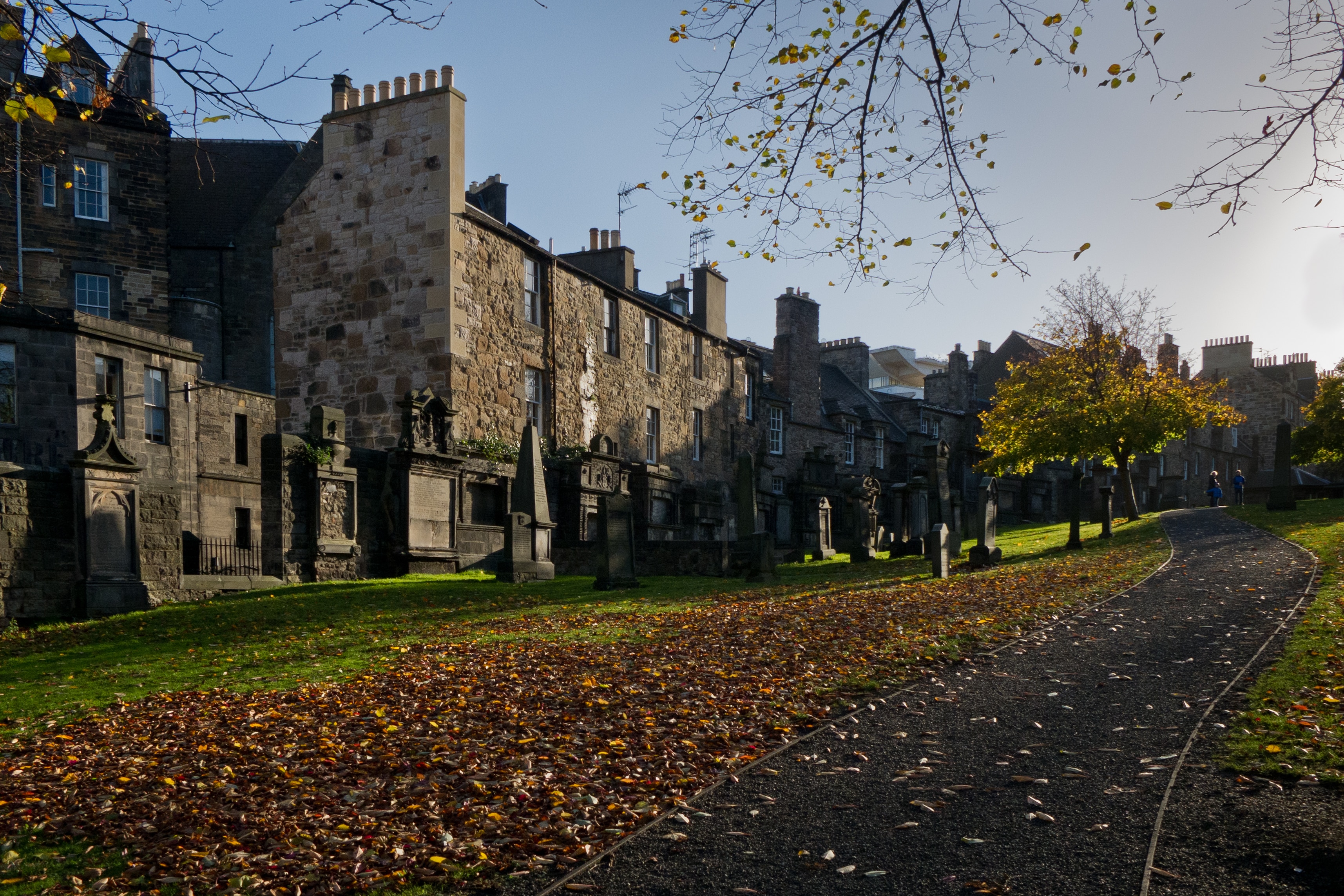
Tucked down in the center of Edinburgh’s Old Town, Greyfriars Kirkyard is among Scotland’s most notoriously haunted sites, where an atmosphere of continuous supernatural interest has been produced by centuries of history, tragedy, and mythology interweaving. Not just for its historical relevance but also for its reputation as a portal between the world of the living and the realm of the dead, the ancient burial cemetery with its worn tombstones and majestic mausoleums has drawn worldwide notice. From the wicked Mackenzie Poltergeist to the devoted ghost of Greyfriars Bobby, the kirkyard has created a tapestry of spectral stories that keep changing and enthralling the imagination of both residents and visitors.

History
The kirkyard gets its name from the Franciscan friary that had occupied the area until the Scottish Reformation in 1560, when the Catholic monastery was abolished and the property repurposed. Formally designated as a burial site in 1562, the cemetery encircles Greyfriars Kirk, a parish church that has seen many turning points in Scottish history. The graveyard itself is a labyrinth of narrow walkways snaking between beautiful tombs, plain headstones, and big family vaults, many of which are decorated with detailed carvings of mortality symbols—skulls, crossbones, and hourglasses—serving as silent reminders of life’s brevity. An area where over 100,000 people have been laid to rest is enclosed by stone walls blackened by centuries of Edinburgh’s notorious “auld reekie” pollution, with their remains piled several layers deep under the uneven earth (Golledge, 2018).
Greyfriars’ historical relevance goes beyond its role as a burial site; it was the background for turning points in Scotland’s religious and political past. Signed inside the kirkyard in 1638, the National Covenant opposed King Charles I’s efforts to force Anglican ceremonies on the Presbyterian Scots, hence leading to the Wars of the Three Kingdoms. Over 1,200 Covenanters were imprisoned in improvised conditions inside the kirkyard following the Battle of Bothwell Bridge in 1679, exposed to the elements in what came to be called the Covenanters’ Prison. While some were killed or sent to the colonies as slaves, their agony supposedly marked the site and produced what paranormal investigators call a perfect recipe for residual hauntings. Many died from exposure, hunger, and illness (Miller, 1867).
Hauntings
Undoubtedly the most renowned ghostly inhabitant of Greyfriars, the Mackenzie Poltergeist is linked to the burial of Sir George Mackenzie, a 17th-century Lord Advocate known as Bluidy Mackenzie for his severe persecution of the Covenanters. Local legend has it that in 1998 a homeless man looking for shelter broke into Mackenzie’s Black Mausoleum and fell through the floor into a hole where plague corpses had been unceremoniously thrown years before. This sacrilege supposedly roused or freed Mackenzie’s evil spirit, which has now been held responsible for an unusually high number of unknown physical assaults. With more than 500 recorded instances of collapse and physical injuries happening around the mausoleum, visitors to the tomb have claimed to be scraped, bruised, burned, and even knocked out (Henderson, 2012).
The folklore surrounding Greyfriars goes beyond Mackenzie’s restless spirit to encompass many more spectral presences haunting the old kirkyard. Many times, visitors run across the ghost of a little white dog thought to be Greyfriars Bobby, the devoted Skye Terrier who allegedly watched over his master’s grave for 14 years until his death in 1872. Some people mention seeing the Grey Lady, who roams amid the graves in eternal sadness, a headless drummer boy, and a ghost lawyer still working on unfinished business. Commonly reported phenomena all over the graveyard, especially after dusk when the atmosphere becomes thick with an almost tangible sense of being watched by unseen beings, include cold spots, mysterious mists, disembodied voices, and the feeling of invisible hands grasping at hair or clothing.
Reflecting more general cultural changes in beliefs toward the supernatural, Greyfriars’ haunted reputation has evolved significantly throughout time. Reports of hauntings at Greyfriars in the 17th and 18th centuries were mostly connected to theological interpretations; ghostly appearances were considered divine warnings or demonic activities connected to the religious strife that had bled the kirkyard. The inclusion of Greyfriars Bobby in the kirkyard’s spiritual pantheon gave the hauntings a more idealized character during the Victorian era, when spiritualism became prominent and ghost stories became a cultural phenomenon. Though grounded in reality, the devoted dog’s story evolved more emotive supernatural aspects as it was related through generations, changing from a narrative of canine devotion to one implying a spiritual link beyond death (Halliday, 2013).

Impact
Particularly since the appearance of the Mackenzie Poltergeist event in the late 1990s, Greyfriars’ haunted reputation has seen maybe the most spectacular transformation in the modern period. Through television documentaries, paranormal investigation programs, and the internet’s capacity to disseminate ghostly experiences worldwide, what started as a local tradition rapidly grew into worldwide recognition. The establishment of ghost tours, which capitalized on visitors’ fascination with the macabre, coincided with the commercialization of the kirkyard’s eerie reputation. Interestingly, as more people discussed paranormal events, it raised doubts about how much suggestion and expectation shaped these supernatural experiences while also providing a lot of witness accounts that paranormal researchers use as evidence of real hauntings.
Scientists have suggested several reasons for the strange experiences reported at Greyfriars, including infrasound (low-frequency sound waves that can make people feel uneasy or see things that aren’t there) created by the kirkyard’s unique shape and Edinburgh’s underground caves, as well as the effects of mass hysteria and people’s expectations. Others point out that toxic molds and fungi in the old tombs can release spores when disturbed, which might cause hallucinations and physical symptoms similar to what visitors have reported. Others highlight the prevalence of toxic molds and fungi in the ancient tombs, which, when disturbed, can release spores capable of producing hallucinations and physical symptoms resembling those reported by affected visitors. Others highlight the ancient tombs’ widespread toxic molds and fungus, which, when disturbed, can discharge spores capable of generating hallucinations and physical symptoms resembling those experienced by affected tourists. Still, the reported encounters’ substantial number, consistency, and physical character continue to challenge total rational explanation despite these scientific theories.
Greyfriars’ hauntings cultural influence goes beyond simple ghost stories; it shapes literature, cinema, and even Edinburgh’s city identity. With names from its tombstones showing in her books, the kirkyard inspired people and places in J.K. Rowling’s Harry Potter series; the graveyard itself supposedly motivated the look of the made-up cemetery where Lord Voldemort is brought back. The spectral stories have greatly enhanced Edinburgh’s tourist sector and cultural legacy by becoming entwined with its self-image as a city rich with history and mystery. With social media enabling quick sharing of alleged paranormal events, including images of unusual mists, orbs, and shadows that intensify the kirkyard’s status as a supernatural hotspot, the stories keep changing in the digital era (Anderson, 2020).
Conclusion
Greyfriars Kirkyard stands as a powerful symbol of humanity’s enduring fascination with the afterlife and the fragile line that divides the living from the dead in the transitional period between history and myth. From religious cautionary stories to commercialized ghost experiences, the growth of its haunted reputation illustrates our shifting relationship with death, religion, and the supernatural over centuries. The strength of Greyfriars’ ghost stories is in their capacity to link us with the past and challenge our mortality, whether one sees the events as psychological projection, brilliant marketing, or real paranormal activity. Whether real or imagined, the spirits of the ancient kirkyard will keep walking between realms as long as it stands with its aged tombstones and shadowy mausoleums, so guaranteeing the haunted history of Greyfriars remains for years to come.
References
Anderson, J. (2020). Burials, Disease & Dark Tourism: A Study of Greyfriars Kirkyard (Doctoral dissertation, Brandenburg University of Technology).
Golledge, C. (2018). Greyfriars Graveyard. Amberley Publishing Limited.
Halliday, R. (2013). Edinburgh After Dark: Vampires, Ghosts and Witches of the Old Town. Black & White Publishing.
Henderson, J. A. (2012). The Ghost That Haunted Itself: The Story of the Mackenzie Poltergeist-The Infamous Ghoul of Greyfriars Graveyard. Random House.
Miller, J. M. (1867). The epitaphs and monumental inscriptions in Greyfriars Churchyard, Edinburgh. Edinburgh, Scotland
Leave a Reply