Smoke Dragons: Key Points
-
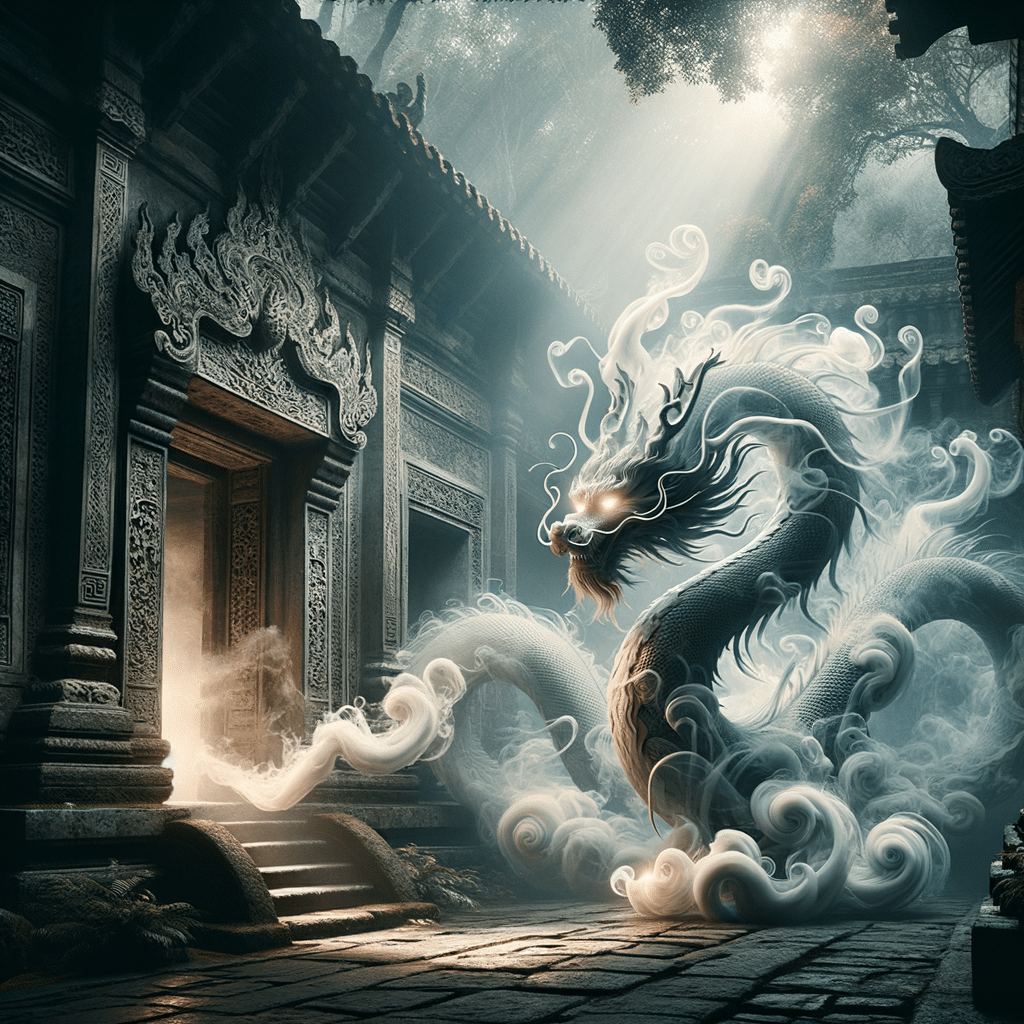
Smoke dragons are made up of mist and vapor that swirl around. They are always changing from being visible to almost invisible.
-
They gather information instead of treasure and can fit through small places or make clouds that choke when they feel threatened.
-
They are linked to prophecy, divination, and sending messages across worlds in many traditions.
-
In stories, they’ve changed from signs of doom to complicated philosophical beings.
-
They are both ethereal enemies and mysterious quest-givers in games.
-
They stand for hard-to-get knowledge and the conflict between being clear and being unclear.
Introduction
The smoke dragon is one of the most mysterious and interesting monsters in mythology. It is made out of swirling mists and fleeting vapors that move between the lines of substance and shadow. These dragons are different from their more physical counterparts because they are always changing. Their bodies break down and re-form like smoke from a fire that never goes out. Throughout history, people all throughout the world have created elaborate rituals around these strange beings, giving them control over fog, mist, and even the air we breathe. Their impact can be seen in everything from old folk tales to new fantasy books and tabletop role-playing games, where they still fascinate people with their strange nature and unpredictable character.

Description
Smoke dragons don’t fit into any of the usual categories because they don’t have a solid shape. Instead, they are intelligent groups of moving smoke and vapor. Their bodies usually transform into thick, swirling smoke that coils like a snake. This smoke may condense and expand at will, making them look huge and scary one moment and almost undetectable the next. Many stories say they look like dragons, with long snouts, horned crests, and huge wings, but they are made of gray, white, or sometimes blue-tinged smoke that is not solid. What I find most fascinating about them is that they can go into the smallest crevices, like through keyholes or cracks in walls, and then reassemble their full draconic shape on the other side. Such versatility makes them impossible to completely contain or jail (Collins, Wyatt & Williams, 2003).
Smoke dragons act in a way that shows how their bodies are always changing and unpredictable. Fire dragons like to burn things, and earth dragons want to claim land. Smoke dragons, on the other hand, are mostly temporary beings who don’t often build permanent homes or accumulate physical goods. People say they are thoughtful beings who float about the world as quiet watchers, gathering information and mysteries instead of riches or diamonds. When they feel threatened, they can either spread out completely, making them look like natural mist, or they can focus their shape to make strangling clouds that confuse and smother their adversaries. Whispers borne on the wind or patterns that emerge in their smoky bodies are common ways for them to talk to one another. This makes them enigmatic even to the few people who say they have seen them.
The stories about smoke dragons that people tell vary a lot from culture to culture, but there are some things that are common in many of them. People in Norse mythology thought that they were the breath of Níðhöggr, the serpent that gnaws at the roots of Yggdrasil and carries omens and portents on the wind (Kauffmann, 1903). There are stories in China about “yun long,” or cloud dragons, who ruled the mists of mountaintopsand could see people’s futures if they made the right gifts of incense (Hayes, 1922). Native American traditions talk of smoke spirits that came out of holy flames and served as messengers between the physical world and the spirit world. Many cultures linked smoke dragons to prophecy and divination. Their constantly shifting shapes were thought to represent how fate and the future are always changing.

Analysis
Over the years, writers have changed how they write about smoke dragons. In medieval times, they were scary emblems, but now they are more like real people in fantasy stories. Early literature typically saw smoke dragons as bad signs, their presence signaling tragedy or otherworldly events beyond human understanding. The epic poem Beowulf talks of a “mist-drake” whose breath was like mist and brought disaster. Middle Eastern stories included smoke dragons that were like djinn and granted wishes, but the results were not always what the wishers wanted. In modern fantasy books, writers like Ursula K. Le Guin and China Miéville have turned smoke dragons into philosophical creatures that challenge what it means to be permanent and what it means to be yourself. Lynn Abbey (2000) has smoke dragons in the novel,The Nether Scroll. Because they are so otherworldly, they are great for addressing themes of change, impermanence, and the false nature of reality in more complex stories.
In the world of role-playing games, smoke dragons have found a very interesting place. They give game designers and players new ways to think about strategy and story. In games like Dungeons & Dragons, they show up as tough enemies whose invisible forms are hard to hit with normal weapons and whose powers to modify visibility and air quality can completely change how an encounter goes. Game systems typically give them the power to create illusions, teleport through smoke, and make people see things that aren’t there or get confused. In campaign settings, smoke dragons often act as mysterious quest-givers or sources of cryptic knowledge, giving players riddles or visions instead of direct information. Because they can change shape, they are powerful protectors of secrets that lie across realms or dimensions. These ideas fit in well with the creative world of fantasy role-playing (Forgotten Realms Wiki, n.d.).
Smoke dragons are a representation of how complicated our relationship with air and fire is, since they can both light up and hide things. They are like animals that are born from fire but don’t have its destructive power. They symbolize knowledge that illuminates the path but never fully unveils, and truths that remain partially concealed. In psychological terms, they stand for the unconscious mind, which can be seen in flashes but can’t be fully understood or contained. More and more, modern interpretations have linked smoke dragons to environmental issues, seeing them as spirits harmed by pollution or as signs of ecological imbalance. This change shows how old mythological ideas keep changing to deal with modern worries and concerns, staying relevant across generations.
Conclusion
Smoke dragons are among the most complex mythological ideas because they are both contradictory and changeable. Their ability to change makes them important symbols in both ancient stories and modern ones because they make us question what we think we know about boundaries and permanence. We are still fascinated by them because they are beings that dwell between states—neither totally physical nor wholly intangible. They show how confusing human experience and perception can be. Smoke dragons, whether they are in old stories, fantasy books, or at a gaming table, remind us that some of the deepest mysteries are those that we can see but never fully understand, as they change shape even as we try to define them. In a world where tangible facts and digital accuracy are becoming more and more important, the fact that these vaporous beings are still interesting to us shows that we need to be amazed and that not everything can be put into a box, contained, or controlled.
References
Abbey, L. (2000). The Nether Scroll. Wizards of the Coast.
Collins, A., Wyatt, J., & Williams, S. (2003). Draconomicon: Dungeons and Dragons Accessory.
Forgotten Realms Wiki. (n.d.). Smoke drake. Fandom. Retrieved June 26, 2025, from https://forgottenrealms.fandom.com/wiki/Smoke_drake.
Hayes, L. N. (1922). The Chinese Dragon. Commercial Press.
Kauffmann, F. (1903). Northern mythology. JM Dent, & Company.

Leave a Reply