Banshees: Ghosts or Fairies? Key Points
-
The banshee exists ambiguously between ghosts and fairies in Irish folklore. Irish ghosts are spirits of deceased humans tied to earthly locations due to tragic deaths or unfinished business.
-
The banshee, meaning “woman of the fairy mound,” warns of death through distinctive wailing. These beings appear in various forms and their cries serve as unmistakable death omens.
-
Evidence for banshees as ghosts includes their origins as tragically deceased women and their sorrowful, human-like emotional nature. Their attachment to specific families suggests bonds between human spirits and descendants.
-
Arguments for banshees as fairies include their etymology, linking them to the sídhe, and their shapeshifting abilities. Their prophetic powers and guardian roles align with supernatural fairy characteristics.
-
Theories suggest banshees might be ancestral spirits, fairy women who married mortals, or demoted goddesses. Different types of banshees with varying origins may explain conflicting folklore accounts.
-
The banshee occupies a liminal space between categories rather than fitting neatly into either one. This ambiguity reflects the fluid nature of Irish supernatural tradition.

Introduction
In Irish folklore, the banshee occupies a unique and somewhat ambiguous position, existing between the world of ghosts and the realm of fairies. The Banshee, a spectral woman whose cries signal impending death, has taken on various forms in Irish folklore, evolving with each telling and across different parts of the country. To determine whether banshees are ghosts or fairies, a careful examination of both categories in Irish tradition is necessary, along with a detailed look at the specific characteristics and behaviors associated with banshees.
Banshees, Ghosts, and Fairies
In Irish culture, ghosts are generally considered the spirits of people who have died but still have some connection to the living world, often for various reasons. These spectral entities are often connected to specific places where they lived or died. Their presence usually relates to unfinished business, tragic events, or violent deaths. Irish ghost stories often revolve around spirits. These apparitions might appear to deliver a warning, to seek retribution, or because they can’t find peace after their death. Unlike the nature spirits and otherworldly beings of Irish mythology, ghosts are fundamentally human, representing people who once lived in the physical world. Ghosts are often depicted as transparent figures, sometimes appearing exactly as they did when they were alive. Their appearances are usually sad or frightening, rather than playful or magical.
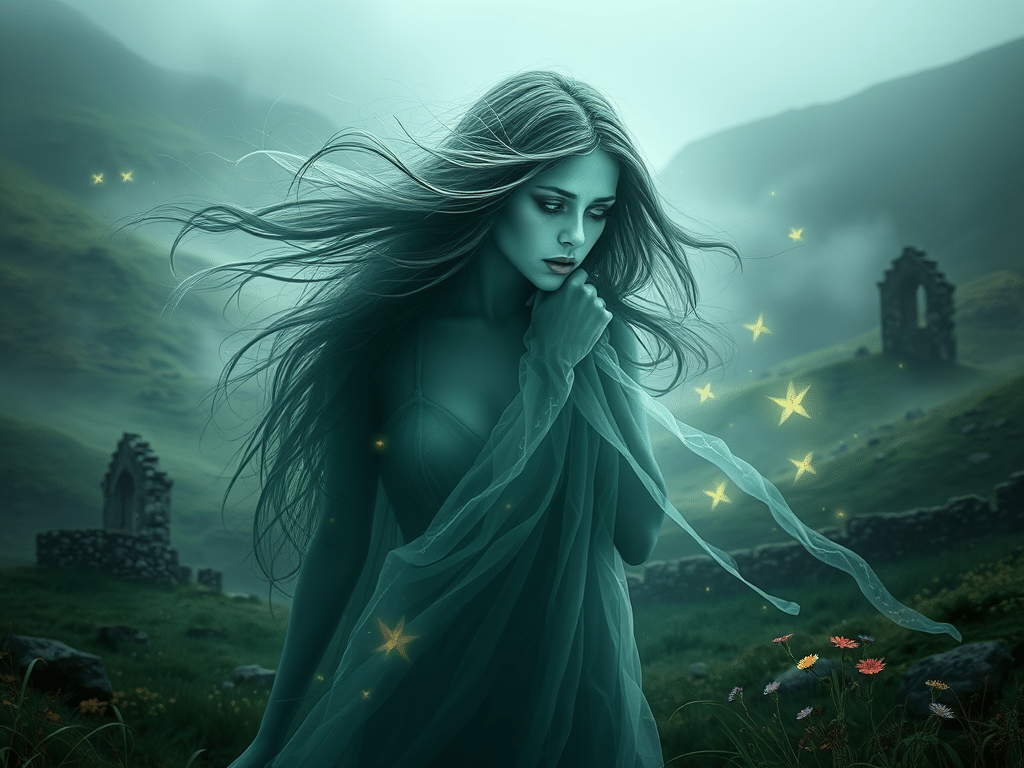
The term “banshee,” or “bean sídhe” in Irish Gaelic, literally means “woman of the fairy mound.” This immediately suggests a connection to the fairy world, rather than the world of human spirits. In Irish folklore, banshees are often depicted as ethereal women associated with specific ancient Irish clans, especially those whose surnames commence with “O” or “Mac.” Their most notable attribute is their lamentation, a shrill sound that serves as a harbinger of death within the family they are connected to. Banshees are often described in different ways. They might appear as beautiful young women, or as middle-aged women, or even as scary old hags. These figures are usually shown with long hair and wearing white or gray clothes. Their cries, it’s said, are a sound you can’t mistake, a sound that chills you to the bone. They travel far, cutting through walls, a warning that demands attention, that can’t be misunderstood.
The banshee, a well-known figure in Irish folklore, is a female spirit. Her wailing is said to announce the death of a family member. The connection between banshees and the idea of foretelling can be traced back to earlier storytelling traditions, similar to themes found in different cultural narratives. Pinpointing the story’s genesis, however, proves more elusive. These figures represent complex themes of loss and change, symbolizing society’s understanding of death. Polzenhagen’s work has shown that these supernatural beings have been studied through cultural and linguistic analysis, emphasizing their role in stories about ancestry and mourning (Polzenhagen et al., 2024).
Several compelling arguments support the classification of banshees as ghosts, rather than fairies. Initially, a number of Irish tales propose that banshees are the restless spirits of women. These women either perished during childbirth or met with violent, tragic ends. This would imply that banshees are, in fact, human souls, not entities from another realm. In some regional versions of the banshee legend, it’s said that these beings were once human women. Their strong love for their families was so great that even death couldn’t break their bond, which is why they returned as warning spirits. The banshee’s connection to particular families, rather than to natural settings or fairy mounds, aligns more closely with ghostly traditions. In these traditions, spirits maintain connections with their descendants or former homes. Furthermore, the banshee’s lament, characterized by its sorrowful and mournful quality, implies a depth of grief and emotional resonance that appears more akin to human experience than to the Fae. This is in contrast to the common portrayal of fairies in Irish folklore, where they are often depicted as capricious, potent beings, emotionally removed from human preoccupations.
In contrast, substantial evidence suggests that banshees are part of the fairy world, rather than being spirits of the dead. The term “bean sídhe” clearly links these beings to the sídhe, the fairy folk who are said to live in the ancient mounds and hills of Ireland. Unlike ghosts, who are usually tied to a specific place, banshees can move freely and appear wherever their assigned families are, showing a level of mobility and power that fits with fairy characteristics. In Irish folklore, fairies are known for their ability to change shape and appear in different forms. This characteristic is similar to the banshee’s reported transformations, which include the appearances of a young woman, a middle-aged woman, and an old woman. Moreover, banshees are said to have the power of prophecy and foresight, traits usually linked to the otherworldly fairies, not to the spirits of the deceased who linger here. Their structured and intentional behavior, acting as family protectors and harbingers of death, suggests a supernatural role. This is different from the aimless, troubled existence often associated with ghosts.
Across different cultures, fairies are often depicted in various ways, and they can represent a wide range of human traits, from kindness to cruelty. Literary works frequently reflect both romantic ideals and deep-seated fears about the supernatural. Bull posits a close connection between the depiction of fairies and early modern romantic literature. In these stories, themes of wealth and morality often appear alongside fairies (Bull, 2019). The depiction of fairies has changed over time, influenced by cultural values and artistic trends. Madolimov highlights the unique characteristics of fairy tales, which distinguish them from myths and legends, by pointing out their structured narratives, typical characters, and common opening phrases (Madolimov, 2025). The development of this genre shows how fairy tales can adapt, conveying complex moral lessons while also representing cultural identity.

Folklore Examples
The classification of banshees becomes clearer when we look at specific examples from Irish folklore. These examples, including particular stories and regional traditions, provide evidence that supports both interpretations. In County Kerry, a well-known tale tells of a banshee linked to the O’Brien family. This spirit, it was said, was the ghost of a young woman. She’d been passionately in love with an O’Brien forebear, but a tragic fate intervened, and they never wed. The banshee, a harbinger of death, would be seen at the stream close to the family home, scrubbing bloodstained garments. Her sorrowful demeanor and actions hinted at a human woman, not a fairy, whose love endured even after death. Likewise, the Mac Carthy family’s banshee in Cork was thought to be the ghost of a nurse, a woman who had tended to the family for many years. When she passed away, her spirit, it was said, couldn’t bear the thought of leaving them vulnerable to whatever misfortunes might come their way.
The bean nighe, a version of the banshee, offers some of the most compelling ghostly examples in Irish folklore. These figures are usually described as the spirits of women who died during childbirth. They are said to be forced to wash the burial clothes of those who are about to die, continuing this work until the time they would have lived if they hadn’t died. The bean nighe, linked to Clan MacKay in Ulster, was described as a mournful figure. She was seen in ragged clothes, her hands busy washing shrouds in a river, tears streaming down her face. According to local lore, she’d been a young mother who had perished during childbirth, delivering twins. She looked utterly human and, frankly, quite sad. Unlike the enchanting, potent presence often attributed to fairy women, she seemed to evoke a deep sorrow in those who saw her. Instead of the usual fear and wonder that accompanied such meetings, witnesses felt a profound sadness. A Limerick tale recounts a banshee’s visit to a family. She materialized before a relative, identifying herself as the man’s great-grandmother. Her purpose? To issue a warning to her descendants, a testament to her enduring affection for them, even after death.
In contrast, many stories portray banshees with distinct fairy-like characteristics, which sets them apart from typical ghostly figures. The O’Grady family’s banshee, as various accounts tell, was a woman of remarkable, otherworldly beauty. She had long, flowing golden hair that cascaded to the ground, and she was often seen in a green silk dress that seemed to glow with an ethereal light. She was spotted, a silver comb in hand, grooming her hair within a fairy fort, one of those old mounds linked to the sídhe. Her beauty, it was said, was so dazzling that those who saw her couldn’t meet her gaze. This particular banshee possessed the uncanny knack of disappearing in an instant when someone got too close. It could also materialize in several places at once, a feat more in line with fairy magic than the usual, grounded behavior of ghosts. The O’Neill family’s banshee, a spirit of Tyrone, was also known as a fairy woman of the sídhe. Legend held that she’d sworn loyalty to the family long ago. She was said to appear, riding a white horse through the night sky, just before a major family death.
Theories
Over the centuries, various theories have emerged to explain the contradictory aspects of the banshee’s nature. A common theory suggests that banshees represent an old type of ancestor spirit. These spirits are thought to have existed before the clear separation of ghosts and fairies in Irish folklore, and they show traits of both. Another theory suggests that banshees were originally fairy women who married into human families. They then maintained their connection to those families, even after the human generations had passed away. Some researchers suggest that the banshee tradition could have come from ancient Irish goddesses linked to death and rule. These goddesses, who were once seen as divine, may have been later changed in popular belief into either fairies or ghosts after the spread of Christianity. A particularly interesting theory suggests that different types of banshees might exist. Some could be fairy guardians, assigned to specific families, while others might be the spirits of devoted family members. This idea would explain the conflicting stories found in Irish folklore.
Cultural forms often evolve from simpler storytelling traditions to more complex narratives. Like the early fabliaux, which established key themes in European storytelling, the figure of the banshee represents a more complex cultural narrative. This narrative blends gender roles, emotional struggles, and existential themes related to death and mourning. However, the link between the banshee and fabliaux isn’t definitively proven, and such claims should be approached with caution, as Hart (1908) suggests. Banshees, as manifestations of grief, also reflect broader cultural ideas about femininity and death, similar to figures in other mythologies. Folklore often features the “female savior” archetype, where women break free from traditional roles. This is similar to the role of banshees, who both warn of and have power over life and death (Lapina, 2020). This comparison highlights how folklore can reshape gender roles while still being linked to existing societal views of femininity.
Furthermore, parallels can be observed within global mythologies, where female figures of the supernatural frequently serve as harbingers of transformation; this is evident in cross-cultural narratives that depict women as embodying the duality of creation and destruction. In many indigenous mythologies, including those of Native American cultures, the connection between humans and the natural world often includes feminine spiritual elements (Thompson, 2019). Modern academic research increasingly emphasizes the relevance of folklore, particularly stories about banshees, in today’s world. Storytelling and the use of folklore in education help reinforce cultural identity, similar to how banshees symbolize specific historical and family stories. Comparative studies of different folklore traditions show that similar themes of grief and community preservation are expressed through figures similar to banshees (Asamoah-Poku, 2024). These connections suggest a lasting impact, where the supernatural serves as both a reminder of mortality and a way to build social bonds.
Additionally, fairies fulfill a pedagogical function, as demonstrated by numerous educational models that employ folklore-based instruction to cultivate cognitive abilities in learners, thereby emphasizing their significance beyond mere amusement (Abidin & Nurhuda, 2022). Studies have shown that engaging with fairy tales can foster cognitive development, supporting their use in education (Abidin & Nurhuda, 2022; Hudhana et al., 2023). Perhaps folklore uses banshees for a similar reason. Folklore also plays a crucial role in stories about societal change and resilience, highlighting the importance of legends in maintaining community bonds and passing down values through generations (Eslit, 2023). Therefore, the story of the banshee can be a useful way to explore broader themes of identity, femininity, and tradition in a world that is constantly changing.
Banshees’ cultural significance also connects to wider themes in folklore, where they represent shared worries and beliefs about death. Banshees’ appearances in different folklore highlight their role in local storytelling, offering a way to deal with grief and the inevitability of death (McDowell, 2012). These figures serve as both a spectral warning and a cultural expression of mourning, potentially strengthening community bonds through shared stories (Doyin et al., 2021). In the field of folklore studies, these figures are categorized within the broader categories of myths and legends. They are considered to represent the core of human experience, cultural identity, and moral lessons (Mullyar et al., 2021). Fairy tales, which have been studied for their depictions of women (Brown, n.d.), are important for showing how women’s roles and societal expectations have changed. These stories illustrate the evolving views of femininity and morality in different cultures.
Conclusion
The question of whether banshees are ghosts or fairies might be impossible to answer completely, given the difficulty of putting rigid categories on the ever-changing nature of folklore. Irish beliefs about the supernatural have always been marked by a certain comfortable ambiguity, where the boundaries between different types of otherworldly beings are intentionally kept flexible. The banshee, it seems, represents a powerful and ancient figure in Irish tradition, a being that inspires both respect and fear, regardless of how she is classified. Perhaps the banshee is best understood not as fitting neatly into either the ghost or fairy category, but as occupying a liminal space between the two, embodying both the human grief of mortality and the otherworldly power of the fairy realm in her mournful, prophetic cry.
References
Abidin, Y. and Nurhuda, T. (2022). Mixed Reality (MR) in Folklore Learning. Proceedings of the 3rd International Conference on Educational Science and Teacher Profession (ICETeP 2021), 62-69. https://doi.org/10.2991/978-2-494069-19-0_8
Asamoah-Poku, F. (2024). Preserving Traditional Ghanaian Folklore through Storytelling. European Modern Studies Journal, 8(2), 308-318. https://doi.org/10.59573/emsj.8(2).2024.26
Brown, A. Hags, frogs, diamonds, and fairies: A history of female representation in fairy tales.. https://doi.org/10.24124/2017/58920
Bull, S. J. (2019). The Alchemist and Medieval Faerie Romance. Ben Jonson Journal, 26(2), 206-226. https://doi.org/10.3366/bjj.2019.0255
Doyin, M., Suseno, S., & Zuliyanti, Z. (2021). Reconstruction of People’s Stories as a Potential Development of Regional Edu Tourism. Proceedings of the 1st International Conference on Social Science, Humanities, Education and Society Development, ICONS 2020, 3. https://doi.org/10.4108/eai.30-11-2020.2303723
Eslit, E. R. (2023). Resilience of Philippine Folklore: An Enduring Heritage and Legacy for the 21st Century. International Journal of Education, Language, and Religion, 5(1), 9. https://doi.org/10.35308/ijelr.v5i1.7504
Hart, W. M. (1908). The Fabliau and Popular Literature. PMLA/Publications of the Modern Language Association of America, 23(3), 329-374. https://doi.org/10.2307/456792
Hudhana, W. D., Sumarlam, S., & Sumarwati, S. (2023). Educational Value of Banyumas Folklore Dari Lesmana ke Tegal and Its Utilization as Literary Appreciation Learning Materials. Proceedings of the 2nd International Conference of Humanities and Social Science, ICHSS 2022, 17 December 2022, Surakarta, Cent. https://doi.org/10.4108/eai.17-12-2022.2333289
Lapina, E. (2020). Women in love against the underworld: “Female savior” scenario in English, Russian and Turkish folklore narratives. Functional Plurality of Language in Contextualised Discourse, 95-107. https://doi.org/10.5817/cz.muni.p210-9767-2020-7
McDowell, S. (2012). Folklore. The Encyclopedia of the Gothic. https://doi.org/10.1002/9781118398500.wbeotgf008
Madolimov, K. (2025). The Formation Of The Fairy Tale Genre In German Folklore. Pubmedia Jurnal Penelitian Tindakan Kelas Indonesia, 2(1), 6. https://doi.org/10.47134/ptk.v2i1.2111
Mullyar, L. A., Kuliev, F. M. o., Ozherelyeva, O., Grigoshina, L. Y., & Grankin, Y. Y. (2021). “A Fairy Tale Is A Lie, But It Has …”–Axiological Potential. European Proceedings of Social and Behavioural Sciences, 915-923. https://doi.org/10.15405/epsbs.2021.11.122
Polzenhagen, F., Wolf, H., Latić, D., & Peters, A. (2024). World Englishes and Cultural Linguistics: Theory and research. World Englishes, 43(3), 360-378. https://doi.org/10.1111/weng.12655
Thompson, T. (2019). Listening to the Elder Brothers: Animals, Agents, and Posthumanism in Native Versus Non-Native American Myths and Worldviews. Folklore: Electronic Journal of Folklore, 77, 159-180. https://doi.org/10.7592/fejf2019.77.thompson
Leave a Reply