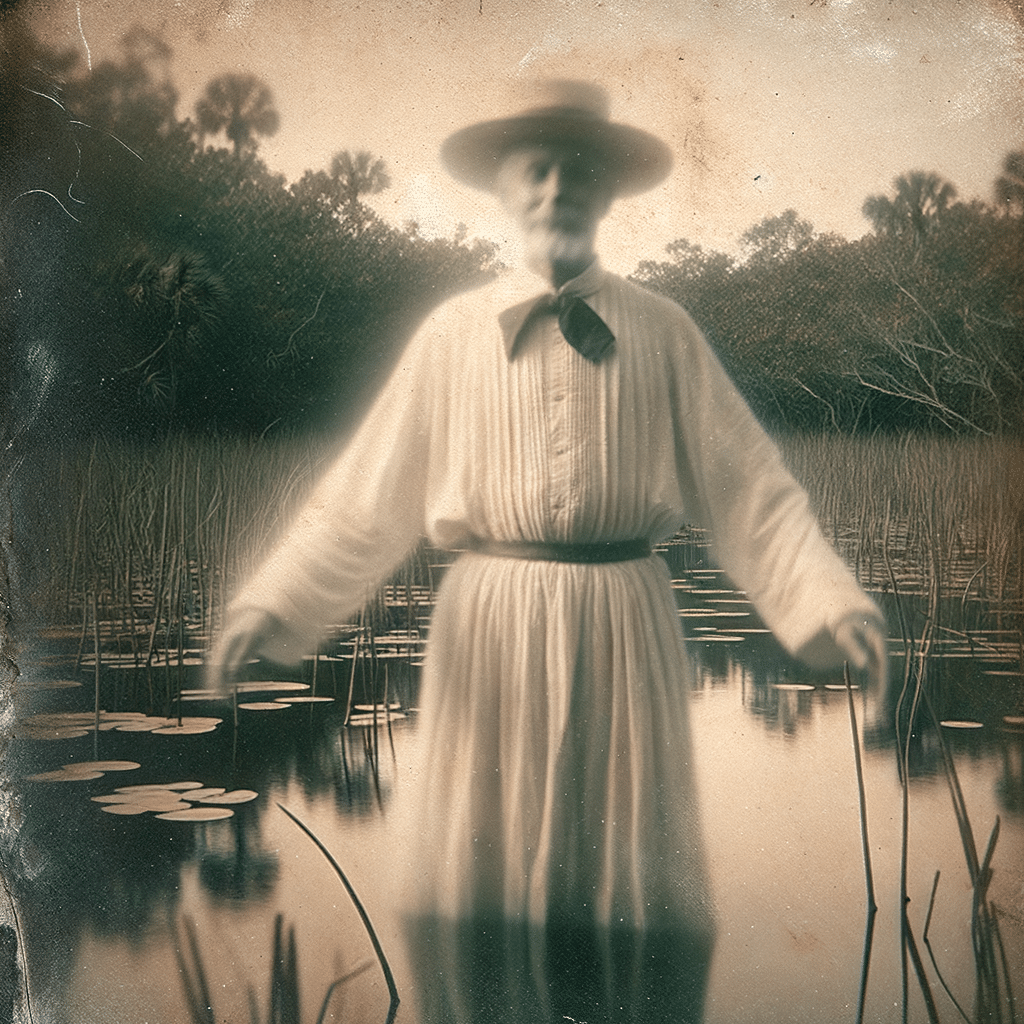
The Ghost of Edgar J. Watson: Key Points
-
Edgar J. Watson was a violent frontiersman born in 1855 who fled multiple murder charges before settling at Chatham Bend in Florida’s Ten Thousand Islands in the 1890s.
-
Watson allegedly murdered his workers instead of paying them, disposing of bodies in surrounding waters until he killed the Tucker family, prompting locals to act.
-
On October 24, 1910, armed Chokoloskee residents shot Watson dead with 33 bullets when his wet shotgun misfired at the Smallwood Store.
-
Watson’s ghost reportedly haunts Chatham Bend and the Smallwood Store, with witnesses reporting apparitions, phantom sounds, and overwhelming dread.
-
Haunting theories range from psychological explanations to beliefs that Watson’s violent death or potential innocence left his spirit seeking revenge or vindication.
-
The Watson legend has shaped Southwest Florida’s culture through literature, museum reenactments, tourism, and discussions about frontier justice and historical trauma.

Introduction
The unsettling ghost of Edgar J. Watson is one of Florida’s oldest and scariest supernatural stories. He is said to still roam the mangrove swamps and remote waterways of the Ten Thousand Islands region. The restless ghost is said to be that of a man whose violent life and death left behind a legacy full of blood, mystery, and folklore. The entanglement of Watson’s story with Southwest Florida’s history makes it difficult to distinguish fact from fiction. His ghost is said to roam the very places he used to rule out of fear and terror.
The Watson Story
Edgar J. Watson was born on November 11, 1855, in South Carolina. He led a life marked by violence, ambition, and constant movement on the American frontier. He and his mother and sister left their home state when he was young to escape away from a violent and abusive father. They finally settled in Fort White, Florida, where he spent the rest of his childhood (Staff, 2020). In Florida, Watson killed his first person when he was young because of his short temper. He then ran away to Oklahoma and rented land from the famous thief Belle Starr. Starr shot Watson in the back while riding her horse into town after he attempted to kick her out, knowing he had an arrest warrant out for him (Staff, 2020). However, a grand jury later found him not guilty. Watson finally went back to Florida, where he killed another man in Arcadia, saying it was in self-defense, and then he pushed toward the Ten Thousand Islands, where he planned to build his doomed plantation.
In the early 1890s, Watson bought forty acres from the Louisville and Nashville Railroad Company at Chatham Bend along the Chatham River. He then built a big house and started growing sugarcane to make syrup under the brand name Island Pride. “At the turn of the century, Ed Watson lived here in a two-story house where he grew vegetables and refined sugarcane,” the National Park Service said (National Park Service, 2021). Watson went to Marco Island, Fort Myers, and other places to hire people for his business. He usually hired drifters and people who wanted to disappear from society. People started saying that Watson would kill his workers rather than pay them and then dump their bodies in the river and marshes, where people from Chokoloskee and Everglades City would find them floating in the water. The last straw was when Watson killed the famous Tucker family at Lost Man’s River because they wouldn’t leave the land he had bought from them right away. He threw their bodies into the river, which made people finally take action against him.
Three days after a terrible storm, on October 24, 1910, Watson took a boat to the Smallwood Store on Chokoloskee Island, where he found a group of frustrated, armed town residents. Watson tried to avoid taking responsibility by saying that he had killed his boss, Leslie Cox, who he said was responsible for the killings. As proof, he showed the crowd Cox’s hat with a bullet hole in it. The locals weren’t convinced and told Watson they were going to arrest him for questioning. Watson then raised his shotgun and tried to fire, but the gun missed because the paper shells were wet from the flooding during the storm. The mob started shooting before he could get to his secret Smith & Wesson pistol. A 1954 story in the Collier County News called Edgar J. Watson “the desperado of Chatham Bend. ” He was killed in 1910 by 33 bullets going through his body, according to the Naples Daily News (Green, 2025). At first, his body was tied to a boat and dragged to Rabbit Key, where it was buried in a shallow hole filled with coral rocks. Three weeks later, his son-in-law, Walter Langford, dug up the body and had it reburied at the Fort Myers Cemetery on Michigan Avenue.
Ghostly Reappearance
There have been ghost stories about Edgar Watson for over one hundred years on the remote islands and rivers where he lived and died. They started almost right after he was killed violently. People who visit the Watson Place at Chatham Bend, which is now part of Everglades National Park, say they feel a heavy presence near the historic site. There are still things from Watson’s life there, like a cement tank, a sugarcane syrup cauldron, and farm equipment. Many people say they see a big, scary figure dressed in old clothes standing among the strange plants that still grow on the old farm and staring at boats going by with a mean face. Watson died at the Smallwood Store on Chokoloskee Island. It is thought to be one of the most haunted places in the area, with workers and visitors reporting hearing footsteps, the sound of a shotgun misfiring, and feeling like someone is watching them from above (Hamilton, 2022). At dusk, fishermen who are in the water near Chatham Bend say they can hear the sound of sugarcane being processed far away and the cries of Watson’s victims reverberating across the water. These are sounds that don’t make sense in the middle of nowhere.
More ghost stories say that Watson’s ghost shows up on nights when there is no moon near the water at Chatham Bend. His ghostly form is said to stand still, as if waiting for workers who will never come or looking for the mob that killed him. Kayakers and canoeists who camp in the Watson Place wilderness site say they wake up in the middle of the night to the sound of heavy footsteps circling their tents. When they check in the morning, they don’t find any signs of a visitor. Some people say they saw an apparition that looked a lot like Watson walking through the ruins of his old homestead. The apparition seemed to be unconscious that people were there and was going about his daily tasks as if he were stuck in an endless loop of his old life (J.W.H., 2024). Local fishing guides who know the area well say that after dark, you shouldn’t go to certain spots near Chatham Bend. This is because Watson’s anger still lingers in those places, making them feel cold on even the warmest nights and giving tourists an unsettling feeling of dread. As Peter Matthiessen did research for his book, he talked to many descendants of the first people who lived in Chokoloskee. These descendants told him family stories about encounters with Watson’s ghost. These stories were never meant to be shared with the public but were told within families as warnings about what would happen if people were violent or unfair (Matthiessen, 1990).

Theories and Impact
There are a lot of different ideas about why Watson’s ghost keeps coming back to the Everglades. These ideas range from psychological ones to supernatural ones that involve unfinished business and violent deaths. Some researchers think that the story of Watson’s ghost comes from the dramatic way he died and the strange, solitary nature of the Ten Thousand Islands, which makes for a good setting for ghost stories and supernatural fears. Others think that if Watson’s spirit does indeed live on, it might be because he died quickly and violently, before he could try to make peace with his victims or seek redemption. This could have left his soul stuck between worlds. According to Lynn Smallwood-McMillin, executive director of the historic Ted Smallwood Store, Watson may not have been guilty of the deaths in Chatham Bend. She said, “I don’t think it was Watson,” and suggested that nerves and fear caused a sad miscarriage of justice (Green, 2021). This theory adds another layer to the haunting because Watson’s ghost could be the spirit of not a guilty murderer but a man who was wrongfully killed and is now looking for justice for a crime he did not commit. Leslie Cox has never been found, dead or living. This has led to the idea that Watson may have been telling the truth about his foreman’s guilt, and this unfinished wrong could be what connects Watson’s spirit to the place where he was killed.
The Edgar Watson tale has had a giant effect on Southwest Florida’s culture, tourism, and understanding of history. It’s not just a story about a ghost. The book Killing Mr. Watson, by Peter Matthiessen, published in 1990 as part of his Shadow Country trilogy, made Watson’s story famous across the country and helped make it an important part of American frontier legend. Watson’s death has been reenacted many times at the Smallwood Store Museum. In 2010, a big event was held to mark the 100th anniversary of the murder, which drew history buffs and ghost hunters from all over the country. For example, the Coastal Breeze News said, “Although the event occurred over 100 years ago, many can still sense his presence at the Smallwood Store” (Staff, 2020), showing that the story is still interesting to people today. The Watson story has become an important part of how the Ten Thousand Islands region offers itself to tourists. The ghost story provides a dark contrast to the area’s natural beauty and draws people who want to experience both the natural world and the supernatural. Watson’s story is taught in Southwest Florida schools as part of the state’s history program. This ensures that future generations will persistently contemplate justice, violence on the frontier, and the delicate balance between law and vigilantism.
The story has also led to important discussions about how we remember the past and how communities deal with deadly events that happened in the past. The fact that no one knows for sure if Watson was guilty or innocent brings up troubling questions about mob justice and whether the people of Chokoloskee killed Watson without following the law. It’s hard to find the absolute truth when it comes to oral history because, as Smallwood-McMillin says, “there’s a lot of versions about what happened.” For example, Watson’s story shows how dangerous frontier justice can be and how fear can make people do crazy things they may later regret. People are still interested in Watson’s ghost, which shows that we need to revisit and rethink this troubling event. We use supernatural stories to help us deal with the moral ambiguity of what happened that October day in 1910.
Conclusion
Edgar J. Watson’s ghost is a permanent part of Florida folklore. It stands for the harshness, ambition, and moral complexity of life on the border in the Everglades. Watson’s story continues to fascinate and terrify people who come across it, whether they believe in the real presence of his restless spirit or see the ghost stories as symbolic expressions of historical trauma and unanswered questions. At Chatham Bend, the physical remains of his life serve as visible links to a violent past. At the Watson Place and Smallwood Store, reports of ghost sightings and other supernatural events keep his memory alive in a way that mere historical records could never do. The haunting of Edgar J. Watson will probably never go away as long as the mangroves along the Chatham River stay thick and the waters around the Ten Thousand Islands stay wild and mysterious. He will always be there to remind us that even the most beautiful places can have dark sides.
References
Green, B. D. (2025, February 2). From the Archives: ‘The desperado of Chatham Bend’. Naples Daily News. https://www.naplesnews.com/story/life/2025/02/02/from-the-archives-the-desperado-of-chatham-bend/77720612007/
Hamilton, K. Y. (2025, January 21). Ambush at Chokoloskee: The murder of E. J. Watson. Exploring Florida History. https://exploringfloridahistory.org/2025/01/21/ambush-at-chokoloskee-the-murder-of-e-j-watson/
J.W.H. (2024, July 18). The ghost of Edgar Watson and the shadows of the swamp. GhostXShop. https://ghostxshop.com/the-ghost-of-edgar-watson-and-the-shadows-of-the-swamp/
Matthiessen, P. (1990). Killing Mr. Watson. Random House.
National Park Service. (2021, April 12). The Watson Place. U.S. National Park Service. https://www.nps.gov/places/the-watson-place.htm
Staff. (2020, December 17). The story of Edgar J. Watson: The infamous businessman & serial killer. Coastal Breeze News. https://www.coastalbreezenews.com/opinion/columnists/the-story-of-edgar-j-watson-the-infamous-businessman-serial-killer/article_e53a5f09-ff02-5b4f-9273-a0753cfbf46e.html
Leave a Reply