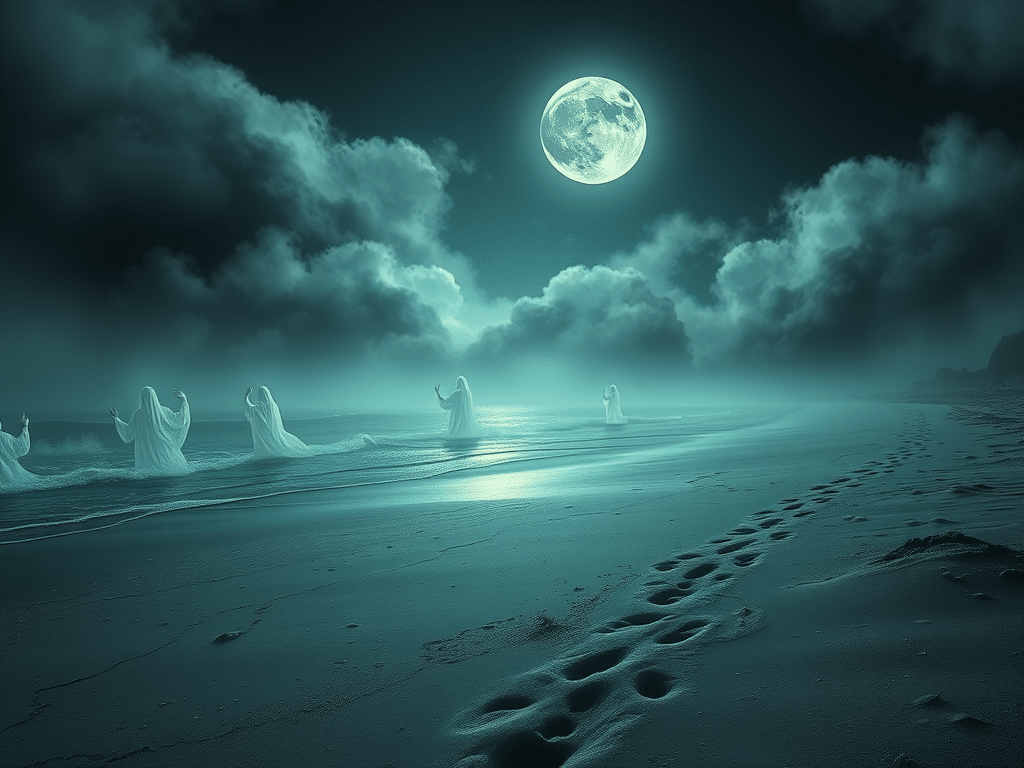
Haunted Beaches: Key Points
-
Beaches have paranormal reputations due to histories of shipwrecks, drownings, and tragedies, plus their isolated, liminal nature as thresholds between land and sea.
-
Common reports include apparitions, disembodied voices, phantom ships, temperature drops, mysterious footprints, and feelings of dread.
-
Notable haunted beaches include Point Sur’s woman in white, Normandy’s ghostly soldiers, Pawleys Island’s Gray Man, and sites of shipwreck victims.
-
Believers cite residual energy from tragedies, while skeptics point to psychological factors, environmental conditions, and suggestion.
-
Haunted reputations bring ghost tourism revenue to some communities but deter family visitors from others.
-
Haunted beaches represent our fascination with death and the supernatural, reminding us that beauty and tragedy often coexist.

Introduction
People often discuss how beautiful, relaxing, and amazing the beaches are, where families can enjoy the sun and surf. But many coastal places have a darker side that people don’t know about: they are known for paranormal activity and strange events. Not only are many beaches globally renowned for their breathtaking views, but also for the enigmatic creatures rumored to inhabit them. These beaches include the misty shores of California and the historic coastlines of Europe. These haunted beaches are a fascinating mix of history, tragedy, and the unknown. People who believe and don’t believe come to their dunes in search of experiences with the otherworldly.
Historical and Environmental Factors in Coastal Hauntings
There are several legitimate reasons why beaches have gained a reputation for being ghostly places. These reasons are based on their particular features and history. Coastal places have been the sites of shipwrecks, drownings, conflicts, and other catastrophes for a long time. Some people think that these events leave a mark on the soil. Many beaches are mysterious because they are so far away from other places. This occurrence is especially true at night when fog sets in and the sound of waves makes the environment spooky. Beaches are also important in many cultures because they are areas where the land and sea meet. They are considered borders between worlds, where the living and dead may be closer. The tides vary all the time, showing and hiding the shoreline in an infinite cycle. This perspective makes it seem like beaches are always changing and that the conventional rules of reality don’t always apply.
Hauntings encompass not just spectral entities but also environmental indicators, media narratives, and cultural memory that metaphorically represent beaches as ‘haunted.’ A review of the literature on environmental psychology and architectural phenomenology examines haunt-type experiences and identifies ambient variables (temperature, lighting, air quality, infrasound, and electromagnetic fields) that may be associated with reports of haunt phenomena, although the empirical support is predominantly null or mixed (Dagnall et al., 2020). This area of study stresses that belief systems, how people see the world, and how people are different all affect how people report ghost encounters (Dagnall et al., 2020).
Characteristics and Notable Examples of Haunted Beaches
There are some things that are the same about reports of ghostly experiences at beaches that set coastal hauntings apart from other paranormal events. Witnesses typically say they saw individuals walking down the shore that looked like ghosts or shadows and disappeared when they got closer. People often hear disembodied voices, screams, or calls for aid, especially when it’s stormy or at night when the beach is empty. Many people have said that they suddenly felt frigid, very sad, or quite scared, or that they saw lights moving over the sea that they couldn’t explain. Ghostly ships have been reported to travel silently through the fog off several shores before disappearing without any trace. Some people who go to haunted beaches say they feel unseen hands touching them, hear their names being shouted when no one is around, or see footsteps in the sand that don’t seem to come from anywhere (Heyer, 2022).
There are several beaches across the world that are known for their supposed paranormal activity, and each one has a sad story to tell. People say that Point Sur in California is haunted by the spirit of a woman in white who is constantly looking for her husband, a sailor who drowned in the dangerous seas below the lighthouse. Many people have said that they have seen ghostly troops reenacting the D-Day landings on the beaches of Normandy in France. These landings were quite violent and involved gunfire, explosions, and the cries of injured men. The beach at Pawleys Island in South Carolina is renowned for the Gray Man, a ghostly figure that shows up before hurricanes to warn people of danger. People say that the beaches near the wreck of the SS Morro Castle off the coast of New Jersey are haunted by the people who died in the 1934 disaster. There are even reports of ghostly passengers still trying to get to the shore. People claim that ghostly Aboriginal figures and the spirits of shipwreck victims haunt Stockton Beach in Australia.

Theoretical Perspectives and Cultural Interpretations
Various theories explain the haunting of beaches. Some say it’s because of the supernatural, while others say it’s because of the mind or the surroundings. People who believe in the paranormal say that catastrophic occurrences, especially those that include abrupt death or a lot of pain, might leave behind energy that plays back like a tape in the places where the catastrophes happened (Jenkins, 2005). Some paranormal experts say that water, which is found on most beaches, has qualities that make psychic impressions stronger or last longer. This characteristic makes coastal places more likely to have hauntings. Skeptics offer different reasons, pointing to how suggestions, stories, and our natural tendency to find meaning in unclear experiences can explain these feelings. Environmental variables like infrasound from waves, electromagnetic fields, or strange weather could cause psychological reactions that individuals think are paranormal encounters. The remoteness and darkness of beaches at night, along with the continual sound of the ocean, might make it easy to make things wrong and feel more emotional.
The conversation about hauntings goes on into the Anthropocene, when beaches and coastal areas become places where human time scales, environmental change, and ghostly imaginations all come together. The concept of haunting in quotidian coastal settings is explored in environmental humanities and cultural geography, examining spectral entities (e.g., Black Shuck) and coastal folklore as means to confront deep time and ecological stewardship along shorelines (Woolley, 2018; Fredriksen, 2021). People often think of beaches as the border between land and sea, beauty and peril, and fun and risk. Coastal fiction and criticism use this liminality to discuss national identity, how gender and class affect who may access shorelines, and the politics of beach spaces in cities and postcolonial settings (e.g., Gold Coast tales; Australian beach imaginaries) (Palmer, 2018). In this kind of writing, the beach is a place to test social identities, power dynamics, and shared memories.
Economic and Cultural Impact of Paranormal Tourism
Many coastal cities across the world have seen a big cultural and economic effect from haunted beach reputations. Some places have embraced their ghost stories and used them in tourism efforts. They also offer ghost tours that draw in people who are interested in the paranormal. This kind of paranormal tourism can help struggling coastal towns by bringing in money and jobs during the off-peak seasons when regular beach tourism drops down. Some beaches, on the other hand, are reputed for being haunted, which has kept people away, especially families looking for safe, healthy places to vacation. This practice has caused property values to go down and tourism income to go down. The cultural effect goes beyond money. These ghost stories become part of the local identity and folklore, passed down from generation to generation and changing how people in those communities perceive their history. Media coverage of beach hauntings, including TV shows and podcasts, has made people more interested in these places. It has also helped make money off of the sad events that are said to have caused the hauntings, which is sometimes considered trivializing the tragedies, leading to debates about the ethical implications of profiting from such stories and the impact on the communities involved.
Paranormal tourism has developed into a unique market phenomenon, with travelers journeying to purportedly haunted locations for both experience and commercial purposes. Market evaluations of paranormal tourism focus on spatial activation, monetization, and experience economies that can turn typical coastal areas into magical or haunting places through branding, storytelling, and immersive technologies (Houran et al., 2020; Santo & Barceló, 2021). Location-based games and ghost-hunting events exemplify how visitors engage in participatory experiences that amalgamate reality, fiction, and site-specific folklore (e.g., location-based mobile apps that emulate paranormal investigations) (Carrigy et al., 2010). Haunted beaches are created by a combination of (a) experiential reports from witnesses (witness accounts, poltergeist-like phenomena, sensed presences), (b) mediated representations (television, films, paranormal tours, online narratives), and (c) institutionalized and entrepreneurial practices (paranormal tourism, haunted-house experiences, location-based games) that turn a place into a place of evidence, memory, and commodified wonder (Dagnall et al., 2020; Carrigy et al., 2010; Santo & Barceló, 2021; Ndakalako, 2022).
Conclusion
Haunted beaches are a unique type of paranormal event that combines the beauty of nature with the mystery of the otherworld. They tap into the deep connections people have with the sea and the afterlife. Whether these reported encounters arise from authentic interactions with spirits, environmental influences, psychological phenomena, or just folklore, they signify our persistent intrigue with mortality, tragedy, and the potential for an enduring essence post-death. These beaches, which have negative reputations, remind us that even the most beautiful places can have sad pasts and that the line between the living world and whatever lies beyond may be as changeable and unclear as the tide itself. As long as beaches are locations where people tell stories of happiness and sadness against the backdrop of a sea that doesn’t care, stories of their hauntings will continue to interest us and make us question what we think we know about reality.
References
Baker, J., & Bader, C. (2014). A social anthropology of ghosts in twenty-first-century America. Social Compass, 61(4), 569-593. https://doi.org/10.1177/0037768614547337
Carrigy, T., Naliuka, K., Paterson, N., & Haahr, M. (2010). Design and evaluation of player experience of a location-based mobile game. 92-101. https://doi.org/10.1145/1868914.1868929
Dagnall, N., Drinkwater, K., O’Keeffe, C., Ventola, A., Laythe, B., Jawer, M., Massullo, B., Caputo, G., & Houran, J. (2020). Things that go bump in the literature: An environmental appraisal of “haunted houses.” Frontiers in Psychology, 11, Article 1328. https://doi.org/10.3389/fpsyg.2020.01328
Devienne, E. (2016). The right to the beach? Urban renewal, public space policing and the definition of a beach public in postwar Los Angeles, 1940s-1960s. Revue Française d’études Américaines, 148(3), 31-51. https://doi.org/10.3917/rfea.148.0031
Eaton, M. (2018). Manifesting spirits: Paranormal investigation and the narrative development of a haunting. Journal of Contemporary Ethnography, 48(2), 155-182. https://doi.org/10.1177/0891241618756162
Fredriksen, A. (2021). Haunting, ruination and encounter in the ordinary Anthropocene: Storying the return Florida’s wild flamingos. Cultural Geographies, 28(3), 531-545. https://doi.org/10.1177/14744740211003650
Heyer, P. (2022). Haunted Jersey Shore beaches, boardwalks and lighthouses. Arcadia Publishing.
Houran, J., Hill, S., Haynes, E., & Bielski, U. (2020). Paranormal tourism: Market study of a novel and interactive approach to space activation and monetization. Cornell Hospitality Quarterly, 61(3), 287-311. https://doi.org/10.1177/1938965520909094
Ironside, R. (2024). Ghost hunting events and storytelling. Event Management, 28(4), 649-654. https://doi.org/10.3727/152599524×17077053867629
Jenkins, G. (2005). Florida’s ghostly legends and haunted folklore: South and central Florida (Vol. 1). Pineapple Press.
Long, N. (2010). Haunting Malayness: The multicultural uncanny in a new Indonesian province. Journal of the Royal Anthropological Institute, 16(4), 874-891. https://doi.org/10.1111/j.1467-9655.2010.01658.x
Ndakalako, M. (2022). Visitations. 356-363. https://doi.org/10.1163/9789004471641_031
Palmer, K. (2018). The beach as (hu)man limit in Gold Coast narrative fiction. Queensland Review, 25(1), 149-162. https://doi.org/10.1017/qre.2018.13
Parker, E. (2025). The coastal Gothic in Aotearoa New Zealand: Reclaimed land and unsettling seas in Janet Frame’s 1960s fiction. Literature Critique and Empire Today, 60(3), 372-386. https://doi.org/10.1177/30333962251366646
Ray, N. (2021). Who is this who is coming? From neurosis to neurodegeneration in television adaptations of M. R. James’s ‘Oh, Whistle and I’ll Come to You, My Lad’. The Journal of Popular Television, 9(3), 355-376. https://doi.org/10.1386/jptv_00062_1
Santo, D., & Barceló, G. (2021). New media and the digitized paranormal: Instrumentation, affective atmospheres, and the production of history in Chile. Journal of the Royal Anthropological Institute, 27(2), 321-339. https://doi.org/10.1111/1467-9655.13492
Sayad, C. (2019). Reality TV, ghosts and the index. Screen, 60(4), 587-605. https://doi.org/10.1093/screen/hjz038
Wilt, J., Exline, J., Pait, K., Gemmen, A., Smith, S., & Fong, T. (2025). Bridges to the spirit world: A qualitative study of beliefs about how ghosts and spirits communicate. Imagination Cognition and Personality, 45(1), 20-46. https://doi.org/10.1177/02762366251337043
Woolley, J. (2018). Hounded out of time. Environmental Humanities, 10(1), 295-309. https://doi.org/10.1215/22011919-4385580
Yusof, A., Hashim, R., Yusof, N., & Satkunananthan, A. (2017). Unravelling the family-based haunted house film patterns in Malaysian and American haunted house films. 3L: The Southeast Asian Journal of English Language Studies, 23(4), 170-183. https://doi.org/10.17576/3l-2017-2304-13



Leave a Reply