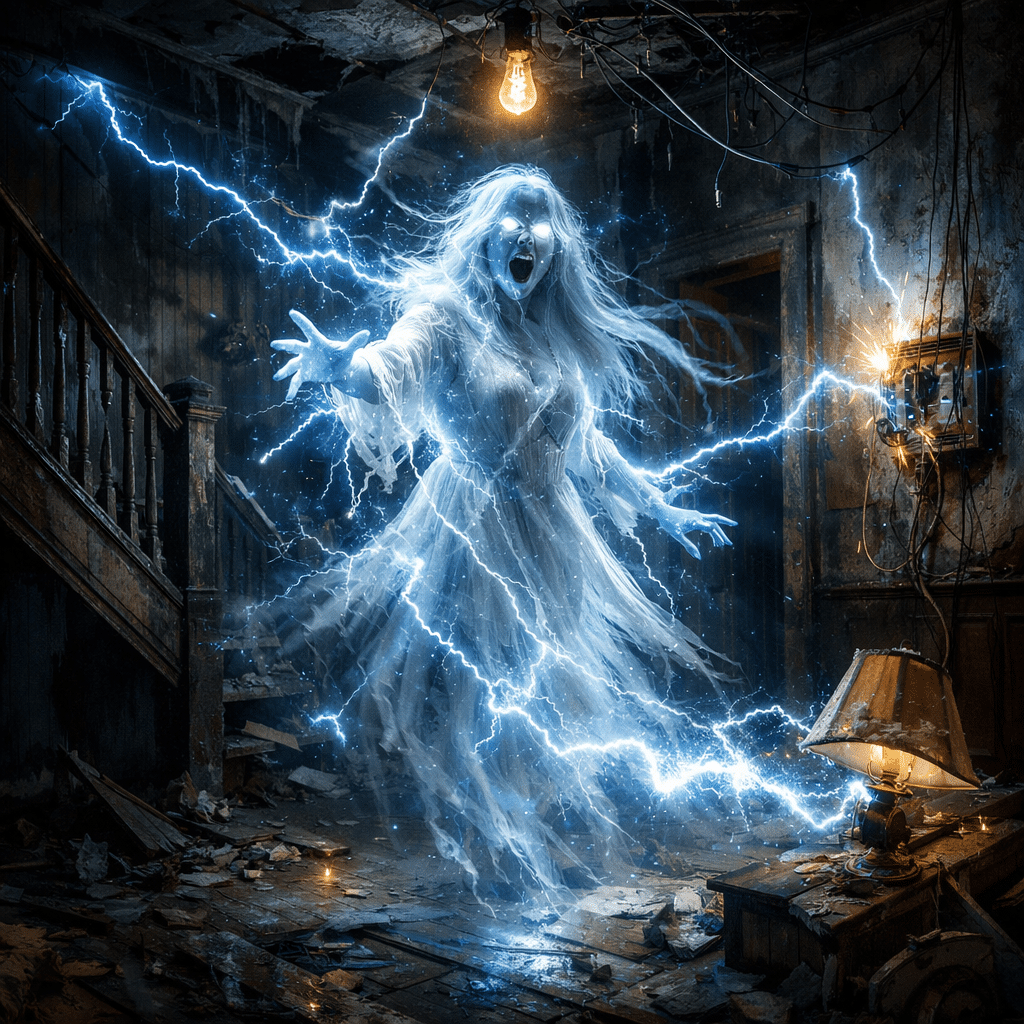
Ghosts and Electricity: Key Points
-
Electricity has been linked to the supernatural since it was first discovered, as its mysterious, life-like qualities made it feel connected to spiritual forces from the very beginning.
-
In paranormal investigation, electrical disturbances such as flickering lights, drained batteries, and EMF spikes are treated as the most common and recognizable signs of a ghostly presence.
-
Many ghost traditions describe spirits as beings made of energy, which makes electricity the most natural medium through which they might interact with or disturb the physical world.
-
Ghosts are frequently reported to use electricity as a means of communication or aggression, from poltergeist activity involving malfunctioning appliances to fictional depictions of spirits launching outright electrical attacks.
-
Scientific theories suggest that naturally occurring electromagnetic fields can cause people to hallucinate presences or feel watched, meaning electricity may actually be generating the ghost experience rather than simply accompanying it.
-
Whether ghosts are real or not, their enduring connection to electricity reflects the human belief that life is a form of energy that does not simply disappear after death.

Introduction
The connection between ghosts and electricity is one of the most “shocking” topics that falls between science and superstition. For ages, people have said they’ve seen unusual things happen around places that are said to be haunted. A surprising amount of those encounters have to do with how electrical systems, lights, and electronics work, suggesting that fluctuations in electrical fields may contribute to the sensations and experiences reported in haunted locations. The reoccurring theme of electricity in ghost stories is difficult to ignore and really worth looking into, whether you believe in the paranormal or not.
Electricity’s Historical and Cultural Ties to the Supernatural
Electricity has been linked to powers that are beyond what most people can grasp for a long time, even before the present era of paranormal research. When humans first started to use and study electricity in the 18th and 19th centuries, they thought it was nearly mystical or supernatural. The crackling arc of a static charge, the violent flash of lightning, and the strange unseen force that could make a dead frog’s limb move all made people think that electricity was somehow tied to the force that gives life to things. This idea made it seem natural, even necessary, that electricity would become a big part of ghost stories as they changed along with modern technology.
The haunted house and the “spectral turn” in media are often linked to technologies that change how we see and feel things. For a long time, people have interpreted hauntings through the lens of evolving communication methods, including the telegraph, telephone, radio, and television. In these cases, electrical phenomena are not just background noise; they are engines of spectral meaning. This relationship is demonstrated in analyses of how séance-era “spectral aphasia” and ghostly communications were historically connected to the development of electrical networks and messaging systems (telegraph and postal system), indicating an infrastructural conception of presence beyond the living realm (Manning, 2021; Dagnall et al., 2020; Bhattacharya, 2022). Specifically, spiritualist communication methods are characterized as converting vocalizations and knocks into a “spectral code” that engages with the overarching telegraphic imagination, associating ghostly signals with electrical communication technology (Manning, 2021).
Electrical Phenomena as Evidence and Communication in Paranormal Encounters
In paranormal studies and popular ghost stories, electricity is seen as proof that ghosts are there and a way for them to interact with the real world. Ghost hunters often say that changes in electromagnetic fields, or EMF readings, are signs that a ghost is close by. Tools like EMF meters are now standard in paranormal investigations. Spikes in readings are seen as signs that a ghost is trying to talk to someone or just passing through an area. Lights flickering, electronics turning on and off for no reason, and batteries draining at strange speeds are some of the most common electrical problems that people say are caused by ghosts. These things happen so often across cultures and time periods that they make up a kind of universal language of ghostly activity. The Chilean paranormal instrumentation literature illustrates how contemporary diagnostic tools (EMF meters, EVP recorders, temperature sensors) evolve into affective technologies that influence collective memory and historical interpretation. In this narrative, the devices generate “dark media” that influence public perception of heritage and history, with electricity-driven instruments serving as both evidence and spectacle in ghost tourism (Santo & Barceló, 2021).
But the link between spirits and electricity goes beyond just messing with equipment. Many traditions and modern stories say that spirits are beings that live, at least in part, as a kind of energy. Electricity is the most obvious sort of energy that most people come into contact with every day. If a ghost is thought of as the energy that stays with a person after they die, then it makes sense that this kind of being may naturally interact with, attract, or bother electrical equipment. Some people who have had experiences say they feel static electricity on their skin during an encounter, like a prickling sensation on their arms or the back of their neck. This is sometimes seen as direct touch with a presence that is in an energetic state rather than a physical one. The notion that a ghost is not a tangible or visible entity but rather an invisible energy field significantly parallels the behavior of electricity itself.
People typically consider ghosts to be people who use electrical means to send or receive messages. For example, electric lights flicker, machines break down, and signals turn into “messages” from the other side. This phenomenon is evident in descriptions of “spectral aphasia,” where ghostly disturbances are interpreted as manifestations co-created by human apparatus, perception, and infrastructural limitations (e.g., telegraph-like rhythm in rap/patter or electrical disturbances accompanying haunt-type experiences) (Manning, 2021; Dagnall et al., 2020). The Haunt-type phenomenology literature asserts that perceived anomalies, including objective electrical disturbances and sensory experiences, are influenced by psychological frameworks, environmental contexts, and belief systems, highlighting that electrical phenomena gain spectral significance through interpretive frameworks (Laythe et al., 2021).

Cultural Depictions and Scientific Explanations
Folklore, movies, and personal accounts often show ghosts using electricity as a way to show themselves or even as a weapon. Poltergeist cases, which are characterized by chaotic and often violent paranormal disturbances, often feature electrical phenomena such as appliances activating at full power, phones ringing without a caller, or entire home electrical systems malfunctioning inexplicably. Some stories say that spirits seem to be controlling electrical energy on purpose, as if they are utilizing it to show wrath, impatience, or haste. In horror stories, this idea has been taken to the extreme, with ghosts being able to electrocute humans, fuse with power lines, or surge through wiring to hit people in other rooms. These theatrical portrayals are fictional, although they are rooted in a longstanding tradition of genuine recorded phenomena where electricity appears to be influenced by an invisible intelligence.
Several serious hypotheses attempt to explain the frequent connection between electricity and the paranormal. The infrasound and electromagnetic field hypothesis is one of the most talked about in science. It says that naturally occurring electromagnetic fields in some buildings, caused by faulty wiring, underground water sources, or geomagnetic activity, can make people feel uneasy, see things that aren’t there, or sense a presence that isn’t there. Michael Persinger and other researchers have done experiments that show that putting weak magnetic fields on the temporal lobes of the brain can make people feel like they are not there or that there is someone else there. This supports the idea that electromagnetic energy can create experiences that feel supernatural. This does not definitively refute the existence of ghosts; nonetheless, it presents a mechanism via which the two may remain continuously connected in the absence of a spirit.
The literature on “Haunted People Syndrome” (HP-S) offers a detailed framework for understanding ghostly experiences, characterized by a combination of subjective perception and observable electrical or physical disturbances (such as sensations of electricity, object movement, and lights), as well as the influence of belief systems on interpretation. HP-S shows that ghostly experiences can be sorted along S/O (subjective/objective) axes, with recognition patterns that fit into a Rasch structure, connecting electrical disturbances to specific experiential codes (Royle, 2008; Laythe et al., 2021; Houran, 2025; Houran & Laythe, 2022). This makes it clear how spectral experiences fit into modern diagnostic and narrative vocabulary.
Energy Theories, Residual Forces, and Media Representations
Some paranormal investigators say that ghosts need energy to show themselves and will take it from any source, such as electrical systems, batteries, or even the body heat of individuals in the room. This would explain why batteries die quickly during supposed hauntings, why electronic gadgets break down, and why some people say they feel chilly or tired during encounters. People who believe this typically talk about an “energetic transaction” in which the ghost borrows or takes electrical or thermal energy so that people can see it. This is still only a guess from a scientific point of view, but it makes sense logically and is now a key part of how modern paranormal investigators do their job.
A third idea, which is more based on physics than parapsychology, is on residual energy that is left behind in the surroundings. Some researchers suggest that emotionally or physically strong experiences might leave an energy signature in the materials of a place, especially in stone or water. This signature can be replayed like a tape when the conditions are correct. In this interpretation, electricity serves as a trigger or playback mechanism, and the ghost is more of an echo, a repeated release of stored energy that replicates the patterns of a living person. The stone tape theory is another name for this idea. It doesn’t have any real-world proof, but it does a good job of explaining why so many hauntings tend to happen in certain places and why electrical activity seems to be both present and sometimes cause paranormal phenomena.
In literature and media, electric screens and broadcast signals serve as venues for ghosts to “appear” or “disappear” among noise, static, and interference. Static and visual snow on screens serve as narrative and aesthetic devices that encode haunted, technologized presences (e.g., Poltergeist as a case of haunted television and the general trope of “haunted media” that trails the interface between living users and spectral others) (Williams, 2025; Schmitz, 2021). The notion that electricity and electronic media make presence minor yet discernible amid interference is a persistent theme in the literature on haunted media and “hauntology” (Holloway & Kneale, 2008; Schmitz, 2021).
The relationship between ghosts and electricity ultimately reflects something profound about how human beings process the unknown, namely by reaching for the most powerful and mysterious force they currently understand and using it as a framework for what they cannot explain. The electricity that runs through their mythology is quite illuminating, whether ghosts are real, neurological illusions caused by electromagnetic fields, or cultural creations created by fear and storytelling. It alludes to a deep-seated belief that life is a type of energy and that energy doesn’t just go away. The flickering light, the dead battery, and the crackling static of an empty room nonetheless make us uneasy because they make us think, even if only for a moment, that the line between the living and the dead might not be as strong as the current that runs through the walls around us.
References
Bhattacharya, R. (2022). Haunted by Cultural Memory: Analysing Spectral Presence in Select Novels of Amy Tan. Media Watch, 13(2), 184–196. https://doi.org/10.1177/09760911221092826
Dagnall, N., Drinkwater, K., O’Keeffe, C., Ventola, A., Laythe, B., Jawer, M., … & Houran, J. (2020). Things That Go Bump in the Literature: An Environmental Appraisal of “Haunted Houses.” Frontiers in Psychology, 11. https://doi.org/10.3389/fpsyg.2020.01328
Holloway, J., & Kneale, J. (2008). Locating haunting: a ghost-hunter’s guide. Cultural Geographies, 15(3), 297–312. https://doi.org/10.1177/1474474008091329
Hooper, T. (Director). (1982). Poltergeist [Film]. MGM/UA Entertainment.
Houran, J., & Laythe, B. (2022). Case Study of Recognition Patterns in Haunted People Syndrome. Frontiers in Psychology, 13. https://doi.org/10.3389/fpsyg.2022.879163
Houran, J. (2025). Prototyping Haunted People Syndrome: Artificial intelligence-generated narrative, structured interview, and clinical validation. Psychology of Consciousness Theory Research and Practice. https://doi.org/10.1037/cns0000447
Laythe, B., Houran, J., Dagnall, N., & Drinkwater, K. (2021). Conceptual and clinical implications of a “Haunted People Syndrome.” Spirituality in Clinical Practice, 8(3), 195–214. https://doi.org/10.1037/scp0000251
Manning, P. (2021). Spectral Aphasia, Psychical Ghost Stories, and Spirit Post Offices: Three Modern Ghost Stories about Communication Infrastructures. Signs and Society, 9(2), 204–233. https://doi.org/10.1086/714424
Royle, N. (2008). Clipping. FORUM: University of Edinburgh Postgraduate Journal of Culture & the Arts, (07). https://doi.org/10.2218/forum.07.605
Santo, D., & Barceló, G. (2021). New media and the digitized paranormal: instrumentation, affective atmospheres, and the production of history in Chile. Journal of the Royal Anthropological Institute, 27(2), 321–339. https://doi.org/10.1111/1467-9655.13492
Schmitz, R. (2021). The Supernatural Media Virus. https://doi.org/10.14361/9783839455593
Williams, K. (2025). The Haunted Broadcast: Using Static to Understand Broadcast’s History and Present. Television & New Media. https://doi.org/10.1177/15274764251335602
Leave a Reply