Eloko of Central Africa: Key Points
- The eloko, plural biloko, is a malevolent dwarf-like creature from the folklore of the Mongo and Nkundo peoples of the Democratic Republic of the Congo, believed to haunt the deep rainforest.
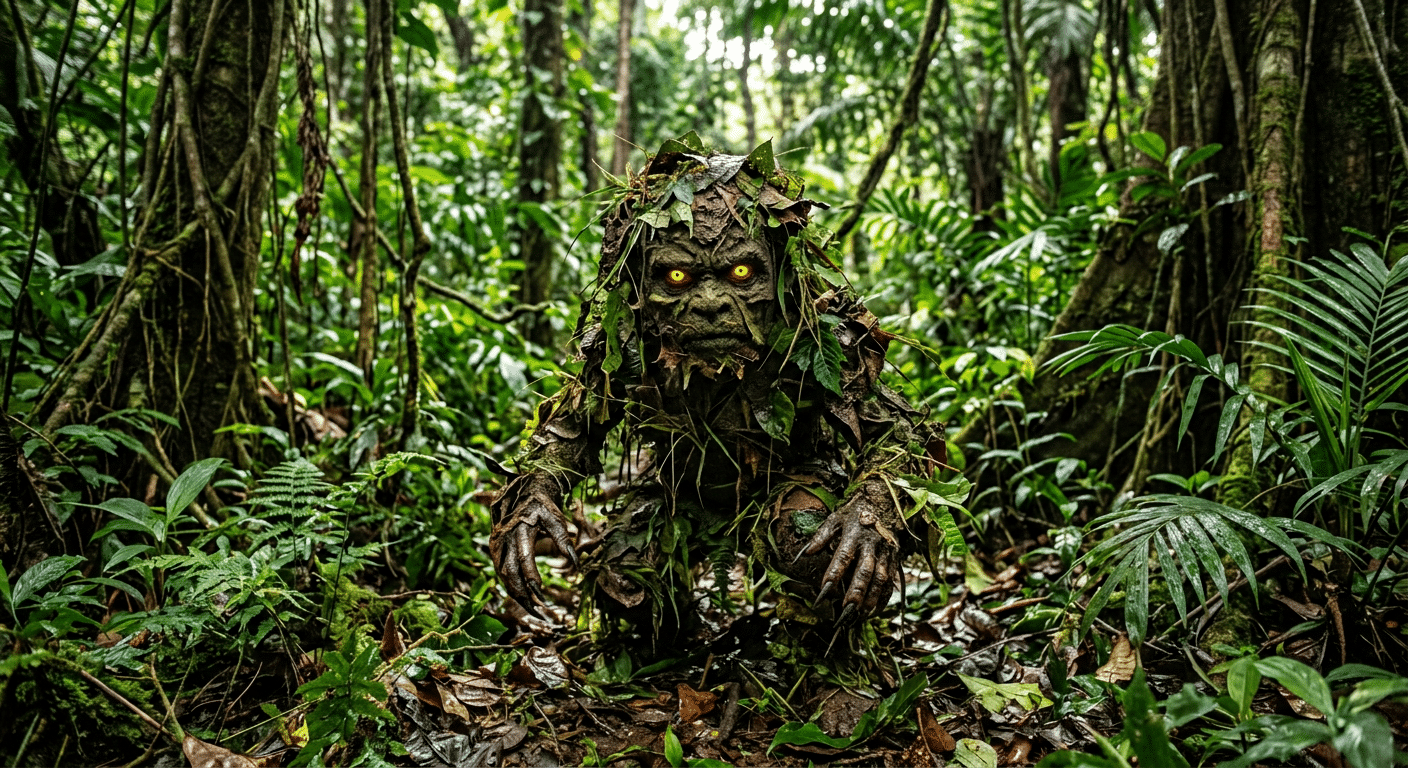
- Physically, it is a small humanoid covered in grass and leaves for camouflage, with glowing eyes, sharp claws, and long snapping jaws filled with razor-sharp teeth, often carrying a magical bell.
- The eloko behaves as a jealous guardian of the forest, using its enchanted bell to entrance intruders before devouring them, relying on cunning and deception rather than force.
- In folklore it functions as a cautionary figure, teaching lessons about loyalty, courage, restraint, and respect for the natural world through stories of hunters and their households.
- The eloko strongly resembles Western European faeries, since both are dangerous wild beings who guard natural spaces and lure mortals through enchantment, reflecting a shared human tendency to populate the unknown with such spirits.
- Theories explain the legend as a way of personifying real forest dangers, expressing psychological fears of being consumed, and symbolizing the tension between human settlements and the untamed wilderness.

Introduction
Deep in the dark rainforests of Central Africa, particularly in the traditions of the Mongo and Nkundo peoples of the Democratic Republic of the Congo, lives a creature both feared and fascinating. Sometimes called “biloko” in the plural, the eloko is an evil dwarf-like creature supposed to haunt the center of the forest. They hold a vibrant place in Congolese mythology, symbolizing perils and secrets that are present in places where humans do not dare to venture. The eloko offers a glimpse of a worldview where the wild is full of spirits and where greed and irresponsibility are met with supernatural wrath. This essay discusses the physical characteristics, behavior, folklore significance, comparison with Western faeries, and different interpretations of these mythical entities.
Eloko are generally depicted as diminutive woodland-dwelling beings with a lethal taste for fooling or injuring people. They are sometimes said to inhabit trees or the forest edge and to be able to ambush or enchant people stealthily. Their peril is a motif returning in oral literature and in ethnographic journalism. This general characterization aligns with various interpretations of African folklore, where forest spirits or tricksters are cautionary figures about the hazards of the wild and the unknown (Ben‐Amos, 2021; Moonga, 2022). In the Congolese and Central African cultures, eloko figures belong to a larger pantheon of spirits and entities that roam forested landscapes and contain moral or social warnings in mythological narratives. Cross-references to relevant studies of the Akan, Mangbetu, or Manden genres assist in shedding light on how such entities are incorporated in genre systems that categorize stories, myths, and tales in West and Central African cultures (Zavyalova, 2023).

Physical Description and Behavior of the Eloko
The eloko is described as slightly humanoid, usually no taller than a child or dwarf. Its body is described as unsightly and ugly to look at. The monster is supposed to be coated in grass and leaves instead of skin or hair, which allows it to blend effortlessly into the forest floor and the surrounding vegetation. This natural camouflage causes the eloko to be almost undetectable until it is far too late. Some say it has glowing and piercing eyes; others emphasize its razor-like claws. Its mouth is maybe the most scary of all. The eloko is claimed to often have long snapping jaws with razor teeth, ideal for eating human flesh. In several stories, the creature is described as having a bell, a device with magical abilities that lets it cast spells on unsuspecting victims.
The eloko’s behavior is described as matching its appearance in a threatening manner. They are said to be guardians or jealous spirits of the deep forest and to defend with fierceness the fruit, game, and treasure of the forest. An eloko hates intruders. If a hunter or tourist wanders too deep into the forest, the creature may ring a mesmerizing tone on its charmed bell, beguiling the human into a trance. Once it has taken hold, the sufferer is helpless prey. The eloko is a cannibalistic creature, eating whatever it catches. It is believed to be able to speak in a strange tongue and to leave faint signs of its presence, such as the smell of cooking or the rustle of leaves. Eloko is intelligent and patient and relies on trickery rather than physical force.
Folklore Significance and Cultural Meaning
Folklore literature from around Africa has demonstrated that various languages and areas have entities such as woodland spirits or tricksters, and these beings typically have similar functions—warning against greed, warning against the unknown, or explaining natural phenomena. These cross-cultural trends allow for a comparative reading of eloko as part of a greater constellation of forest spirits and guardian creatures across Central and West Africa (Zavyalova, 2023; Moonga, 2022). Diasporic and global trajectories: While eloko is part of Central African folklore, the broader study of African mythologies and folk narratives and the global interest in the role of folklore in literature and media play a role in situating eloko in transnational scholarly conversations on myth-making, symbolism, and the politics of representation in folklore studies (Ben-Amos, 2021; Usman & Crous, 2018; Weeks, 1910).
In the broader context of folklore, the eloko holds a much greater role than that of mere entertainment or scares. The legends of these beings are cautionary tales, warnings handed down through the generations to educate the young and remind the old. One of the recurring themes in Mongo mythology is the hunter whose wife is seduced by an eloko or the need to guard his home against the tricks of the eloko. These stories frequently have moral teachings about loyalty, courage, and the repercussions of greed. In this perspective, the forest transcends mere resource usage; it becomes a life area deserving of respect. Excessive consumption, careless wandering, and neglecting one’s responsibilities can lead to a terrifying encounter. In this approach, the eloko fosters social values and appreciation for the natural world.
Comparison with Western Faeries
The similarities between the eloko and the Western European faeries are readily apparent. Both are members of a wide family of little, unearthly beings that live on the wild edges of the human world. Many faeries, like the eloko, are tied to particular pockets of nature: forests, hills, groves, the sort of places humans are told to stay away from. The faeries of Irish, Scottish, and English myth are often malevolent rather than benign like the winged sprites of modern fancy. The earlier traditions nonetheless speak of beings who are violent, unpredictable, and ready to punish trespassers or those who exhibit disrespect. How does the eloko use its magical bell to hypnotize its victims? This technique mirrors the faerie art of luring mortals with song, glamor, and illusion to dance or feast from which they may never return. Both entities employ enchantment to break down a person’s caution. The theme of sound and spell bewitchment recurs in cultures, reflecting a shared fear of losing one’s mind and will to forces concealed in the natural world. There are variances as well. The eloko is more overtly cannibalistic and horrific than the average faerie, whose menace is usually more subtle and capricious. But both have a comparable social role. They set the limits of human safety, and they announce that the wilderness belongs to creatures who do not share human ideals. The likeness does not need to entail any historical relationship between these far-flung traditions. Instead, it illustrates something universal to the human imagination: a drive to fill the unknown margins of the world with little, powerful, and unpredictable beings.
Interpretations, Classification, and Modern Relevance
There are many hypotheses about how the mythology of the eloko came to be and why it persists. Some historians believe that legends like the eloko emerged as an explanation of the true hazards of the rainforest, where there were predators and poisonous plants and the very real danger of becoming lost. Giving the hazards the shape of a monster may facilitate their discussion and teaching. Others suggest a psychological aspect, claiming that the eloko reflects human fears of the unknown, of famine, and of being devoured by forces outside human control. Cultural anthropology interpretations can also be found, which see the creature as a representation of the tension between the settlements of mankind and the nature that surrounds them. This third thought is supported by the comparison to faeries, for in so many societies, there is the autonomous invention of guardian spirits to rule the areas outside the village. Whatever eloko stands for, true environmental dangers, psychological fears, or moral lessons, its continued presence speaks to the power of narrative.
The eloko can be categorized with other folklore figures, like dwarfs, sprites, or forest beings, in the typology of myth, legend, and folktale. Such beings are often classified into Danandjaja’s triadic folktale classification in African and other world literatures: myths (supernatural beings, divine or semi-divine), legends (human-centered, often with supernatural assistance), and folktales (mythical or magical events involving non-realistic beings) (Firmansyah, 2017). This framework helps to locate eloko in a larger folkloric system and makes clear that eloko could occur in different narrative strata depending on the local tradition. Folktale scholarship stresses that motifs, animals, and entities (including dwarflike or magical figures) serve as vehicles for moral, social, or cosmological instruction within a community’s repertory of stories. For example, local folkloric creatures (including dwarves or similar beings) are discussed in cross-cultural surveys of myth, legend, and folktale genres, where creatures are analyzed in terms of their narrative role and the cultural meanings they encode (Reed, 2019; Firmansyah, 2017; Eslamieh, 2013).
The continuing relevance of local mythic beings, such as eloko-like beings, for reading development, cultural continuity, and cross-language comprehension is reflected in examples like the use of local languages (e.g., the African Storybook initiative and related literacy programs) in educational and cultural heritage projects that document and publish stories. These initiatives highlight the use of local legendary figures in multilingual literacy campaigns to foster reading for pleasure and learning in local languages (Reed, 2019). Studies of folklore in various cultures show that the same or similar beings (including dwarf-like figures) may occur in myths, legends, or folktales in different places, reflecting common human drives in storytelling but maintaining local color and meaning. This highlights the importance of analyzing eloko stories in the wider comparative context of myth, legend, and folktale and the need to recognize regional specificities in the interpretation of such beings (Firmansyah, 2017; Eslamieh, 2013; Wardarita & Negoro, 2017).
Conclusion
In summary, the eloko remains one of the more colorful characters in Central African legend, a creature whose grassy body and snapping jaws have tormented the imaginations of the Mongo and Nkundo peoples for generations. It is much more than a basic monster. It is a forest protector, a cautionary symbol, and a carrier of cultural ideals and concerns. Its ugly physicality and crafty behavior make it unforgettable, and the moral truths it teaches provide it lasting importance. The proximity to the faeries of other regions reminds us that the human imagination, wherever it resides, fills the wild and unknown with watchful spirits. Theories of its meaning demonstrate the depth of mythic dependence of human beings on myth to describe danger and the unknown. The eloko endures not because it is genuine, but because the truths it bears about respect and restraint and the secrets of the wild still ring true.
References
Ben‐Amos, D. (2021). Introduction to the Special Issue “The Challenge of Folklore to the Humanities.” Humanities, 10(1), 18. https://doi.org/10.3390/h10010018
Eslamieh, R. (2013). Folkloric Axis of Relexified Language and the Subversion of Colonial Cultural Hierarchy. Academic Journal of Interdisciplinary Studies. https://doi.org/10.5901/ajis.2013.v2n9p487
Firmansyah, A. Y. (2017). Types and Motifs in The Folktale of Sawunggaling in Surabaya. Nobel Journal of Literature and Language Teaching, 8(1), 49–59. https://doi.org/10.15642/nobel.2017.8.1.49-59
Moonga, N. (2022). Once were Stories. Voices: A World Forum for Music Therapy, 22(1). https://doi.org/10.15845/voices.v22i1.3261
Reed, Y. (2019). Countering linguistic imperialism with stories in the languages of Africa: The African Storybook initiative as a model for enabling in and out of school literacies. South African Journal of Childhood Education, 9(1). https://doi.org/10.4102/sajce.v9i1.637
Usman, J., & Crous, M. (2018). African Folklore: A Catalyst in Contemporary African Fictions. Issues in Language Studies, 7(2). https://doi.org/10.33736/ils.1224.2018
Wardarita, R., & Negoro, G. P. (2017). A Comparative Study: The Folktale of Jaka Tarub (Indonesia) and Tanabata (Japan). Advances in Language and Literary Studies, 8(6), 1. https://doi.org/10.7575/aiac.alls.v.8n.6p.1
Weeks, J. H. (1910). Anthropological Notes on the Bangala of the Upper Congo River (Part III). The Journal of the Royal Anthropological Institute of Great Britain and Ireland, 40, 360. https://doi.org/10.2307/2843264
Zavyalova, O. (2023). Folklore genre designation among the Manden peoples. Tydskrif vir Letterkunde, 60(3), 17–26. https://doi.org/10.17159/tl.v60i3.14401



Leave a Reply