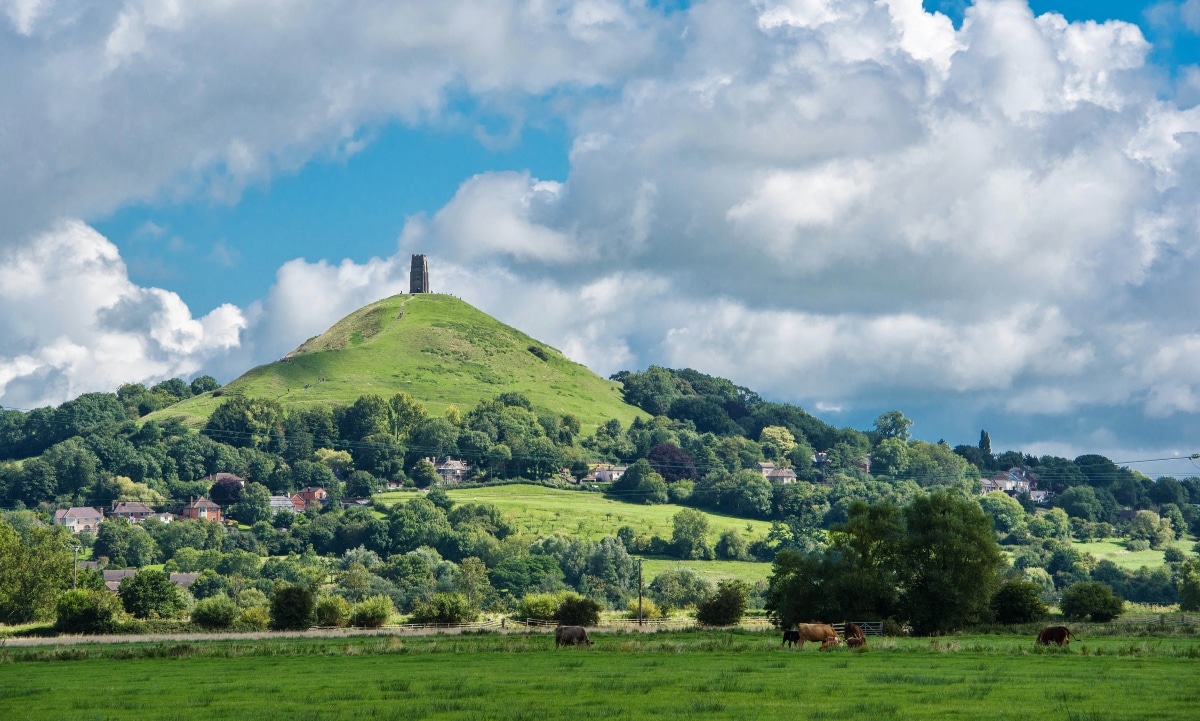
Glastonbury Tor: Key Points
- Glastonbury Tor is a striking terraced hill in Somerset, crowned by the ruined tower of St. Michael and wrapped in more legend than almost any landscape in Britain.
- Its spiral terraces may be the remains of medieval farming or the path of an ancient ritual labyrinth, and the dedication to Michael suggests early Christians were claiming a site already seen as a doorway.
- In the twentieth century the Tor became a key point on the supposed St. Michael ley line, an alignment of sacred places said to carry hidden earth energy.
- The hill is most famously tied to King Arthur, since monks at Glastonbury Abbey claimed in 1191 to have found his grave, a discovery many historians dismiss as a convenient fundraising effort.
- Beneath these layers lies the older Celtic belief that the Tor was a gateway to Annwn, the otherworld ruled by Gwyn ap Nudd, lord of the dangerous fair folk who could lure travelers into a glamour and never let them return.
- What endures is not the proof of any single claim but the persistent sense that this hill is a threshold, a place where the ordinary world feels thin enough to glimpse something beyond it.

Introduction
Glastonbury Tor is a hill that will not be ordinary, rising from the flatness of the Somerset Levels. It is topped by the roofless tower of St. Michael, ringed with terraces that spiral up to the top like the coils of a stone serpent. It has a reputation few landscapes on earth can match. To some it is merely a stark geological feature, a hill of clay and sandstone left by the erosive action of time. To some, it is the gateway to Avalon, where King Arthur lies and the apparent world fades until something older shows through. This article follows the spiral way upward, tracking the physical ruins, the buried monarch, the fair folk, and the Celtic stories of Annwn, the otherworld whose gates were fabled to open in places just like this one.
Celtic and Arthurian symbolism consistently converges around the Tor, a liminal landscape feature. Architectural, landscape, and mythical readings are countered by historians who record the Tor’s prominence as linked with “Isle of Avalon” allegories, Arthurian geography, and Celtic sacred topography. This constellation confirms long-standing claims of Glastonbury’s preeminent significance in the legendary history of Britain, its relationship with Avalon, the Grail, and Joseph of Arimathea. These assertions are part of wider Celtic revival discourses that recast Glastonbury as a place where myth is a resource for national and regional identity (Gemie, 2016; Hayward, 2022; Johnston, 2020; Gilchrist, 2020; BALCH, 1913).
The Terraces, the Church, and the Ley Lines
The first mystery is the terraces themselves. Seven different ledges spiral around the slopes, and nobody can determine who created them or why. Some researchers say these are the worn traces of medieval agricultural strip farming, the practical wounds of humans who needed to cultivate food on steep land. Others maintain that the pattern forms one continuous labyrinth, serving as a processional track along which a pilgrim would have walked from the base to the top in a gradual ritual ascension. If the second reading is right, then the Tor is more than just a hill with a ruin on top. It is a giant 3D icon, a meditation carved into the earth itself and climbing it is an act of meaning rather than exercise. The truth is probably somewhere between farming and faith, which is appropriate for a place that has always been both sacred and mundane.
The Church of St. Michael is now reduced to the tower on the peak. An older church on this site fell down in an earthquake in 1275 and the tower we see today is part of a fourteenth-century reconstruction that was later dissolved under Henry VIII. The loyalty to Michael goes beyond mere appearances. Churches to the archangel are commonly to be found across Europe on high and dramatic sites, on rocks and crags where the divine was considered to conduct fights with the powers below. Michael is the dragon-slayer and guardian of thresholds. The early Christians who erected here may have been consciously seizing a spot already marked as charged by ancient beliefs. They came to a hillside that was not vacant. They arrived at a location that was already regarded as a doorway, and they sealed it, as was their custom, with the dedication of a saint.
This event brings us to the topic of ley lines. In the twentieth century, the idea of the St. Michael Line, a long alignment of sacred sites stretching across southern England from Cornwall through Glastonbury to the eastern coast, was popularized by the writer John Michell. Such lines are spoken of by believers as conduits of delicate ground energy, invisible currents that the ancients could perceive and which they honored by raising stones and churches along the path. The Tor is one of the brightest beads on this string. Sceptics are right to point out that if you distribute enough monuments over a country, you can draw a straight line through nearly anything, and no equipment has ever measured the energy in question. But the appeal of the idea is not actually about physics. It appeals to an ancient belief that some sites, like the Tor, are more important than others. The words are literal or figurative, but the feeling is the same: the feeling of standing at a crossroads, evoked by the hill.

King Arthur and the Isle of Avalon
There is no legend more tenacious of life than that of King Arthur in Glastonbury. The link was cemented in 1191 when the monks of Glastonbury Abbey proclaimed an astounding finding. The monks dug in their cemetery and claimed to have found a hollowed oak coffin containing the bones of a tall man and a woman with golden hair, along with a lead cross inscribed with words, asserting that this was the burial site of King Arthur in the Isle of Avalon. Later the bodies were transferred to a black marble tomb in front of the high altar, which disappeared at the dissolution of the monasteries. Modern historians are very suspicious about the find. The monastery had suffered a severe fire recently and sorely needed money and status and a royal grave; luring pilgrims would have met both demands admirably. Conveniently, the situation was quite advantageous. The monks did not need to create the mythology. The monks were invoking a much older relationship, specifically the idea that Avalon, the foggy isle where the injured Arthur was taken for treatment, was actually Glastonbury itself, at a time when the surrounding lowlands were flooded and the Tor stood as a real island rising from the waters.
Several studies point to the historical layering of myth at Glastonbury Abbey and the Tor and draw attention to the ways in which monastic memory, hagiography, and mythical origin myths were mobilized in post-medieval times to construct English nationhood and religious authority. Memory work on Arthur and Arimathea linked the site to broader discourses about English identity (Gilchrist, chapter on Glastonbury Abbey). Re-interpretations after the Reformation shaped the memory of the landscape (Gilchrist, 2020). Likewise, the current scholarship on monastic memory stresses the strategic use of Glastonbury’s legends of Joseph of Arimathea and the Grail in the early modern and modern periods to support narratives of English church independence and national memory (Cunningham, 2009; Gilchrist, 2020).
The topography of the Tor has been interpreted as an island formation, an “island” in a marshy plain, further intensifying its aura as a transitional site where Celtic and Christian mythologies collide. The Tor is, according to several accounts, the centerpiece of the idea of Avalon and its accompanying mythic geography, connecting the topography with Arthurian and Celtic symbol systems. This topographical reading resonates with conversations in the broader literature on place-naming and mythic landscapes where place, memory, and myth co-create a sense of sacred geography (Thaler, 2022; Khvesko, 2018; Gilchrist, 2020).
The Celtic Otherworld of Annwn
The image of the island serves as the key to uncovering the Celtic layer of the story. In the earlier mythology of the Welsh and Britons, the otherworld was named Annwn, a region of feasting and endless youth, with cauldrons restoring the dead and treasures beyond price. It was not thought of as a heaven in the distance but as a place beside us through special doors. Hills, lakes, mounds, and islands were the preferred gateways, and a hill that became an island when the floods came would have been a doorway of the highest order. One myth makes the Tor the actual fortress of Gwyn ap Nudd, a lord of Annwn and leader of the Wild Hunt, who was reported to ride out from the hill with his spectral hounds. Read this way, the spiral terraces become more than a stairway up a hill. They become the approach to a threshold, the gradual circling descent and ascension that the ritual so often asks of anybody hoping to pass between worlds.
The Fair Folk and the Modern Tor
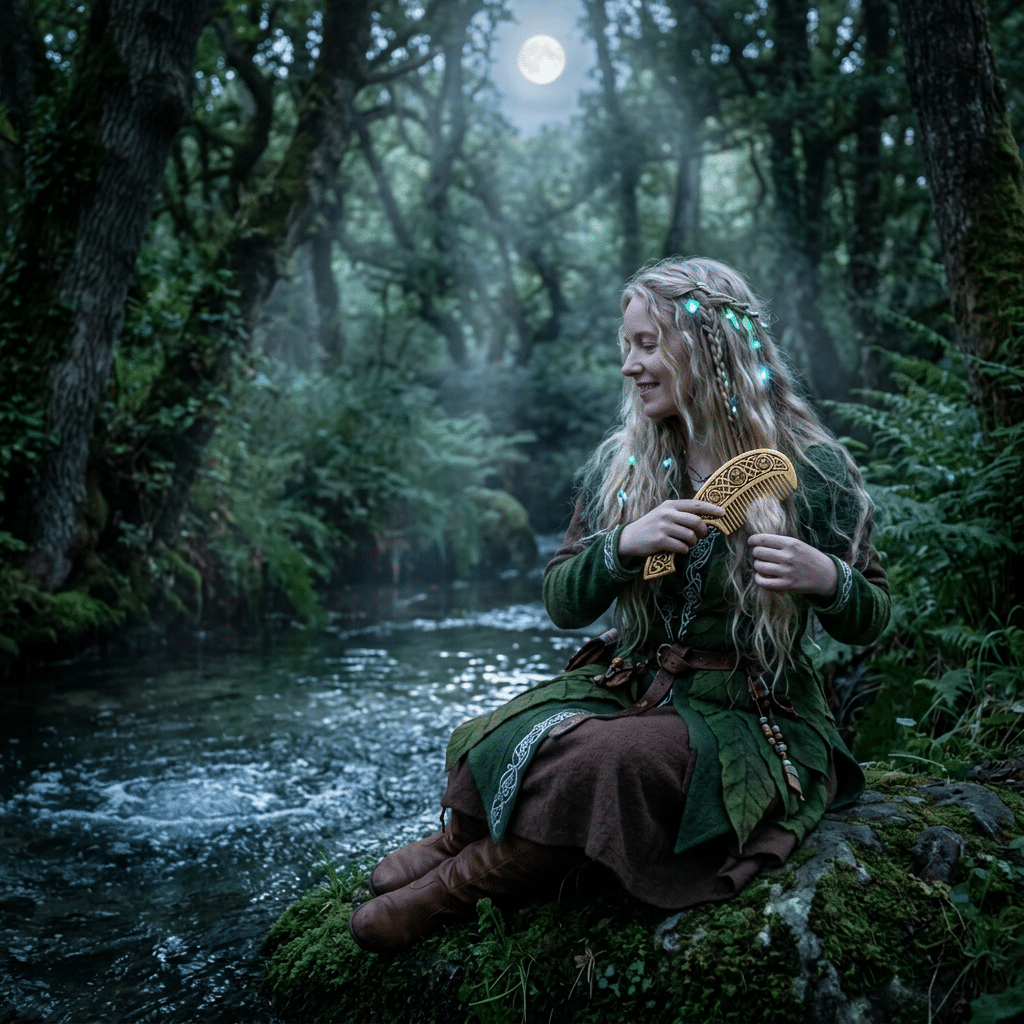
The faerie tale of the Tor reaches deeper than the postcard image of lovely winged beings may imply. The faeries, in the old Celtic view, weren’t little and charming. They were the Tylwyth Teg, the fair folk, a race of the otherworld, who might be benevolent or cruel by turns, and they were directly connected with Annwn and with Gwyn ap Nudd, the very lord who was supposed to dwell within the hill. These entities were actually threatening to the medieval psyche, and the Tor was one of their strongholds rather than a delightful sanctuary for natural spirits. This is graphically told in a well-known story. Gwyn ap Nudd called to Saint Collen, a hermit who had taken up his abode on the slopes, to a bright palace at the top, full of music and feasting and well-dressed attendants. The saint suspecting illusion poured holy water across the hall, and in a moment the whole shining court had gone, and he was alone on the bleak and windswept mountaintop. That old warning lies in the story’s bones: that the magnificence presented by the lovely folk is a gloss draped over emptiness and that those who eat their food or accept their hospitality may never return to the world they know. The idea of liminal time and place is what gives the Tor its specific charge in this tradition. Faeries were said to meet at twilight and dawn, at the boundary times of Samhain and Beltane, in fog and at the brink of water. The Tor, an island in the ancient floods, a hill always cloaked in low cloud, was a boundary rendered solid, and that made it alluring to such entities. People told of entrances in the hillside, of travelers drawn astray by lights or music, and of time sliding away so that an hour with the fair folk became a hundred years in the ordinary world. Much of the tension has been eased by modern Glastonbury and visitors now leave ribbons and small donations in an attitude of gentle reverence rather than genuine terror. But the core belief remains: the hill is home to more than what is seen, and the barrier is thin here.
Today, in both tourism and esotericism, Glastonbury Tor is constantly described as a place of ley-lines, sacred geography, and New Age symbolism (Glastonbury as a point in global mythic networks). Farinelli and Hayward point to how Glastonbury Tor is enmeshed within New Age and folkloric discourse, with the Tor as the “Isle of Avalon” and as a nexus for Grail, Arthurian, Druidic, and UFO-linked myths. This study shows how mythical geography becomes a cultural product in the contemporary day (Farinelli & Hayward, 2019). Scholars understand the Celtic rebirth surrounding Glastonbury as a political-cultural effort and a legendary project. Gemie investigates the ways in which Celtic themes and Arthurian correspondences associated with Glastonbury have been re-mapped in late-modern contexts (New Age, nationalism, and identity construction). The paper explores the way in which Avalon-like myths and Holy Thorn mythology are part of a landscape that mobilizes Celtic identity as a sort of cultural capital and political worth in Britain (Gemie, 2016).
Conclusion
And the layers build on top of each other. And they don’t cancel each other out. The geologist sees erosion and agriculture. The historian observes a medieval monastery exploiting a beneficial mythology. The Christian pilgrim sees Michael guarding a holy hill. The follower of the old ways can sense Annwn breathing just beyond the veil, the fair folk waiting at the threshold. What is remarkable about Glastonbury Tor is that it contains all of them simultaneously without disintegrating, for the hill itself is simply there, neutral and patient, while each age that encounters it translates its own innermost concerns into its slopes. King Arthur may not rest in the Somerset clay, nor will any compass ever swing to a magnetic doorway at the peak. However, the tales persist because they satisfy a need that mere facts cannot fulfill: the belief that certain locations are more than just a collection of stones and that if we climb high enough and circle long enough, the ordinary world might temporarily part to reveal a glimpse of what lies beyond.
References
BALCH, H. E. (1913). VIII.—Further Excavations at the Late-Celtic and Romano-British Cave-dwelling at Wookey Hole, Somerset. Archaeologia, 64, 337–346. https://doi.org/10.1017/s0261340900010766
Cunningham, J. P. (2009). ‘A young man’s brow and an old man’s beard.’ Theology, 112(868), 251–259. https://doi.org/10.1177/0040571×0911200403
Farinelli, M. A., & Hayward, P. (2019). Place, Visibility and Perception: The materiality of Es Vedrà and its enfolding within New Age discourse and media-lore. Coolabah. https://doi.org/10.1344/co20192731-51
Gemie, S. (2016). Visions of Albion: ancient landscapes, Glastonbury and alternative forms of nationalism. Nations and Nationalism, 23(2), 327–345. https://doi.org/10.1111/nana.12234
Gilchrist, R. (2020). Monastic Legacies: Memory and the Biography of Place. 145–175. https://doi.org/10.1017/9781108678087.006
Hayward, P. (2022). Multiple Avalons: Place naming practices and a mythical Arthurian island. Island Studies Journal, 17(2), 126–142. https://doi.org/10.24043/isj.174
Johnston, M. A. (2020). Fee, Christopher R. Arthur: God and Hero in Avalon. Renaissance and Reformation, 43(2), 374–376. https://doi.org/10.33137/rr.v43i2.34853
Khvesko, T. V. (2018). Place names metaphora in language and communication. Language and Culture, (12), 14–24. https://doi.org/10.17223/24109266/12/2
Thaler, M. (2022). How modern is technology? : the link between prehistoric UFOs and modern traditionalism. Religio Revue Pro Religionistiku, (1), [7]-24. https://doi.org/10.5817/rel2022-1-2

Leave a Reply