The Questing Beast: Key Points
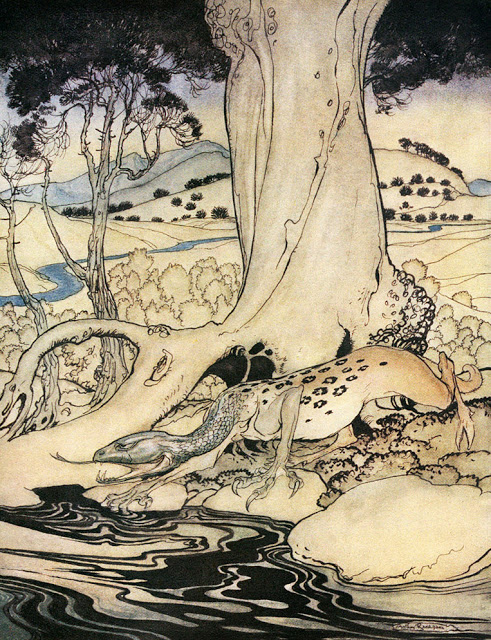
- The Questing Beast is a composite monster with the head of a serpent, the body of a leopard, the haunches of a lion, and the feet of a hart. Its most famous feature is the sound of thirty or forty baying hounds that emanates from its belly.
- Its name comes from “questing,” a medieval term for the barking of hunting dogs, referring to the noise within it. The creature wanders the wilderness as an elusive quarry that can never be caught, inspiring endless pursuit without ever posing a real threat.
- The beast appears to Arthur after a troubling dream and shortly before Merlin reveals the consequences of his incest, linking the creature to themes of sin and the eventual doom of his kingdom.
- The hunt is the hereditary burden of King Pellinore’s family, and after his death the quest passes to Sir Palamedes, a Saracen knight who becomes most associated with the beast in later tradition.
- The creature functions as a motif of the impossible quest, resembling the Grail in inspiring lifelong searching but offering no spiritual reward, only the chase itself.
- Scholars interpret the beast variously as an allegory for sin and chaos, a symbol of scandal and rumor, a representation of unfulfillable human desire, or simply a marvel of medieval imagination whose meaning is deliberately left open.

Introduction
Among the many bizarre and amazing creatures that inhabit the world of Arthurian mythology, few are as remarkable and distinctive as the Questing Beast. It is a creature unlike the dragons and giants that usually menace knights, defined less by its threat than by its strange look and the obsession it generates. This creature occurs in some of the most important medieval writings of the Arthurian legend, including Sir Thomas Malory’s Le Morte d’Arthur and the earlier French Vulgate and Post-Vulgate cycles. The Questing Beast rarely occupies the spotlight, but it remains a symbol of futile search, mysterious origins, and eternal adventures that shape the stories. The essay considers the beast’s appearance, its behavior, its connection to Arthur and his knights, its role in legend, and the various interpretations presented by scholars.
The Appearance of the Questing Beast
The Questing Beast is a mismatched creature, physically, made from parts of various other creatures, giving it an eerie, dream-like aspect. The head of a serpent, the body of a leopard, the haunches of a lion, and the feet of a hart or deer, as Malory says. It is a composite form and hence belongs to the chimerical creatures of medieval bestiaries, where abnormal combinations often symbolized the unholy or the supernatural. But the most defining quality of the beast was not his body but the noise he produced. From its guts sounded a roar, like the baying of thirty or forty hounds in full scream, a peculiar internal clamor that warned of its coming long before it was sighted. This unusual characteristic led to one of its names, as “quest” meant to bark or yelp in the Middle Ages, similar to the hounds of the chase. So the creature was named not for the act of hunting but for the noise it carried inside it, although the two meanings got muddled up over time. The Beast’s arrival is understood as a critique of masculine power and accountability and the vulnerability of the king and knights. Malory’s analyses position the Beast as a metaphor of the forces that undermine the orderly sovereignty of Camelot, forces that are interwoven with Arthur’s own consanguineous and political misjudgments regarding succession, kinship, and oath-keeping (Vianen, 2022).
The Behavior of the Beast
The beast’s conduct strengthened its reputation as a being of mystery and frustration. It haunted the forests and the wastes, never directly attacking knights or giving them any obvious reason to hunt it, but stirring an almost magnetic need to pursue and chase. For those who sought the beast, it was elusive to the extreme, always sliding away, always just out of grasp. For years, even lifetimes, the chase continued, and the beast seemed less interested in fleeing than in becoming an eternal target. The chase furnished the monster with a metaphor, as if it were something that might be chased eternally and yet never overtaken. Its restless mobility, and its reluctance to be caught, made it an appropriate symbol for the questing spirit that motivated the knights of the Round Table.

The Beast’s Connection to Arthur and His Knights
Early on, the story introduces an alarming connection between King Arthur and the Questing Beast. In the Post-Vulgate cycle and in Malory, Arthur meets the beast immediately after a disturbing prophetic dream and just before Merlin the prophet reveals to him the consequences of his unwitting incest with his half-sister, which will produce Mordred and ultimately bring about the fall of his kingdom. The appearance of the beast at this point connects it to concepts of sin, dread, and concealed consequence. Arthur sees a knight, King Pellinore, who is chasing the thing and Pellinore says that the pursuit is the hereditary burden of his family. After Pellinore’s death, the search goes to Sir Palamedes, a Saracen knight, who takes up the chase and is the figure most connected with the beast in the later narrative. Thus the creature connects a number of major individuals and strands of the legend, weaving through the greater narrative without ever being fundamental to it.
In Malory, the Questing Beast is tied to Arthur’s troubled consolidation of power, including machinations around Mordred, Guinevere, and the Round Table oath culture that structures chivalric conduct. The beast serves as a visual and narrative technique that reveals the conflicts between idealized knights and flawed humanity in Camelot, exposing the savagery and appetite that lie beneath the mythical order (Vianen, 2022). The knights were men, and men sometimes behaved in questionable ways.
The Beast’s Role in Legend and Scholarly Interpretations
In the larger context of medieval romance and legend, the Questing Beast is a repeating image of the impossible quest. Medieval literature loved to come up with tasks that could never be accomplished and things of desire that were always beyond reach, and the beast fits the pattern nicely. It shares one key characteristic with the Grail: it inspires dedication and lifetime questing. But the beast provides no spiritual reward and no ultimate revelation—only the hunt. The quest for the beast is linked to Palamedes’ own unfulfilled love and his status as an outsider as a non-Christian knight, such that the beast is a reflection of his yearning and his sense of never belonging. The beast, thereby, works on a symbolic level as an embodiment of the gap between desire and fulfillment that is so pervasive in medieval narrative.
There are many theories from academics and readers alike as to what exactly the Questing Beast is. A popular explanation is that the beast represents sin, disorder, and the violent instability that festers within Arthur’s kingdom, especially as it emerges with the disclosure of his incest. It has been proposed that the weird composite body and the baying of hounds within represent the clamor of public scandal or rumor chasing the guilty. Others interpret the beast as a psychological metaphor for the human desire, a restless urge to pursue unattainable goals. Some writers have explored possible origins in older Celtic myths or garbled travelers’ tales of strange real animals, but such links remain speculative. There is also a long tradition of loving the beast merely as a creation of medieval imagination, a creature whose meaning is purposefully left ambiguous and whose strangeness is part of its continuing allure.
The Beast is viewed via numerous theoretical lenses, ecocritical readings, intertextuality with beast legends, or as a symbol reinterpreted in contemporary media. Some respond by considering the Arthurian myth as a palimpsest that modern authors can use to reframe the beast as a comment on modern concerns (gender, power, environmental ethics); others emphasize fidelity to the medieval text and its moral complexities (Pireddu, 1997; Manlove, 2016; Edman, 2015). It is agreed that the Questing Beast stands for moral and political danger in Camelot, but there is no agreement on whether it works mainly as a symbol of sexual or transgressive desire, a failure of governance, or some more general critique of chivalric idealism.
Some analyses highlight romantic or marital conflicts (e.g., Guinevere and Lancelot relationships) as key to the meaning of the Beast. Others highlight the Beast as a structural critique of kingly authority and oath-keeping. The literature thus suggests a multi-faceted, not entirely cohesive view of the symbolic role of the Beast in the Arthurian corpus (Vianen, 2022). And the additional depth comes when Malory’s Beast is compared with later adaptations and critical retellings, when the Beast may be recast as a symbol for external or internalized “beasts” (war, empire, ecological rot), not simply a sexual or courtly threat. These modifications are not the result of one authoritative medieval reading but rather of broader transmedial and intertextual discourses regarding Arthurian myth (Besamusca & Quinlan, 2012; Stampone, 2014; Liaqat, 2018).
Conclusion
One of the most fascinating things about Arthurian legend is the Questing Beast, and this is because it was hard to explain. It’s a monster that does little damage, a quarry that can never be caught, and a symbol that bends to fit whatever meaning a reader takes to it. Every generation that stumbles over the stories recalls its hideous patchwork form and the uncanny baying that comes from within. Whether viewed as a sign of Arthur’s fate, a symbol of eternal longing, or perhaps a wonder of medieval imagination, the beast remains as a reminder that certain pursuits are not determined by their outcome but by the very act of seeking. In that sense the creature is the perfect companion to the knights who hunted it, continually chasing something just beyond the edge of the woods.
References
Besamusca, B., & Quinlan, J. (2012). The Fringes of Arthurian Fiction. 191–242. https://doi.org/10.1017/9781782040637.010
Edman, T. B. (2015). Power in Jeopardy: A Poststructuralist Reading of the Arthurian Legend from Malory’s Le Morte d’Arthur and Tennyson’s Idylls of the King to Tolkien’s The Lord of the Rings. Journal of History Culture and Art Research, 4(2), 88. https://doi.org/10.7596/taksad.v4i2.436
Liaqat, Q. (2018). War Afflicted Beings: Myth-Ecological Discourse of the Play Bengal Tiger at the Baghdad Zoo by Rajiv Joseph // Seres afligidos por la guerra: Discurso mito-ecológico de la obra Bengal Tiger at the Baghdad Zoo de Rajiv Joseph. Ecozon@ European Journal of Literature Culture and Environment, 9(2), 72–88. https://doi.org/10.37536/ecozona.2018.9.2.2306
Malory, T. (1485). Le Morte d’Arthur.
Manlove, C. (2016). Before MacDonald. 29–38. https://doi.org/10.57132/book17-4
Pireddu, N. (1997). Ca R terbury Tales: Romances of Disenchantment in Geoffrey Chaucer and Angela Carter. The Comparatist, 21(1), 117–148. https://doi.org/10.1353/com.1997.0022
Stampone, C. (2014). “You can’t buck against the railroad”: The Arthurian World of Frank Norris’s The Octopus. Studies in American Naturalism, 9(1), 26–51. https://doi.org/10.1353/san.2014.0003
Vianen, L. van. (2022). De Worde, Beardsley, and the Complicated Chivalry of the Round Table. Quaerendo, 52(4), 251–275. https://doi.org/10.1163/15700690-20221143

Leave a Reply