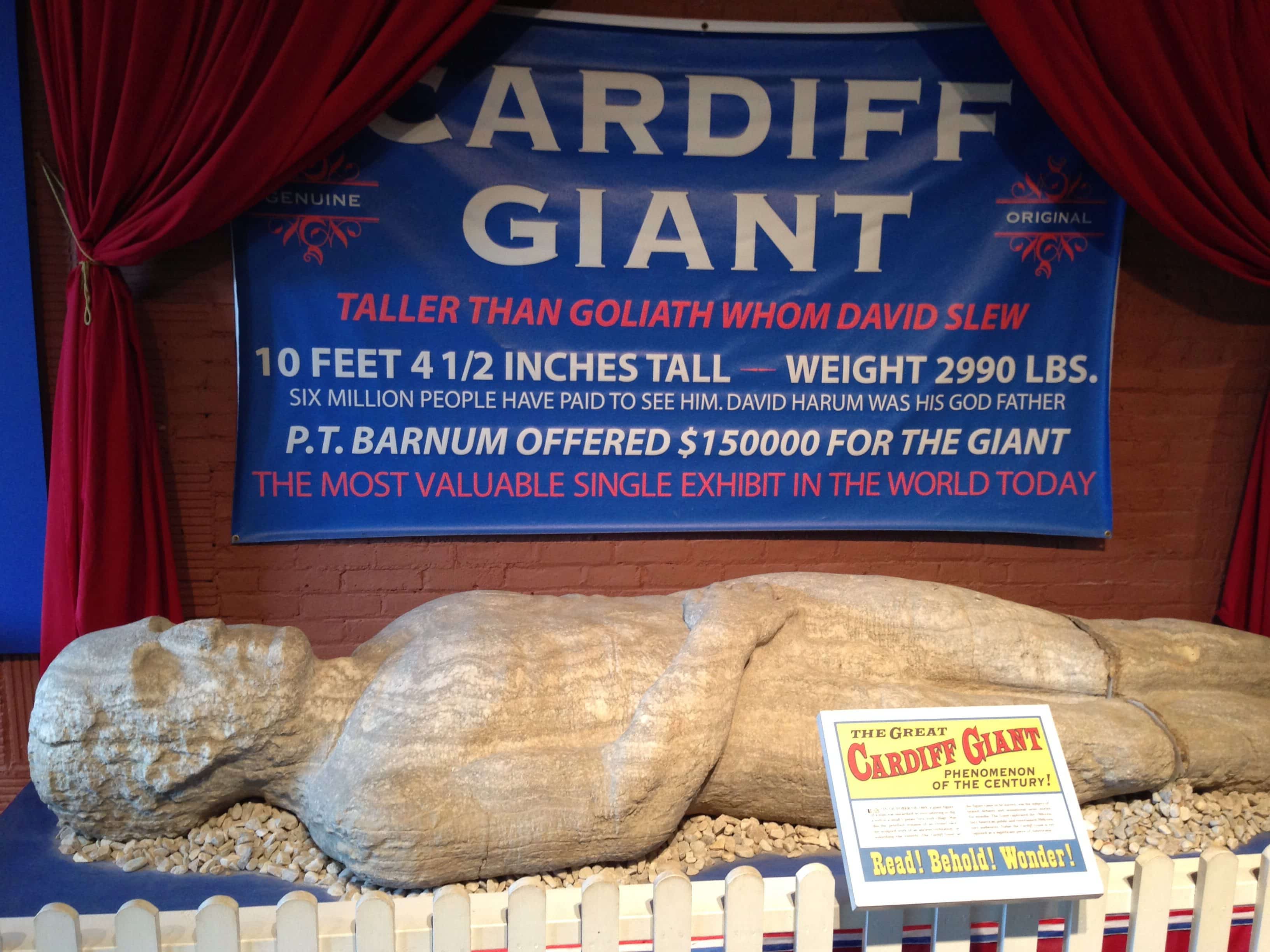
Cardiff Giant Impact: Key Points
- In October 1869, well diggers on William Newell’s farm near Cardiff, New York, uncovered an apparently petrified man over ten feet tall, and the discovery drew paying crowds from across the region.
- The figure was a fraud created by George Hull, a skeptic who carved a block of Iowa gypsum in secret after arguing with a preacher about the biblical verse on giants, then buried it behind the barn for a year before staging its discovery.
- Exposure came fast, with Yale paleontologist Othniel Marsh calling it a decided humbug and Hull confessing by December, though the giant kept touring and P. T. Barnum profited from a plaster copy.
- It worked because Americans already believed in giants through literal readings of Genesis, the myth of a vanished race of mound builders, and long-standing confusion of mastodon bones with human remains.
- The hoax helped launch decades of newspaper reports about giant skeletons in West Virginia, Pennsylvania, and Ohio, nearly all following the same formula and often claiming the bones were shipped to the Smithsonian.
- Fraud, misidentified fossils, sloppy measurement, and the profitability of sensational filler explain these stories far better than the modern conspiracy claim of a Smithsonian cover-up, which ignores both the evidence and basic biomechanics.

Introduction
In October 1869, two well diggers on small farm in upstate New York hit something hard about three feet deep, and within days the hamlet of Cardiff had become one of the most visited destinations in America. They had discovered what looked to be the stone body of a man almost 10 feet tall, lying contorted, as if dying in pain. The Cardiff Giant was a fake, revealed in weeks and admitted in months, but its effect outlived its short life as a scientific mystery by a long time. The hoax crystallized a set of American beliefs about a vanished race of giants, gave those beliefs a vocabulary and a set of visual conventions, and helped seed the strange wave of giant skeleton reports that filled small town newspapers for the rest of the nineteenth century and into the twentieth. Knowing how the Cardiff Giant was made and why it was so successful explains a lot about why so many Americans still believe that giants once walked the continent and that their bones now remain concealed in a government storehouse.
The episode interconnects science, religion, media, and public spectacle. Scholars have conducted extensive studies on the episode’s interconnections of science, religion, media, and public spectacle, producing entire narrative histories and historiographical appraisals. Scholars have produced extensive studies on the episode’s interconnections of science, religion, media, and public spectacle, including whole narrative histories and historiographical appraisals. The basic facts (discovery, dimensions, material) and the later unmasking of the hoax are told in several sources, which also cover the broader cultural implications and how scientific authority was publicly challenged by showmanship and fraud (Rasmussen, 2010; Dehler, 2010). In later historiography, the Cardiff Giant has been read as a parable about pseudoscience, public credulity, and the contest over scientific authority in nineteenth-century America (Gordin, 2019; Hansen, 2003). The event remains a touchstone in discussions of hoaxes, science communication, and the politics of expertise (Rasmussen, 2010; Dehler, 2010; Hansen, 2003).
Manufacturing a Giant
The scheme began with a quarrel about the Bible, according to its author. George Hull, a cigar manufacturer of Binghamton, N.Y., and a stout skeptic in religious matters, was traveling in Iowa in 1866 when he got into a dispute with a Methodist revivalist over Genesis 6:4, the verse that says there were giants in the earth in those days. The preacher insisted the passage was literal history. Hull, irritated and calculating, began to wonder how many people would pay to see such a giant if he produced one. In 1868 he bought a big block of gypsum from a quarry near Fort Dodge, Iowa, telling the quarrymen it was to be a monument to Abraham Lincoln.
The stone was shipped to Chicago, where a German stonecutter named Edward Burghardt and two assistants carved it in secret, using Hull himself as a rough model. The finished figure was ten feet four and a half inches tall and weighed close to three thousand pounds. To age it, the conspirators scrubbed it with sand and water, washed it in sulfuric acid to darken the surface, and pounded it with a block studded with darning needles to simulate skin pores. This element—carving and surface distressing to evoke antiquity—was openly revealed as part of the fraud when the promoters’ scheme subsequently unraveled, openly revealing this element—carving and surface distressing to evoke antiquity—as part of the fraud (Rasmussen, 2010). This element was revealed as part of the fraud when the promoters’ scheme subsequently unraveled (Rasmussen, 2010). The involvement of professional artisans and the explicit aim of manufacturing an “ancient” appearance are repeatedly noted in contemporary summaries of Tribble’s account and subsequent syntheses (Rasmussen, 2010; Dehler, 2010). The whole production cost somewhere in the neighborhood of twenty-six hundred dollars.

Spectacle, Publicity, and Profit
The promoters of the hoax leveraged public display and promotional momentum after its discovery by moving the figure to urban hubs, including movements by wagon and by rail to Chicago, where further sensational marketing and display arrangements were made (Rasmussen, 2010). The narrative foregrounds the deliberate use of showmanship and publicity to maximize public interest and monetize the spectacle, drawing on promotional conventions associated with P. T. Barnum-era entertainments (Rasmussen, 2010).
The stone man traveled east by rail and wagon to the farm of Hull’s cousin, William Newell, near Cardiff in Onondaga County. In November 1868, the two men buried it behind the barn and waited nearly a year for the ground to settle. Then Newell hired two neighbors to dig a well in exactly the right spot. The discovery on October 16, 1869, produced instant pandemonium. Newell threw a tent over the pit and initially charged twenty-five cents for admission, but he later raised the price to fifty cents as the crowds grew larger. Special stagecoaches ran from Syracuse. Farmers stood in line for hours to look into a hole in the ground. Within a few weeks, Hull sold a two-thirds interest to a syndicate of local investors, headed by a Homer banker named David Hannum, for about twenty-three thousand dollars, and the giant was moved to Syracuse for exhibition. P. T. Barnum offered a large sum to lease it, was refused, and simply had a plaster copy made and displayed in New York as the genuine article. Hannum’s disgusted remark about the crowds lining up to see Barnum’s imitation, that there was a sucker born every minute, was later attached to Barnum himself and became one of the most famous sentences in American showmanship.
Experts, Clergy, and the Cultural Ground
The experts arrived quickly, and they did not all agree. Othniel C. Marsh, the Yale paleontologist, looked at the figure and said it was very new and definitely a fake, noting fresh tool marks and that gypsum would have broken down in damp New York soil long before any fossil could last. A local physician had already argued that the object was a carved statue. James Hall, the New York State geologist, hedged in a way that helped the promoters enormously, calling it the most remarkable object yet brought to light in the country and suggesting it might be an ancient sculpture rather than a body. Clergymen were among the giant’s most enthusiastic defenders. Some preached that here at last was material proof of Genesis, a physical rebuttal to geologists and to the followers of Darwin, whose work had appeared only ten years earlier. Others accepted a compromise position and declared the giant an ancient idol, evidence of some forgotten civilization. Promoters also borrowed from Onondaga tradition by invoking Iroquois stories of stone giants to give the giant a sense of local antiquity, although this use of Native oral tradition did not reflect the true meaning of those stories. By December Hull had confessed, and the sculptor and the quarry workers confirmed the story, but the giant kept touring for years and can still be seen at a museum in Cooperstown.
The religious aspect is crucial to the entire situation. Hull chose a giant because he knew what his audience already half believed. American Protestant culture in the middle of the nineteenth century took the Old Testament as reliable history, and Genesis 6:4, together with the accounts of Goliath and the bed of Og of Bashan, guaranteed that giants had once existed. A parallel secular myth reinforced it. The enormous earthen mounds of the Ohio and Mississippi valleys were widely attributed to a lost race of builders, more civilized and often imagined as physically larger than the Native peoples who lived there, a theory that conveniently implied the land had been taken from someone else long before. Popular science writing about fossils encouraged the confusion further. Mastodon and mammoth bones had been read as human giant remains since colonial times, most famously when Cotton Mather interpreted enormous teeth found at Claverack, New York, as relics of an antediluvian giant and reported them to the Royal Society. Put those threads together, and the Cardiff Giant made sense. It was the confirmation of something a great many people expected to be true.
Newspapers, Folklore, and the Modern Conspiracy
The newspapers then took over the story. For decades afterward, small-town papers ran short, breathless items about giant skeletons: bones fourteen feet long washed out of a riverbank at Brownstown, West Virginia, by high water in 1899, complete with a stone pipe and a tomahawk; roughly one hundred and fifty enormous skeletons pulled from a cave near Northeast, Pennsylvania, with thigh bones as thick as a good-sized bucket and stone hatchets beside them; six giant skeletons in an Ohio mound near Homer, laid feet to the east on a floor of stone, buried with copper vessels and a wooden bucket; and feature columns that recycled centuries-old European tales of thirty-foot skeletons found at Rouen and in Dauphiné. These stories share a formula. They are datelined from somewhere small, they cite a farmer or a workman rather than a scientist, they often note that the bones crumbled on exposure to air, and they very frequently end by announcing that the remains have been forwarded to the Smithsonian Institution for study. That last detail did real work. It conferred authority, closed the story, and verified someone else’s job. The Smithsonian did receive vast quantities of material in this period, and its Bureau of Ethnology conducted a significant mound survey under Cyrus Thomas in the 1880s and early 1890s, which is precisely why its name was available for borrowing. The irony is that Thomas’s survey dismantled the lost race theory by proving that living Native nations’ ancestors constructed the mounds. Thomas’s survey dismantled the lost race theory by proving that the ancestors of living Native nations constructed the mounds. The irony lies in the fact that Thomas’s survey disma
ntled the lost race theory by proving that the ancestors of living Native nations constructed the mounds. The institution that supposedly hid the giants is the one that dismantled the myth, which is a fair part of why later conspiracy writers cast it as the villain.
The Cardiff Giant event serves as a case study of how promotional campaigns and media can shape public perceptions of scientific claims, with promoters leveraging controversy and publicity to increase attendance and profits. This case study parallels broader analyses of how pseudoscientific or sensational claims gain traction in a culture of mass entertainment and media spectacle, a theme explored in subsequent historiography on pseudoscience and demarcation challenges (Gordin, 2019). The Cardiff Giant case, therefore, resides at the confluence of science communication, popular culture, and the politics of expertise (Rasmussen, 2010; Dehler, 2010).
The Cardiff Giant shaped this whole genre in specific ways. It proved that a giant story could be enormously profitable, and imitators followed almost immediately, including the Solid Muldoon, unearthed in Colorado in 1877 and traceable once again to George Hull, and a series of petrified men that surfaced from Ithaca to the western territories. It established the standard image of the American giant, roughly ten to twelve feet tall, human in form, discovered by accident during ordinary labor, and interpreted as biblical rather than geological. It also trained editors and readers alike. The Cardiff affair sold papers on a scale that country editors noticed, and in an era when journals filled their columns by clipping items freely from exchanges, a good giant paragraph could travel the continent in a month without anyone checking it. Hoaxing was an accepted newspaper amusement in the period, practiced by Mark Twain among others, and the line between a joke, a filler item, and a sincere report was thin.
Anthropological and folkloristic interest in mythic figures and “giant” motifs Cultural imaginaries, rather than empirical taxa, have always been the focus of anthropological and folkloristic interest in mythic figures and “giant” motifs, cultural imaginaries, not empirical taxa. Classical and cross-cultural scholarship highlights the methodological challenge of distinguishing myths from empirical claims, a challenge that has historically been framed in terms of “myths of observation,” in which observed phenomena are interpreted through mythic narratives rather than through testable hypotheses (Tylor, 1878). The cross-cultural literature on giants, dwarfs, and related beings—from the Baltic-Finnish motif clusters to Amerindian and Mesoamerican traditions—shows that gigantism in folklore often functions as a symbol, cosmology, or social critique rather than evidence of a past biological giant in North America (Berezkin, 2007). This academic background warns against interpreting mythical giants as mere factual or biological beings, even if we accept that such stories can shape cultural memory and popular imagination of the past.
There are a few sets of theories put up to explain all of these phenomena. The best-documented explanation is that these cases are simply instances of fraud for money; the Cardiff Giant, the Solid Muldoon, and several petrified individuals undoubtedly fall into this category. A second explanation is misidentification; large fossil bones, disarticulated skeletons loosely estimated in the ground, and the occasional genuine tall individual with a pituitary disorder could all result in honest reports that grew in the telling; a skeleton reported as six feet eight inches in a field report becomes seven feet in a newspaper and twelve feet in a reprint. Third, the economics and culture of the press rewarded the propagation of unverifiable miracles. Fourth, the ideology of the mound builder myth serves the interests of settlement and eviction. Conversely, we have the modern conspiracy theory, in which the reports have been taken at face value and the Smithsonian accused of systematically confiscating and destroying giant remains to protect Darwinian orthodoxy. This theory has been revived by television documentaries and a widely circulated story from 2014 about a court ordering the release of hidden skeletons, which was based on a satirical fake news website. The conspiracy theory must explain not only why there aren’t giant skeletons in any museum in the world, including those with no vested interest in American orthodoxies, but also basic biomechanics, because if you scale a human body up to fourteen feet, weight increases roughly as the cube of height, while bone cross sections increase as the square, making a creature that couldn’t stand.
Conclusion
The Cardiff Giant was buried, dug up, displayed, and confessed in roughly fourteen months, but it is one of the most significant deceits in American cultural history. The Cardiff Giant did not create the notion that giants had once roamed the earth; rather, it provided that notion with a physical form, an entry price, and a presence in the press, demonstrating how quickly religious conviction, popular science, race mythology, and economic amusement could merge into a single entity. The following reports, featuring decaying bones and skeletons taken to Washington, are best read not as evidence of a hidden history but as evidence of what nineteenth-century Americans wanted the past to be. Today’s outfit has the same modern appetite as the discussion of suppressed Nephilim and a conspiratorial Smithsonian. Perhaps the most captivating part of the whole narrative is that George Hull set out to disgrace literal readers of Genesis and instead handed them a mythology that outlived him by a hundred and fifty years.
References
Berezkin, Y. (2007). Dwarfs and cranes: Baltic-Finnish mythologies in Eurasian and American perspective (70 years after Yrjö Toivonen). Folklore: Electronic Journal of Folklore, 36, 67–88. https://doi.org/10.7592/fejf2007.36.berezkin
Dehler, G. J. (2010). Last stand: George Bird Grinnell, the battle to save the buffalo, and the birth of the new West. The Annals of Iowa, 69(4), 464–465. https://doi.org/10.17077/0003-4827.1487
Gordin, M. D. (2019). The other demarcation problem. Isis, 110(4), 766–769. https://doi.org/10.1086/706533
Hansen, O. T. K. (2003). Forfalsket forhistorie – Arkæologisk svindel og selvbedrag. Kuml, 52(52), 7–34. https://doi.org/10.7146/kuml.v52i52.102636
Rasmussen, C. (2010). A colossal hoax: The giant from Cardiff that fooled America. The Annals of Iowa, 69(4), 465–467. https://doi.org/10.17077/0003-4827.1488
Tylor, E. B. (1878). Historical traditions and myths of observation. 306–332. https://doi.org/10.1037/12848-011


Leave a Reply