Qiongqi in Chinese Myth: Key Points
- Qiongqi is one of the most unsettling creatures in Chinese mythology, representing not just destruction but a deliberate inversion of virtue, where goodness is punished and wickedness is rewarded.
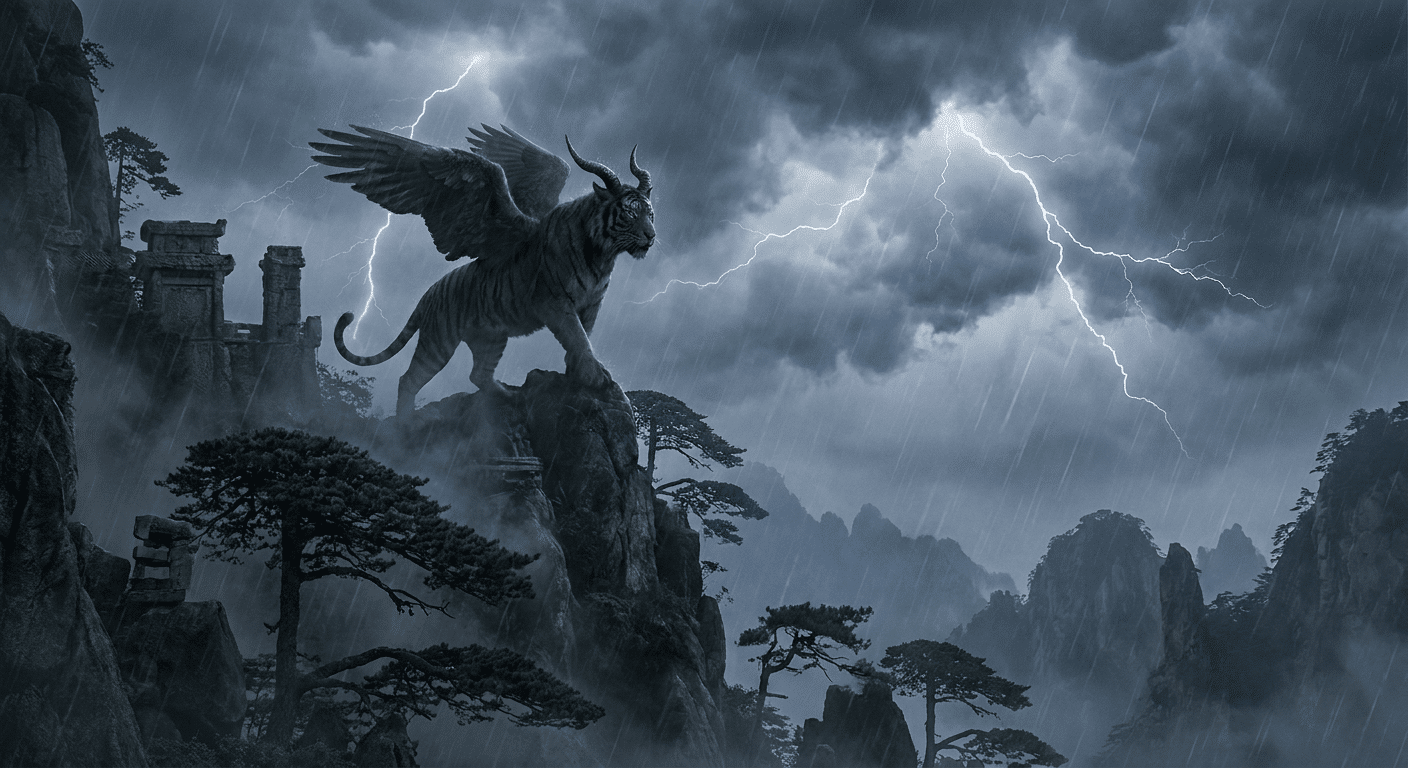
- Its physical appearance varies across sources, described in the Shanhaijing as either a quill-covered ox or a winged tiger, but always producing a sound like a howling dog.
- Its defining behavior is moral perversity: it attacks honest and virtuous people while actively bringing food and care to criminals and wrongdoers.
- In the legend of the Four Perils, the sage emperor Shun banished Qiongqi alongside three other catastrophic beings to the edges of the world, an act understood as restoring cosmic and social order.
- Some texts suggest Qiongqi was once a corrupt human whose sustained wickedness transformed him into a beast, serving as a warning about the consequences of abandoning virtue.
- Scholars theorize the creature may symbolize social disorder, encode memories of defeated rival tribes, or function as a mythological device that defines goodness by showing its opposite.

Introduction
Of the numerous weird and terrifying animals chronicled in the illustrious heritage of Chinese mythology, few are as morally troubling as the Qiongqi. The old beast has a special place in the Chinese cosmological imagination, not merely embodying destructive force or sheer terror but something far more disturbing: an inversion of virtue itself. To meet Qiongqi is to meet an upside-down universe where virtue is punished and evil rewarded. Its story runs through some of the oldest extant writings in Chinese literary history, and the concerns it raises about evil, order, and the nature of moral turmoil are still riveting today.
Contextual Background and Physical Form
The term ‘qiongqi’ is encountered in conversations about mythic entities and monsters in Chinese tradition, generally as part of a wider discussion of folklore, myth, and classical storytelling. The categories of “mythological beings”, “monsters”, and similar areas are addressed in several sources in the offered materials, and these provide the contextual background to place specific figures, such as qiongqi, in Chinese mythic imagination (JIANG, n.d.; “推薦一般演題”, 2020; ZHANG, 2023). In the literature, such entities are always considered existing along a spectrum, ranging from shapeshifters, demons, or monsters to more personified figures with narrative functions in myth and legend (JIANG, n.d.; ZHANG, 2023).
Qiongqi is described differently physically in different sources, and this contradiction is telling in itself (Dehai, Jing & Dinghao, 2020). At least two different representations of the creature can be found in the Shanhaijing, or Classic of Mountains and Seas, an important source of ancient Chinese mythology. In one passage it is like a big bull, its hide bristling with porcupine-like quills, creating a fierce and ugly figure. In another chapter the same source describes a tiger-like figure, low to the earth and muscular, with gigantic feathered wings folded against its flanks. Both tales agree that the monster makes a howling, dog-like sound. Qiongqi is a vivid embodiment of the notion of familiar animal traits assembled into something horribly wrong, a trademark of Chinese mythological monsters. Its hybridity indicates its status as a creature that does not belong in the natural order of things (Mittman & Dendle, 2017).

Behaviour and Moral Inversion
What really differentiates Qiongqi from other threatening monsters in Chinese folklore is his behaviour. Most monsters only kill. Qiongqi does something weirder. According to the classical stories, if the creature hears of a person who has acted virtuously or spoken honestly, it attacks him by biting off his nose or eating him up altogether. When it comes across a criminal, or a liar, or a man who has committed evil deeds, it does the contrary. It feeds them. It provides them food. The ancient writings tell of the beast bringing the newly captured animals to the wicked, considering evil a trait worthy of food and attention. This isn’t violence for violence’s sake. It is a systematic, almost wilful corruption of the ethical order on which human civilisation and cosmic equilibrium rest. The creature can distinguish between good and evil yet chooses evil every time (Hwang, 1996).
Qiongqi and the Four Perils
In terms of folklore, Qiongqi is arguably best known in connection with the mythology of the Four Perils, known in Chinese as the Sizong or Sixiong (Hammond, 2015). The Zuo Zhuan and other ancient histories relate how the great sage emperor Shun inherited a world troubled by the evil of four monstrous creatures who disturbed the ways of civilisation. These four were: Taotie, Taowu, Hundun, and Qiongqi. These four creatures represented different forms of anarchy and moral corruption. So Shun sent all four to the furthest ends of the known planet, far away, so their influence could no longer taint human societies. Qiongqi was sent to the northern wilderness, beyond the boundaries of civilisation. Banishment was not only a pragmatic measure but also a cosmic one. Shun was considered to be restoring the appropriate relationship between human society and the heavenly order by banishing these creatures. The exile of Qiongqi was the exile of perversity itself (Yang, 2023).
In certain traditions, Qiongqi was connected to a human bloodline. Some of the classical authors say that it was not originally a beast, but that it was at some former time a corrupt minister or a degenerate nobleman, whose depravity was so great that it became his last form. This tradition of moral transformation, in which persistent evil eventually remakes a person into a monster body, extends through many strands of Chinese mythological philosophy. In this version of the myth of the Qiongqi, the creature serves as a figure of caution, a warning of the destination of the path of chronic vice. The line between man and beast is thin, and those who give up their human virtue will soon lose their human shape.
Scholarly Interpretations and Contemporary Relevance
Qiongqi in Chinese mythology should not be considered an independent and consistently defined entity in all sources but as part of a larger corpus of mythological beings and monsters that researchers explore in broader considerations of myth, folklore, and literary adaptations. In contemporary studies, the image of myth is generally discussed through the lens of its persistent presence, its transformation in modern media, and its significance as a cultural resource, rather than being viewed as a fixed, traditional canonical image. Multiple sources emphasise the dynamic relationship between traditional mythic material and its modern reinterpretation, which has implications for how Qiongqi will be investigated and presented in current scholarship (Hong, 2022; JIANG, n.d.; “推薦一般演題”, 2020; Huang & Jin, 2020; ZHANG, 2023).
Scholars and mythologists have suggested several interpretations regarding what Qiongqi originally stood for. One persuasive explanation is that the creature symbolises social instability, in particular the threat posed by individuals who reward betrayal and punish honesty, thus undermining collective trust. In a farming culture where cooperation and fair dealing were essential for survival, someone who subverted those ideals posed a significant danger. Qiongqi might have been a type of legend that personified and named that threat. Another explanation is that the Four Perils, including Qiongqi, were once totemic animals linked to opposing clans or tribes that were defeated and ostracised when the Zhou and previous Huaxia cultural spheres established their influence. The demonization of this species may evoke historical memories of political oppression. A third view considers the cosmological purpose of monsters such as Qiongqi and argues that their presence in the mythological system is specifically designed to demarcate the limits of virtue through negation. The books cannot properly describe what it is to be virtuous without a monster that rewards evil.
Conclusion
Qiongqi remains one of the most intriguing characters in the Chinese mythological tradition precisely because its evil is not random or accidental but intentional and selective. It sees the virtuous and destroys them. It looks at the evil and it feeds on them. Whether considered a sign of social chaos, a negative tribal memory, or a way to explore the idea of cosmic unfairness, the creature still reflects a true aspect of human experience with injustice: that being good can sometimes lead to suffering, while being bad can lead to success. The ancient mythmakers who had spun the legend of the Qiongqi were struggling with that terrible fact, and they gave it wings and claws and set it screaming across the wilderness at the edge of the globe.
References
Dehai, H., Jing, X., & Dinghao, Z. (2020). Illustrated myths & legends of China: The ages of chaos and heroes. Tuttle Publishing.
Hammond, P. (2015). Fantastic fearsome beasts: Scary monsters of myths and legends. Amber Books Ltd.
Hong, Y. (2022). Return of Myth, Myth Resources, and the Contemporaneity of Mythology in Korea and China Today. International Journal of Korean History, 27(1), 325–354. https://doi.org/10.22372/ijkh.2022.27.1.325
Huang, S., & Jin, M. (2020). Author identification using function phrases as stylometric features in Japanese. Joho Chishiki Gakkaishi, 30(3), 390–400. https://doi.org/10.2964/jsik_2020_035
Hwang, M. C. (1996). Ming-tang: cosmology, political order and monuments in early China. Harvard University.
JIANG, W. (n.d.). 中國當代故事新編小說研究 (神話傳說類). https://doi.org/10.14793/chi_etd.26
Mittman, A. S., & Dendle, P. J. (2017). Monsters Lift the Veil: Chinese Animal Hybrids and Processes of Transformation. In The Ashgate Research Companion to Monsters and the Monstrous (pp. 257–276). Routledge.
Shanhaijing [Classic of Mountains and Seas]. (n.d.).
推薦一般演題. (2020). Folia Endocrinologica Japonica, 96(S.Update), 102–189. https://doi.org/10.1507/endocrine.96.s.update_102
Yang, L. M. (2023). The Four Gods Figurines as Tomb Guardians: Their Function, Circulation, and Disappearance in Tang China (618–907 AD). Springer Nature.
ZHANG, X. (2023). A Comparison of Expression Theory Between Expressionism and Chinese Traditional Poetics. Asia-Pacific Journal of Humanities and Social Sciences, 3(3), 021–034. https://doi.org/10.53789/j.1653-0465.2023.0303.004
Zuo Zhuan [Commentary of Zuo]. (n.d.).



Leave a Reply