Did Medieval Villagers Fear the Dead Rising? Key Points
- Between the eleventh and fourteenth centuries, villagers at Wharram Percy in Yorkshire buried the cut, broken and burned remains of at least ten local men, women and children in pits outside the churchyard.
- The knife marks cluster around the head and neck, which points to decapitation and dismemberment carried out on several separate occasions.
- Researchers rejected the idea that the dead were outsiders, because isotope tests showed they grew up locally, and they rejected famine cannibalism, because the marks don’t match butchery for meat.
- Medieval writers such as William of Newburgh and a Byland Abbey monk described corpses that walked and spread disease until people dug them up, cut them apart or burned them, and these stories come from the same region and period as the bones.
- The comparison has limits, because these stories were written by churchmen with moral and religious aims and don’t perfectly match what the bones show.
- The marks show clearly what was done to the bodies but can’t prove why, so the revenant explanation is the most convincing reading available, though it remains an inference.

Introduction
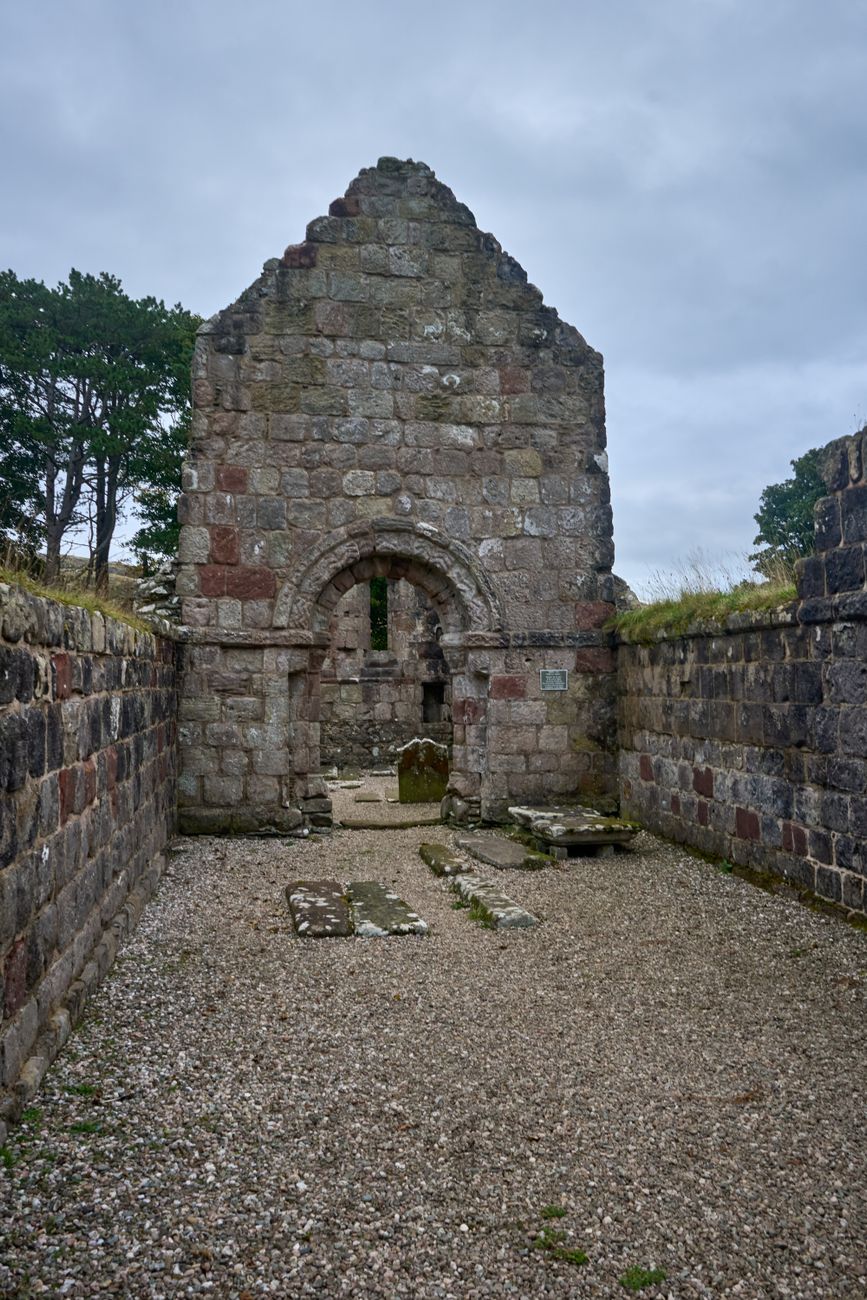
In a small Yorkshire village, during the eleventh and fourteenth centuries, the villagers excavated a pit distant from the churchyard and placed in it the shattered, hacked, and burned corpses of at least 10 men, women, and children. The village was in North Yorkshire at Wharram Percy. It was later deserted and is today one of the most famous medieval settlements in England. After a thorough analysis of these bones, the researchers provided an odd suggestion. Perhaps the locals were trying to stop the dead from coming back to life. Medieval chroniclers did write about corpses that got out of their graves and attacked the living, and some of those accounts tell of carcasses being dug up, hacked apart, and burned. The storylines align remarkably well with the bones, but not perfectly. Here I argue that the marks on the Wharram Percy bones plainly demonstrate what was done to these bodies. They can’t prove why it happened. The revenant explanation is the most plausible on offer, but it remains an inference, its power derived from comparison and the elimination of alternatives, not from the bones themselves.
The Wharram Percy Bones
Wharram Percy is a well-researched deserted medieval village in North Yorkshire, England, with large skeletal assemblages dating from the eleventh to the sixteenth centuries AD, permitting integrated biological and archeological inferences about the life, health, and diet of the peasantry (Richards et al., 2002; Turner‐Walker et al., 2001). This setting provides a baseline for understanding occupation, diet, and development in a rural English population during the medieval period (Atwood, 2008; Richards et al., 2002; Turner‐Walker et al., 2001).
The physical proof comes first: the bones were excavated in 1963 but were not researched in any detail until decades later, when Simon Mays and colleagues at Historic England and the University of Southampton published their analysis (Mays et al., 2017). They found 137 bone fragments from at least ten persons, including seven adults (five male and two female) and three young children. The bones came from overlapping holes in the settlement area near where a home was later built, not the village cemetery. The bones were cut with knives, mostly on the head and neck, with no markings below the upper torso. That suggests decapitation and dismemberment. Some of the bones had been snapped purposely after death. Others had scalding. Radiocarbon dates stretched the bones from the eleventh to fourteenth centuries, implying a series of distinct events rather than one occurrence (Mays et al., 2017). So the bones speak of a recurrent and deliberate practice. Somebody hacked, broke, and burned human bodies more than once, then buried the remains outside consecrated land.
Alternative Explanations
That description is very solid. Interpretation is more difficult. The angle, depth, and position of the blade on the bone are recorded by a cut mark. It does not register a belief. A butcher, a murderer, someone preparing a body for reburial, and a horrified neighbor may all leave identical markings. So Mays and his team weighed many explanations against each other. One was that the dead were outsiders, like migrants or foreigners, and were treated differently because they didn’t belong to the community. A strontium isotope study of tooth enamel argued against this theory, as the results were consistent with those who had grown up nearby (Mays et al., 2017). Another possibility was cannibalism in times of hunger. Medieval England did suffer from acute food shortages and survival cannibalism has left its remains elsewhere in the archeological record. But the pattern of the marks didn’t fit slaughter. Meat cutting generally focuses on the major muscle attachments and joints of the limbs and thus the markings are crowded around the head and neck (Mays et al., 2017). With those choices eliminated, the researchers came up with the concept that the bodies were destroyed so they would not walk. Mays was careful with his words. He noted the revenant theory “seems to fit the evidence best” and that if the team was right, the discovery would be the first reliable archeological proof for the practice in England (quoted in Wharram Percy Bodies, 2017).

Revenants in Medieval Accounts
This is when the textual sources become relevant. Medieval English literature provided us colorful descriptions of the walking dead. Most notable are those of William of Newburgh, an Augustinian canon from Yorkshire, who produced his Historia rerum Anglicarum in the 1190s. In Book Five he relates tales of various revenants: somebody at Berwick, another in Buckinghamshire, a chaplain at Melrose Abbey, and a man near Alnwick Castle (William of Newburgh, ca. 1198/1856). These figures are not ghosts in the contemporary sense. They are corpses that rise from the grave, terrorizing the populace and spreading sickness. In the tale of Alnwick, the dead man walks by night, and the air seems to grow vile. People start becoming sick and dying. The two brothers dug out the body, struck it with a spade and found it bloated with blood. They remove the heart, bring the corpse out of the community, and burn it, and the plague is finished (William of Newburgh, ca. 1198/1856). A second batch of anecdotes, recorded by a monk of Byland Abbey c. 1400, discusses comparable issues in the same section of Yorkshire. In one, the body of a rector, James Tankerlay, rises by night and injures his old sweetheart until the monks dig him up and toss him into a lake (James, 1922).
In important aspects these stories are consistent with the Wharram Percy evidence. They came from the same area and are in the dating range of the bones. They tell of the dead being dug up, hacked up, and burned, which is what the bones depict. They also emphasize the body as a site of peril. Simpson (2003) notes that almost all of William’s revenants and many of the Byland ones are ‘walking dead’—corpses that have physically emerged from their graves. Their closest medieval parallels are the Icelandic draugar, which had to be wrestled, beheaded, and burned. If the threat originated from the corpse, then destroying it was a logical course of action. Cut off the head, smash the bones, and burn the remnants. That would disable a body that could otherwise get up.
Limits of the Revenant Interpretation
But the comparison should be made with care. The stories were not written as detached accounts of community custom. William of Newburgh was a churchman writing history with a moral intent, and modern academics view his revenant tales in part as teachings against sin, evil conduct, and the risks of dying unreconciled with the Church (Caciola, 2016). The ghosts in his stories are typically malevolent characters. An adulterous one. He is a priest who neglected his duties. A man who died in a jealous rage. The Byland stories are also formed by religious considerations, many of which conclude with absolution and Masses for the dead, rather than violence to the body (James, 1922). Thus, the texts give us a picture of what educated monks thought, or desired their readers to think, regarding the deceased. They are a flawed guide to what people in a farming hamlet actually did with a shovel and a knife. Nor do the written record and the archeological record perfectly match. William’s stories are about the heart, yet bones cannot tell us if a heart was removed. Wharram Percy: The cutting’s focus is on the head and neck; however, the texts are less consistent in referring to beheading.
There is also a more basic methodological difficulty. And the explanation of revenants was obtained largely by the process of elimination. That is not an unreasonable argument, but it relies on having thought of every feasible alternative. The list may not be exhaustive. Other causes for destroying a body might leave comparable traces: punishment of an executed criminal, ritual treatment of those who died in a certain way, or local rituals that never got into any chronicle. Other researchers on the site have also suggested that the evidence is more ambiguous than it looks, since burning and breaking can happen in ways that are impossible to tell apart after centuries underground. None of these doubts disprove the Wharram Percy view. They demonstrate that the bones support the Wharram Percy view, rather than proving it definitively. A bone can inform us in the end that a blade was pulled across a neck. Only context, comparison, and reasoning can imply the dread that may have guided the hand.
Conclusion
So can the marks on the Wharram Percy bones explain to us why the people handled these bodies as they did? They cannot do it alone. The bones tell a clear and certain story of what was done: beheading, mutilation, purposeful breaking and burning, repeated over centuries, and local people buried outside the churchyard. To account for these behaviors, we must go beyond the bones into the written culture of medieval Yorkshire. Here chroniclers such as William of Newburgh and the Byland monk spoke of walking corpses and the terrible medicines used against them. The fit between the stories and the remains is close enough, and the alternatives are poor enough, that the revenant explanation is the most convincing reading available. It must, however, be handled with the same caution its writers demonstrated. Wharram Percy is an example of how much archeology can tell us about the past and where it cannot. The bones can tell you exactly what people were doing. What those people felt had to be gleaned from multiple sources and even then it can’t be verified.
References
Atwood, M. L. (2008). Osteoporosis in a prehistoric Bay Area population [Master’s thesis, San Jose State University]. SJSU ScholarWorks. https://doi.org/10.31979/etd.7a32-5cf9
Caciola, N. M. (2016). Afterlives: The return of the dead in the Middle Ages. Cornell University Press.
James, M. R. (1922). Twelve medieval ghost-stories. The English Historical Review, 37(147), 413–422. https://doi.org/10.1093/ehr/XXXVII.CXLVII.413
Mays, S., Fryer, R., Pike, A. W. G., Cooper, M. J., & Marshall, P. (2017). A multidisciplinary study of a burnt and mutilated assemblage of human remains from a deserted mediaeval village in England. Journal of Archaeological Science: Reports, 16, 441–455.
Richards, M. P., Mays, S., & Fuller, B. T. (2002). Stable carbon and nitrogen isotope values of bone and teeth reflect weaning age at the medieval Wharram Percy site, Yorkshire, UK. American Journal of Physical Anthropology, 119(3), 205–210. https://doi.org/10.1002/ajpa.10124
Simpson, J. (2003). Repentant soul or walking corpse? Debatable apparitions in medieval England. Folklore, 114(3), 389–402. https://doi.org/10.1080/0015587032000145397
Turner‐Walker, G., Syversen, U., & Mays, S. A. (2001). The archaeology of osteoporosis. European Journal of Archaeology, 4(2), 263–269. https://doi.org/10.1179/eja.2001.4.2.263
Wharram Percy bodies mutilated to “stop dead rising”. (2017, April 3). BBC News. https://www.bbc.com/news/uk-england-york-north-yorkshire-39477005
William of Newburgh. (1856). The history of William of Newburgh (J. Stevenson, Trans.). Seeleys. (Original work written ca. 1198)

Leave a Reply