Is the Bimini Road Atlantis? Key Points
- In 1932, Edgar Cayce said a survey near Bimini might reveal evidence of Atlantis. In 1940, he separately said Poseidia would “rise again” in “’68 and ’69” but never mentioned Bimini or ruins.
- In 1968, divers led by J. Manson Valentine described a J-shaped row of flat stones off North Bimini. Cayce’s followers saw it as the prophecy fulfilled.
- Later accounts merged the two readings, got the date wrong, and added “ruins” near Bimini. Rising land became an archaeological find.
- Eugene Shinn’s team drilled and x-rayed cores from the blocks. They found natural beachrock, which forms along shorelines and cracks into rectangles.
- Radiocarbon dates came out at about 2,780 to 3,510 years old. That is far too young for an Atlantis said to have sunk 12,000 years ago.
- Critics like Greg Little question the dating and core results. Still, no tool marks or artifacts have been found, so a drowned natural shoreline remains the best explanation.

Introduction
For more than half a century, a stretch of pale limestone blocks off North Bimini in the Bahamas has captivated divers, dreamers, and documentary crews. It is known as the Bimini Road formation. Much of the reputation is due to Edgar Cayce, a psychic born in Kentucky who died in 1945, more than twenty years before anyone described the stones. Cayce’s trance readings placed Atlantis in the western Atlantic, and his followers eventually used the 1968 discovery in Bimini as evidence that he was accurate. But side by side, Cayce’s words and the popular retellings say different things. The scientific work tells a third tale. Geologists bore into the blocks and dated the material. Their results suggest that the material is a natural beach deposit rather than evidence of a lost civilization. This essay examines what Cayce stated, how his words evolved in the telling, and what the rock itself has to say.
The Bimini Road Formation
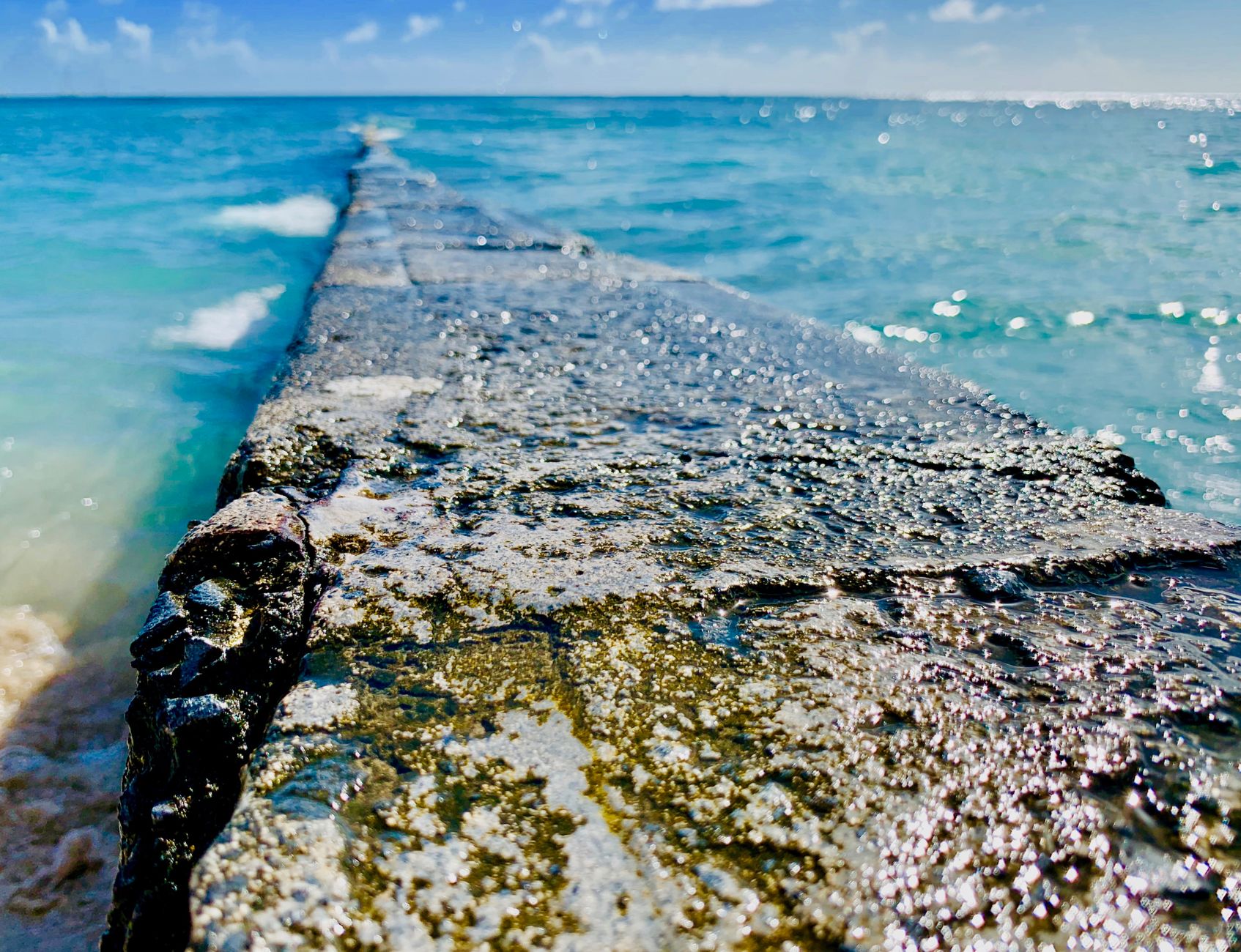
The Cayce Atlantis claim is located on what is an intertidal beach rock block off the northwest edge of Bimini, Bahamas. Large rectangular blocks create an apparent linear configuration in relatively shallow water. The prevailing geological opinion is that these are natural beachrock formations produced by continuous sedimentary processes in the subaerial to shallow-marine environment during the Holocene and not constructed structures (Shinn, 2009). Later presentations of the same topic stress that beachrock in Bimini is forming today (i.e., forming now) and that the “Bimini Road” is a natural grouping of beachrock pieces and not an intentional building by either ancient peoples or extraterrestrials. This conclusion is reflected in later geological commentary (e.g., the depositional-record literature) that argues against interpreting the Bimini Road as a manmade harbor or roadway (Kump et al., 2025).
Edgar Cayce’s Atlantis Readings
Cayce gave thousands of readings while in a self-induced trance that he and his supporters characterized. Many were health-related, but a good proportion were about former incarnations and ancient history, and Atlantis popped up again and time again. Two readings are particularly important for the Bimini story. In reading 364-3, given in 1932, Cayce located Atlantis “between the Gulf of Mexico on one side” and “the Mediterranean upon the other” (Edgar Cayce NYC Community, 2017). He continued by saying that “the British West Indies or the Bahamas, and a portion of the same that may be seen in the present—if the geological survey would be made in some of these—especially, or notably, in Bimini and in the Gulf Stream through this vicinity, these may be even yet determined” (Edgar Cayce NYC Community, 2017). The grammar is a mess. But the claim is quite modest. Cayce hypothesized that a geological examination of the Bimini area would reveal evidence that the Bahamas had once been part of a bigger continental mass.
It is the second reading that is the source of the renowned dates. In reading 958-3, given in June 1940, Cayce observed, “Poseidia will be among the first portions of Atlantis to rise again. (Cayce, 1968). Expect it in ’68 and ’69; not far away!” According to the Cayce material, Poseidia was Atlantis’ western portion. There is no reference in the text of Bimini, ruins, roads, or fortifications. It doesn’t say anything about divers finding anything. It mentions land rising, a geological occurrence, not an archeological finding. The connection of “Poseidia” to Bimini is made by reading the text in conjunction with other readings, such as 364-3, that refer to Bimini in a different context.

The 1968 Discovery and Later Retellings
By 1968, the stitching was well underway. That year Cayce’s son Edgar Evans Cayce compiled the fragmented readings into one story for a general audience and published Edgar Cayce on Atlantis (Cayce, 1968). Then, in September 1968, biologist and explorer J. Manson Valentine and his diving colleagues reported a straight, J-shaped row of flat, rectangular stones in shallow water off North Bimini. It is approximately 0.8 kilometers long (The Archeologist, 2026). The timing seemed too coincidental for Cayce’s disciples. Predictions for ’68 and ’69 were followed by a finding in 1968 near an island Cayce had named. For many readers, the discovery was a sufficient reward.
The retellings demonstrate how significantly the phrasing changed. One famous story argues that Cayce gave his forecast in 1938 and claims that he “explicitly predicted that the ruins of the lost continent of Atlantis would be rediscovered in the waters around Bimini between 1968 and 1969” (The Archeologist, 2026). Almost every word in that statement is extrapolated from the original. The reading was from 1940, not 1938. No mention of ruins. It does not place the 1968 event at Bimini. And it speaks of growing land, not rediscovery. A more gentle take is offered by a community group linked to Cayce, which says he “prophesied the appearance of a new land off the East Coast of North America in 1968/9,” and then notes that “during this same time, the ‘Bimini Road’ was discovered” (Edgar Cayce NYC Community, 2017). This version is closer to the original but still slides from ‘new land would appear’ to ‘a road was discovered’ as if the two are the same. In 1968 and 1969 there was no land around Bimini. What happened was that divers saw rocks that always were on the seabed.
That slippage is characteristic of the way prophesies grow retrospectively. Vague phrases become definite specifics, distinct statements are fused, and the successful “hit” is described in language borrowed from the consequence. When the story becomes public, the prediction seems to be a clear reference to the Bimini Road. The original interpretations do not do that. They claim that proof of Atlantis can be found at Bimini and that a portion of Atlantis would rise around 1968 at the latest. It took decades of other people’s interpretation to make those two sentences into “Cayce predicted the Bimini Road.”
Geological Investigations and Radiocarbon Dating
Scientists immediately became interested. In 1971 the geologist Wyman Harrison wrote a brief report for Nature entitled “Atlantis Undiscovered—Bimini, Bahamas.” He stated that the formation revealed characteristics of natural rock and not of human manufacture (Harrison, 1971). The most complete investigation was done by Eugene Shinn, a geologist with the U.S. Geological Survey, who had a field station about fifty miles from Bimini. Later, Shinn reported that writer Peter Tompkins, hoping to verify the Atlantis theory, requested his team to take their core drill to the site (Shinn, 2004). They did. Oriented cores were taken from the blocks, allowing them to determine the original orientation of each sample on the seafloor. In the laboratory, cores were sliced with a diamond saw and x-rayed to display the internal layers (Shinn, 2004).
The drilling solved several questions immediately. The cores revealed the blocks to be beachrock, a type of limestone formed when beach sand and shell pieces are cemented together by calcium carbonate in the intertidal zone. The older rock in the cores was “identical to that forming on the main swimming beach at Bimini,” Shinn (2004) said, where current litter, such as bottle caps, is sometimes seen in new beach rock. Beachrock is created in situ along the shore. As it dries and is exposed, it has a tendency to crack into rectangles, very much like an old sidewalk. If the shore is straight, the rock is straight. That was Shinn’s straightforward point (Shinn, referenced in American Association of Petroleum Geologists, 2026). These historic beach sediments became submerged when sea level rose following the previous ice age. Nature carried out McKusick and Shinn’s argument that the interior bedding was consistent with natural formation where it was. The layers of blocks moved by people would be expected to be randomly arranged.
Radiocarbon dates provided a time window. Samples from Shinn’s cores were dated at the University of Miami. Whole-rock samples yielded radiocarbon ages of roughly 2,780, 3,350, and 3,500 years, while a shell sample was dated at about 3,510 years (Calvert et al., 1979). Some secondary reports also point out that dating the cement separate from the shells indicates that the cementing happened somewhat later than the silt accumulated, as one would expect for beachrock (Crystalinks, 2024). These ages are in the late Holocene, just a few thousand years ago, with an error margin. Cayce’s readings dated the eventual destruction of Atlantis to about 10,000 BCE. A 3,000-year-old rock cannot be the pavement of a civilization that supposedly sank 12,000 years ago.
The dispute didn’t end there. The proponents of an artificial origin, most notably researcher Greg Little, have argued against the reliability of bulk dating of complete rock. And they note that Shinn’s 1978 Sea Frontiers report found less than a fifth of the cores had strata descending toward the sea. They felt that the results sounded more uniform than they were in later reports (Systemagic Motives, n.d.). These are things worth remembering, because careful examination of the original technical reports is fair game for any side. But they do not constitute positive evidence of human work. There are no tool traces, no mortar, no foundations, and no artifacts that link the blocks to the wider scientific community. The rock type, its mode of formation and its young age nevertheless suit a natural beach rock origin better than any other explanation.
These sources indicate an academic consensus that there is no archeological evidence for Atlantis as an old engineered harbor of beachrock blocks at Bimini or elsewhere. The location and time of Atlantis are unknown and have not been validated by peer-reviewed archeological research, and the Bimini stones are not evidence of Atlantis (Kump et al., 2025). Some arguments point out that there is no scientifically validated location or coordinates of Atlantis; the Atlantis idea remains unsupported by substantiated archeological data. Bimini Road does not substantiate Cayce’s assertions of Atlantis.
Conclusion
The Bimini Road is a good case study because it illustrates how a prophesy can evolve after it has been made. Cayce stated Atlantis proof may be found near Bimini and also said Poseidonia will rise in 1968 and 1969. His successors amalgamated such statements; later writers added ruins, highways, and a particular finding. With each telling, the prophecy became more like what actually happened. The geologists tried another strategy. They bore into the stones, sliced and x-rayed the cores and sent samples for radiocarbon testing. What they uncovered was regular beachrock, produced along an ancient shoreline a few thousand years ago and then drowned by rising waters. The stones are real, and the story is appealing. However, the rock reveals the slow and gradual processes of tides, sand, and sea level changes, rather than indicating the existence of Atlantis.
References
American Association of Petroleum Geologists. (2026, March 3). Some will learn, others ‘believe’. AAPG Explorer. https://www.aapg.org/news-and-media/explorer/some-will-learn-others-believe/
The Archaeologist. (2026, June 18). Bimini Road: Bahamas’ Atlantis-linked underwater stones. https://www.thearchaeologist.org/blog/bimini-road-bahamas-atlantis-linked-underwater-stones
Calvert, P. M., Introne, D. S., & Stipp, J. J. (1979). University of Miami radiocarbon dates XIV. Radiocarbon, 21(1), 107–112.
Cayce, E. E. (1968). Edgar Cayce on Atlantis. Hawthorn Books.
Crystalinks. (2024, November 3). Bimini Road. https://crystalinks.com/biminiroad
Edgar Cayce NYC Community. (2017, March 28). Edgar Cayce on Atlantis. https://edgarcaycenyc.org/edgar-cayce-on-atlantis/
Harrison, W. (1971). Atlantis undiscovered: Bimini, Bahamas. Nature, 230, 287–289.
Kump, L. R., Hine, A. C., & Ingalls, M. (2025). Introduction. The Depositional Record, 12(1), Article e70046. https://doi.org/10.1002/dep2.70046
McKusick, M., & Shinn, E. A. (1980). Bahamian Atlantis reconsidered. Nature, 287(5777), 11–12. https://doi.org/10.1038/287011a0
Shinn, E. A. (1978). Atlantis: Bimini hoax. Sea Frontiers, 24, 130–141.
Shinn, E. A. (2004). A geologist’s adventures with Bimini beachrock and Atlantis true believers. Skeptical Inquirer, 28(1), 38–44.
Shinn, E. A. (2009). The mystique of beachrock. In P. K. Swart, G. P. Eberli, J. A. McKenzie, I. Jarvis, & T. Stevens (Eds.), Perspectives in carbonate geology: A tribute to the career of Robert Nathan Ginsburg (pp. 19–28). Wiley-Blackwell. https://doi.org/10.1002/9781444312065.ch2
Systemagic Motives. (n.d.). Bimini Road evidence review. https://systemagicmotives.com/atlantis_rising/skeptical-record.htm

Leave a Reply