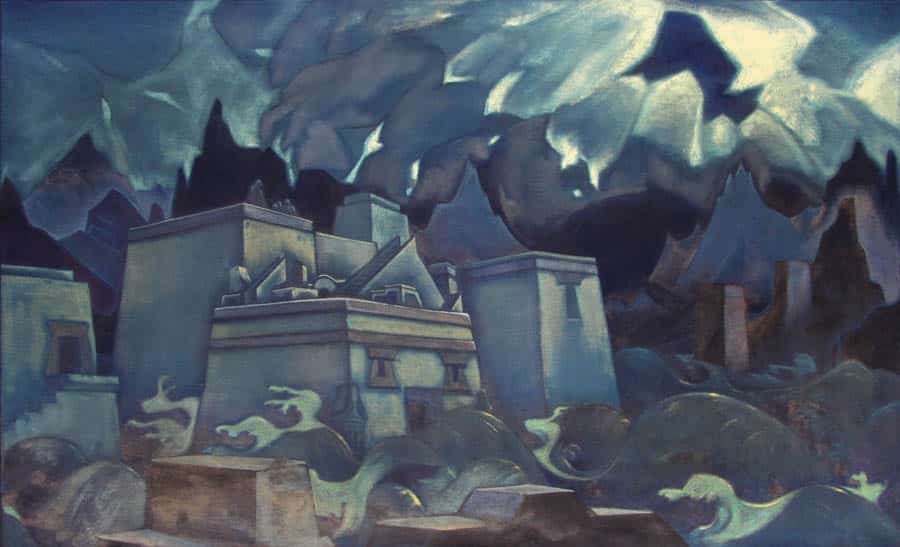
Cosmic Destruction of Atlantis and Lemuria: Key Points
- Atlantis originates from Plato’s dialogues Timaeus and Critias around 360 BCE, described as a wealthy, advanced island empire beyond the Pillars of Hercules that sank beneath the waves in a single day and night.
- Lemuria is a more recent and dubious invention, beginning as a nineteenth century land bridge hypothesis by zoologist Philip Sclater before occultists like Helena Blavatsky transformed it into a lost spiritual continent.
- The destruction stories of both lands share a common theme of grand civilizations brought down suddenly by flood and fire, echoing flood myths found across many cultures.
- According to Stuart Webb’s Children’s Encyclopedia of Unexplained Mysteries, a French astronomer named G. R. Coril supposedly proposed in 1785 that a comet fragment destroyed Atlantis, though this figure is hard to verify historically.
- Ignatius Donnelly was the most influential catastrophist, arguing for a real Atlantis in his 1882 book Atlantis: The Antediluvian World and developing his comet impact theory in his 1883 book Ragnarok: The Age of Fire and Gravel.
- While modern science confirms that impacts and airbursts are real and can be devastating, there is no geological evidence for either lost continent, so the cosmic destruction theories explain the end of places that most likely never existed.

Introduction
Stories of sunken continents consumed by the sea have long captivated the human imagination. The two most famous of these fabled landmasses, Atlantis and Lemuria, belong to a broader tradition of lost civilizations said to have been destroyed by sudden and dreadful cataclysms. For more than a century, some writers have argued that these disasters were not caused solely by gradual geological change or divine punishment, but by violent contact with the cosmos itself—a comet or a swarm of meteors striking the Earth. This essay considers these legendary continents, their stories of destruction, and the catastrophist hypotheses that link their demise to fire raining from the sky.
Atlantis: From Platonic Allegory to Cosmic Catastrophe
The older and more widely known of the two is Atlantis. The story originates with the Greek philosopher Plato, who described it in Timaeus and Critias around 360 BCE. Beyond the Pillars of Hercules, he wrote, lay a prosperous and technologically advanced island empire governed by the descendants of the sea god Poseidon. Over time, its people became corrupt and arrogant, and, according to Plato, the island sank beneath the sea in a single day and night of sorrow. Ever since, scholars have debated whether Plato intended the account as literal history or as a moral allegory (Ившин & Kudelina, 2023; Harvey, 2014; Lyall, 2022). Many interpret it as a literary device within a broader philosophical discussion about moral decline, governance, and the fate of civilizations. Modern scholarship situates Atlantis within a continuum of myth, cultural memory, and political philosophy, examining how myth functions in reflections on government, modernity, and eschatology. This scholarly context is essential when considering claims that Atlantis was destroyed by a cosmic event, since such interpretations often reflect broader cultural narratives rather than strictly historical evidence (Campion, 1998; Wojcik, 2022; Hallam, 1991).
Studies of mythic destruction and cosmic catastrophe further demonstrate how ancient and later cultures frequently associated the end of civilizations with celestial phenomena such as comets and meteors. These references may be metaphorical or may preserve proto-scientific observations embedded in myth. In this light, the destruction of Atlantis can be understood not as documentation of a verified impact event, but as part of a long tradition of interpreting catastrophe through the imagery of the heavens (DİLEK & KAHYA, 2023; S.F., 2014; Beardsley, 1986).

Lemuria: Scientific Hypothesis and Occult Reinvention
Lemuria, by contrast, originated not in classical philosophy but in nineteenth-century scientific speculation. Zoologists such as Philip Sclater and Ernst Haeckel proposed a lost continent in the Indian Ocean to explain the distribution of lemur fossils between Madagascar and India. Although initially framed as a geological hypothesis, Lemuria soon acquired a broader cultural life through occult and Theosophical movements (Wojcik, 2022; Bongiorno, 2011; “Biology at the British Association”, 1893; Pittaway, 2017). In Helena Blavatsky’s The Secret Doctrine and related works, Lemuria became the homeland of a “third root race,” woven into elaborate metaphysical narratives about human evolution and spiritual development. Over time, the concept drifted further from its scientific origins and merged with other speculative lost continents, such as Mu, becoming a spiritual symbol rather than a serious geological proposal (Wojcik, 2022; Bongiorno, 2011; “Biology at the British Association”, 1893).
Shared Narratives of Sudden Destruction
Despite their different origins, the disaster stories of Atlantis and Lemuria share a common emotional core. Each describes a place of immense splendor abruptly destroyed. Atlantis vanishes beneath the sea, its harbors and towers swallowed in a single catastrophe. Theosophical accounts portray Lemuria succumbing to earthquakes and floods, with survivors scattering to seed future civilizations. These narratives echo flood myths from around the world, from the biblical Deluge to the Mesopotamian story of Utnapishtim. What unites them is the overwhelming suddenness of destruction: an entire world ends not gradually over centuries but almost instantaneously. This abruptness has encouraged writers to seek an external cause dramatic enough to match the scale of the calamity (Campion, 1998; Wojcik, 2022; Hallam, 1991; Troeva, 2022).
Geoarchaeological and geoscientific studies of ancient disasters offer a framework for understanding such stories. Floods, earthquakes, and volcanic eruptions are historical realities, and memories of them can become embedded in myth, later shaping narratives of societal collapse or displacement. This body of scholarship cautions against drawing a simple one-to-one correspondence between myth and a specific impact event. It emphasizes the need to distinguish between the metaphorical or moral use of “catastrophe” in myth and evidence-based claims about ancient comet strikes.
Catastrophist Hypotheses and the Cosmic Explanation
Although it is difficult to identify the first proponent of a cometary explanation for Atlantis, the idea has deep roots. Stuart Webb reports that a French astronomer, G. R. Coril, supposedly proposed in 1785 that a fragment of a comet struck the Earth and destroyed Atlantis. If accurate, this would place the cosmic hypothesis surprisingly early, predating the nineteenth-century flourishing of catastrophist thought. However, corroborating this figure in the historical record is challenging, and the claim should be treated cautiously. The broader intellectual pattern is clear, however: eighteenth-century thinkers sometimes invoked comets to explain historical disasters, as William Whiston did when attributing the biblical Flood to a comet.
In the nineteenth century, the most influential catastrophist associated with Atlantis was Ignatius Donnelly, an American politician and amateur scholar. Writers in this tradition gathered scattered myths, geological curiosities, and historical fragments, arguing that they all pointed to a single, devastating event. A comet or meteor impact was an appealing explanation, as it could account for sudden flooding, widespread fire, darkened skies, and the apparent collapse of complex societies. Modern science has demonstrated that impacts and airbursts are real and can be devastating, as shown by the extinction of the dinosaurs and the Tunguska event. In this limited sense, catastrophist intuition anticipated genuine natural phenomena.
Yet no geological evidence supports the existence of a drowned continent in the Atlantic or Pacific Oceans corresponding to Atlantis or Lemuria. The continents themselves appear to have arisen from philosophical allegory and speculative science later reshaped by occult imagination. While cosmic impacts are scientifically plausible events, there is no evidence linking such an event to the destruction of Atlantis or Lemuria. The hypothesis of cosmic annihilation, vivid though it may be, attempts to explain the disappearance of lands that most likely never existed.
Conclusion
Ultimately, the belief that comets or meteors destroyed Atlantis and Lemuria belongs more to mythology and the history of ideas than to established science. Greek philosophical narrative and nineteenth-century scientific conjecture, transformed through mysticism, gave birth to these lost continents. Their dramatic destructions reflect a deep human fascination with sudden ruin, and writers from the obscure Coril to the prolific Donnelly projected that fascination onto the heavens, imagining fire falling from the sky. These theories are imaginative and, in some respects, intriguingly prescient about the reality of cosmic impacts. Yet the worlds they sought to explain remain, as far as the evidence shows, magnificent creations of the human imagination rather than submerged chapters of history.
References
Beardsley, T. (1986). SDI on campus. Nature, 319(6053), 437–437. https://doi.org/10.1038/319437b0
“Biology at the British Association”. (1893). Nature, 48(1250), 574–576. https://doi.org/10.1038/048574b0
Blavatsky, H. P. (1888). The Secret Doctrine: The synthesis of science, religion, and philosophy. Theosophical Publishing Company.
Bongiorno, F. (2011). Aboriginally and historical consciousness: Bernard O’Dowd and the creation of an Australian national imaginary. Aboriginal History Journal, 24. https://doi.org/10.22459/ah.24.2011.03
Campion, N. (1998). Editorial. CC, 2(01), 1–2. https://doi.org/10.46472/cc.0102.0101
DİLEK, Y., & KAHYA, Ö. (2023). Flood and Earthquake as Punishment of Gods in Antiquity. Afet Ve Risk Dergisi, 6(3), 819–828. https://doi.org/10.35341/afet.1230017
Hallam, A. (1991). Theories for everything. Nature, 354(6351), 327–328. https://doi.org/10.1038/354327a0
Harvey, D. A. (2014). THE LOST CAUCASIAN CIVILIZATION: JEAN-SYLVAIN BAILLY AND THE ROOTS OF THE ARYAN MYTH. Modern Intellectual History, 11(2), 279–306. https://doi.org/10.1017/s147924431400002x
Lyall, S. (2022). “And so with the moderns”: The Role of the Revolutionary Writer and the Mythicization of History in J. Leslie Mitchell’s Spartacus. Clotho, 4(2), 127–152. https://doi.org/10.4312/clotho.4.2.127-152
Pittaway, G. (2017). Food for finality: feeding the bereaved and ‘feasting’ the dead. Text, 21(Special 45). https://doi.org/10.52086/001c.25848
Plato. (ca. 360 BCE). Timaeus and Critias.
S.F., U. (2014). Udartsev S.F. Сosmic state: the forming and development of the idea in the history of thought. Право И Политика, 4(4), 548–561. https://doi.org/10.7256/1811-9018.2014.4.11415
Troeva, E. (2022). Eschatological Notions in Post-Socialist Bulgaria. Yearbook of Balkan and Baltic Studies, 5, 112–135. https://doi.org/10.7592/ybbs5.05
Wojcik, D. (2022). UFO Mythologies: Extraterrestrial Cosmology and Intergalactic Eschatology. Traditiones, 50(3). https://doi.org/10.3986/traditio2021500302
Ившин, К. С., & Kudelina, E. (2023). Digital visual modelling of educational virtual media. E3s Web of Conferences, 389, 08011. https://doi.org/10.1051/e3sconf/202338908011



Leave a Reply