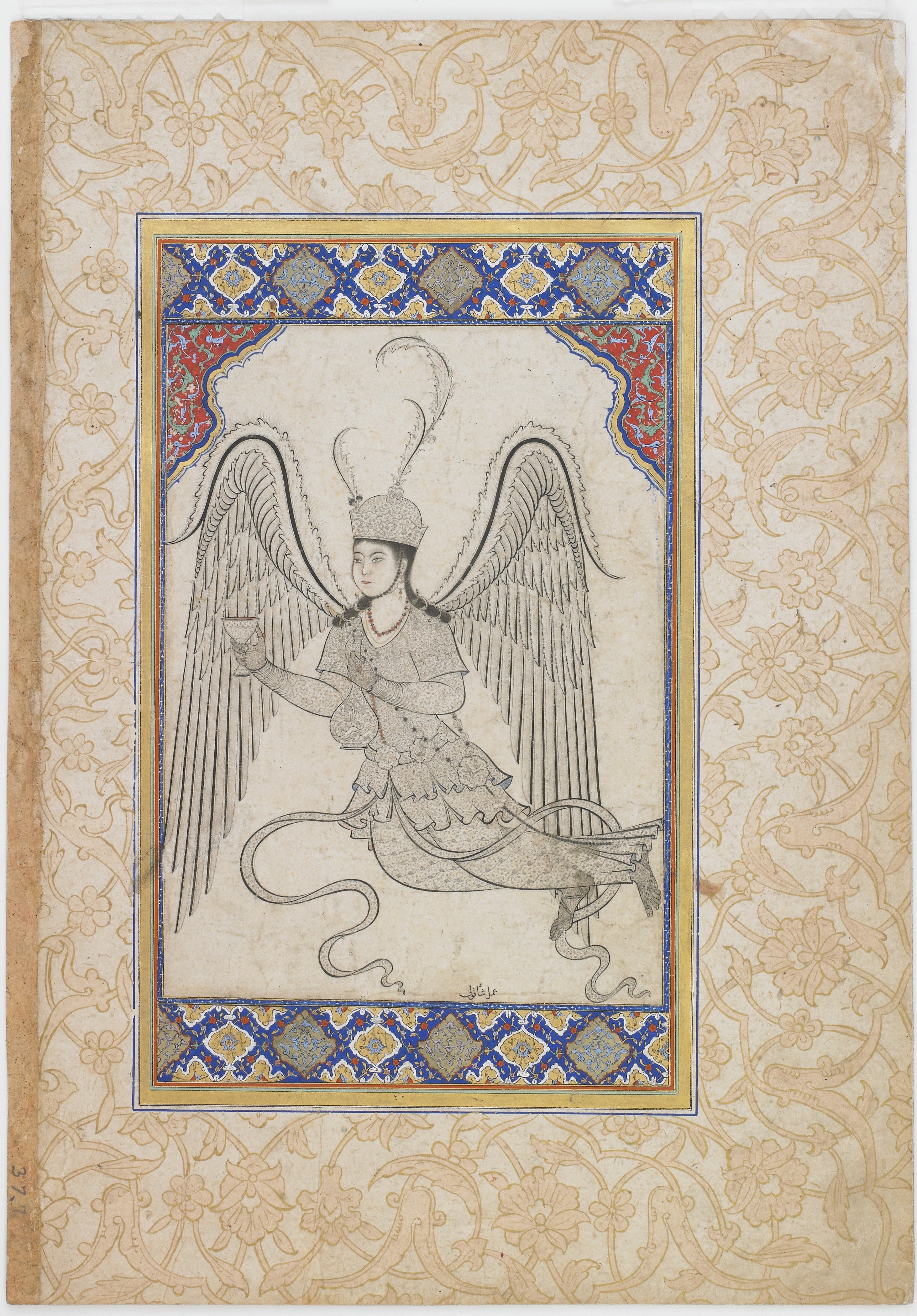
Peri Fairies in Persia: Key Points
- Peris are female nature spirits or fairies of ancient Persia whose beauty was said to be so overwhelming that the rainbow was only a faint echo of it (Rosen, 2009).
- They are described as slender, radiant, winged, fragrant, and partly made of fire or vapor, sometimes wearing a feather garment that binds them to earth if stolen.
- Behaviorally they are proud, wilderness dwelling, drawn to music and dance, prone to punishing offense with illness or madness, and inclined to love mortals and then abandon them. (Rosen, 2009).
- Their moral status shifted with religion: in the Zoroastrian period they embodied light against the dark deevs, while later Islamic era myth blamed them for storms, drought, and crop failure and recast them as fallen angels who must earn their way back to Heaven (Rosen, 2009).
- Persian literature preserves them widely, from the Shahnameh and the Hamzanama to the tale of Prince Ahmed and the Peri Banu, alongside folk stories of stolen feather robes and vanishing peri brides.
- Scholars variously explain them as demonized pre-Zoroastrian goddesses later rehabilitated, as personifications of drought and desert heat, or as a cultural language for explaining illness and misfortune, and the likeliest answer combines all three.

Introduction
Of all the creatures imagined on the Iranian plateau, few have been as enduring, attractive, or difficult to define as the peri. These bright female spirits are neither fully divine nor purely mortal, inhabiting a mutable middle ground between heaven and earth, and their nature has been rewritten repeatedly over the course of three thousand years of religious and literary transformation. They have been devils and angels, temptresses and penitents, drought bringers and light guards. Their name remained in modern Persian as a synonym for beauty, and their influence spread into Turkish, Armenian, Urdu, and eventually European literature. To trace the peri is to follow the rich religious history of Persia itself, from Zoroastrian dualism to Islamic cosmology to the romances of medieval courts.
Regional Presence and Physical Form
In Kazakh and wider Central Asian folktales, the Peri is specifically described as a water fairy and is associated with Iranian mythological ancestries. Kazakh material recognizes Peri as an element of mythological imagery that cuts between Muslim and pre-Islamic strata and locates “the image of the nymph Peri” in the Iranian and Turkic mythic strata (Zharylgapov et al., 2023). This placed Peri within a cross-cultural constellation of fairies/spirits that traverse mythic domains (Islamic, pre-Islamic, and regional shamanic) and show up in epic and fairy-tale motifs in Turkic contexts (Zharylgapov et al., 2023).
Physically, the peri is characterized above all by an excess of beauty. In ancient Persia, for example, female nature spirits were so beautiful that the rainbow was a pale reflection of their beauty (Rosen, 2009). And through all their lives, the Persian poets returned to this contrast and spoke of peris as thin, pale, and shining, with faces like the full moon and hair long enough to be a ladder or a snare. They are usually imagined as winged, but their wings are not so much the feathered pinions of Abrahamic angels as something more like the iridescent membranes of an insect or the sheen of light on water. Some say they have bodies of fire or vapor, allowing them to pass through walls, ride the wind, or vanish at will. They smell pleasant. They are perfumed and, in many stories, their arrival is heralded by a smell of musk or roses before they are seen at all. Their apparel is exquisite silk, sometimes a gown of feathers that, once stolen, strands the peri on earth and bonds her to the thief. They are tiny, fragile, and weightless, like flame, and mortals who see them are said to be speechless.
Temperament, Liminality, and the Encounter With the Hero
Female supernatural creatures regularly serve as helpers, testifiers, or tributes to cosmological order in Turkic and Iranian mythology. For instance, the Turkish and Turkic epic traditions contain demonological and fairy figures (Zhalmauyz Kempir in Kazakh discourse, peri-type beings, and fairy brides) that disturb or assist heroes and are situated within a broader context of shamanic, totemic, and cosmogonic motifs (Орaзхан et al., 2024). The literature notes that the core of epic narratives consists of “fairies” and “demonological” images. Images often stand in liminal places between realms and between beings of power and ordinary humans (Оразхан et al., 2024).
They are as fickle as their behavior. Peris are spirits of the woods, not city dwellers; they are hidden in gardens, desert dwellers, or air dwellers, not dwellers of mods. They flock; they dance; they are attracted by music and poetry. They are also fiercely proud and easily offended, and they punish rudeness with disease, madness, or paralysis, which is why for so long traditional healers throughout Iran and Central Asia considered some seizures and fevers as personal afflictions requiring appeasement rather than treatment. Tales speak of peris that live in beautiful castles within iron cages on top of trees, where other peris send them perfumes as tribute (Rosen, 2009). That image is worth dwelling on, because the cage is both a fortress and a prison, and it conveys something vital about the Persians’ understanding of these beings: exalted, protected, confined, and never completely free. Peris falls in love with mortals. They also forsake them, frequently without warning, and the abandoned lover often fades away or spends the rest of the novel trying to locate a road back to a nation that does not exist on any map.
A frequent element in Turkic and related mythology is the marriage or liaison of a hero and a fairy-like figure (sometimes described as a daughter of the other realm). This link encodes a bridge between civilizations, and it is a narrative device for the transfer of cosmological knowledge, power, or lineage. The literature indicates that such themes, when a hero marries a fairy or is associated with a female other-world figure, are inscribed into epic narratives and are used to demonstrate the hero’s relationship to ancestral and cosmological forces (Kerimkulova & Ibraev, 2021; SAHITZHANOVA et al., 2023). Turkic tales contain demonological imagery (diyu, shaitan), which works in opposition or antagonism to heroes and benevolent peri-like aids. The demonic female figures in these corpora could represent a threat, a moral test, or an archetypal challenge that the hero must conquer or outwit, lending structure and an ethical logic to the epic (Kerimkulova & Ibraev, 2021; Оразхан et al., 2024). The peri-like entities are associated with cosmogonical knowledge and ritual knowledge in mythological discourse, including relations to ancestors, sacred sites, and ritual deeds. The emergence of such beings in the mythological narrative is viewed as a manner of integrating common ideas about the world—cosmology, ethics, and social order—into the narrative (Orazkhan et al., 2024; Seferova, 2020).

Religious Transformation and Literary Preservation
Religion dramatically changed the function of the peri in Persian folklore. In the older Zoroastrian period, the peris were viewed as the benevolent and light powers of the world, rather than the dark and evil forces termed deevs (Rosen, 2009). In this dualistic scheme, cosmic history is a conflict, and every creature is drafted into one side or the other. Later, in the legendary tales that grew under Islam, peris were blamed for disastrous weather, for the failure of the sun and for destroyed harvests (Rosen, 2009). Islam also provided them with a new theology. They were called fallen angels, cast out of Heaven, who would not return until they had done enough virtuous deeds on earth to be readmitted (Rosen, 2009). This notion of exile and moral struggle endowed the peri with a sorrow that was never achieved by evil demons alone and explains the homesick, morally striving peri of so many later legends. Popular usage further absorbed them, mixing them with the jinn of Arabic cosmology, so that the village storytellers might speak of Muslim peris, of peri rulers, and of peri weddings performed in accordance with law.
The finest instances of Persian tale literature have been preserved. Ferdowsi’s Shahnameh, compiled around the year 1000 from much older oral material, is replete with peri imagery, most notably in its praise of women whose beauty is said to be peri-born and in its stories of heroes such as Rostam, who contend with the deevs that are the natural opposites of the peris. The major cycle of Hamza tales, the Hamzanama, leads its hero into the world of the peris and jinn, where he is assisted, imprisoned, wedded, and continually tricked by supernatural ladies. In the story “Prince Ahmed and the Peri Banu,” a tale that is attached to the Thousand and One Nights but is Persian in flavor and setting, a mortal prince follows an arrow into a subterranean realm, marries a peri of extraordinary power, and finds that his good fortune cannot survive the jealousy of the human court. Folk versions gathered from all around Iran, Afghanistan, and Tajikistan tell of the stolen feather dress; the peri wife who bears children and then runs away; and the shepherd who spies on peris bathing in a mountain lake and pays for it with his sanity.
Contested Origins and Mythic Functions
There are competing theories about their origins. The name originates from the Avestan term pairika, which presents a dilemma because the oldest Zoroastrian scriptures depict the pairika as not benevolent at all. They are depicted as dangerous sorceresses who entice righteous men, appear as shooting stars and hold back rain. One popular theory is that the pairika were the goddesses or nature spirits of a pre-Zoroastrian, probably non-Iranian people, demonized by the new priesthood in exactly the same way as the Indic devas became the Iranian deevs. On that reading the peri was not corrupted over time but rehabilitated, gradually regaining her older reputation as a benign spirit of fertility and beauty once the polemical urgency had abated. Another idea holds that the peri is a personification of nature, the drought, the dust storms, and the heat haze over the desert that provides the raw material. Another emphasizes social function, suggesting that this belief provided a language in which to point out illness, infertility, and unexplainable tragedy in cultures with little other explanation available. These narratives are not incompatible and the fair conclusion is that the peri was compiled from numerous legends rather than being the descendant of one.
In Kazakh and Turkic-related research, fairy/mythic women (including peri-adjacent figures) are part of a larger set of demonic, saintly, or magical entities that mediate between worlds, represent moral orders, and catalyze the hero’s journey or initiation ceremonies. The studies discuss sequences when a fairy figure is involved in marriage, gifting, or testing, which subsequently structures the hero’s journey and the epic’s ethical framing. This pattern is defined within the framework of the Turkic epic, where auxiliary mythological characters (fairies, saints, and diyu) support or occasion critical hero actions (Kerimkulova & Ibraev, 2021; SAHITZHANOVA et al., 2023).
Conclusion
The peri still remains for she is explanations-settled. She absorbed Zoroastrian dualism, Islamic angelology, courtly romance, and rural medicine, never settling into a single concept, and each tradition that accepted her left something behind. By the nineteenth century, she had moved far enough west to emerge in European poetry and song as a figure of desire and exile, a soul sobbing at the doorway of a paradise she could not enter. That would have been familiar to a Persian storyteller of the eleventh century and foreign to a Zoroastrian priest of the sixth century before the common period. That is the point. The period is a record of transition. A lovely figure preserved her beauty even as everything around her, including her own moral position, was rewritten.
References
Burton, R. F. (Trans.). (1885). The book of the thousand nights and a night (Vol. 1). Kama Shastra Society.
Ferdowsi, A. (2016). Shahnameh: The Persian book of kings (D. Davis, Trans.). Penguin Books. (Original work published ca. 1010)
Kerimkulova, R. O., & Ibraev, Sh. I. (2021). Transformation of auxiliary mythological characters in the heroic epic of the Turkic peoples. Bulletin of the L. N. Gumilyov Eurasian National University Political Science Regional Studies Oriental Studies Turkology Series, 135(2), 130–137. https://doi.org/10.32523/2616-6887/2021-135-2-130-137
Lakhnavi, G., & Bilgrami, A. (2007). The adventures of Amir Hamza (M. A. Farooqi, Trans.). Random House.
Rosen, B. (2009). The mythical creatures bible: The definitive guide to legendary beings. Union Square & Co.
SAHITZHANOVA, Z., ARIPZHAN, G., & SERIMBETOVA, R. (2023). The image system of the English and Kazakh versions of the epic “Korugly.” Iasaýı Ýnıversıtetіnіń Habarshysy, 130, 30–44. https://doi.org/10.47526/2023-4/2664-0686.03
Seferova, F. A. (2020). Motive of intellectual test in the Crimean Tatar tale epic. European Proceedings of Social and Behavioural Sciences, 92, 2407–2411. https://doi.org/10.15405/epsbs.2020.10.05.318
Zharylgapov, Z., Syzdykova, B., Kaiyrbekova, A., Babashov, A., & Shakirova, K. M. (2023). Myth and mythological discourse in literary studies. Bakhtiniana Revista de Estudos do Discurso, 18(4). https://doi.org/10.1590/2176-4573e63680
Оразхан, Н., Окур, A., & Әбдіғазиұлы, Б. (2024). Түркі мифологиясындағы Жалмауыз кемпірдің эпикалық шығармалардағы сипаты. Bulletin of the Karaganda University Philology Series, 114(2), 155–162. https://doi.org/10.31489/2024ph2/155-162


Leave a Reply