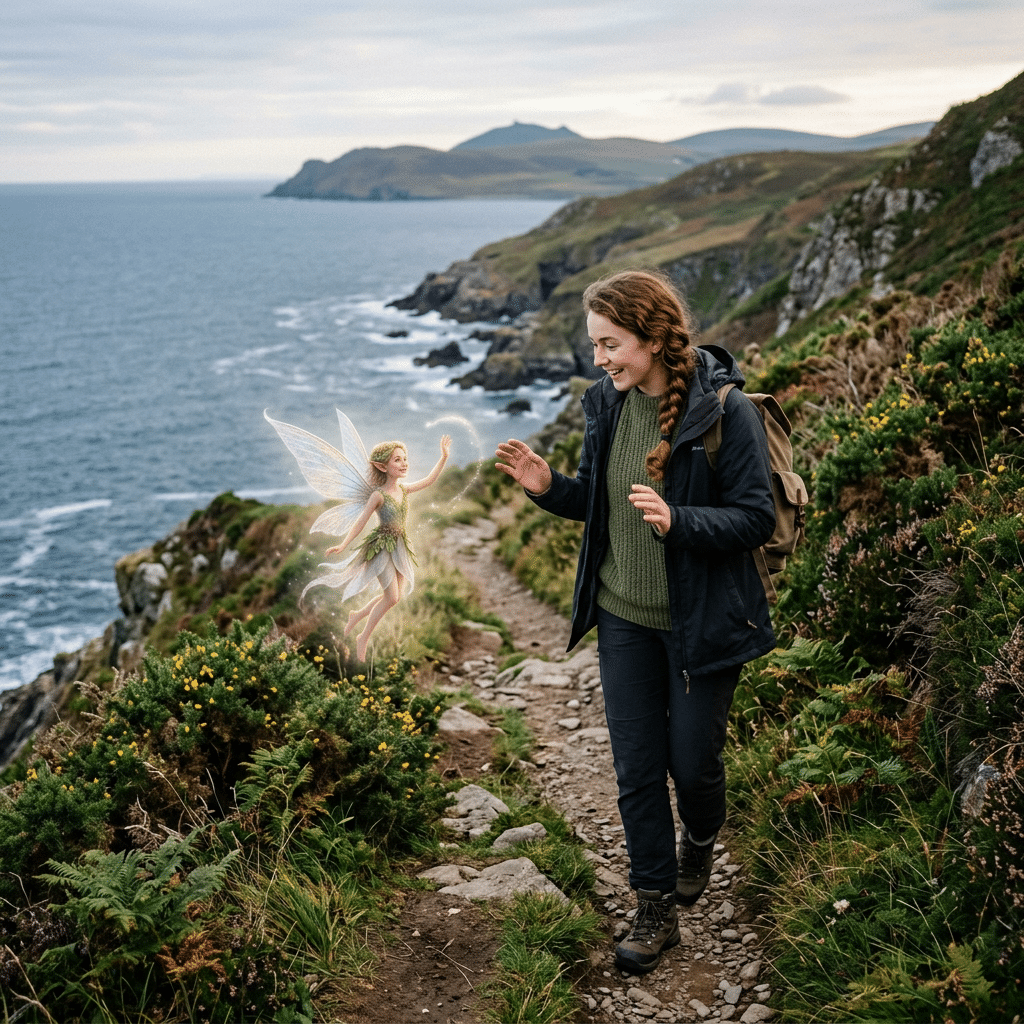
Fairies on the Isle of Man: Key Points
- The Manx fairies were usually called the Mooinjer Veggey (“little people”) or “Themselves” so as not to offend them, and they were seen as neither human, angel, nor devil. Besides the main tribe, there were solitary creatures such as the Fynoderee, the Buggane, and the Glashtyn.
- The common fairies were said to be about two or three feet tall, dressed in green jackets and red caps, and to live inside hills and ancient burial mounds. The solitary beings looked very different, like the huge, hairy Fynoderee and the shapeshifting Buggane.
- The fairies were unpredictable, since they might heal and reward people or steal children, ride horses until the animals were exhausted, and lure musicians away. The Fynoderee did farm work for families but left for good when they gave him clothes.
- Islanders kept the fairies happy by banking the fire, leaving clean water out, and setting bread by the hearth. They protected infants from being swapped for changelings with iron, salt, and rowan crosses.
- Fairy belief shaped daily routines, kept people from disturbing certain places, and gave them a way to explain misfortune. The people who collected the stories also helped preserve Manx language and culture, and the tradition lives on today in the greeting at the Fairy Bridge.
- Scholars have explained the fairies as fallen angels, as folk memories of earlier peoples, as a way to make sense of illness and disability, and as real spiritual experiences. Most likely the belief grew from a mix of all these influences.

Introduction
The Isle of Man is right in the midst of the Irish Sea, roughly halfway between England, Scotland, Ireland, and Wales. It has long been known as one of the British Isles’ strongest fairy belief sites. Older tourists saw it. Folklorists in the late nineteenth and early twentieth centuries took it seriously enough to collect hundreds of testimonies from farmers, fishermen, and storytellers before the Manx language and its oral traditions vanished (Moore, 1891; Morrison, 1911). To this day many residents and tourists meet the fairies when they cross a little bridge south of Douglas. This essay will examine the Manx fairies’ nature, portrayal, behavior, and legends. It then discusses their influence on island life and the leading hypotheses of the belief’s origin. The Manx fairy, it would argue, was never a mere figure of children’s stories. It was a complex and often dangerous neighbor, reflecting back to the land the faith and anxieties of the people who lived alongside it.
The Fairy Landscape and Names of the Little People
The Isle of Man has long been associated with fairy belief, with folklore and landscapes typically described in popular and antiquarian reports as liminal or magical. Manx folklore also connects the island with the landscape of the fairies (e.g., fairy mounds and places such as Rushen Hill) and with characters from the wider Celtic legend of fairies. (Belchem, 2000; Cameron, 1900). Manx cultural histories and folklore studies provide extensive documentation of the milieu. The island’s fairy traditions have been discussed with regard to the volcanic “Fairy Bridge” and other loci of local folklore, although modern heritage authorities have at times questioned the official heritage significance of particular sites (e.g., Fairy Bridge) within heritage planning and national identity discourses (Catte, 2015).
The study of the Manx fairy must start with names. The Manx often avoided the word fairy. The Little People were capable of mischief and spite, Morrison adds (1911), so islanders gave them flattering titles in case they were listening. The most prevalent was Mooinjer Veggey, meaning “the little people.” Others were “the Little Fellows,” “the Good People,” and, above all, “Themselves.” There was the Manx word “ferrish,” but that was apparently an English loan, and many storytellers preferred the safer phrasing. The fairies were not a single being. They were an entire class of entities. The primary group was the tribe of small human-like folk who lived in the hills, and they were accompanied by solitary animals such as the Fynoderee, the Buggane, and the Glashtyn (Moore, 1891). Most accounts situate them somewhere in between—not human, nor angels, nor exactly devils either.
Appearance and Behavior of the Manx Fairies
The descriptions of the ordinary fairies are singularly uniform. They were little, two or three feet tall, commonly said, but otherwise very much like mortals. They frequently wore green jackets and red caps (Morrison, 1911). Occasionally, they would be spotted riding out on horseback to hunt with packs of small dogs, whose coats displayed every color of the rainbow. They resided on green slopes, particularly on the old burial mounds, which stand in the Manx countryside (Moore, 1891). People could see them only if the fairies wanted them to. The single ones were entirely different. The Fynoderee was a big, hairy, ugly, and powerful creature with fire eyes. Moore (1891) notes that he was widely conceived as a fallen fairy, something between a man and a beast. One story says that he was a fairy knight who fell in love with a mortal girl from Glen Aldyn, refused to participate in the grand harvest festival held by his kind in Glen Rushen (Moore, 1891), and was subsequently banished and transformed into a shaggy satyr. The Buggane was much more hideous, a large, shape-shifting ogre that haunted certain locations, such as the waterfall at Glen Meay (Morrison, 1911).
Their behavior constituted the essence of the religion, and it was unpredictable. Some fairies were kind. They could cure sickness, save people from disaster, and reward those who were civil to them. Others abducted youngsters, kidnapped grown-ups, rode the farm horses until they were worn out, and laid unfortunate luck on the houses where they were insulted (Moore, 1891). Their music was known to be dangerous. If you were to wander near a fairy hill one wonderful summer evening, you might hear beautiful music, but a musician had to be wary about staying too long, lest he should be tempted in and caught. The Fynoderee was the more helpful aspect of fairy nature. He threshed crops before storms, mowed fields, and brought sheep in from the mountains. But he was easily insulted. In one Marlowe story, a farmer protested that the Fynoderee had not cut the grass close enough, prompting the creature to violently pull up the roots behind the man, leaving the farmer lucky to escape with his legs intact (Moore, 1891). In the most well-known story, “The Fynoderee of Gordon,” the creature works ceaselessly for a farming family. The family then gives him a present of garments and he departs forever, warning that the clothes would bring disease to every part of his body (Morrison, 1911). The lesson was simple. Fairies sought a fine mix of respect and distance; too much or too little attention may ruin it.

Legends, Customs, and Influence on Island Life
Manx legends encompass entities like the Ferrishyn (Fairy Folk) and associated Dooinney-Oie narratives, featuring themes of music, dance, and enchantment that echo wider Celtic fairy stories. Such patterns arise in trans-Celtic studies of fairies and their musical/cultural practices (singing, dancing, and performance as acts that traverse boundaries) in Celtic folkloristics and comparative studies (Miller, 2012; Silver, 1986). Long discussions of Celtic fairy creatures and their functions in marine and island societies reference the Manx Dooinney-Oie and similar figures (Miller, 2012).
This balance was surrounded in Manx legend by a comprehensive set of customs. At night the families would burn the turf fire so that the fairies could bask in the warmth, and on stormy nights the residents in the mountain parishes went to bed early so that the visitors could enjoy the embers undisturbed (Moore, 1891). They put out bread and filled the water pot with clean water for the night. In the morning the water was poured out and nothing further was done with it. Women did not spin on Saturday evenings, which was supposed to offend the Little People, and a small amount of dough or butter might be left for them at baking and churning (Moore, 1891). Hospitality was as necessary as protection. Iron, salt, and rowan crosses were used against fairy intervention, particularly to prevent infants unborn or unbaptized from being exchanged for changeling infants (Briggs, 1976; Moore, 1891). When Evans-Wentz (1911) collected testimony on the island with the assistance of Morrison, he found that many people still spoke of these beings as part of everyday experience rather than as remnants of a far-off past.
This notion had a real effect on Manx life. It governed everyday life, from the maintenance of the hearth to the hours of labor. It also shaped the landscape, for builders and farmers were frequently unwilling to damage mounds or locations associated with the fairies. It was an explanation of calamity. If a child was sickly, a horse was lame, or a churn failed, it was no accident but the fault of the Gods. It also helped to conserve the Manx culture. Fairy stories were collected by the likes of Moore (1891), Rhys (1901), and Morrison (1911) when the Manx language was in decline, and their work preserved vocabulary, place names, and techniques of storytelling that might otherwise have been lost. The most famous modern legacy is the Fairy Bridge on the way from Castletown to Douglas. Even today, islanders and visitors say a “hello” or a “good morning” to the fairies as they cross, and many leave written notes and wishes in the trees nearby. The tradition is half serious, half joking, and half a tourist attraction. It shows how an old belief can endure by altering its work, from a source of terror to a sign of local identity.
Theories of Origin and Manx Identity
There are several hypotheses about the origins of these beliefs. One, documented among the Manx themselves, was that the fairies were angels who were cast out of heaven with Satan but fell short of hell and remained in the air, the sea, and the ground (Evans-Wentz, 1911). This explains the in-between nature of the fairies and reveals how Christian doctrine was built on ancient concepts. A second view, by Rhys (1901), is that fairy tales are in part a folk memory of earlier, smaller peoples who lived on the islands before the Celts, mixed with mythology about gods and spirits of water and land. While the idea of fairies residing in prehistoric mounds is appealing, most researchers currently reject it in its entirety. A third thought is that belief in fairies was a means of comprehending disease and handicap. Eberly (1988) says that changeling stories typically mirrored known childhood medical problems, so the fairy explanation helped families cope with inexplicable agony. Evans-Wentz (1911) himself proposed a fourth theory: that fairy encounters were actually psychic or spiritual experiences. This idea is no longer held by scholars, but it shows how seriously some early researchers took their informants. Each theory is likely to have some truth in it. The Manx fairy was likely composed of religious ideals, family memory, the worries of a harsh agricultural existence, and the powerful atmosphere of a misty island landscape.
The history of the study of the Isle of Man’s identity has mirrored the impact of Celtic revivalism and heritage branding on political and cultural self-understanding since the Victorian period. Manx nationalism, “Manxness,” and the politics of identity have often provided the framework for fairy lore and folk culture as part of a wider effort to claim cultural distinction in the British Isles while being constitutionally loyal to the British Empire. Works on Manx identity stress the connection between Celtic revivalism, Norse legacies, and the public history of heritage, which influence present-day ideas of “Manxness” (Belchem, 2000; Catte, 2015). The Tynwald Day celebration and Manx Gaelic elements are part of this larger story of self-definition and political symbolism, in which antiquarian and folkloric materials were marshaled to support a recognizably Celtic and distinct Manx culture (Belchem, 2000).
Conclusion
To put it simply, the fairies of the Isle of Man were much more than small winged creatures. They were known as the Mooinjer Veggey, who were little red-capped riders of the hills. Hairy giants threshed maize, while ogres haunted waterfalls. They could cure or injure, help or steal, and they expected constant respect with fire, water, bread, and cautious discourse. Their stories helped define household routines, explain tragedy, safeguard sacred locations, and maintain Manx language and culture during a time of rapid change. Scholars have interpreted them as fallen angels, as recollections of ancient peoples, as responses to illness, and as expressions of spiritual experience, and no single explanation suffices. What remains is what the stories tell: island people living cautiously alongside forces over which they had no control. Every passenger mutters a greeting at the Fairy Bridge and retains a small portion of that bond.
References
Belchem, J. (2000). The Little Manx Nation: Antiquarianism, Ethnic Identity, and Home Rule Politics in the Isle of Man, 1880–1918. Journal of British Studies, 39(2), 217–240. https://doi.org/10.1086/386217
Briggs, K. M. (1976). An encyclopedia of fairies: Hobgoblins, brownies, bogies, and other supernatural creatures. Pantheon Books.
Cameron, John. (1900). The Gaelic names of plants (Scottish, Irish and Manx). https://doi.org/10.5962/bhl.title.111608
Catte, E. (2015). “Manxness”: The Uses of Heritage on the Isle of Man. Public History Review, 22, 8–22. https://doi.org/10.5130/phrj.v22i0.4752
Eberly, S. S. (1988). Fairies and the folklore of disability: Changelings, hybrids and the solitary fairy. Folklore, 99(1), 58–77. https://doi.org/10.1080/0015587X.1988.9716425
Evans-Wentz, W. Y. (1911). The fairy-faith in Celtic countries. Henry Frowde; Oxford University Press.
Miller, D. A. (2012). Supernatural Beings and “Song and Dance”: Celtic and Slavic Exemplars. Studia Celto-Slavica, 6, 101–112. https://doi.org/10.54586/vojo4470
Moore, A. W. (1891). The folk-lore of the Isle of Man: Being an account of its myths, legends, superstitions, customs, and proverbs. Brown & Son; D. Nutt.
Morrison, S. (1911). Manx fairy tales. David Nutt.
Rhys, J. (1901). Celtic folklore: Welsh and Manx (Vol. 1). Clarendon Press.
Silver, C. (1986). On the Origin of Fairies: Victorians, Romantics, and Folk Belief. Browning Institute Studies, 14, 141–156. https://doi.org/10.1017/s0092472500003503
Leave a Reply