Korrigans: Key Points
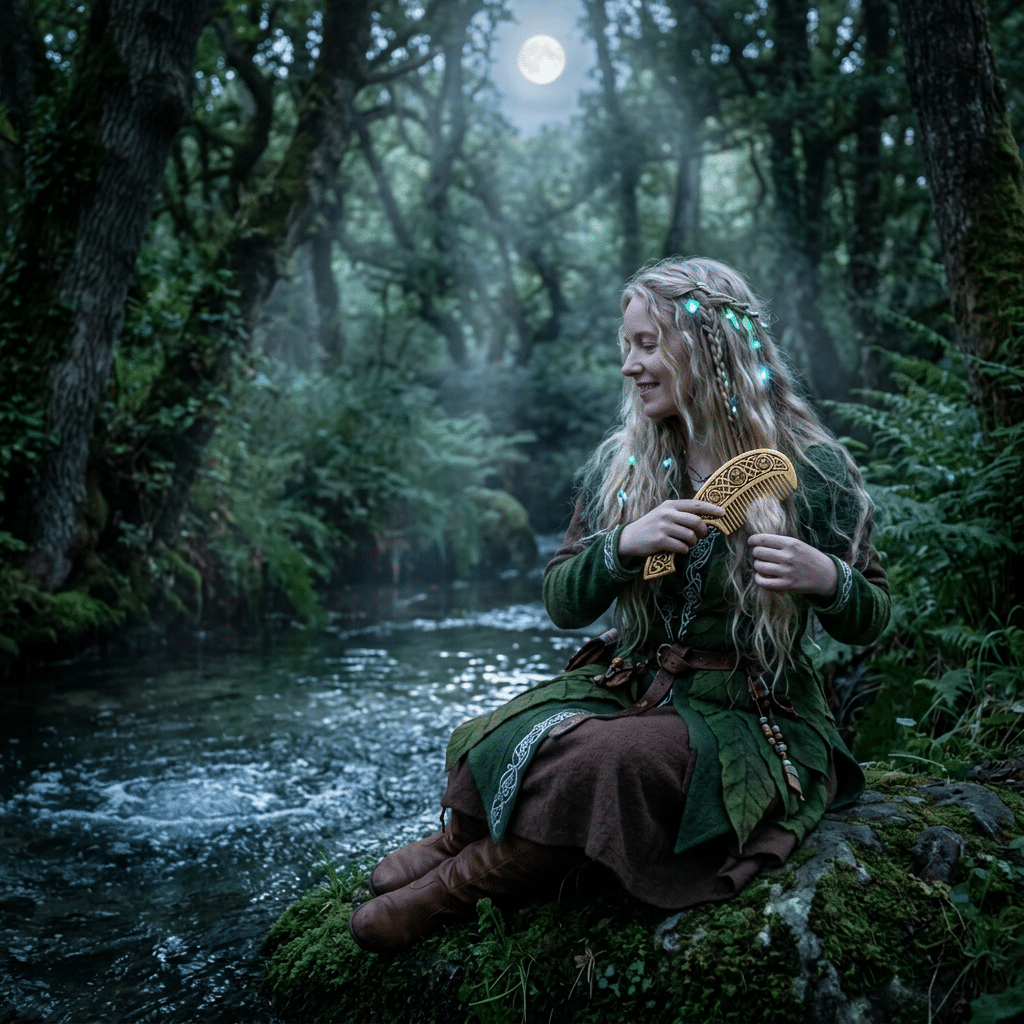
- Korrigans are small, mysterious beings from the folklore of Brittany, and their name comes from the Breton word for “dwarf.” They appear either as rough, goblin-like dwarves or as beautiful, golden-haired women who comb their hair beside springs.
- Despite their tiny size, they were believed to have great powers, such as predicting the future, changing shape, moving as fast as thought, and healing illness.
- Their behavior ranges from playful to deadly. They dance in rings near standing stones, guard treasure, hold secret feasts, steal children, and seduce young men.
- The best-known korrigan story is the ballad of Lord Nann, in which a young lord turns down a korrigan’s marriage offer and dies under her curse. Other tales warn that anyone who breaks the creatures’ rules will be punished.
- The korrigan helped bring Breton culture to Romantic Europe and became a symbol of Breton identity, though its popular image has been criticized as overly romanticized.
- Theories about its origins include memories of pagan religion, a universal belief in spirits, and explanations for mysterious megaliths and childhood illness. Some scholars argue that the tragic water-fairy version owes much to nineteenth-century literary invention.

Introduction
Korrigans are little supernatural creatures from the folklore of Brittany, in northwestern France. They are found in two primary types in Breton tales. In one, they are dwarfish spirits who dance among the standing stones at night. In the other, they are long, lovely, dangerous women who sit by springs, combing their hair. Their legends are of abducted children, buried treasure, deadly romance, and broken norms, and that heady mix has kept them alive in Breton tradition for a very long time. And they are a riddle. Some writers consider them to be the remains of a pre-Christian religion; others contend that most of what we “know” about them was invented by writers of the nineteenth century. The essay discusses the appearance and habits of the korrigan as a trope of Breton regional imagination, evaluates the main legends concerning the creature, assesses its cultural impact as a trope of Breton regional imagination, evaluates the main legends concerning the creature, and presents numerous interpretations regarding its provenance and meaning.
The korrigan is a popular figure in Breton mythology, usually represented as a small magical being who inhabits the forests, fields, and beaches of Brittany. Korrigans are among the most persistent and polymorphous liminal entities in many Breton and, more broadly, Celtic traditions, associated with mischief, craft, and doors to fairyland. The following sources provide context for the korrigan theme and its role in Breton tradition, as well as scholarly study of Breton mythic beings and their transmission (Garault, 2006; Postic, 2010; Sueur-Hermel, 2021; Bonolas, 2021; Cassard, 2010; Déroff, 2009; Coiffier, 2013).
Appearance and Habits of the Korrigan
The name provides an initial hint. The term korrigan is derived from the Breton word korr, meaning “dwarf.” The diminutive suffixes in the name suggest a meaning similar to “little dwarf” (Gods and Monsters, n.d.). The creature is about being small. Thomas Keightley (1828/1892), following the Breton collector Théodore Hersart de La Villemarqué, noticed that korrigans were claimed to be barely more than two feet high but wonderfully proportioned, with long flowing hair that they neatly combed. The best-known figure is the female korrigan of the fountains. She is fair-haired and gorgeous and especially lovely in the moonlight, and her golden comb has become her trademark (La Villemarqué, 1839/1883). The male figures of rural tradition are much different: rougher, darker, closer to goblins. The korrigans, small as they were, were supposed to have enormous abilities. They could foretell the future, adopt any form they pleased, fly as swiftly as the mind could conceive, and heal diseases with charms that they shared with the mortals they favored (Keightley, 1828/1892).
Korrigans are described as little, fairy-like beings seen in rural and coastal Brittany. They are part of a larger Breton and Celtic folk background that includes other mythical beings like fairies and leprechaun-like creatures, and korrigans tend to be found in liminal places (hedgerows, springs, meadows, and rocky coasts). Several sources indicate their place in a wider universe of Breton mythological entities, and their presence is linked to local landscapes and activities (Garault, 2006; Sueur-Hermel, 2021; Bonolas, 2021; Cassard, 2010).
They can be playful and generous, or they can be dangerous. Many local tales tell of korrigans dancing in rings at night around menhirs, dolmens, and crossroads. A mortal who enters the circle may be rewarded or punished (Gods and Monsters, n.d.). They are guarding buried wealth. They are accused of domestic noises, and horses were found sweaty and tangled in the morning. Keightley (1828/1892) says that he remembers their spring feast particularly well. A spring spreads a cloth of snow-white and covers it with exquisite food. In the middle was a blazing crystal cup, and the drink that was handed around at the end of the feast was thought to impart godlike wisdom. If a man comes near, the feast vanishes. Corrigans were also feared as child-stealers. To safeguard infants, Breton households would hang a rosary or scapular around the neck of the kid to place it under the protection of the Virgin Mary (Keightley, 1828/1892). Legend has it that the female korrigans went in search of gorgeous young men to regenerate their doomed species. Those unions rarely worked out well for the man.
Some stories describe korrigans as mischievous or protective, sometimes guiding or hindering people. Other traditions associate them with sites of power (holy springs, dolmens, or sea coves). The leitmotif of diminutive size and magical agency is recurring in discussions of Breton entities along with other spirits of the land (Garault, 2006; Sueur-Hermel, 2021; Bonolas, 2021). The korrigan, as a trope of Breton regional imagination, is also found in literature and art, where the beings are nodes in the web of Breton heritage and identity, appearing in discussions of legends and mythic figures in Brezhoneg and French-language treatments of Brittany. This more general literary-cultural framework is recognized in assessments of Breton literature and folklore (Garault, 2006).

Major Legends and Classification
The best-known Korrigan narrative is the ballad of “Lord Nann and the Korrigan” written by La Villemarqué in his Barzaz Breiz of 1839. A young lord hunting a white doe rides into the woods and comes upon a korrigan combing her hair by a fountain. She forces him to marry her. He refuses, for he is faithful to his new wife, and she curses him. He dies soon afterwards, and his wife, grief-stricken, follows him to the grave (La Villemarqué, 1839/1883). The ballad is short, but it captures most of the Korrigan tradition: spring, hair, love, and the cost of saying no. The dwarf stories have a more comedic thread. One famous motif is the dancing song of the korrigans, which enumerates the days of the week but never succeeds in finishing it. In a tale from near Lorient, a korrigan who tried to include Saturday was instantly transformed into a hunchback. A girl at Carnac who worked another day to their song was given a bracelet. A second girl, who disrupted the beat of the dance, was doomed to see nothing but darkness even at midday (Gods and Monsters, n.d.). The lesson is obvious. Korrigans live by rules, and people who meet them have to respect them.
So what is a Korrigan, then? The scribes who documented the tradition never agreed on a single explanation. La Villemarqué used korrigan more or less as a word for “fairy” and considered the korrigans to be distinct from dwarves. Walter Evans-Wentz’s fieldwork in Brittany in 1909 and 1910 found that the Morbihan district made no distinction between korrigans and dwarves. Many of his informants described them both as wicked spirits or demons destined to reside on earth in penance for an unknown length of time. Korrigans are among the several named lutins (sprites and goblins of Breton legend) listed by Françoise Morvan (1998/2005), along with poulpiquets, kornandons, and similar monsters. This perspective makes more sense of korrigan as a loose family of local spirits rather than one clearly defined species. Vagueness is not a shortcoming of the tradition. Oral folklore is like that; each valley assigns its spirits somewhat distinct names, features, and behaviors.
Multiple accounts compare Korrigans with other local spirits and other regional myths (for example, Celtic fairy legends). However, the korrigan is particularly characterized by its regional traits and toponyms in Brittany, while other discussions have highlighted a common folklore logic about fairies and goblin-like creatures throughout Europe. The cross-referencing with broader fairy traditions helps explain why korrigans are often invoked in Breton cultural discourse as a symbol of Brittany’s magical past (Garault, 2006; Cassard, 2010). Discussions within the framework of Breton legends are frequently found in studies examining the interaction between regional myth cycles and language, literature, and memory, particularly in analyses of Breton folklore collections that include korrigan narratives as part of the corpus of regional legends (Garault, 2006; Postic, 2010; Déroff, 2009).
Cultural Impact
The Korrigan’s cultural significance is far more than village tales. Barzaz Breiz brought the culture of the Breton people to the notice of Romantic Europe, and the collection is often regarded as inspiring the current Breton cultural and political identity. Keightley (1828/1892) introduced the korrigan to British readers through English translations, integrating it into the broader Victorian fascination with fairies. The figure also serves as a symbol within Brittany itself. Today, Korrigans appear in children’s books, music, festivals, and many souvenir stores, often as jolly tiny men with pointed caps. That popularity has attracted criticism. Morvan (1998/2005) uses humor to resist the romantic, identity-based image of Breton folklore. She believes that the genuine tradition as related by rural people was weirder, funnier, and more local than the polished image of a Celtic fairy. So the Korrigan’s influence is twofold. Regional folklore has remained in the public spotlight, raising questions about who has the authority to define that tradition.
Interpretations of Origin and Meaning
There are several hypotheses as to the origin of the Korrigan. The earliest, popularized in the nineteenth century, is that korrigans represent a remembrance of pre-Christian religion. Some of the Breton traditions (including Keightley’s, 1828/1892) say that the korrigans were once powerful princesses or druidesses who rejected Christianity when the first missionaries arrived in Brittany. This belief would explain why the animals were reported to despise priests and churches. A second view, preferred by Evans-Wentz (1911), regards fairy belief as part of a global animism. From this perspective, the same instinct that gave rise to religions and myths also gave rise to the spirits of place and the spirits of the dead. Evans-Wentz saw the Carnac stones as part of the Breton ‘fairy-faith,’ which he claimed had its origins along with all religions and mythologies. A third explanation is pragmatic, and I present it as a conceivable interpretation, not as a truth. Brittany is strewn with megaliths raised by peoples of whom the latter inhabitants knew nothing, thousands of years before. The dolmens were called the “houses” of the small people, helping to make sense of the environment. Likewise, tales of changelings may have assisted families in coping with the unexpected illness or disability of a child.
The fourth theory is the most skeptical. This theory posits that the beautiful korrigan of the fountains is primarily a literary fabrication. As early as 1868, the folklorist François-Marie Luzel accused La Villemarqué of having composed his ballads in the manner of James Macpherson’s Ossian forgeries rather than of having collected them properly. This discussion continued on for over a century (Constantine, 1996). When Donatien Laurent (1989) analyzed the newly discovered field diaries of La Villemarqué, he considered them to have been authentically collected. However, La Villemarqué had changed and refined the material, similar to how the Brothers Grimm altered their collections. Morvan (1998/2005) goes farther, depicting the common image of the korrigan as a neo-Celtic ornament rather than something rural Bretons believed in. Perhaps the fairest conclusion is that both are true. The dancing dwarf of the countryside appears to be real in local folk belief. The tragic water fairy in the form most people know today owes much to the Romantic literature.
Conclusion
So that’s the korrigan: a small creature with a big and complex history. Depending on the village and the teller, it might be a dancing dwarf at the standing stones, a seductive ghost at the spring, a thief of children, or a guardian of treasure. Its traditions emphasized reverence for holy sites, watchfulness by night, and the peril of transgressing the rules of the other world. Its effects are visible in Romantic literature, the resurgence of Breton identity, and the contemporary tourist industry. The explanations regarding it range from pagan survival to literary fabrication, and none of them is sufficient. That may be what is most permanent about korrigans. It is like a creature that vanishes when mortals come near it. It never allows itself to be caught, and that is why it comes again and again to scholars and storytellers.
References
Bonolas, P. P. (2021). Portée et sens de la recréation mémorielle dans l’œuvre de Françoise Enguehard L’Île-aux-Chiens. 229–238. https://doi.org/10.18485/asec_sacs.2021.9.ch16
Cassard, J.-C. (2010). Le breton dans la BD franco-belge. La Bretagne Linguistique, 15, 195–223. https://doi.org/10.4000/lbl.2338
Coiffier, C. (2013). Les rêves océaniens de Jacques et Betty Villeminot. Journal De La Société Des Océanistes, 136–137, 233–238. https://doi.org/10.4000/jso.6877
Constantine, M.-A. (1996). Breton ballads. CMCS Publications.
Déroff, M.-A. B.-L. (2009). Quand des institutions cherchent à sortir de la marge… Exploration de mots choisis pour raconter la Bretagne aux touristes. Port Acadie Revue Interdisciplinaire En Études Acadiennes, (13-14–15), 221–232. https://doi.org/10.7202/038430ar
Evans-Wentz, W. Y. (1911). The fairy-faith in Celtic countries. Henry Frowde; Oxford University Press. https://www.gutenberg.org/ebooks/34853
Garault, C. (2006). Francis Favereau et Hervé Le Bihan (dir.), Littératures de Bretagne. Mélanges offerts à Yann-Ber Piriou. Annales De Bretagne Et Des Pays De L Ouest, 113–4, 210–212. https://doi.org/10.4000/abpo.574
Gods and Monsters. (n.d.). The Breton dwarf who cannot say Saturday. https://godsandmonsters.info/korrigan/
Keightley, T. (1892). The fairy mythology: Illustrative of the romance and superstition of various countries. George Bell and Sons. (Original work published 1828)
Laurent, D. (1989). Aux sources du Barzaz-Breiz: La mémoire d’un peuple. ArMen.
La Villemarqué, T. H. de. (1883). Barzaz Breiz: Chants populaires de la Bretagne. Didier. https://archive.org/details/barzazbreizchant01lavi (Original work published 1839)
Macpherson, J. (1765). The works of Ossian, the son of Fingal (Vols. 1–2). T. Becket and P. A. De Hondt.
Morvan, F. (2005). Vie et mœurs des lutins bretons (New ed.). Actes Sud. (Original work published 1998)
Postic, F. (2010). Écrire le non-dit? Port Acadie Revue Interdisciplinaire En Études Acadiennes, (16–17), 115–122. https://doi.org/10.7202/045135ar
Sueur-Hermel, V. (2021). Hommage à Philippe Le Stum (1962-2021). Nouvelles De L Estampe, 266. https://doi.org/10.4000/estampe.1809
Leave a Reply