Bigfoot Sightings in Muskingum and Guernsey Counties of Ohio: Key Points
- Since 1930, people in the rolling hills of Guernsey and Muskingum Counties in east-central Ohio have reported a large, hairy creature. Many of the reports come from Salt Fork State Park.
- In the 1930s, witnesses described a roaring, chest-beating “ape” that climbed trees. Local people blamed escaped circus animals or even a bootlegger wearing his wife’s fur coat.
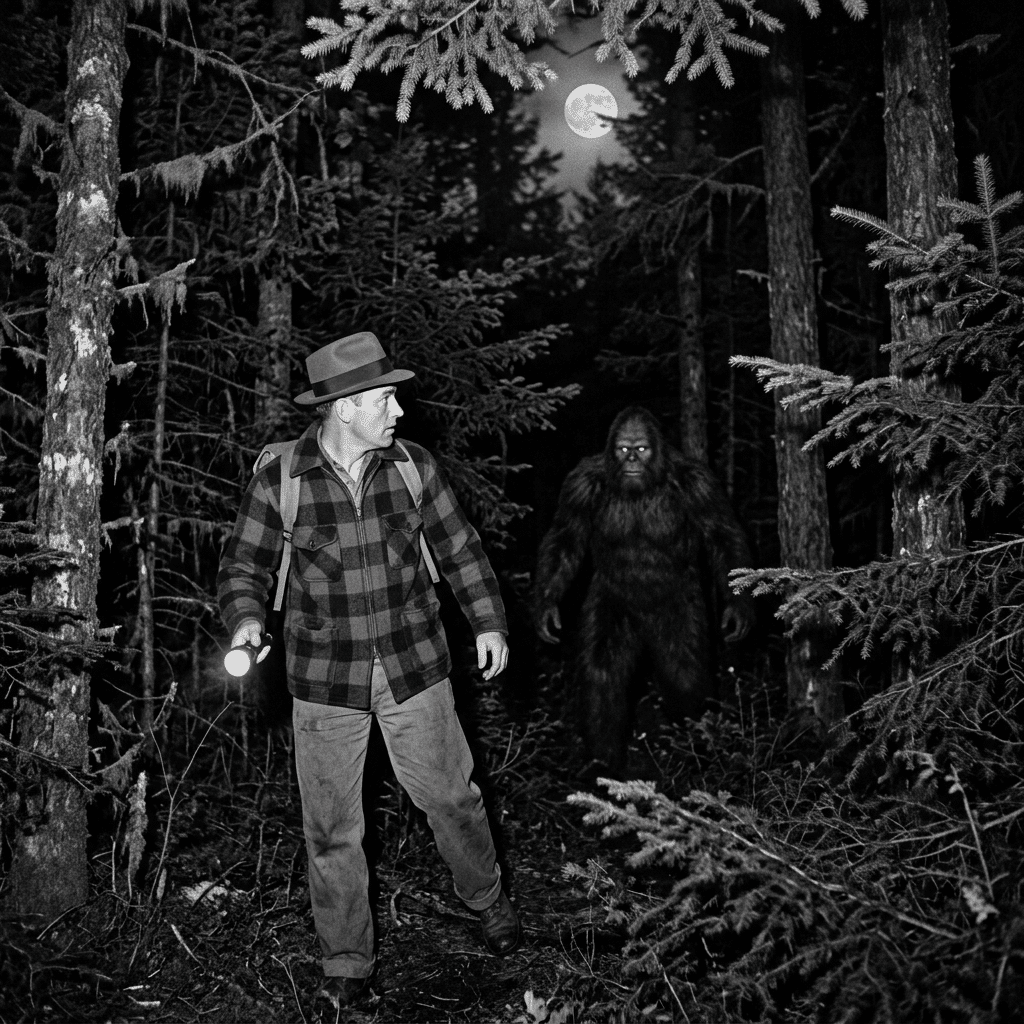
- Modern witnesses describe an upright giant, 7 to 10 feet tall, with dark hair, glowing eyes, long arms, and almost no neck. They also report deep footprints and strange howls and knocks on trees.
- In both eras, the reports share the same pattern: wooded hills near water, sightings at dusk or night, a creature that stares at people, and frightened witnesses who run away.
- Some believers think it’s an unknown primate or a surviving Neanderthal living in the area’s large forests. Skeptics point out that no body or bones have been found, and an FBI hair test found the hair came from deer.
- People seem to describe the creature through the ideas of their time. Without physical proof, the sightings can’t be confirmed.

Introduction
The rolling hills of east-central Ohio don’t appear like traditional Bigfoot habitat. It is not towering redwoods or snowy Cascade peaks. But for almost a century, tales of a big, hairy, manlike creature have been the home of Guernsey County and neighboring Muskingum County. Much of the current activity is on Salt Fork State Park in Cambridge, which one researcher has labeled “the hotbed for Ohio Bigfoot sightings” (Ryan, 2022). The record goes back a long way. In the summer of 1930, six men from Cambridge reported having seen an ape-like animal roar from a tree, and, two years later, people of Muskingum County in the vicinity of Chandlersville did not venture outdoors for fear of a “big ape” in the woods (Arment, 2019). This essay uses both historical newspaper testimonies and more recent reports from the Bigfoot Field Researchers Organization (BFRO) to show how witnesses imagine the body and behavior of the creature. It also analyzes the accounts over time and place, reviews the hypotheses suggested to explain them, and weighs the strong reasons for doubt. Together, the sources reveal a regional tale that has persisted and also morphed over ninety years.
Physical Descriptions of the Creature
Bigfoot is generally described in folklore as a hairy, bipedal, oversized creature. Contemporary studies in folklore look at how such descriptions are constructed from eyewitness accounts, memorials, and stories, which together build an image of a huge, humaniform monkey adapted to forest settings. The wider context of North American monsters in folklore and contemporary legends (Puglia, 2023; Milligan, 1990) provides a framework for discussing the descriptive traditions. The discussion centers on the form and consistency of witness accounts, which, despite variation, are considered part of a larger folkloric repertoire rather than conclusive biology (Lewis & Bartlett, 2024; Puglia, 2023).
The earliest local descriptions are vague and sound much more like an ape than a giant. On a Tuesday afternoon in August of 1930, six men fixing a flat tire in a hollow near the High Hill schoolhouse, three miles southwest of Cambridge, heard a “rumbling roar” that they initially thought was thunder. Then they saw “a large animal with every appearance of an ape moving about in a tree.” The animal climbed down and stood beneath the tree “beating its fore legs against its chest” while making “loud gutteral sounds,” according to the Cambridge Jeffersonian (as cited in Arment, 2019, p. 761). Accounts for Muskingum County for 1932 are significantly thinner. The Zanesville Times Recorder confessed that “neighbors living in the Chandlersville vicinity are unable to give an accurate description of it other than that it is an ape” (as stated in Arment, 2019, p. 765). Two fox hunters gave one detail, noting that the monster clutched tree branches “with odd hands and feet.” The Zanesville Signal also remarked that the creature was identifiable by “a white ring about its neck” (as recounted in Arment, 2019, p. 766).
Modern accounts of Guernsey County are far more precise, and they depict a quite different entity. Most witnesses describe an erect monster, much taller than humans. A couple picnicking at Salt Fork in 2004 described a “nearly 8-foot-tall, dark-colored subject” that moved away “in a human form” (BFRO, 2004b). Teenagers trekking near the park cabins in 2006 estimated their creature to be 8 to 10 feet tall. It was said to be muscular, with long blackish-brown hair covered in mud, a flat nose, a dark complexion, and enormous hands with five fingers (BFRO, 2006a). A witness near Pleasant City estimated the top of the creature’s head to be at a spot that an investigator measured at 8 ft 6 in (BFRO, 2004a). Some estimates are not that dramatic. A woman commuting to work in 2017 spotted a “hunched-over hairy figure” with long brown hair and guessed it stood 7 to 8 feet tall, but she conceded she had nothing to compare it with (BFRO, 2017). A catfisherman near the Salt Fork spillway described his animal as being only 5.5 to 6 feet tall (BFRO, 2006b).
The modern reports exhibit some common traits. Eyes are a frequent motif. In 2013, a Bigfoot Ridge camper observed “two large, yellowish golf ball-sized eyes” in the reeds near her tent (BFRO, 2013a), while the adolescent witnesses in 2006 described “big yellowish eyes” with brown centers (BFRO, 2006a). Another is body shape. The 2013 camper noted that the figure was “most obviously wider” than her six-foot-five partner (BFRO, 2013a). With one hand on the trunk, the young hiker noticed that a witness on the Shadebush Trail reported seeing two animals with “black as coal,” lustrous hair that was “well groomed.” They possessed arms longer than a human’s and nearly no apparent neck, so they twisted their complete upper body to look back (BFRO, 2013b). Physical traces add flesh to the picture. In 2017 a cast was made of a 12-inch left footprint at the site of the case near Hosak’s Cave, which was pressed 2.5 inches deep on its outer border. Investigators believed it revealed a “mid-tarsal break,” a flexible midfoot that some researchers associate with nonhuman primates. A man weighing 340 pounds and barefoot jumped in the area, leaving an impact of barely about half an inch (BFRO, 2017).

Reported Behavior
Behavior is where the reports of the two periods become most fascinating. Sound is a big factor. The roars of the 1930 Cambridge animal could be mistaken for thunder (Arment, 2019, p. 761). Modern witnesses speak of “really weird loud screams” (BFRO, 2013a), howling that escalated to “thunderously loud” (BFRO, 2004b), deep grunts (BFRO, 2006a), and a muffled sound of talking, resembling “an 8-track tape player that was eating the tape” (BFRO, 2013b). In 2021, four boaters heard a bassy howl that sounded like “an old mechanical tornado/air raid siren starting to wind up” that they later linked to a recording called the “Ohio Howl” (BFRO, 2021a). Another common subject is knocking. Nite fishermen at the Salt Fork Marina heard five knocks, “like a bat hitting a tree,” before fist-sized boulders began to land nearby (BFRO, 2011).
Another trend is watching people, which links the old and the new accounts. “All the while peering at them,” the Muskingum fox hunters reported the animal perched on a tree before it climbed away through the leaves (Arment, 2019, p. 766). Modern witnesses describe the same unwavering stare. With one hand on the trunk, the young hiker noticed another hiker looking around the tree (BFRO, 2006a). The spillway fisherman lit up a pair of eyes that “never drifted off for a second,” even when he stomped and snorted as a deer (BFRO, 2006b). A Pleasant City witness stared at a big creature for about a minute (BFRO, 2004a). The other creatures didn’t seem to care. The 2017 driver reported the figure “acted like it didn’t care that I was there” (BFRO, 2017).
Witnesses also describe how the animals alter their environment and how they search for food and shelter. Henry Hardesty of Chandlersville heard his monkey “crashing around in the woods” at night, and the Times Recorder said it had “made itself at home in the Hardesty woods and refused to leave” (as cited in Arment, 2019, p. 765). In 1930, in Cambridge, a crowd saw the branches of a graveyard elm “sway and jerk” on a windless night, and many blamed the monkey (Arment, 2019, pp. 761-762). Modern complaints include accounts of frogs and birds that have been silenced (BFRO, 2004b, 2006a, 2013a) and dogs that refuse to leave vehicles (BFRO, 2013a). Some reports indicate foraging. The next morning a witness in a pleasant city reported her bananas and cantaloupe missing (BFRO, 2004a), and a camper heard something picking up handfuls of grass alongside her tent (BFRO, 2013a). Investigators also recorded possible shelters. They discovered a 10 by 15 foot patch of matted grass near Pleasant City (BFRO, 2004a), and two hunters east of Cambridge spotted an igloo-shaped structure constructed from blackberry vines in 1979 (BFRO, 2021b).
Comparing Accounts Across Time and Place
The records are true continuity. The animal is commonly found in wooded hill land, usually near water, and often at dusk or during the night. It produces odd, loud vocalizations and watches people. If you approach it, it leaves swiftly. In both periods witnesses were scared enough to run away. The 1930 truckers “drove hastily to Cambridge” (Arment, 2019, p. 761), while the 2013 campers left their tent at 2 a.m. (BFRO, 2013a). Fear also impacted the behavior of large populations. Parents warned the youngsters in 1932 in Chandlersville (as described in Arment, 2019, p. 766) not to venture into the fields or woodlands. Another notable resemblance is that in both periods organized searches were unsuccessful.
The differences are equally telling. The most obvious differences between the two periods are in posture and habitat. The 1930s animals were tree-climbing animals characterized by apes, gorillas, monkeys, and even a “missing link” (as cited in Arment, 2019, pp. 761, 774). The modern species is typically a bipedal, upright, ground-dwelling creature that stands 7 to 10 feet tall and moves through bushes instead of branches. The color also varies from brown to coal black, and the white neck ring of 1932 has no parallel in the recent descriptions. Height estimates are from 5.5 to 10 feet, a rather large range for a single species. Temperaments also vary, from rock flinging reported at the marina (BFRO, 2011) to the driver’s testimony of an animal that seemed not to care. The quality of evidence is equally as variable. Only three of the ten recent reports (BFRO, 2004a, 2004b, 2013b) received the BFRO’s Class A rating for clear sightings. The rest depends on sounds, eyeshine, or short glances.
The record for Muskingum County is mainly historical, and the best documented occurrence is the 1932 “ape scare.” Reports arrived over a period of several weeks from the Hardesty farm, about a mile east of Chandlersville, and the Osborne farm near Rix Mills. Sheriff William Curtis was alerted, and county officials, the dog warden, the game protector, and residents of Salt Creek Township all tried to locate the animal (Arment, 2019, pp. 765, 775). Then the story went out of the county. In September, city officials in Steubenville asked Sheriff Curtis if the “Zanesville ape” had moved north after a furry creature was spotted along the Ohio River. That animal was believed to have “eyes as big as a dollar” and to produce “sounds like an automobile horn” (as quoted in Arment, 2019, pp. 774-775). The two counties are still connected today. Wills Creek is part of the Muskingum River watershed (BFRO, 2006b), fed by water from the Salt Fork spillway, and Ohio researcher Doug Waller is from Muskingum County (Fuzinski, 2023). Public interest remains. There is still public interest: Dillon State Park in Muskingum County announced a cryptozoology program for October 2026 (Zanesville Times Recorder, 2026).
Explanations and Skepticism
People have described these occurrences in many different ways over time. In the 1930s, the prevailing theory was that a circus animal had run away. Newspapers blamed apes that purportedly fled from circuses in Carey, Mansfield, and later Zanesville itself (as cited in Arment, 2019, pp. 758, 762, 775). Another explanation was humans. In one clipping that doesn’t identify its county in the preserved pages, a former sheriff named Aaron Davis decided the “large” ape was a short, heavyset bootlegger. The man, in his wife’s fur coat, had run from tree to tree to retrieve whiskey that he had hidden in the woods (Arment, 2019, p. 764). Modern believers (including the BFRO) often propose an undiscovered ape. The spillway fisherman, for example, determined that the knocking he heard was “primate behavior” (BFRO, 2006b). Others have proposed a surviving branch of early humans such as Boris Porshnev’s hypothesis of residual Neanderthals (Britannica, n.d.). Habitat-based theories focus on the 17,000+ acres of the Salt Fork (BFRO, 2011). They also refer to the strip-mined land that Don Keating referred to as the “Sasquatch Triangle” (BFRO, 2021b). Others believe that environmental stress, such as flooding, could make the animals show up (Rose, 2026).
Skepticism is needed in both ages, and the old newspapers themselves were openly dubious. The Chandlersville ape, the Zanesville Signal, claimed to have failed to substantiate a wide search. It joked that the animal may have ‘crawled into its hole (if apes dwell in holes)’ and named it ‘the bosom pal of one Mr. Darwin’ (quoted in Arment, 2019, pp. 774-775). Sheriff Curtis joked that if the Steubenville animal was indeed from his county, it “must have been the missing link” (as cited in Arment, 2019, p. 774). Read the clippings together, and the circus explanation seems fishy, too. The same alleged runaway ape was accused in Alger, Cambridge, Knox County, Chandler’sville, and Steubenville, and the site it fled from kept changing. The Signal itself used the word “epidemic” for “ape,” suggesting that press coverage helped disseminate the sightings (Arment, 2019, p. 774). The 1930 cemetery assessment acknowledged that “no one saw or could determine the exact cause of the movements” (Arment, 2019, p. 762). The incident of the bootlegger illustrates how quickly a person with a fur coat in the dark can generate panic.
Modern reports also raise similar concerns. Nobody, skeleton or confirmed biological sample, has ever been produced (Britannica, n.d.), and the FBI investigation of reported Bigfoot hair previously declared it to be “of deer family origin” (Rose, 2026). Expectation obviously colors many encounters. Campers chose a spot known as Bigfoot Ridge and knocked on trees for fun in 2013 (BFRO, 2013a). The adolescent hikers were out looking for Bigfoot (BFRO, 2006a). The witness to the Shadebush Trail was a vendor at a park “creature weekend” (BFRO, 2013b). The evidence is often flimsy. The evidence includes eyeshine that could belong to deer or raccoons (BFRO, 2006b), a single footprint with no others nearby (BFRO, 2017), and boulders that reportedly increased in size from fist-sized to bowling-ball-sized as the story was told (BFRO, 2011). Salt Fork’s approximately two million tourists each year also represent “many potential witnesses” (Ryan, 2022). If there’s a Bigfoot, a bustling park full of stories is going to yield reports.
Folklorists have noted motifs of nocturnal or covert conduct, tracks, vocalizations, and enigmatic movement patterns passed down through oral history and later media portrayals. These motifs help maintain the mystery and the sense of danger or wonder about the creature in local landscapes (Puglia, 2023; Milligan, 1990; Lewis & Bartlett, 2024). Bigfoot-type legends are embedded in regional storytelling throughout the United States and Canada, with variations related to local ecosystems, Indigenous oral histories, settler narratives, and contemporary legend-making. Scholarship explicitly treats Bigfoot as part of a North American cryptid landscape where folklore, rumor, and media converge (Puglia, 2023; Moir, 2015; Lewis & Bartlett, 2024).
Conclusion
The accounts from Guernsey and Muskingum Counties tell a story that has endured and changed over the years. The 1930s reports describe a tree-climbing, chest-beating “ape” that people blamed on escaped circus animals. Modern reports describe an upright, dark, 8-foot giant with yellowish eyes that watches campers and fishermen from the tree line. The constants are loud calls, a tendency to stare at people, quick retreats, frightened witnesses, and searches that yield no results. The differences in shape, size, and explanation suggest that people describe what they see through the ideas of their era. In 1930, the prevailing idea was that the creature was a runaway ape. Today it is Bigfoot. Whether these hills harbor an unknown animal or well-loved regional folklore, the experiences are clearly real to the people who report them. Proving the creature exists would require physical evidence that no account from either county, old or new, has yet provided.
References
Arment, C. (2019). The historical Bigfoot: Early reports of wild men, hairy giants, and wandering gorillas in North America (2nd ed.). Coachwhip Publications.
Bigfoot Field Researchers Organization. (2004a, September 6). Man has an early morning sighting near Pleasant City (Report No. 9281). https://bfro.net/GDB/show_report.asp?id=9281
Bigfoot Field Researchers Organization. (2004b, August 19). While picnicking in early evening, a couple has sighting at Salt Fork State Park (Report No. 9188). https://bfro.net/GDB/show_report.asp?id=9188
Bigfoot Field Researchers Organization. (2006a, July 30). Possible sighting by teens in Salt Fork State Park (Report No. 15371). https://bfro.net/GDB/show_report.asp?id=15371
Bigfoot Field Researchers Organization. (2006b, September 17). Possible stalking near Salt Fork Lake spillway (drains into Wills Creek) (Report No. 15876). https://bfro.net/GDB/show_report.asp?id=15876
Bigfoot Field Researchers Organization. (2011, December 29). Possible rock throwing display while night fishing at Salt Fork State Park (Report No. 31439). https://bfro.net/GDB/show_report.asp?id=31439
Bigfoot Field Researchers Organization. (2013a, June 18). Couple flees their camp site after a possible late night encounter at Salt Fork State Park (Report No. 41452). https://bfro.net/GDB/show_report.asp?id=41452
Bigfoot Field Researchers Organization. (2013b, May 24). Sighting of two animals walking a ridge line in Salt Fork State Park (Report No. 41232). https://bfro.net/GDB/show_report.asp?id=41232
Bigfoot Field Researchers Organization. (2017, February 14). Possible sighting and casting of a print near Hosak’s Cave in Salt Fork State Park (Report No. 56800). https://bfro.net/GDB/show_report.asp?id=56800
Bigfoot Field Researchers Organization. (2021a, June 7). Salt Fork boaters hear a loud, deep howl (“Ohio Howl”) from adjacent shore (Report No. 69304). https://bfro.net/GDB/show_report.asp?id=69304
Bigfoot Field Researchers Organization. (2021b, July 1). Two men find unusual brush structure while deer hunting 10 miles east of Cambridge (Report No. 69398). https://bfro.net/GDB/show_report.asp?id=69398
Britannica. (n.d.). Sasquatch. In Encyclopaedia Britannica. https://www.britannica.com/topic/Sasquatch
Fuzinski, P. (2023, December 11). Sasquatch footprint unearthed in Fort Hill Ohio’s wilds. Wildman of the Woods. https://wildmanofthewoods.com/blog/sasquatch-footprint-unearthed-in-fort-hill-ohios-wilds
Lewis, J., & Bartlett, A. (2024). The Shape of Bigfoot: Transmuting Absences into Credible Knowledge Claims. Cultural Sociology, 20(1), 75–95. https://doi.org/10.1177/17499755241264879
Milligan, L. (1990). The “Truth” about the Bigfoot Legend. Western Folklore, 49(1), 83. https://doi.org/10.2307/1499483
Moir, J. (2015). Of Monsters, Myths and Marketing: The Case of the Loch Ness Monster. Analyses/Rereadings/Theories a Journal Devoted to Literature Film and Theatre, 3(1), 12–19. https://doi.org/10.18778/2353-6098.3.02
Puglia, D. J. (2023). The (Mostly) Unseen World of Cryptids: Legendary Monsters in North America. Humanities, 13(1), 1. https://doi.org/10.3390/h13010001
Rose, A. (2026, May 8). Was Bigfoot just spotted in Ohio? Reported sightings stoke a long-running hunt for answers. CNN, via Yahoo News. https://www.yahoo.com/news/articles/bigfoot-just-spotted-ohio-reported-110051717.html
Ryan, M. (2022, February 21). Searching for Ohio’s Bigfoot. Ohio’s Country Journal. https://ocj.com/2022/02/searching-for-ohios-bigfoot/
Zanesville Times Recorder. (2026, October 3). Cryptids, campfires and candy. Dillon State Park’s October adventure begins. https://www.zanesvilletimesrecorder.com/story/news/local/2026/10/03/dillon-state-park-october-events-halloween-spooktacular-muskingum-county-hayrides-trick-or-treat/91985261007/


Leave a Reply