Did the Smithsonian Hide Giant Skeletons From Cahokia? Key Points
- Cahokia was built by the Mississippian culture in what is now Illinois. At its peak around AD 1050 to 1200 it was home to about twenty thousand people, and its Monks Mound has a base larger than the Great Pyramid of Giza.
- Many nineteenth-century Americans refused to believe Native Americans built the mounds, so they credited them to a lost race. Reports of giant skeletons fit neatly into that story.
- Believers say large skeletons, some with red or blond hair, were dug from the mounds and sent to the Smithsonian, never to be seen again.
- In 2014, a satirical website falsely claimed the Supreme Court forced the Smithsonian to admit it destroyed thousands of giant skeletons. The story still circulates online.
- Cyrus Thomas’s 1894 Smithsonian report concluded that Native Americans built the mounds. The institution accused of hiding the truth is the one that disproved the lost-race theory.
- The legend took credit away from Indigenous peoples and helped justify forcing them off their lands. It also made it easier to destroy mounds at Cahokia and in St. Louis.

Introduction
Long before the Europeans arrived in the Mississippi Valley, a city sprang up from the floodplain east of what is now St. Louis. Its earthen pyramids are still there. For more than two centuries, people have attempted to highlight the earthen pyramids and provide explanations for them, although some of these explanations have strayed far from the evidence. One of the most frequent allegations is that giant skeletons, seven or eight feet tall, were excavated out of the mounds in Cahokia and then quietly put away by the Smithsonian Institution. The story is dramatic and readily retold. It comes apart on examination as well. The Cahokia giant skeleton myth reveals more about its tellers than the mound builders.
Cahokia: A Planned Mississippian City
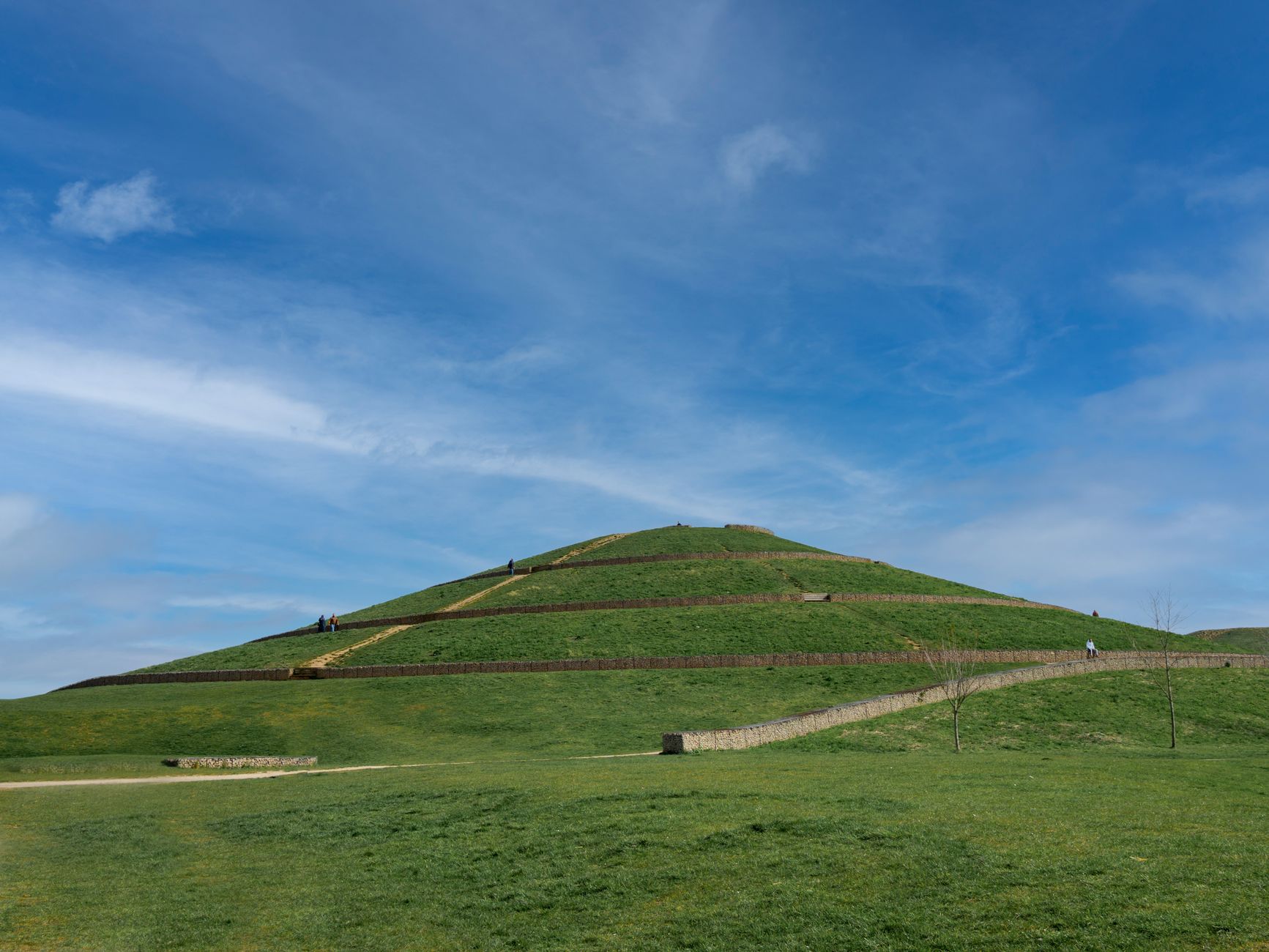
Cahokia, constructed by the Native American Mississippian culture, is Illinois’ oldest town. The larger site comprises around 4,000 acres, with roughly half of that preserved as a state historic site and containing over 120 earthen structures (Tremeear, 2013). Monks Mound, a terraced earthen pyramid, sits at its heart, erected between AD 900 and 1200. Its base is around 14 acres, which is a larger footprint than the Great Pyramid of Khufu at Giza (Tremeear, 2013). The mound is around 100 feet high and contains well over 22 million cubic feet of earth. It is named for the Trappist monks who farmed its terraces in the early 1800s, which newspapers were full of stories about. It was surrounded by a vast plaza, about the size of forty-five football fields, a wooden stockade, and a circle of posts known as “Woodhenge” that recorded the sun’s position during the year (Tremeear, 2013). Maybe twenty thousand people were there at the height of it. “Archeologist Timothy Pauketat (2009) says that the city sprang up virtually overnight around 1050 CE, a transition sometimes called Cahokia’s “big bang,” as people moved in from the surrounding region to create a new kind of community. Cahokia was more than a community. The burials of Mound 72 indicate that it was an organized city with a formidable leadership. Excavations there uncovered the remains of a high-status man, together with dozens of young women and numerous men who appear to have been sacrificed, proof of a tight social hierarchy (Pauketat, 2009; Tremeear, 2013).
Monk’s Mound is described in the literature as a large central earthwork. It is believed to hold tens of millions of cubic feet of earth and to have taken a significant amount of labor organization. This is consistent with an understanding of a central elite authority capable of organizing massive workforces (e.g., Monk’s Mound and central plaza/mound complexes) (Chase-Dunn, 1996; Jeske, 1996). The site is described as a Grand Plaza surrounded by mounds and palisades, a documented Stirling-phase/Moorehead-phase sequence with expanding monumental architecture and later palisade walls dividing residential areas around their mounds and plazas, indicating a sophisticated territorial and political arrangement (Chase-Dunn, 1996; Jeske, 1996; Reed et al., 1968).

The Origins of the Giant Skeleton Legend
Early American visitors were astonished at that scale and soon began to speculate. In 1811, the lawyer and amateur historian Henry Brackenridge noted the massive mound and compared it to the Egyptian pyramids, commenting that its construction “must have required years and the labors of thousands” (as cited in Tremeear, 2013). Many white Americans of the time questioned that Native American predecessors could have done such labor. Instead, they attributed the mounds to Phoenicians, Vikings, or a lost tribe of Israel (Tremeear, 2013). According to historian Jason Colavito (2020), this thinking developed into what he terms the “Mound Builder “myth”—the concept that the earthworks were constructed by a lost white race of “true” Americans, who were then eradicated by the progenitors of today’s Native Americans.
Giants were part of that story. In the 1800s, newspapers were full of stories about giant skeletons dug up from mounds in the Midwest and South. Expert observers rarely verified these reports. Some resulted from misunderstanding the size of specific bones. Others were just exaggerations or outright hoaxes. But the image of a lost race of giants persisted and became part of American folklore.
At Cahokia, the mythology of the giant took a special form. As Tremeear (2013) notes, “many large-stature skeletons were exhumed from the mounds during the nineteenth century” and were turned over to the Smithsonian Institution “to never be seen or heard of again.” Supporters of this take the claim that the skeletons appeared quite different from Native American remains and the surviving hair was often red or blond (Tremeear, 2013). They also note claims of seven- to eight-foot skeletons at other mound sites in North America.
The story was greatly helped in December, 2014, when a website named World News Daily Report posted an item saying that a verdict by the U.S. Supreme Court forced the Smithsonian to admit that it had destroyed thousands of gigantic human skeletons in the early 1900s (O’Rourke, 2022). The piece was widely shared online. It was a fabrication. The website describes its content as parody, and a Smithsonian spokesman acknowledged the assertion was untrue (Reuters Fact Check, 2022). There is no such Supreme Court case. Yet, years later, the hoax resurfaces on social media, often with digitally manipulated photographs of skulls that are too big (O’Rourke, 2022; Reuters Fact Check, 2022).
Evaluating the Evidence and Competing Explanations
There is no clear peer-reviewed claim substantiated by facts that Cahokia possessed true giant skeletons or a population with extraordinary average stature above usual Mississippian populations. Several sources address morgue contexts, mass graves, and sex/dental/isotope analyses (e.g., Mound 72), but no source makes a qualitative or quantitative claim of “giants.” Where bone and tooth morphology, sex estimation, or isotopic data were presented, statements were made about sex attribution, nutrition, seasonality, or mobility rather than unusual size. For instance, Thompson (odontometric sexing at Mound 72) is expressly about methods of sex determination and their interpretation, not about gigantism (Thompson, 2013). Hedman & Slater (2015) discuss groups involved in mass burials but do not identify the presence of enormous individuals as a characteristic of Cahokia’s population.
There are several explanations as to why the giant claims exist, and they differ dramatically in their treatment of evidence. The first explanation is the alternate or fringe view, which interprets the accounts of giants literally. According to this point of view, a distinct, possibly non-Native group created Cahokia and the Smithsonian concealed the facts to protect traditional history. Tremeear (2013) states that some of those who share this view also perceive Cahokia as a gigantic surveying grid, where each mound is at a coded distance and angle from a central hub mound. Some even go so far as to imply that the place was an open-air university for the teaching of an old lunisolar calendar. Another theory that Tremeear (2013) also mentions is the cultural connection between Cahokia and Mesoamerican civilizations, such as the Maya or Toltec. That is a different question from the giant claims yet it shows the same desire to explain Cahokia by looking elsewhere.
Thirdly, the scholarly explanation. It maintains that the mounds were created by the ancestors of the Native American peoples and that accounts of giants were the result of inaccuracy, exaggeration, and hoaxes. Ironically enough, the Smithsonian itself did more to prove this theory than any other organization. In 1894, Cyrus Thomas of the Smithsonian’s Bureau of Ethnology produced a large report based on years of mound excavations around the eastern U.S. He decided that the mounds were the work of Native American tribes and not of a superior, lost race (Thomas, 1894). So the Smithsonian was not covering up the truth regarding the mounds. It was the institution that buried the theory of the lost race. As Colavito (2020) points out, the cover-up mythology persists because it translates that scientific dismissal into proof of a conspiracy. The more strongly professionals deny the giants, the more believers interpret it as suppression.
The Consequences of the Giant Myth
The big legend has had genuine impacts, most of which have been negative. The worst was what it did to the Native Americans. The Mound Builder myth took credit away from Indigenous peoples for one of the major achievements of the ancient world by suggesting that someone else created the mounds. Colavito (2020) reveals that the U.S. government politically supported this myth in the nineteenth century while pushing Native nations from their territories. That elimination was easier to justify because of a myth in which native people had apparently destroyed an earlier civilization. The way red and blond hair is talked about in the Cahokia myth is a direct reflection of this lost white race mentality.
The mounds themselves have been affected by a second influence. Mounds were easily destroyed when viewed as curiosity rather than indigenous heritage. At Cahokia the second largest mound was bulldozed for fill in 1931, while smaller mounds were destroyed to make space for a store and a nightclub (Tremeear, 2013). Across the river, St. Louis was previously called Mound City, but almost all of its mounds were leveled by approximately 1900, and only Sugar Loaf Mound survives (Tremeear, 2013).
Thirdly, there is a cultural effect. Cahokia is now a magnet for those looking for mysteries. More than a thousand people attended the “harmonic convergence” on Monks Mound in 1987, and visitors continue to report seeing blazing lights and apparitions at the location (Tremeear, 2013). That fascination brings in visitors, and some of them learn the true past. It also keeps the disproved huge tale alive online, reaching people who never notice the fact checks (Reuters Fact Check, 2022).
Conclusion
The gigantic Cahokia skeletons are not an archeological discovery but a myth. Cahokia was a large planned city created by the Mississippian ancestors of Native Americans, and its pyramids, plaza, and sun calendar are spectacular without invoking the aid of giants or lost races (Pauketat, 2009). The gigantic myth was a product of nineteenth-century doubt that Indigenous people were capable of building such things. It became the Mound Builder myth, and in the internet age it was revived by a satirical piece that many readers believed as fact (Colavito, 2020; O’Rourke, 2022). The Smithsonian, presented as the villain, actually did the research that proved Native Americans built the mounds (Thomas, 1894). The main enigma at Cahokia today isn’t missing giants. It is the way in which a society organized the work of thousands to create a city from the river’s bottomland. That achievement merits acknowledgment and appreciating it requires letting the evidence, not the fiction, tell Cahokia’s tale.
References
Chase-Dunn, C. K. (1996). Introduction to the Volume’s Two Thematic Sections. Journal of World-Systems Research, 1. https://doi.org/10.5195/jwsr.1996.78
Colavito, J. (2020). The Mound Builder myth: Fake history and the hunt for a “lost white race.” University of Oklahoma Press.
Hedman, K. M., & Slater, P. A. (2015). New dental and isotope evidence of biological distance and place of origin for mass burial groups atCahokia’s mound 72. American Journal of Physical Anthropology, 158(2), 341–357. https://doi.org/10.1002/ajpa.22791
Jeske, R. J. (1996). World Systems Theory, Core Periphery Interactions and Elite Economic Exchange in Mississippian Societies. Journal of World-Systems Research, 350–377. https://doi.org/10.5195/jwsr.1996.85
O’Rourke, C. (2022, November 3). Smithsonian didn’t admit to destroying giant human skeletons. PolitiFact. https://www.politifact.com/factchecks/2022/nov/03/viral-image/smithsonian-didnt-admit-to-destroying-giant-human/
Pauketat, T. R. (2009). Cahokia: Ancient America’s great city on the Mississippi. Viking.
Reed, N., Bennett, J. W., & Porter, J. W. (1968). Solid Core Drilling of Monks Mound: Technique and Findings. American Antiquity, 33(2), 137–148. https://doi.org/10.2307/278515
Reuters Fact Check. (2022, August 4). Fact check: Claims that the Smithsonian destroyed ‘thousands of giant skeletons’ are many years old and satirical. Reuters. https://www.reuters.com/article/factcheck-skeletons-smithsonian/fact-check-claims-that-the-smithsonian-destroyed-thousands-of-giant-skeletons-are-many-years-old-and-satirical-idUSL1N2ZG1I0
Thomas, C. (1894). Report on the mound explorations of the Bureau of Ethnology. In Twelfth annual report of the Bureau of Ethnology to the Secretary of the Smithsonian Institution, 1890–91 (pp. 3–730). Government Printing Office.
Thompson, A. R. (2013). Odontometric determination of sex at Mound 72, Cahokia. American Journal of Physical Anthropology, 151(3), 408–419. https://doi.org/10.1002/ajpa.22282
Tremeear, J. (2013). Illinois’ haunted Route 66: Ghosts from Chicago to St. Louis. The History Press.


Leave a Reply