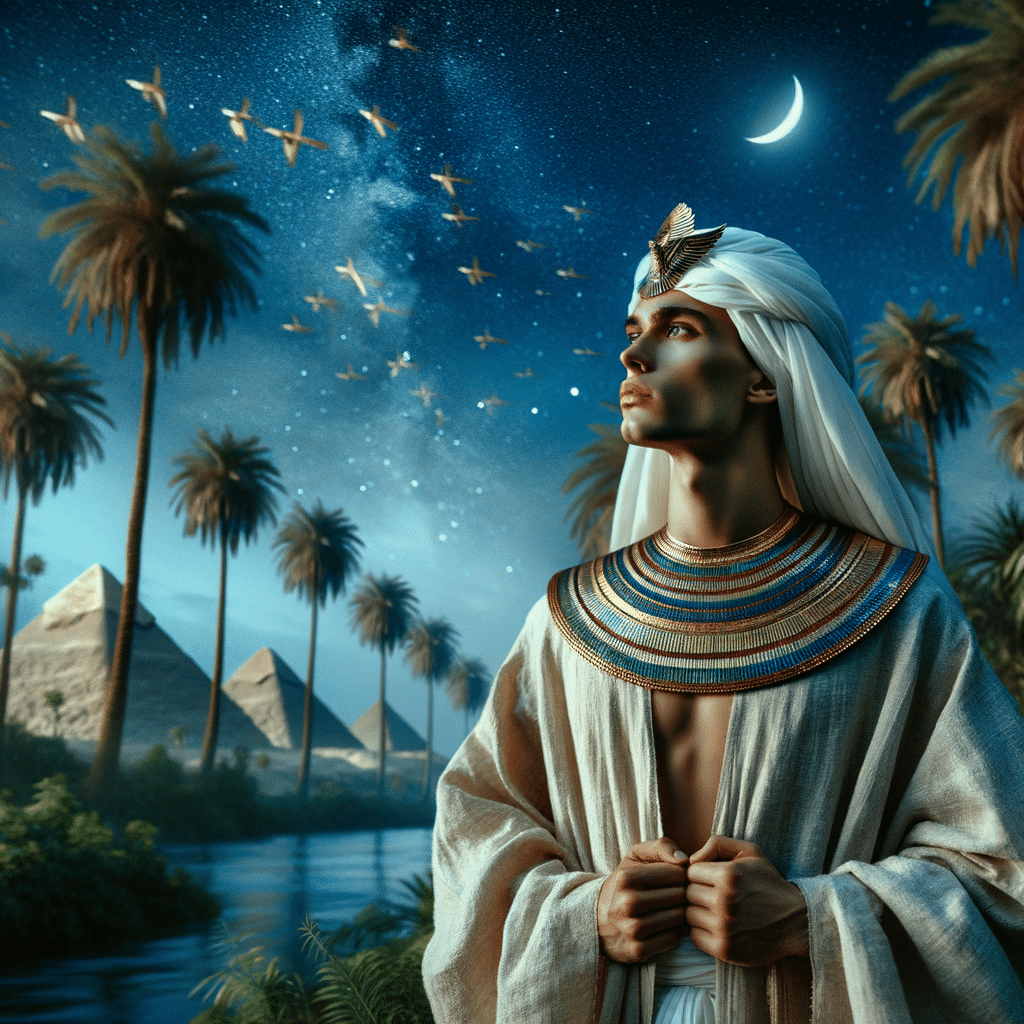
Ancient Egyptian civilization, with its pyramids, temples, and sprawling deserts, was a landscape ripe for exploration not just on the physical plane, but on the metaphysical one as well. At the heart of this exploration was their deep connection with astronomy and astrology. The Egyptians did not view the heavens merely as a vast, impersonal expanse; instead, they saw it as a realm filled with deities, omens, and mysteries. This essay delves into the rich tapestry of Ancient Egyptian astrology coupled with their paranormal beliefs and their understanding of the cosmos.
Egyptian Gods
One cannot speak of Egyptian astrology or astronomy without first addressing the pantheon of deities that resided in the heavens. Stars were not just dots of light in the sky; they were divine beings or the souls of the departed. For instance, the constellation of Orion was associated with Osiris, the god of the afterlife and resurrection. Similarly, the star Sirius which was called Sothis by the Egyptians was seen as the manifestation of Isis, Osiris’s sister and wife. The cyclical appearance and disappearance of Sirius, which heralded the annual Nile flood, gave it a significant place in Egyptian mythology. Its rising marked the start of the New Year and was seen as a renewal of life, tying together celestial events, deities, and the very sustenance of Egyptian civilization.
The monumental pyramids, especially those at Giza, are laid out with extraordinary precision in relation to celestial bodies. The Great Pyramid’s sides are closely aligned with the cardinal points of the compass, and its meridian side is aligned to the North Star. Such precision goes beyond mere architectural prowess; it hints at a profound cosmic connection. Many theories, some speculative, suggest that the pyramids were built to facilitate the pharaoh’s journey to the stars, especially to Orion, which as mentioned was linked with Osiris. The very layout of the pyramids mimicked the constellation’s three-star belt, serving perhaps as a stellar gateway or map for the deceased ruler.

The Sun, personified by the god Ra, was central to Egyptian theology and cosmology. Each day, Ra’s journey across the sky was not just a solar transit but a battle against the forces of chaos, represented by the serpent Apep. Every sunset, as Ra descended into the underworld, it was believed he was confronting and defeating these malevolent entities, ensuring the Sun’s rebirth the next day. Solar eclipses were particularly ominous events for the Ancient Egyptians. They interpreted them as Ra being swallowed by Apep, which caused much fear and ritualistic activities to help Ra overcome the serpent and continue his journey.
Egyptian Astrology and Astronomy
Dreams were another domain where the paranormal intersected with Egyptian beliefs about the cosmos. Priests, who were also the learned astronomers, often played the role of dream interpreters. Dreams of celestial events, like a meeting with the stars or witnessing lunar or solar phenomena, were deemed prophetic. They could signify divine favor, impending doom, or messages from the ancestors.
The Ancient Egyptians had a deep fascination with the night sky and celestial bodies. Their religious beliefs were heavily intertwined with astronomy and they saw gods and magic in the movements of the sun, moon, planets, and stars. One of the most important astronomical phenomena to the ancient Egyptians was the annual flooding of the Nile river, which they believed was caused by the tears of the goddess Isis for her dead husband Osiris. The flooding was critical to the agricultural success of the Egyptian civilization, so they would closely observe the rising of the “dog star” Sirius in the pre-dawn sky, which signaled the imminent arrival of the flood waters.
The ancient Egyptians also had paranormal beliefs related to the afterlife and the soul’s journey there. They buried their dead with provisions for the afterlife and maps of the Duat – the Egyptian underworld – to help guide them on their journey. The Egyptian Book of the Dead contains spells and incantations designed to help the deceased navigate through the Duat successfully to reach immortality. The deceased’s heart would be weighed against the feather of Ma’at the goddess of truth to judge if they led a virtuous life. The god Anubis oversaw this weighing of the heart ceremony.
The Egyptian zodiac was made up of 36 decans – constellation-like star groups that rose just ahead of their associated calendar date. The decans were seen as having magical powers over events on earth. Talismans carved with decan images have been found in tombs, intended to protect and assist the deceased in the afterlife. The movement of the decans and other planets like Saturn were believed to foretell events and were used for horoscopes.
The paranormal beliefs of the ancient Egyptians related to astronomy colored every aspect of their culture and religion. The gods were manifest in celestial bodies and events. The cosmic cycles guided important earthly happenings like the flooding of the Nile. And the charting of the night sky provided maps to aid in the perilous journey of the soul after death. Their astute astronomical observations went hand in hand with their mystical faith in the stars.
Conclusion
The Ancient Egyptians did not compartmentalize their world into the natural and the supernatural; both realms were intricately linked, especially in the canvas of the night sky. Their understanding of astronomy and astrology was not just empirical but was deeply imbued with myth, magic, and spiritual significance. Today, as we look up at the same stars and constellations, we are reminded of this civilization that saw not just lights in the night sky, but stories, gods, and mysteries waiting to be unveiled.
References
Baker, D. (2022). Mesopotamian civilization and the origins of the New Testament. https://doi.org/10.1017/9781009106634
Courgeau, D. (2022). Understanding human life. https://doi.org/10.1007/978-3-031-16143-8
“Origins and development processes of Western astrology – focusing on mythology and natural philosophy.” (2024). https://doi.org/10.55793/jkhc.2024.21.489
Winkler, H. (2021). Stellar scientists: The Egyptian temple astrologers. Journal of Ancient Near Eastern History, 8(1), 15-34. https://doi.org/10.1515/janeh-2020-0017
Winkler, H., & Zellmann-Rohrer, C. (2023). Zodiacs and monuments: An early pictorial “horoscope” from Egypt. Journal for the History of Astronomy, 54(2), 154-169. https://doi.org/10.1177/00218286231159361


Leave a Reply