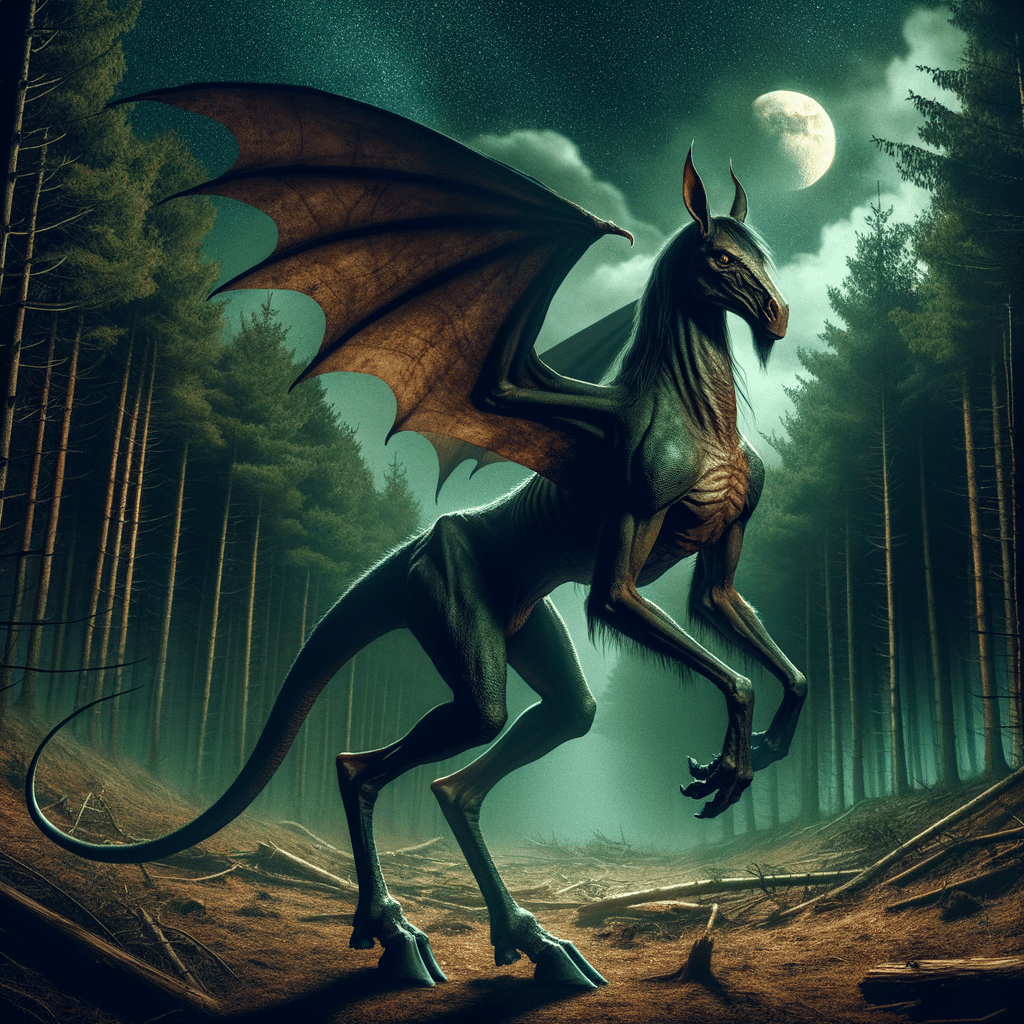
Did Napoleon’s brother see the Jersey Devil? Did Ben Franklin make up the story? This video will look at the history of this cryptid species in the Pine Barrens.
Over the years, many people have been fascinated by the mythical being known as the Jersey Devil. One of the most intriguing and persistent urban legends in American folklore, this fascinating urban myth has its origins in the state of New Jersey.
People say that the monster lives in the southern New Jersey Pine Barrens, where it scares the locals and eats cattle.

Origin
The Jersey Devil myth’s beginnings can be found in the first half of the eighteenth century. The story goes that Mother Leeds, a woman, gave birth to a cursed child. The child, which had been described as having wings, hooves, and a goat-like head, is supposed to have flown away, leaving a path of devastation in its wake.
It now appears that none other than Benjamin Franklin himself may have truly invented this tale. The rumor that Mr. Leeds was a drinker and that his wife gave birth to a demon hurt the Leeds family’s reputation as a direct rival to Franklin’s Farmer’s Almanac. Franklin made fun of Leeds and his prophecies through humor and satire, even going so far as to claim that Leeds had passed away and that his spirit was still working on his almanac. Titan Leeds, Leeds’ son, took over the family business and carried on the conflict with Franklin. He also changed the family crest to include three winged dragons, which may have been the inspiration for the design of the Jersey Devil. Some historians say that Franklin’s jokes about the ghost of Leeds and dragons led to the story of the Jersey Devil.
The frightful beast is said to have many curses and tragedies attached to it over the years, and folklore has it that anyone who crosses it will be cursed to experience its wrath.
Sightings
The New Jersey Devil is infamous for cursing Admiral Stephen Decatur, a hero in the War of 1812. Legend has it that Decatur first saw the monster in 1820 while traveling to see President James Madison. He is said to have shot the creature with a cannonball, but even after it was hit, it kept flying. Decatur became ill and eventually passed away, which led many people to think that the creature had cursed him.
Joseph Bonaparte was Napoleon’s older brother and the previous King of Spain. In 1813, he gave up the monarchy and fled to America. He bought 800 acres of land near where he lived for a while in Bordentown, New Jersey. He enjoyed hunting and frequently heard locals’ tales about the Jersey Devil. He once witnessed a bizarre animal with wings, horns, and hooves swooping over his head as he was alone hunting in the woods. He tried to shoot it but missed because he was scared. The animal took off in flight and vanished into the forest. Later, when he told his friends about what had happened, they didn’t believe him. He never again ran into the Jersey Devil.
The Jersey Devil has reportedly been spotted a lot in and around the Pine Barrens throughout the years, according to reports. For example, a rash of reports of the creature’s sightings in 1909 sparked widespread fear in the area and were covered in several publications. The creature, according to witnesses, had wings, a horse-like head, and a piercing scream that could be heard from a great distance.
He was a high school student in 1960 when he was driving Violet, his date, over an unpaved road in the Pine Barrens, according to a Fox News piece. When he thought something was in the woods, he rolled down the window of his father’s automobile. Then he saw an animal coming toward him with red eyes, horns, wings, and hooves. When he attempted to drive away, the monster landed on the car’s roof and began clawing it. He picked it off by accelerating and swerving. He claimed that he was afraid and that after that evening, Violet stopped speaking to him. “Monsters Across America,” a Fox Nation program, presented his story.

Mythology
The Jersey Devil myth has developed a life of its own over time. The tale has been told in many various ways, and the monster has been portrayed in many different ways, from a fearsome demon to a kind protector of the natural world. The story has also been used as the basis for a lot of books, movies, and other works of art, which has helped it become a part of popular culture.
The main idea of the New Jersey Devil myth is that we don’t like things that are mysterious and hard to understand. The creature represents our innermost anxieties and fears, serving as a reminder that there are aspects of the world that are outside of our comprehension and power. In this way, the legend alludes to a characteristic of all people: the fear that can come with approaching the unknown.
The New Jersey Devil mythology also touches on our need for supernatural belief at the same time. Religion, mythology, and other forms of storytelling have all long attracted people to the supernatural and the unknown. The tale of the New Jersey Devil demonstrates how the paranormal can cause us to think about and worry about things we don’t fully understand.
Along with these common themes, the mythology of how the cryptid New Jersey Devil came to be shows how the area’s history and culture are unique. The legends about the New Jersey Devil show how different cultural and historical factors have affected the area over time. The Pine Barrens are in the southern part of New Jersey. They are a beautiful and unsettling place.
Pine Barrens
The Pine Barrens is well-known for its distinctive environment in addition to its mythical fauna. Several of the rare and endangered plant and animal species found in the region are unique to the world. Most of the trees in the forests are pitch pines, oaks, and other hardwoods. Bobcats, foxes, and many types of birds live in the forests as well.
But the Pine Barrens are known for more than just their ecological importance and beautiful natural surroundings. They are also known for their dark atmosphere and paranormal activity. Some people think that a darker, more sinister force is at work in the woods because there have been many reports of strange lights, sounds, and other strange things happening there.
Even though it has a reputation for being mysterious, nature lovers, hikers, and birdwatchers keep going to the Pine Barrens. There are many hiking trails and other outdoor activities in the area, and anyone who is interested in nature will find the unique ecosystem and natural beauty of the area to be very interesting.
Recently, the monster has become a big reason for people to visit the Garden State. Many local businesses and activities use the story to attract tourists and boost the local economy.
The Batsto Village, a historical place in the Pine Barrens that dates back to the 18th century, is one of the best examples of how the New Jersey Devil has affected local businesses. The area is home to a wide range of stores and eateries that use the New Jersey Devil reputation to draw tourists. Numerous of these establishments sell goods with the New Jersey Devil theme, including t-shirts, hats, and other mementos as well as foods and beverages.
A number of other businesses and attractions in the region, in addition to Batsto Village, have made use of the New Jersey Devil legend to draw tourists. They include hotels, stores, and tour companies that take people through the Pine Barrens and talk about the monster and the stories about it.
The New Jersey Devil has a major effect on nearby businesses and attractions. With many tourists traveling specifically to learn more about the mythology and the area’s related attractions, the monster has recently grown to be a significant tourist attraction in the region. Businesses and attractions in the area say that more people are coming to see them and buying things because of the creature’s fame.
Conclusion
Still, the New Jersey Devil’s influence on nearby businesses and attractions causes some problems. Some companies may find it tough to stand out from competitors who are also using the legend, which makes it harder for them to draw in and keep clients. The popularity of the species could also hide other important things about the area, like its unique ecological and cultural history.

Leave a Reply