
The Holy Grail was undoubtedly the most valuable of all the sacred artifacts that the knights were thought to possess. According to conventional wisdom, this artifact is the cup that Joseph of Arimathea used to gather Jesus’s blood after his crucifixion and that Jesus drank from during the Last Supper. Some theories, however, contend that the Holy Grail is a goblet, a dish, a stone, an abstract spirituality devoid of any physical form, or—as Dan Brown’s best-selling book, The Da Vinci Code, explains—Mary Magdalene’s womb, where Jesus’s child and hence his lineage originated.

Arthurian Legends: The Grail Story
The Holy Grail’s origins can be traced to Christian folklore as well as pre-Christian Celtic mythology and art, according to historians. But the literature of medieval romances, especially those narrating the chivalrous knights of the legendary King Arthur, helped to increase its appeal. Undoubtedly, the pursuit of the Holy Grail emerged as the primary objective for the Knights of King Arthur.
The quest of the knights was first mentioned in Chrétien de Troyes’s incomplete Old French romance, Perceval, The Story of the Grail, published in 1180. Another French poet, Robert de Boron, took up the story and set the Holy Grail where Christ’s death and the Last Supper occurred in his epic Joseph d’Arimathie.
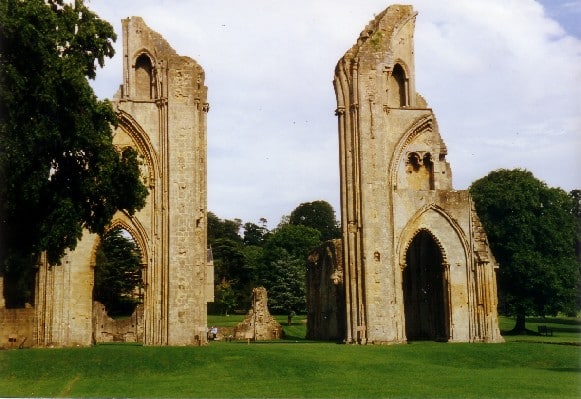
According to an Arthurian legend, Joseph of Arimathea subsequently transported the Holy Grail to Glastonbury, England, where he buried it in soggy soil that keeps turning scarlet because, so believers think, rain passes through the final remnants of Christ’s blood in the cup. The majority of scientists agree that soil-found red iron oxide is what causes the reddish water. The fact that the holy man planted his thorn staff in the ground when he first arrived in Glastonbury and watched as it took root and blossom is another fascinating aspect of the Joseph of Arimathea legend. A little portion of the original tree was planted in the grounds of Glastonbury Abbey, and the tree continues to flourish every Christmas season.
Ultimately, Sir Galahad—a knight with an unwavering bravery and pure heart—found the Grail before King Arthur did.

The Holy Grail and the Templar Knights
What, though, is the story of the Templar Knights’ connection to the Holy Grail? Many people think that Joseph of Arimathea did not actually bring the Grail to England; rather, it was hidden in the Temple Mount, under the guardianship of the Templars. Once the Muslims had taken control of Jerusalem and other Christian cities, a trustworthy knight removed the Holy Grail from the Holy Land and hid it.
Who knows what happened to it after it departed Palestine, but over the ages, numerous archaeologists and treasure seekers have tried to find out where it is hidden. There are two well-known theories.
One is that it was transported to l’enclos du Temple, the Templars’ Paris headquarters. Encircled by eight 10 m high crenellated walls supported by turrets and buttresses, it was a genuine fort that was also incredibly large. It was regarded as the country of the Templars rather than the land of France, a strong “state-within-a-state” that, in addition to a sizable gothic church, had a number of stables and knights’ residences, and a drawbridge for entry and exit. It was similar to embassies today in this regard.
But once Philip of France betrayed the knights, it was rumored that Gerard de Villiers took the Holy Grail on board his enigmatic fleet and they traveled to Scotland and then the New World.
Portugal’s Grail
According to the second theory, the Templars were compelled to relocate to Cyprus, an island they owned, following the fall of Acre, and they took the Grail with them as a means of protection. But they were forced to depart once more when Ottoman soldiers took control of Cyprus. They relocated to Portugal, where they would be safe, and established a number of chapels and Templar homes.
Under his protection, the King assisted them in establishing a new base in the city of Tomar, where they adopted the Order of Christ as their new name. It was possible for any Templar living in the nation to transfer their membership to this new order, which would go on to include monarchs and powerful nobles as members. Portugal’s King D. Manuel assumed the throne in 1495 after becoming Master of the Order in 1484.
Thus, the Holy Grail found a new, secure home in Portugal, where it was appropriately hidden from public view while the Knights Templar carried out their responsibility of guarding it.
Of course, there are a ton of alternative theories regarding the location of the Holy Grail. For example, the caretakers of Valencia Cathedral assert that an actual chalice housed within the building is the unique ancient treasure. However, there is still disagreement about its actual location and whether it has ever existed at all.

Leave a Reply