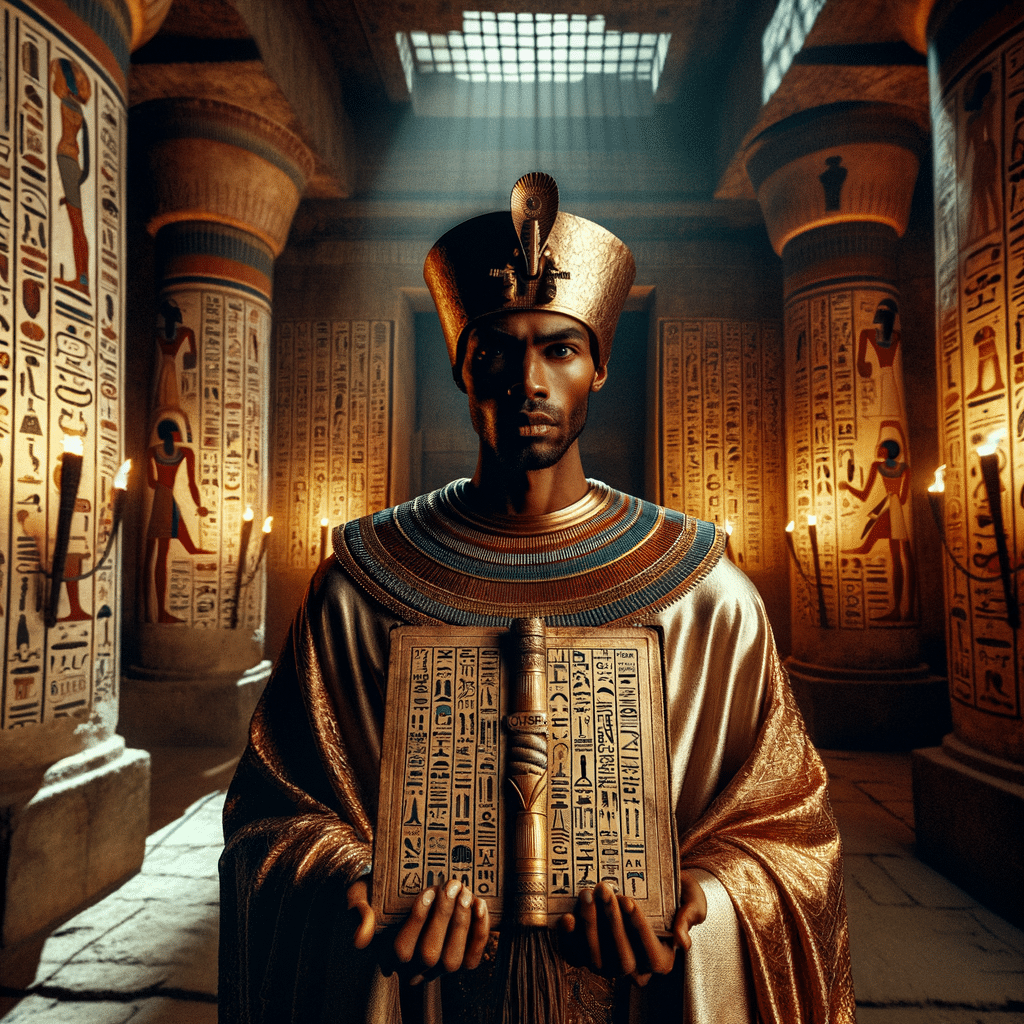
Engraved into the pyramid walls with the primary intention of ensuring the pharaohs‘ afterlife, the Pyramid Texts are the first known collection of funeral spells in the vast history of ancient Egypt. The care with which these inscriptions were engraved was intended to guarantee both the safety of the body and, hence, the immortality of the soul. Only the pharaohs were allowed to die in such splendor, and because the tombs and pyramids were sealed after burial, neither the nobles nor the common people could access this precious information, which was kept safe by the priesthood.
The fall of the Old Kingdom brought about a profound change in Egypt’s socio-political landscape. Thieves broke into the once-holy tombs and pyramids once the First Intermediate Period, which was characterized by a certain amount of lawlessness, started. As a result, the Pyramid Texts became part of common knowledge. The Egyptian elite started writing comparable magical spells on their coffins around the 11th Dynasty, which marked a significant change that resulted in the composition of what are now known as the Coffin Texts.
The Rich Tapestry of the Coffin Texts
A more accessible type of funeral literature, the Coffin Texts included spells that were closely related to ideas about death and the afterlife. Typical characteristics of these coffins included:
The Two Eyes of Horus, also known as the double udjat-eye, were figuratively painted to enable the dead to keep watch over the world of the living.
The lid’s image of the Sky Goddess Nut gave the entombed her all-encompassing protection.
The four sons of Horus, who were in charge of looking after the deceased’s internal organs, placed the corners of the coffin.
Osiris and Anubis, two gods closely linked to mummification and the afterlife, were frequently seen as guardians in side panels.
At the head and foot panels were invocations to the goddesses Nephthys and Isis, requesting their protection.
Numerous spells—roughly a thousand—were scrawled wherever there was an there was an available area on the coffin. These spells served to protect the dead from evil magic, validate their magical might, and guarantee that they would always be able to use magic.
With the number of spells growing rapidly, it was not possible to fit them all onto the small surface of a coffin. Due to this restriction, the Book of the Dead was created. It is an extensive set of papyrus scrolls that contain prayers, songs, and incantations. It is formally called “The Going Forth by Day.” The many copies of the Book of the Dead that have been found attest to the populace’s acceptance of it, despite regional variations in length, quality, and illustration.
The Book of the Dead: An Expanded Guide to the Afterlife
During the New Kingdom, the Book of the Dead was created as a more comprehensive way to incorporate more spells into the funeral than the casket could hold. The name of the departed was added to these pre-written scrolls at the time of purchase by scribes. The Book of the Dead included instructions for reanimating the corpse in the next world, guidelines for judgment in the afterlife, and protection of the body within the tomb.
The ideas of the “ka” and “ba” were central to both the Book of the Dead and ancient Egyptian eschatology. Like the soul, the ‘ba’ was represented as a bird with a human head and was thought to be the person’s doppelgänger that materialized after death. Food offerings were necessary to sustain it until its final voyage and reunion with the body. The dead corpse, or, if the body died, a statue that represented the deceased, held the ‘ka’, a spiritual replica. Magick in the Book of the Dead was carefully prepared in order to guarantee that the ‘ba’ would successfully reunite with the body and that the ‘ka’ would remain intact.
In conclusion, the development of ancient Egyptian ideas about death and the afterlife is reflected in the shift from the exclusive Pyramid Texts to the more widely read Coffin Texts and ultimately the all-encompassing Book of the Dead. This trend also represents a slow democratization of the afterlife, in which a larger portion of society has access to magical spells and rituals that were previously only available to royalty, enabling them to pursue immortality in the same manner as their heavenly overlords.
Further Reading
Allen, J. P. (2005). The Ancient Egyptian Pyramid Texts. Atlanta: Society of Biblical Literature.
This book was selected because it offers a direct translation of the Pyramid Texts, the oldest known religious texts in the world. James P. Allen provides a comprehensive study that is invaluable for understanding the early religious beliefs and practices of ancient Egypt. His work is considered one of the most accessible yet scholarly renditions of these complex inscriptions.
Taylor, J. H. (2001). Death and the Afterlife in Ancient Egypt. Chicago: University of Chicago Press.
John H. Taylor’s work delves into the Egyptian concept of the afterlife and examines the funerary practices that sustained this belief system. The book was selected for its rich illustrations and artifacts that bring to life the ancient Egyptians’ quest for immortality, as well as its exploration of both the Pyramid Texts and the Coffin Texts.
Faulkner, R. O. (1985). The Ancient Egyptian Book of the Dead. New York: British Museum Publications Ltd.
Raymond O. Faulkner is renowned for his translations of Egyptian religious literature. His translation of the Book of the Dead is meticulously detailed and provides insight into the spells and incantations designed to guide the deceased through the afterlife. This book was chosen for its historical significance and its role in shedding light on the continuity and changes in Egyptian funerary practices.



Leave a Reply