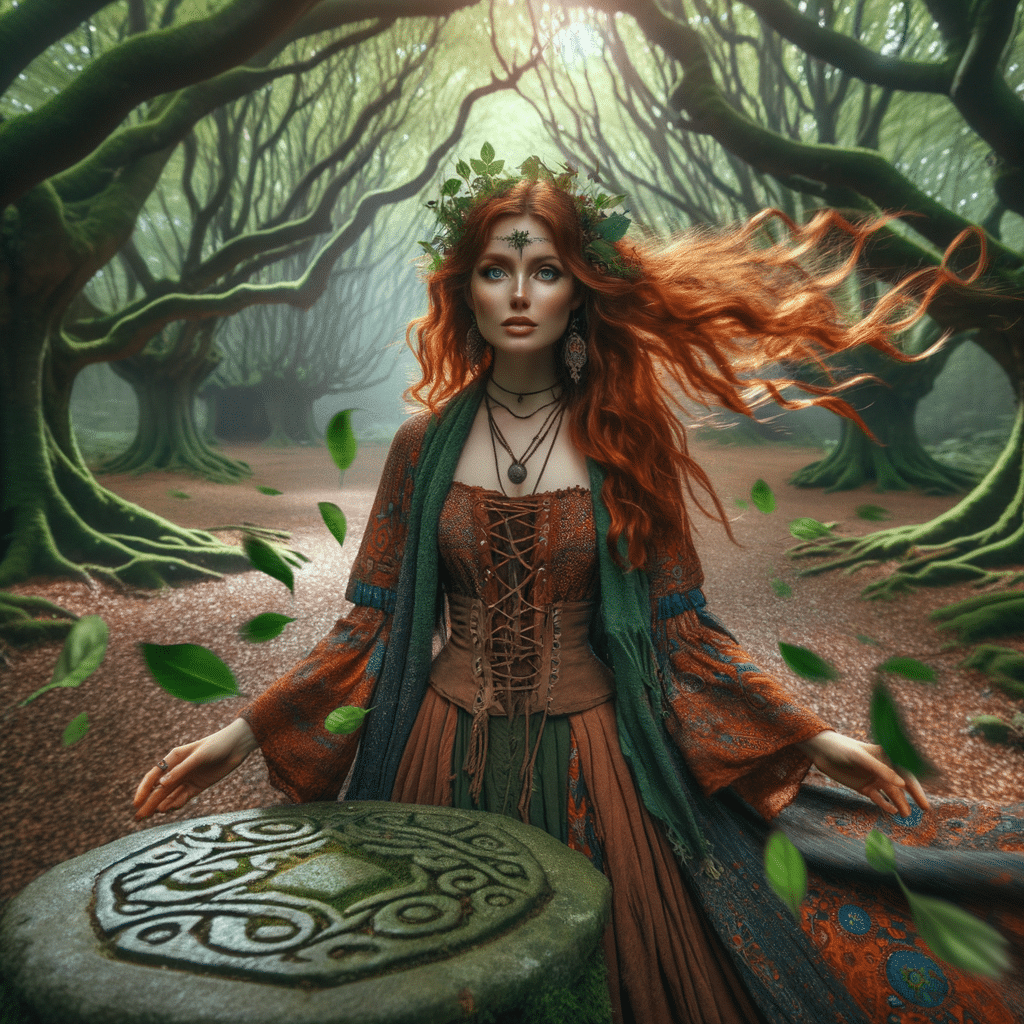
Although often forgotten, women in Celtic culture served as druids and were important religious and civil leaders in their communities.
For ages, the mysterious characters known as druids have captivated the interest of both historians and the general public. Druids were the learned class of Celtic civilization and were involved in education, jurisprudence, diplomacy, and religious obligations. Among them, female druidesses occupied an intriguing position that provides insight into the social and spiritual makeup of prehistoric Celtic societies.
Celtic Society’s Druidic Roles
Celtic society, which included what is now Ireland, Britain, France, and other parts of Europe, had a highly respected position for Druids. In addition to being the leading religious people of their day, they were also the leading scientists, philosophers, and lawyers. Their duties included overseeing judicial disputes as well as performing religious ceremonies and sacrifices. Because of their reputation as go-betweens between the gods and the populace, druids had a profound impact on almost every facet of society and politics.
Druids were also adept healers, treating wounds and ailments with their understanding of plants and other natural cures. They preserved oral traditions and transmitted wisdom and knowledge from one generation to the next. They were well-liked locals with respect.
The Druids inhabited not just the British Isles but also continental Europe, especially Gaul. They established a hierarchical structure, with an elected head druid in charge of the order. Druids trained for a very long time, often up to twenty years, in order to become experts in their fields.

Druid women
There is historical documentation and disagreement regarding the presence of female druids. Classical authors like Julius Caesar, Strabo, and Tacitus described druidesses, implying that women in Celtic tribes might achieve high spiritual and social rank. Throughout these tales, female druids frequently function as healers, prophetesses, and keepers of hallowed places. They were occasionally said to be in charge of ceremonial rites and endowed with the power to use enchantment or divination to affect the course of battles. Nine virgin priestesses known for their prophecies and mastery over the elements lived on the Isle of Sena, off the coast of Brittany. They were known as the Gallisenae.
In addition, there is archaeological proof that female druids existed. Torcs and other ritual artifacts discovered in female graves are examples of grave goods that suggest women occupied high religious rank. The bones of a wealthy Celtic woman were found in the Vix Grave in Burgundy, France. She was interred with a golden torc, indicating her high social standing and potential druidic vocation.
Mythological and folkloric figures, which frequently combine historical reality with fiction, probably had an impact on the social status of female druids. Examples of these figures are the goddess Brigid, who is linked with smithcraft, poetry, and healing, and the goddess Morrigan, who is associated with fate and combat. These mythological figures supported the idea that women can hold significant power and deserve respect for their spiritual strength and wisdom.

Druid Records
The druids left no written documents behind, which contributes to the obscurity surrounding their history. The literature of contemporaneous authors from outside the Celtic culture and archeological findings are used to piece together what is known. The druid tradition is thought to have begun in the first millennium BCE and peaked in the third century BCE.
The first records of druids were recorded in the second century BCE by Greek and Roman authors. One of the most thorough accounts of druids can be found in Julius Caesar’s “Commentarii de Bello Gallico,” which presents them as a significant and important faction in Celtic civilization.
The druids declined, even though they were quite powerful when Roman authority arrived in Celtic countries. The Romans frequently punished the Druids because they saw them as a unifying force of resistance and a threat to their own religious and cultural standards. In addition to military combat, the early Roman-Druid clashes featured diplomatic initiatives, as Caesar first made an effort to have talks with the Druids.
The biggest conflict occurred in 60 and 61 AD when Suetonius Paulinus, the Roman commander, led an attack on Anglesey, a major Druid stronghold in Britain. Boudica, the queen of the Iceni tribe, was inspired to organize a huge rebellion against the Romans in Britannia by the cruel treatment she and her people received at the hands of Roman forces. This brutality is often linked to druidic resistance against Roman control. Although the uprising had started successfully, Boudica’s and many other Druids’ deaths dealt a fatal blow to the Druidic resistance, which the Roman troops eventually put down. The Romans meticulously destroyed the Druidic culture and religion. Some Druidic customs and teachings persisted in spite of their attempts to suppress them; they were mainly assimilated into Roman culture and then into Christianity.
The druidic tradition was mostly banned by the second century CE, but it continued to exist in some form until the coming of Christianity, particularly in Scotland and Ireland. Druids faced marginalization or assimilation into the new religious order as a result of the Christianization of Celtic territories, which further weakened the ancient customs.
The druids’ legacy has persisted through mythology, folklore, and neo-pagan revivals despite their decline. Fictional works like Marion Zimmer Bradley’s The Mists of Avalon have popularized the idea of female druidic power, capturing the imagination of modern audiences.
Men and women can play as druids in the role-playing game Dungeons & Dragons, using the natural world’s might to perform spells and transform into animals. The fact that women can be druids in the game shows a more progressive attitude toward gender roles in fantasy settings and gives players the opportunity to make characters who don’t fit into preconceived notions. Many real-life women have been motivated to investigate druidry as a spiritual discipline, embracing their connection to nature and the divine via rites and ceremonies, by the success of female druid characters in Dungeons & Dragons.
Conclusion
Despite the paucity of historical documentation, it is clear that female druids existed and were important members of Celtic culture. Druid women would have been unique individuals, revered for their wisdom and spiritual authority, and possibly dreaded for their purported magical prowess. The Celtic mythology’s veneration of female goddesses further points to a society that, in certain ways, gave women a prominent role in both religious and intellectual life.
Though fading over time, the heritage of female druids has left a lasting impression on the cultural recollections of the Celtic peoples. It imagines a society in which women could serve as powerful community leaders in addition to serving as spiritual defenders. The place of women in Druidic culture continues to be an intriguing part of the larger story of human history, as contemporary research digs further into the mysteries surrounding the ancient Celts.

Leave a Reply