
Julius Caesar may have written about unicorns. This essay will explore this intriguing question.
Julius Caesar, a renowned figure in world history, continues to captivate historians, scholars, and fans alike. Distinguished by his military and political abilities, his autobiographies and firsthand recollections of the Gallic Wars offer us an intriguing window into his era. One of the many subjects he covered is unicorns, which is a quite uncommon but fascinating topic. In order to fully comprehend this, let us take a quick look at Julius Caesar, the Gallic Wars, and the myth of the unicorns.
Biography
Born around 100 BC, Gaius Julius Caesar belonged to the esteemed Julian Clan. Caesar showed a keen talent for politics at a young age and went on to become one of Rome’s most powerful individuals by moving up the ranks. However, his career in politics and the military truly took off after his selection as consul in 59 BC. He soon began the Gallic Wars, a sequence of military expeditions that extended Roman dominion over all of Gaul, including present-day France and Belgium.
Between 58 and 50 BC, Caesar’s army engaged in combat with several Gaulish tribes during the Gallic Wars. Caesar used his strategic acumen to guide the Roman soldiers throughout these eight years, progressively assimilating Gaul into the Roman Empire. His first-hand narrative Commentaries on the Gallic War, which shed light on the strategy, tactics, and cross-cultural interactions of the era, became a foundational book of military history.
Usually depicted as white creatures akin to horses or goats, unicorns are characterized by a single, enormous, spiraling horn protruding from their forehead. Writings first depicted unicorns around the Bronze Age, and they later frequently appeared in seals from the Indus Valley Civilization, Greek literature, and Medieval and Renaissance folklore.
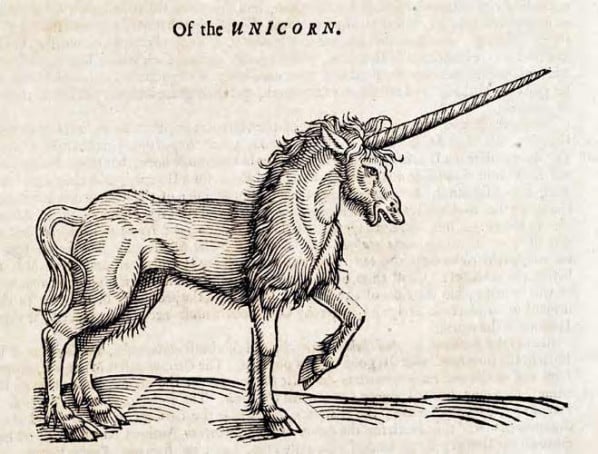
Caesar made an odd reference to unicorns in the middle of his account of the Gallic Wars’ violent conflicts and power struggles. He characterized them as beings that lived in the Hercynian Forest, an enormous, old woodland that stretches throughout the heart of Europe. In contrast to the horse-like creature of modern mythology, Caesar’s depiction of the unicorn had “the body of a stag, the tail of a boar, the head of a horse, the limbs of a moose, and a distinctive horn, longer and straighter than those we are accustomed to seeing.”
Caesar’s story undoubtedly had a significant impact on how Europeans perceived unicorns, but it also generated a great deal of historical controversy. His statement deviated from accepted notions, raising questions about whether he had discovered a previously undiscovered species, whether he was alluding to a well-known animal, such as the aurochs or rhinoceros, or whether he was embellishing or misinterpreting others’ experiences. The argument highlights the difficulties in interpreting historical writings and the degree to which mythology and fact can converge.
We have established the accuracy of most of what Caesar wrote about the Gallic Wars. We must consider his bias towards his own cause when interpreting his writings. However, what he wrote did happen. Was he mistaken about unicorns?

Unicorns
The Bible frequently mentions the unicorn, particularly in the Old Testament, and discusses it in a similar way. It’s crucial to remember, though, that the biblical unicorn is not the same as the well-known mythological animal of today. According to the King James Version, a re’em, which translates to “unicorn,” is a strong, formidable animal. Scholars have proposed that the biblical unicorn could be an aurochs or a wild ox, which adds to the difficulty of deciphering ancient writings.
Many people believe the Bible to be accurate. When the Bible seems to contradict their views, these same people choose to interpret it in a way that supports them and place the blame on context or translation. Are the unicorns in the Bible and Juliet Caesar the same? Is it simply a case of mistranslation or misinterpretation that is nonexistent? Or could it actually be true?
Conclusion
Essentially, Julius Caesar’s description of unicorns during the Gallic Wars is an intriguing example of how history, myth, and interpretation interact. It underscores how our cultural and personal understandings shape our worldview, and how the unusual can infiltrate history, even amidst a military conflict. It is questionable if Caesar’s unicorn was a fable, a recognized animal, or a new species, but it does give his historical narratives a fascinating new dimension and continues to provoke discussions in zoology and history.
References
Alexander, S. (2015). Unicorns: The Myths, Legends, & Lore. Simon and Schuster.
Gilliver, K. M. (2004). Caesar’s Gallic Wars 58-50 BC. Routledge.
Jablonski, J. A. (2015). Unicorns: Past, Present and in the Imagination.
Miller, T. S. (2024). Unicorn Lore: The Multiple Mythologies Behind The Last Unicorn. Peter S. Beagle’s “The Last Unicorn” A Critical Companion, 47-72.
Mohacsy, I. (1984). The legend of the unicorn: An illumination of the maternal split. Journal of the American Academy of Psychoanalysis, 12(3), 387-412.
Smith, H. (2020). The Unicorn Myth. World History Encyclopedia, 82-83.



Leave a Reply