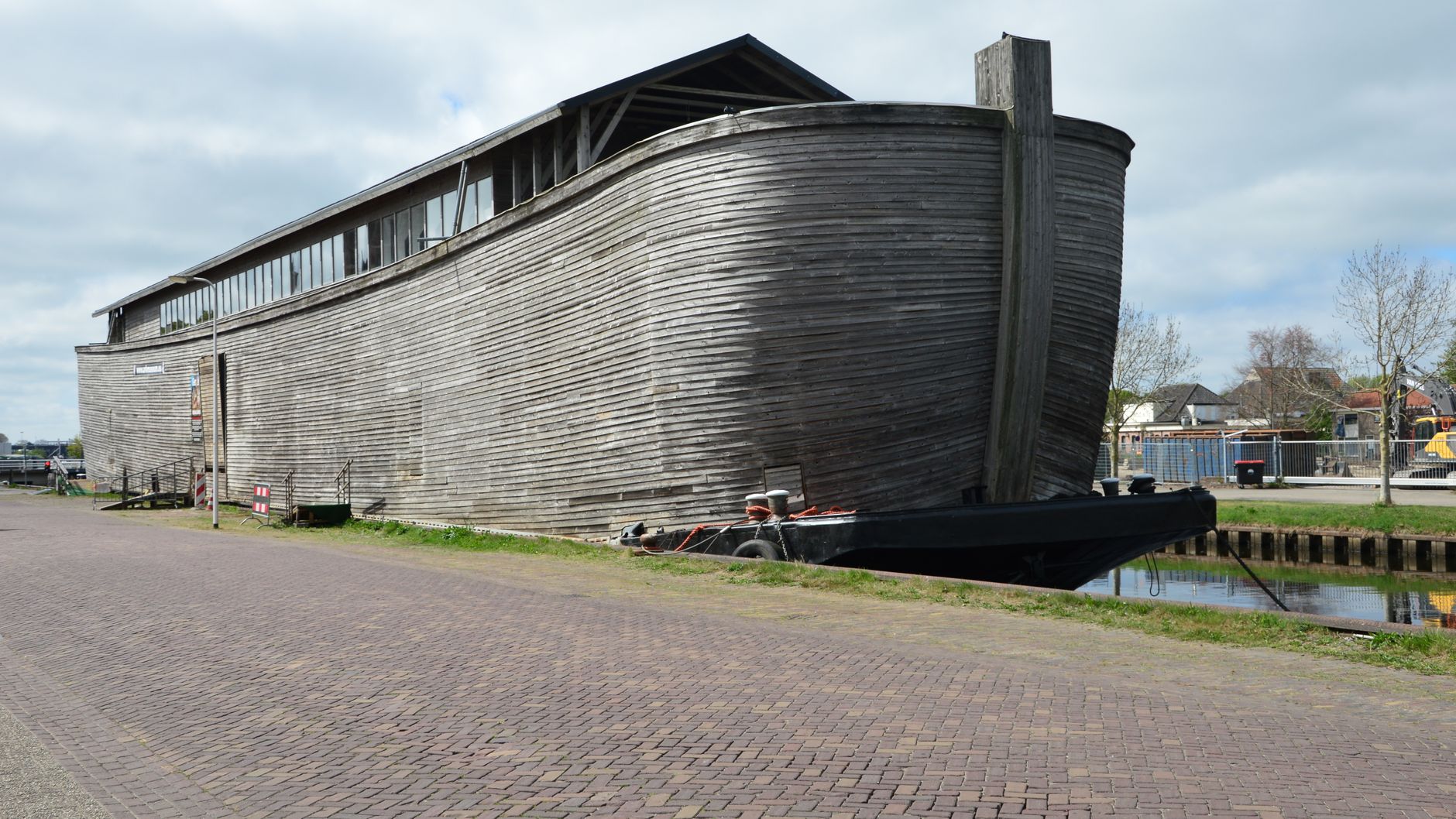
Noah’s Ark Found History: Key Points
- For over two thousand years, people have claimed to find Noah’s Ark. Ancient writers placed it in the mountains of the Kurds, not on modern Ararat.
- Nineteenth-century claims included a deathbed confession whose records supposedly burned, James Bryce’s half-joking relic wood, and an 1883 April Fools’ hoax.
- Twentieth-century witnesses could never show anyone the site, and the Roskovitsky story was made up. Navarra’s wood was dated thousands of years too young.
- The Durupınar formation turned out to be natural rock, and a 1993 CBS special fell for “ark wood” that was really railroad pine cooked in sauces.
- Recent finds revealed that the materials were ice, rock, or most likely planted wood, leading to the dismissal of a lawsuit defending the NAMI site.
- A new 2026 Durupınar claim is still unproven, and the long record of failed claims shows that extraordinary claims need extraordinary evidence.

Introduction
Noah’s Ark has been found more frequently than most things in human history. The Book of Genesis simply says that the Ark rested “upon the mountains of Ararat.” But for over two thousand years travelers, monks, warriors, businesspeople, and amateur explorers have claimed to have found it. Some of the assertions were honest mistakes. Others were legends that expanded with the telling; a surprising number were purposeful hoaxes. One archeologist recently remarked that the Ark may have been “found” more often than any other object or feature in the Bible (Feagans, 2026). If we examine these statements one by one, the pattern is obvious. All guaranteed definitive proof. All of these claims fell apart when someone examined them closely. That pattern is significant, especially as a new claim makes news in 2026.
Ancient and Medieval Origins of the Ark Tradition
The story of Noah’s Ark is at the intersection of the biblical text, the Mesopotamian flood myths, and later interpretive streams in Judaism, Christianity, Islam, and world literature. The Genesis flood narrative has a close set of plot components to early Mesopotamian sources (Atrahasis, Gilgamesh XI). It is often recognized as having a background in these traditions. Several sources agree that Genesis 6–9 addresses Mesopotamian narrators and motifs, but the Hebrew text reshapes and reworks them according to the concerns of Israelite theology. Scholarly studies consistently point to this alignment (Sanders, n.d.; Dickin, 2023; Zhang, 2026; Boyd, 2018; Burns & Goff, 2022). The presence of a Noah’s Ark-like account and a worldwide flood in various literary traditions has prompted many to seek evidence.
The first sources for the Ark’s ruins are ancient scribes, whose descriptions did not correspond to the mountain that most people imagine today. The Babylonian priest Berossus, writing around the third century B.C., located the vessel in the country of the Cordyaeans, or Kurds. Later tradition identified that area with Mount Judi, not with the volcanic mountain presently called Ararat (Colavito, n.d.). The Jewish historian Josephus, writing in the first century CE, preserved the words of Berossus: “It is said there is still some part of this ship in Armenia, at the mountain of the Cordyaeans, and that some people carry off pieces of the bitumen, which they take away and use chiefly as amulets for the averting of mischiefs” (Josephus, ca. 94/1987, Antiquities 1.93). Josephus also cites Nicolaus of Damascus. Nicolaus reports about a mountain named Baris, where “the remains of the timber were preserved for a great while” (Josephus, ca. 94/1987, Antiquities 1.95). And the tradition went on. Even in the 1700s, there was no consensus that the Ark Mountain was the current Mount Ararat (Colavito, n.d.). None of these discoveries were in the current sense of the word discovery. No measurements were taken, and no samples came back. But nonetheless, they sowed the idea that the Ark had survived and might be seen.
The fifth century saw the growth of a legend about Jacob of Nisibis, a fourth-century monk and bishop. Faustus of Byzantium says that Jacob went to “Sararad mountain” in the Korduk area to locate the Ark. An angel appeared to him near the top in his sleep and urged him not to climb further and gave him a plank from the vessel (“Searches for Noah’s Ark,” 2026). Later versions suggest that Jacob undertook the journey because the local people did not believe that the Flood had occurred (Jacob of Nisibis, 2026). The Armenian Church keeps on telling the story. In its version Jacob fell asleep at the foot of Mount Ararat, and when he awoke, he found a portion of the Ark in the shape of a cross under his head (‘Saint Jacob of Nisibis,’ n.d.). The relic is stored in a reliquary made in 1698 at Etchmiadzin Cathedral in Armenia (“Why Armenian Christians Recall,” 2024). The differences in the specifics indicate how a legend might float from one mountain to another in the retelling. The story also introduced a recurring element: a piece of wood brought down from the heights.

Nineteenth- and Early Twentieth-Century Eyewitnesses and Hoaxes
The nineteenth century saw a new form of claim, blending adventure, early science, and the rising popular press. On his deathbed Haji Yearam, an Armenian immigrant, declared he had led a covert mission to the Ark in 1856, when he was a youngster (Feagans, 2026). The next version of the story was that Yearam and his father took three visiting scientists up the mountain. They entered the Ark and discovered that it had several sections. The scientists, who intended to disprove the Bible, threatened the guides with murder if they ever spoke about the incident. Yearam later related the story to a friend who wrote it down. That acquaintance then said he had read in a newspaper of a London scientist who had made a similar deathbed confession. A fire reportedly destroyed both the written account and the newspaper clipping (“What About the Search,” n.d.). Nobody could confirm the story, and that’s presumably why it continued.
Two decades later an Oxford historian who became a prominent statesman, James Bryce, ascended Ararat when on a visit to the region (Bryce, 1878). He climbed above 13,000 feet, well above the forest line (“Was the Story of Noah’s Ark,” 2026). There he came upon what he termed “a piece of wood about four feet long and five inches thick, evidently cut by some tool, and so far above the limit of trees that it could by no possibility be a natural fragment of one” (Bryce, 1878, cited in “Searches for Noah’s Ark,” 2026). Bryce sliced off a chunk of the wood to keep as a souvenir. He allowed that another explanation had occurred to him. Still, he concluded, with some amusement, that “no man is bound to discredit his relic” (Bryce, 1878, quoted in “Searches for Noah’s Ark,” 2026).
In 1883, the line between news and fiction disappeared altogether. A genuine avalanche on Ararat wiped out numerous villages on March 26 of that year. A writer named George McCullagh Reed used the event for an April Fools’ Day joke in the New Zealand Herald, under the pen name “Pollex.” He claimed the avalanche had uncovered Noah’s Ark. His story described a team of “commissioners appointed by the Turkish government,” which included a made-up English scientist called “Captain Gascoyne.” It even mentioned “an enterprising American traveler” who hoped to buy the Ark for exhibition. Reed intended for readers to recognize that traveler as the showman P. T. Barnum (“Searches for Noah’s Ark,” 2026). Many readers missed the joke. By August 10, 1883, the Chicago Tribune was reporting that Turkish investigators “came upon a gigantic structure of very dark wood protruding from a glacier. ” That version added that locals were afraid to go near it because “a spirit of fierce aspect had been seen looking out the upper window” (“What About the Search,” n.d.).
The next major claim came in 1887 from John Joseph Nouri, who was born in Baghdad in 1865. In 1885 he was made an archdeacon in the Chaldean Catholic Church. He said he reached the summit of Ararat in April 1887 and saw the Ark there. Later he toured the United States under a long string of grand titles, one of which was “The Discoveror of Noah’s Ark and the Golden Mountains of the Moon.” At one point during his travels he was held at the Napa Insane Asylum in California, and his account was never confirmed (“Searches for Noah’s Ark,” 2026).
The early twentieth century added eyewitness accounts that could never be tested. Georgie Hagopian, an Armenian American, said his uncle took him up Ararat twice as a child. Sources do not even agree on when. Some place the trips between 1902 and 1908, while others give 1908 and 1910 (Feagans, 2026; “Where Is Noah’s Ark?,” 2021). Hagopian did not share his story with Ark searchers until around 1970, more than sixty years later. He described a long, rectangular vessel sitting on the edge of a cliff on top of bluish-green rock. Its bottom was flat, its roof was nearly flat, and its wood seemed as hard as stone (“Where Is Noah’s Ark?,” 2021). He said he climbed onto the roof both times. Hagopian died in 1972 (“Have They Found Noah’s Ark?,” 2009). Even after a lifetime of telling the story, he was never able to show anyone the exact spot (“Is Noah’s Ark on Mount Ararat?,” 2026).
Then came a far more dramatic story. A Russian aviator named Vladimir Roskovitsky supposedly saw a giant shipwreck on Ararat around 1916 or 1917. In the story, Tsar Nicholas II sent 150 soldiers to investigate, but the Bolshevik Revolution broke out, and the report was suppressed (“Searches for Noah’s Ark,” 2026). Several religious papers printed the tale in 1941 and 1942. Some of them later ran retractions. The story came back anyway in a Canadian magazine in March 1945, now with extra details added (Wood, 1946). It also spread into more serious-looking books. The French scholar André Parrot repeated it in a 1953 study of the Flood, and a White Russian colonel named Alexander Koor published his version in a Russian-language periodical (Montgomery, 1971). Its author eventually admitted that the original account was fiction (Feagans, 2026).
World War II produced another witness. Ed Davis, an American who served with the U.S. Army in Iran in 1943, said that local villagers led him to a mountain overlook and showed him a broken wooden structure that they called Noah’s Ark (Feagans, 2026; “Is Noah’s Ark on Mount in Iran?” 2006). He told the story publicly decades later. In 1986 he described it to the Ark researcher Elfred Lee, recalling the moment the clouds parted: “We waited a while, and the fog lifted, and it shone through in the end” (“Noah’s Ark,” 2020). Davis said the vessel had split into two pieces. He said it had three decks, with large cages on the bottom deck and smaller ones above (“Noah’s Ark,” 2020). He could not say exactly where the mountain was. Critics have also raised doubts about whether Davis could have been at the site he described in 1943 (“Bob Cornuke,” 2026). As with Yearam and Hagopian, there was no physical evidence, only memories told years later.

Twentieth-Century Expeditions and Scientific Scrutiny
The most famous site in the whole search appeared in the middle of the century. On May 19, 1948, heavy rain and earthquakes stripped mud from a hillside south of Mount Ararat. A Kurdish shepherd named Reshit Sarihan is credited with discovering a long, boat-shaped ridge (“Durupınar Site,” 2026). In October 1959, Turkish Army Captain İlhan Durupınar spotted the formation in aerial photographs taken during a NATO mapping mission (“Was Noah’s Ark Found,” 2013). Life magazine published the images in 1960, and excitement spread quickly. That September, a team from the Archaeological Research Foundation spent two days digging and blasting with dynamite inside the formation. The team included Durupınar and the photogrammetry professor Arthur Brandenberger. They found only soil and rock. Their official statement called the feature “a freak of nature and not man-made” (“Durupınar Site,” 2026). The site is made of limonite and is about 164 meters long (“Durupınar Site,” 2026). It still carries Durupınar’s name, and as later events showed, it never stayed forgotten for long.
Meanwhile, other explorers continued searching Ararat itself. Between 1952 and 1955, the French industrialist Fernand Navarra made several trips to the mountain. He asserted that a hand-shaped wooden beam he retrieved from the 1955 climb lay buried beneath glacial ice. He returned in 1969 and collected more samples (Tkachuck, n.d.). At first the wood looked like a breakthrough. In 1957, newspapers reported that “tests showed it was wood more than 5,000 years old” (“Expedition to Seek Noah’s Ark,” 1957). Those early age estimates were based mostly on the wood’s color and density (Tkachuck, n.d.). Radiocarbon dating revealed a different narrative. Six laboratories tested Navarra’s samples, and most of the dates fell between about 620 and 790 CE. One sample dated to around 270 CE (Taylor & Berger, 1980). Taylor and Berger concluded that the wood probably came from some later structure, not from the Ark (Tkachuck, n.d.). That put it thousands of years too young for the biblical flood (“Was the Story of Noah’s Ark,” 2026). Even so, the 1993 CBS special described the wood as 5,000 years old (“Is Noah’s Ark on Mount Ararat?,” 2026).
The story of George Greene shows how a claim can grow even when the evidence is gone. According to one 1971 account, Greene was a mining engineer flying a helicopter over Ararat in the late summer of 1952. He supposedly saw the prow of a ship sticking out of the ice, circled within ninety feet of it, and took six photographs. About thirty people later said they had seen the prints (Montgomery, 1971). Other versions give the year as 1954. That version first came out in the mid-1960s through Fred Drake, an oil engineer who said he had seen the photos. An investigation by the Archaeological Research Foundation found that Greene had tried and failed to organize an expedition. He then moved to British Guiana and died there in 1962 (“Searches for Noah’s Ark,” 2026). He was murdered, apparently for gold, and none of his belongings were recovered (Montgomery, 1971). The photographs have never been found. Lost photographs would become a regular feature of Ark lore.
In 1977, the Durupınar site came back into the spotlight. Ron Wyatt, a nurse anesthetist from Tennessee with no training in archaeology, began promoting the formation as the true Ark. He said he had found petrified wood held together by metal fittings, along with iron brackets and stone anchors (“The New Noah’s Ark Claim,” 2026). Wyatt also claimed to have found the Ark of the Covenant, the ruins of Sodom and Gomorrah, and Egyptian chariot wheels on the floor of the Red Sea. Archaeologists have never confirmed any of these claims (Sinkinson, 2026). For a while his work at Durupınar drew serious attention, and the Turkish government declared the area a national park in 1986 (Feagans, 2026). The case did not last. In 1987, a professional radar operator could not reproduce the scans that supposedly showed walls and bulkheads inside the formation. In 1996, the geologist Lorence Collins published a study with David Fasold, who had once been one of the site’s strongest supporters. Their study indicated that the “ark” was a common geological structure (“The New Noah’s Ark Claim,” 2026; Collins & Fasold, 1996). Specifically, it is a double-plunging syncline, which is a fold in layers of rock shaped over time by erosion and weathering (Feagans, 2026).
The search for the Ark also attracted some who sought to prove how readily the media might be deceived. In 1993, CBS broadcast a prime-time show, The Incredible Discovery of Noah’s Ark. One of its star witnesses was part-time actor George Jammal, who said he found the Ark in an ice cave on Ararat in the 1980s. On camera, Jammal presented a piece of what he called sacred wood, despite having never been on the mountain; this immediately revealed the deception. The wood was modern pine aged to appear antique (Rosenberg, 1993). Jammal had arranged the fake with Gerald Larue, a professor of biblical history and archeology, to demonstrate how laxly the producers verified their sources. The “ark wood” was railroad ties from Long Beach, Calif. Lippard (1994) reports that Jammal baked it in the oven with a mixture of sauces, including wine and soy sauce. His history had not been investigated, and the wood had not been tested (Rosenberg, 1993).
Satellite Imagery and Twenty-First-Century Claims
By the twenty-first century, satellites had taken the place of shepherds and warriors. The “Ararat Anomaly” is a black form in the snowfields some 15,500 feet up the mountain. It was originally seen in United States Air Force reconaissance photographs in 1949 (“Ararat Anomaly,” 2026). Daniel McGivern, a 64-year-old Roman Catholic entrepreneur from Honolulu, became certain it was the Ark. Satellite photographs taken during Europe’s record heat wave in 2003 had shown the peak with less snow than normal. In one close-up, McGivern reported that he could see three beams and a crossbeam (Govier, 2004). His certainty and his outlay are differently stated. Feagans (2026) reports him as being “98 percent sure” and says the cost is roughly half a million dollars. Christianity Today stated “90 percent sure,” and $900,000 was planned for a 30-member U.S. and Turkish team (Govier, 2004). McGivern was quoted at a news conference in Washington as saying that the finding of the Ark was “the single greatest event since the resurrection of Jesus Christ” (Govier, 2004). His objective was to take a picture of the thing, not to dig it up (Associated Press, 2004). Turkey denied his request in September, in part because the mountain was located in a military zone (“Ararat Anomaly,” 2026; “Searches for Noah’s Ark,” 2026). Critics said the whole thing was a PR hoax. They also asked why he had chosen expedition leader Ahmet Ali Arslan, who had formerly claimed to have photographed the Ark. One researcher informed National Geographic that “Ahmet is a big talker” (“Searches for Noah’s Ark,” 2026). A CIA examination of the photos concluded that the anomaly was most likely layers of ice covered by younger snow and ice (“Ararat Anomaly,” 2026).
Others looked further afield, beyond Turkey. Bob Cornuke, founder of the BASE Institute, believed ancient sources indicated Iran. He followed the map Ed Davis had drawn him (“Is Noah’s Ark on Mount in Iran?” 2006). In July 2005 and June 2006 Cornuke-led crews climbed Mount Takht-e Suleyman in the Alborz Mountains. They found a dark rock formation approximately 400 feet long at an elevation of 13,120 feet (“Bob Cornuke,” 2026). One team member remarked it “nearly looked like carved wood, but certainly rock. ” Cornuke himself was careful: “I think we’ve found something that deserves a lot more research” (“Is Noah’s Ark on Mount in Iran?” 2006). He was very honest about what his job supplied: “We sell hope” (“Is Noah’s Ark on Mount in Iran?” 2006). The geologists were less optimistic. Some believed the formation was just regular rock (“Is Noah’s Ark on Mount in Iran?” 2006). Creationist geologists also cautioned against this, and John Morris of the Institute for Creation Research claimed that he did not believe the rocks were petrified wood or the Ark (“Bob Cornuke,” 2026).
A few years later came one of the greatest deceptions in the story. In 2008, the evangelical group Noah’s Ark Ministries International (NAMI) in Hong Kong had reported a find (“Noah’s Ark Makes Waves,” 2010). On April 25, 2010, it conducted a news conference in Hong Kong with its Turkish partners. Scientists dated the wooden chambers discovered at 12,000 feet on Mount Ararat to around 4,800 years ago. It also claimed to be “99 percent sure” the wood originated from Noah’s Ark (“Doubt Cast on Noah’s Ark,” 2010). The group had a Kurdish guide, Ahmet Ertugrul, known locally as “Parasut.” He allegedly requested $100,000 in advance and secured the site’s location (Feagans, 2020). Doubts emerged within days. In 2008 the team’s archeologist was Randall Price, an evangelical archeologist from Liberty University. In a leaked email, he added that “large wood beams from an old structure in the Black Sea area (where the photos were originally taken) are said to have been placed at the Mt. Ararat site by Kurdish workers.” He stated that more wood was put inside a cave in the summer of 2009, just before the Chinese team came to film it (“Doubt Cast on Noah’s Ark,” 2010). Other scholars opposed the claim on more prosaic grounds. “There isn’t enough H₂O in the world to get an ark that high up a mountain,” said archeologist Peter Kuniholm. The Turkish Ministry of Culture and Tourism also started examining how items from the find wound up in Hong Kong (“Noah’s Ark Makes Waves,” 2010). Later that year Price said his crew had gotten to the location, carbon-dated the wood to current times, and recorded a local resident showing how he helped build the structures. His group also produced a 33-page study accusing the guide of fraud in the past. NAMI disputed all of the allegations and threatened to sue for defamation (Creation Ministries International, 2010). The Hong Kong team was more likely to be the victim of the prank than the creator (Feagans, 2020).
The NAMI tale did not stop in 2010. It found a new champion in Joel Klenck, a Harvard-trained archeologist who ran a corporation called the Paleontological Research Corporation. In November 2011, Klenck published a press release stating, “The site is no hoax.” He described a big wooden structure of cypress timbers, basalt bowls, stone tools, and “one room with a floor covered by chickpea seeds” (Klenck, 2011b). He placed most of the material in the Late Epipaleolithic, perhaps 13,100 to 9,600 BCE, rather than NAMI’s estimate of 4,800 years (Klenck, 2011b). That date is thousands of years before any biblical account of Noah. When Price and the creationist Don Patton called the site a hoax, Klenck said the critics were motivated by “financial and emotional reasons.” He also blamed competition among local travel businesses (Klenck, 2011a). He sued Liberty University, Price, Patton, and others for defamation in a Florida court in 2015. His complaint was dismissed with prejudice, meaning he could not refile it. An appeals court maintained that ruling without comment, and the Florida Supreme Court declared it had no authority to revisit the matter. Klenck appealed to the U.S. Supreme Court to hear the case in 2022 (Klenck v. Liberty University, 2022). By 2020 he was releasing new press releases that Noah’s Ark was a fact and that its features were consistent with the ancient descriptions of Berossus and Josephus (Feagans, 2020). Other archeologists regarded the claims as pseudoarchaeology. Klenck “offers no evidence he’s even been to the purported site” (Feagans, 2020). One of the releases he said blamed Ottoman Turks, Armenians, and a Soviet cabal for burying the Ark.
This approach leads to the latest assertion. A US researcher, Andrew Jones, formed a group called Noah’s Ark Scans in 2026 that put the Durupınar formation back in the limelight. The company says radar surveys have shown halls, rooms, and multiple levels beneath the surface. It has drilled cores 18 meters deep and lowered a robotic camera down the bore holes. Jones’s team also found that soil samples collected in 2024 contained nearly three times as much organic material inside the formation as outside it. In June 2026, the Turkish government issued permits for a major study led by the archeologist Cenker Atila (“The New Noah’s Ark Claim,” 2026). By October, the team said it had completed the first part of its search and generated a 3D model of the vessel “as it currently rests.” The radar interpretations are based largely on a preliminary assessment by engineer Khosrow Bakhtar (King, 2026). Some headlines and social media posts have stated that the site is “100% confirmed” (Sinkinson, 2026). Much of the lab work and the whole technical report remain incomplete, according to critics. They further claim that for decades, experts have explained the formation as natural rock. Even a real buried structure would require much more evidence before anyone could say it was Noah’s Ark (Feagans, 2026; Sinkinson, 2026). For the moment the assertion remains untested.
Conclusion
The story of Noah’s Ark discoveries is less about a missing boat than it is about humans. It illustrates how much people desire to see proof of their religion. It also shows how easily hoaxers can exploit that hope, enthusiasts can inflate it, and the press can disseminate it. Time and again, a compelling story was presented, but the evidence later disintegrated. The ancient writings indicated a different peak from the one later explorers ascended. Jacob’s relic is an item of faith to be preserved, not to be scientifically tested. Bryce saved his wood partially as a joke, and Navarra’s was thousands of years too young. Yearam’s records burned, Greene’s images disappeared, and Hagopian and Davis could never bring anyone back to what they had seen. The finding began as a prank in 1883: Roskovitsky was fabricated, and Jammal’s relic was railroad pine in sauce. McGivern’s beams were probably ice; Cornuke’s timbers were rock. Local individuals probably made the compartments for the Hong Kong team. Klenck’s claim was dismissed when he tried to defend them in court. The Durupınar formation, “discovered” more than once, is still best explained as folded rock. Not even antique wood would solve the subject. There would be no way of linking it to Noah, as archeologist Jodi Magness described it. (“Was the Story of Noah’s Ark,” 2026). None of this establishes or disproves anyone’s religion. Christian writers have argued for years (Sinkinson, 2026) that thorough questioning of assertions is part of being faithful, not the opposite. The search will likely continue. If so, the last two thousand years have made one thing clear: exceptional claims require extraordinary evidence, and that evidence has never been found.
References
Ararat anomaly. (2026, May 19). In Wikipedia. https://en.wikipedia.org/wiki/Ararat_anomaly
Associated Press. (2004, April 26). Explorers plan quest in search of Noah’s Ark. NBC News. https://www.nbcnews.com/id/wbna4838007
Bob Cornuke. (2026, August 7). In Wikipedia. https://en.wikipedia.org/wiki/Bob_Cornuke
Boyd, S. L. (2018). The flood and the problem of being an Omnivore. Journal for the Study of the Old Testament, 43(2), 163–178. https://doi.org/10.1177/0309089217725259
Bryce, J. (1878). Transcaucasia and Ararat: Being notes of a vacation tour in the autumn of 1876. Macmillan. https://archive.org/details/transcaucasiaara00brycuoft
Burns, D. M., & Goff, M. (2022). The Dead Sea Scrolls and the Nag Hammadi Codices. https://doi.org/10.1163/9789004517561
Colavito, J. (n.d.). The hunt for Noah’s Ark. JasonColavito.com. https://www.jasoncolavito.com/the-hunt-for-noahs-ark.html
Collins, L. G., & Fasold, D. F. (1996). Bogus “Noah’s Ark” from Turkey exposed as a common geologic structure. Journal of Geoscience Education, 44(4), 439-444.
Creation Ministries International. (2010, September 29). Noah’s Ark, or … what? Important update. Creation.com. http://chinese.creation.com/noahs-ark-or-what
Dickin, A. P. (2023). Recovering Genesis One from Scientific and Societal Misunderstanding. Christian Perspectives on Science and Technology, 2, 28–57. https://doi.org/10.58913/ulgj3154
Doubt cast on Noah’s ark found in Turkey. (2010, April 28). The Christian Science Monitor. https://www.csmonitor.com/World/Global-Issues/2010/0428/Doubt-cast-on-Noah-s-ark-found-in-Turkey
Durupınar site. (2026, October 14). In Wikipedia. https://en.wikipedia.org/wiki/Durup%C4%B1nar_site
The epic of Gilgamesh (A. George, Trans.). (1999). Penguin.
Expedition to seek out Noah’s Ark. (1957, May 10). The Detroit Jewish News, 11. https://digital.bentley.umich.edu/djnews/djn.1957.05.10.001/11
Feagans, C. (2020, December 22). The pseudoarchaeology of Noah’s Ark. A Hot Cup of Joe. https://ahotcupofjoe.net/2020/12/the-pseudoarchaeology-of-noahs-ark/
Feagans, C. (2026, October 18). Noah’s Ark is the herpes of pseudoarchaeology. A Hot Cup of Joe. https://ahotcupofjoe.net/2026/10/noahs-ark-is-the-herpes-of-pseudoarchaeology/
Govier, G. (2004, July). Explorers of Noah’s lost ark. Christianity Today. https://www.christianitytoday.com/2004/07/explorers-of-noahs-lost-ark/
Have they found Noah’s ark? (2009, July 1). The Watchtower. https://www.jw.org/en/library/magazines/wp20090701/Have-They-Found-Noahs-Ark/
Is Noah’s Ark on Mount Ararat? (2026, September 19). Answers in Genesis. https://answersingenesis.org/noahs-ark/noahs-ark-found/noahs-ark-mount-ararat/
Is Noah’s ark on mount in Iran? (2006, August 12). Deseret News. https://www.deseret.com/2006/8/12/19968163/is-noah-s-ark-on-mount-in-iran
Jacob of Nisibis. (2026, June 30). In Wikipedia. https://en.wikipedia.org/wiki/Jacob_of_Nisibis
Josephus. (1987). The works of Josephus (W. Whiston, Trans.). Hendrickson. (Original work published ca. 94 CE)
King, J. (2026, October 13). Noah’s Ark hunters build 3D scale model as “phase 2” underway. Newsweek. https://www.newsweek.com/noahs-ark-hunters-build-3d-scale-model-after-examining-site-12559115
King James Bible. (2017). King James Bible Online. https://www.kingjamesbibleonline.org/ (Original work published 1769)
Klenck, J. (2011a, December 22). Archaeologist Joel Klenck counters critics: Mount Ararat discovery is a prehistoric site [Press release]. SBWire. https://www.researchgate.net/publication/344664952_Archaeologist_Joel_Klenck_Counters_Critics_Mount_Ararat_Discovery_Is_a_Prehistoric_Site
Klenck, J. (2011b, November 15). New support for alleged Noah’s Ark discovery [Press release]. SBWire. https://www.researchgate.net/publication/344664364_Joel_Klenck_New_Support_for_Alleged_Noah’s_Ark_Discovery
Klenck v. Liberty University, No. 21-1207 (U.S. 2022) (petition for writ of certiorari, appendix). https://www.supremecourt.gov/DocketPDF/21/21-1207/217622/20220304120827026_20220304-115914-00002454-00008161.pdf
Lambert, W. G., & Millard, A. R. (1969). Atra-ḫasīs: The Babylonian story of the flood. Clarendon Press.
Lippard, J. (1994). Sun goes down in flames: The Jammal ark hoax. Skeptic, 2(3). https://w2.eff.org/Net_culture/Folklore/Hoaxes/jamal_ark_hoax.paper
Montgomery, J. W. (1971, July 2). Current religious thought: Ark fever. Christianity Today. http://www.christianitytoday.com/ct/1971/july-2/current-religious-thought-ark-fever.html
The new Noah’s Ark claim: Should we believe it? (2026, October 17). Aish. https://aish.com/the-new-noahs-ark-claim-should-we-believe-it/
Noah’s Ark. (2020, September 7). Unsolved Mysteries. https://unsolved.com/gallery/noahs-ark-2/
Noah’s Ark makes waves. (2010, May 10). South China Morning Post. https://www.scmp.com/yp/discover/news/global/article/3057251/noahs-ark-makes-waves
Rosenberg, H. (1993, July 7). CBS on “Ark”: Mum’s still the word. Los Angeles Times. https://www.latimes.com/archives/la-xpm-1993-07-07-ca-10781-story.html
Saint Jacob of Nisibis, Venerable Maruge the Hermit, and Saint Meletius, Bishop of Antioch. (n.d.). Armenian Church. https://www.armenianchurch.org/en/Liturgical-Calendar/55
Sanders, S. L. (n.d.). What if There Aren’t Any Empirical Models for Pentateuchal Criticism? 281–304. https://doi.org/10.2307/j.ctt1647cmz.16
Schellerup, H. (Director). (1993, February 20). The incredible discovery of Noah’s Ark [TV special]. Sun International Pictures.
Searches for Noah’s Ark. (2026, October 16). In Wikipedia. https://en.wikipedia.org/wiki/Searches_for_Noah%27s_Ark
Sinkinson, C. (2026, October 12). Has Noah’s Ark been found? Premier Christianity. https://www.premierchristianity.com/apologetics/has-noahs-ark-been-found/22351.article
Taylor, R. E., & Berger, R. (1980). The date of “Noah’s ark.” Antiquity, 54(210), 34-36. https://doi.org/10.1017/S0003598X00042836
Tkachuck, R. D. (n.d.). [Review of the article The date of “Noah’s ark,” by R. E. Taylor & R. Berger]. Origins. Geoscience Research Institute. https://www.grisda.org/assets/public/publications/origins/07089.pdf
Was Noah’s Ark found by explorers in eastern Turkey? (2013, December 16). Snopes. https://www.snopes.com/fact-check/noahs-ark-found/
Was the story of Noah’s Ark based on a real disaster? (2026, October 5). History. https://www.history.com/articles/noahs-ark-flood
What about the search for Noah’s Ark? (n.d.). Watchtower Online Library. https://wol.jw.org/en/wol/d/r1/lp-e/101975644
Where is Noah’s Ark? A chronology of searches. (2021, September 14). Historic Mysteries. https://www.historicmysteries.com/archaeology/where-is-noahs-ark/521/
Why Armenian Christians recall Noah’s Ark in December. (2024, December 20). Christianity Today. https://www.christianitytoday.com/2024/12/noah-armenia-ararat-ark-flood-hagop/
Wood, L. H. (1946, July 18). Has Noah’s Ark been found? Present Truth, 62(15). https://documents.adventistarchives.org/Periodicals/PT/PT19460718-V62-15.pdf
Zhang, Z. (2026). Sintflut and Sinai: Genesis 6–8’s allusion to Exodus 24–40. Journal for the Study of the Old Testament, 50(3), 272–298. https://doi.org/10.1177/03090892251367447


Leave a Reply