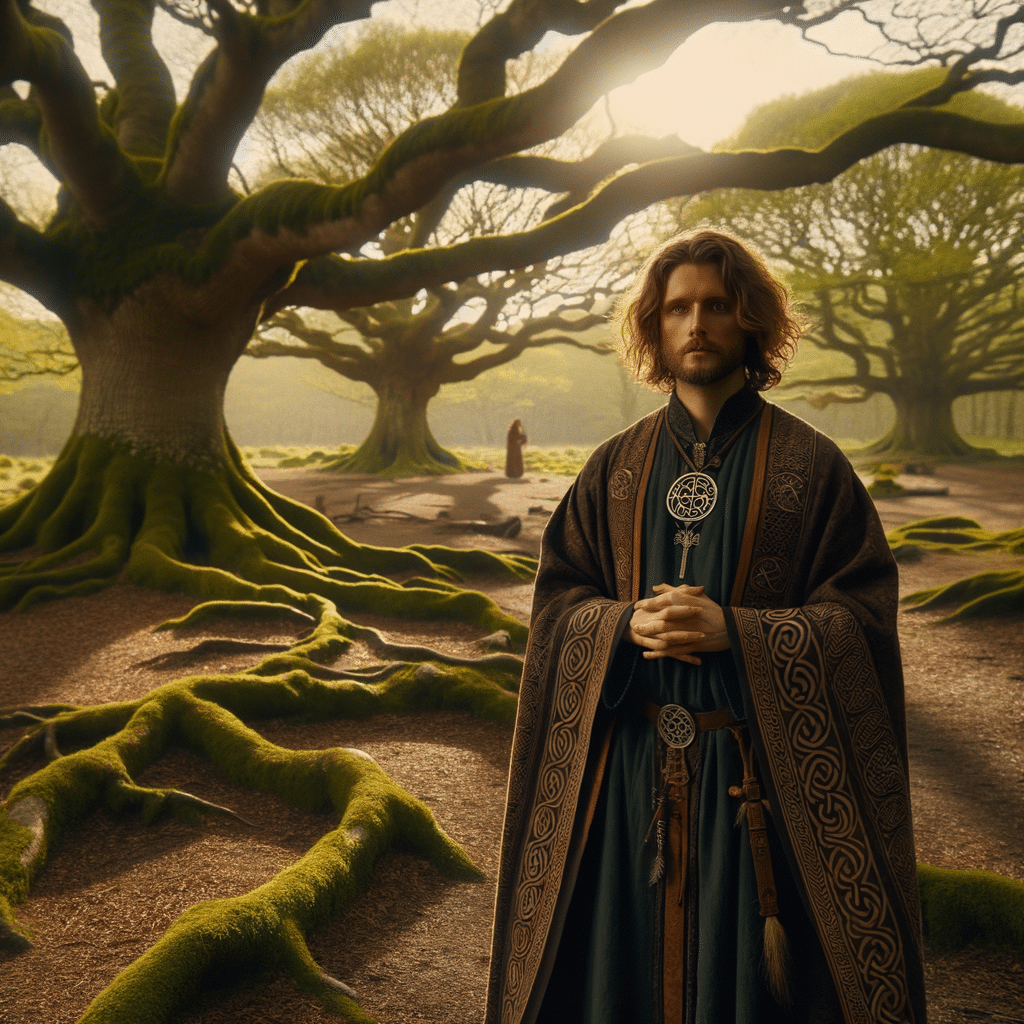
Celtic culture, which persisted for several millennia and covered a wide geographic area, was renowned for its extensive mythology and spiritual practices. This endurance and scope imply that Celtic religious ideas were dynamic, changing throughout time in response to a variety of internal and external influences. But because the texts we have access to are few and frequently outdated, our knowledge of ancient Celtic theology is very dispersed.
Celtic Religious Knowledge’s Original Sources
The names of places with spiritual significance and artifacts like sculptures, inscriptions, and religious paraphernalia are our main sources of information about ancient Celtic religion. In addition, the wealth of Celtic myths and legends—especially those originating in Wales and Ireland—offers priceless insights into their worldview and beliefs. The majority of the information gleaned from these stories was recorded by Christian scribes, whose interpretations would have been influenced by their own religious convictions and possible rejection of features associated with pagan culture.
It is also imperative to recognize that the majority of what we know of Gaulish spirituality comes from the writings of Greek and Roman historians, including Julius Caesar. The prejudices and misconceptions of the authors, who frequently saw Celtic customs through the prism of their own cultural norms, unavoidably have an impact on these recordings. Nevertheless, taken as a whole, these diverse sources provide us with an insight into the ancient Celtic respect for the natural world and their understanding of humanity’s place in it.
Druidism: Its Significance
Druidism, an institution at the center of Celtic spirituality, was the subject of scholarly controversy regarding its historical roots. Some academics contend that when the Celts moved westward from the eastern steppes into Europe and the British Isles, druidism followed. Some claim that it started in Britain and subsequently moved to the continent of Europe. Gender neutral or not, druids occupied powerful positions in Celtic society, ranging from leadership in religion to work in the legal and educational spheres.
Julius Caesar’s writings provide us with a great deal of comprehensive information about the druids, describing them as a caste of magico-religious people who could dictate worship and offer sacrifices. As counselors, teachers, and arbiters, druids occupied a position in society like to that of Merlin, the mythical magician of Arthurian legend, who is frequently regarded as having been shaped by druidic customs.
The Ovate, the druid’s opposite, was adept at healing, divination, and prophesy. Caesar also mentioned the druids’ unique standing in Gaulish culture, which included their exemptions from taxes and military duty. Due to this standing, many families chose to send their kids to study under the druidic order because it was an appealing alternative. According to legend, the word “druid” itself comes from a Celtic word that means “Knowing the Oak Tree,” attesting to the holy status of groves—especially oak forests—in their rites.
Celtic Sacrificial Practices: A Controversy
Greek and Roman writers have often credited the druids with the practice of human sacrifice. Greek historian Diodorus Siculus stressed the need for druids to be present at sacrifices in order to please the gods, reading the victim’s convulsions and blood flow as omens. Caesar recounted a horrifying rite in which a massive wicker man, loaded with live victims, was burned as a sacrifice.
Conclusion
The shards of evidence that we have now help us to piece together an idea of the spiritual terrain of the prehistoric Celts. A glimpse into a world where the divine was closely linked to the natural and the mortal is provided by their pantheon of gods and goddesses, their seasonal festivals and holy days, and their intertwined tales of heroes and magic. As we continue to research the Celts, we find that a great deal of their worldview reflects a deep and intricate spirituality that has, in various forms, survived into modern times, even though it is occasionally viewed through the distorted prism of later cultures.
Suggested Reading
The following works are highly recommended for anyone interested in learning more about the beliefs and practices of ancient Celtic culture:
B. Cunliffe (1997). The Celtic People of Antiquity. Oxford University Press, Oxford.
Barry Cunliffe’s extensive work provides a thorough examination of the Celts, including their prehistoric beginnings and the height of their hegemony throughout Europe. Cunliffe creates a striking portrait of Celtic culture, including their religious customs, by fusing historical research and archaeological data.
M. Aldhouse-Green (2004). The Druids are the Celtic Nature Priests. Thames & Hudson New York.
In this in-depth analysis of the druidic order, Miranda Aldhouse-Green examines the diverse functions that druids fulfilled in Celtic culture. In order to paint a complex picture of these intriguing people, the book carefully examines both the historical accounts written by Roman authors and the discoveries uncovered during archaeology.
J. A. MacCulloch (1911). Celtic religion in antiquity. Edinburgh: Clark, T. & T.
The seminal study by John Arnott MacCulloch is still a valuable tool for comprehending Celtic religious traditions. Given that the book was published more than a century ago, some of the content may be out of date, but overall, it remains a key reference for Celtic studies, especially for its examination of myth and ritual.
For anyone wishing to comprehend the subtleties and complexity of Celtic religious traditions and their historical development, these works ought to offer a strong starting point.

Leave a Reply