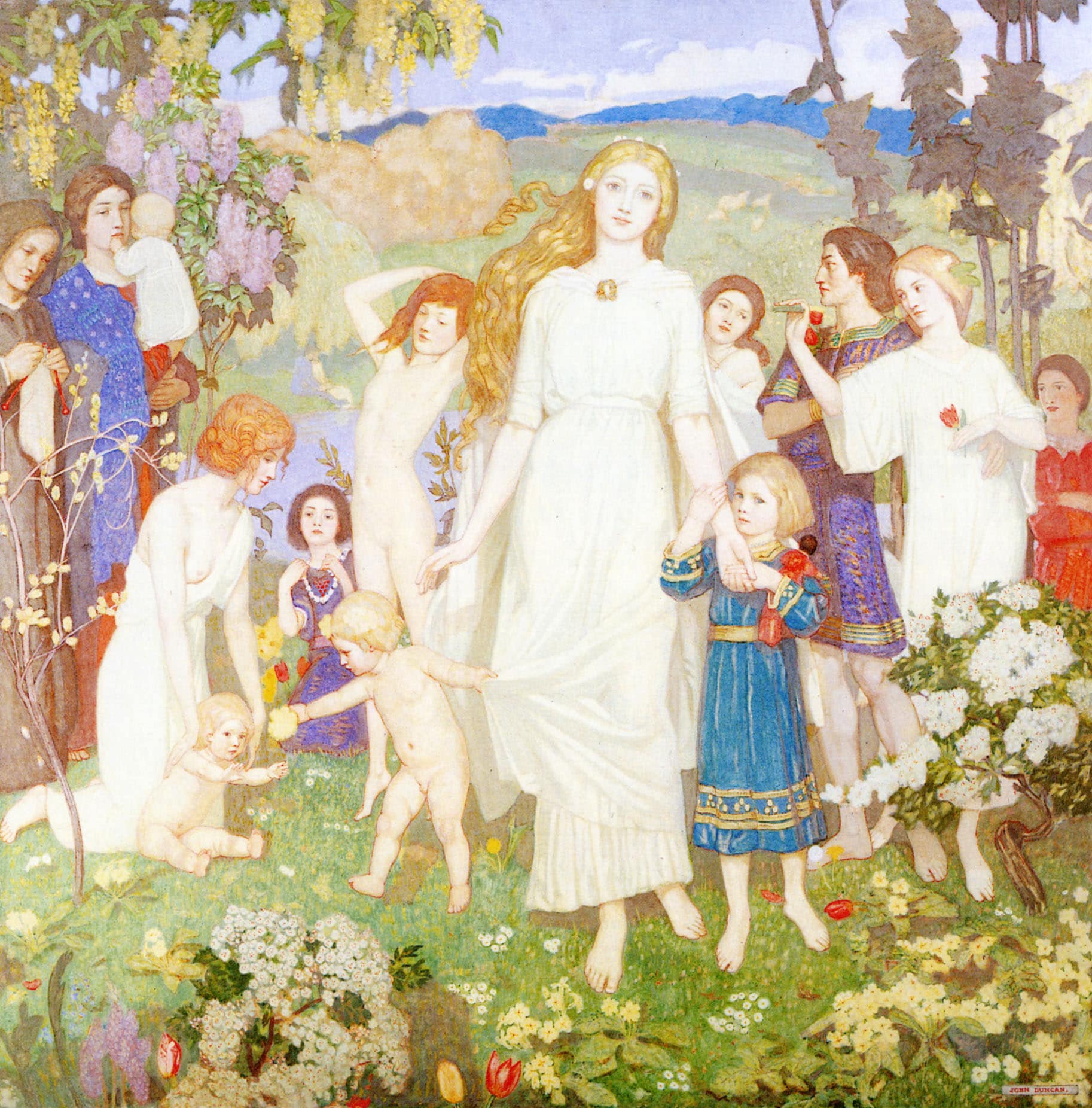
The devotion to Brigid, an Irish mythological figure with profound roots, is an intriguing case study of religious metamorphosis. Thanks to the devout veneration of the Irish people, Brigid, who was once a goddess in the pagan pantheon, had a miraculous transformation into a Christian saint. This essay delves into this shift, describing how Brigid’s ideas were syncretized to enable her to move between two different religious spheres and bringing attention to her importance in both pagan and Christian contexts.

Mythical Roots
Brigid, in her previous life as a pagan goddess, was the daughter of the legendary Irish figure Dagda. A marriage between her and Bress, son of the king of the Fomorians, represented political unity and connections. The story of Brigid’s maternal qualities is brought to light in the account of their son Ruadan, who died in war. Her profound grief at his death mirrored the universality of human loss.
As an embodiment of the contrast between the order and disorder in existence, Brigid’s dualism was shown by her belief in her two halves. As a tribute to her abilities and the power she possessed over the natural world’s ebb and flow, the spring festival of Imbolc was held in her honor.
Brigid was said to have been born at dawn, and the story goes that with her advent came a tower of flame, representing her dominion over fire—a representation of the creative energies, inspiration, and life-giving power of the sun. She was portrayed as a celestial muse for craftspeople and poets, a healer whose footfall created springs of water, and a guardian whose kindness fostered the land and its people in the myths and rituals that revolved around this element.
Conversion to Christianity
Recognizing the profound significance of Brigid to the Irish people, the early Christians prudently decided to integrate her devotion instead of eradicating it. In order to preserve Brigid’s legacy and meet the spiritual requirements of the Irish converts, this intentional syncretism allowed her to be transformed from a goddess to a Christian saint.
As she became known as Saint Brigid of Ireland, she kept many of the characteristics of her pagan ancestor. On February 1, which happened to be the same day as the pagan celebration of Imbolc, the Church officially sanctioned the feast day of Saint Brigid. Observed within a Christian context, this festival maintained the celebration of rebirth and illumination.
The pagan values of Saint Brigid were mirrored in her tales. Legends about the goddess’s boundless compassion, great healing powers, and unshakable devotion echoed in older accounts of her role in the cycle of life.

History and Modernity
Both Brigid’s pagan and Christian personas have left lasting legacies, which shows how spiritual identities can change over time and how religions can incorporate new ideas. As a conduit between the physical and spiritual realms, Brigid provides a fresh angle on how faiths adapt their deities to new circumstances.
A powerful example of the ability of cultural adaptation and assimilation is the story of Brigid, who went from being a pagan goddess to a Christian saint. She was able to stay revered and important throughout the changing religious paradigms in Ireland because of this transformation. Her essence, whether as a spring goddess, a healer, or a creative inspiration, shone brightly in the lives of her devotees.
Further Reading
For those interested in delving deeper into Brigid’s rich history and the transition of her worship through time, the following books are recommended:
Bitel, L. M. (1996). Land of Women: Tales of Sex and Gender from Early Ireland. Ithaca, NY: Cornell University Press.
Condren, M. (1989). The Serpent and the Goddess: Women, Religion, and Power in Celtic Ireland. San Francisco, CA: Harper & Row.
Monaghan, P. (1990). The Book of Goddesses and Heroines. St. Paul, MN: Llewellyn Publications.
These works provide extensive insight into the cultural and religious contexts that shaped Brigid’s transformation from a Celtic deity to a Christian figure of sainthood, enriching the understanding of her enduring influence.



Leave a Reply