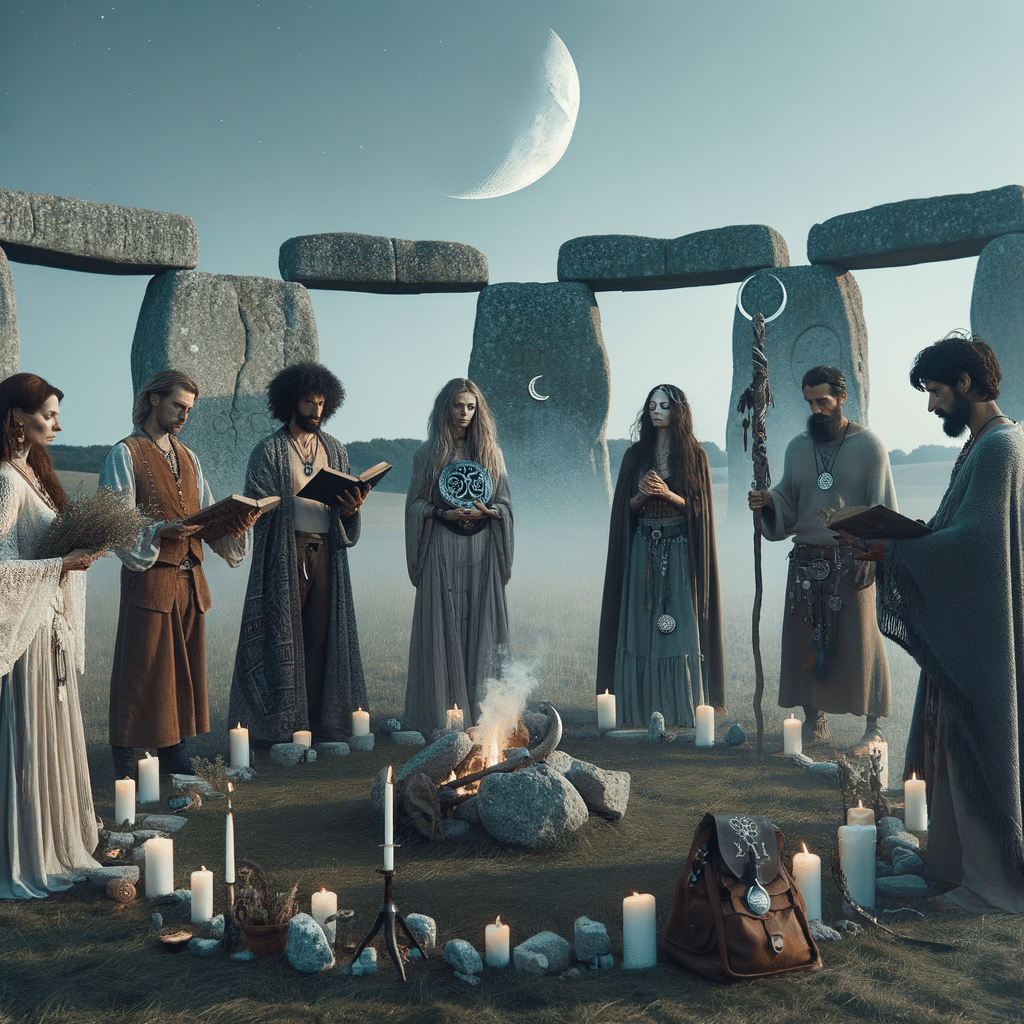
Stonehenge, an ancient and mysterious megalith monument in Wiltshire, England, has captivated scholars, wiccans, spiritual seekers, and tourists for a considerable amount of time. It features an intricate pattern of large stones oriented in relation to the solstices and other astronomical occurrences. Stonehenge’s eternal mystery and grandeur have established it as a symbol of ancient genius and spiritual importance, even though its precise purpose is still up for debate.
The location has gained popularity with contemporary Wiccans, who view it as a strong symbol of their pagan past and a central location for their ceremonies and festivities. This essay investigates the complex relationship between Stonehenge and contemporary Wicca, looking at the monument’s historical background, its use in Wiccan ritual, and the unsolved riddles surrounding it.

Stonehenge Mysteries
Built between 3000 and 2000 BC, this ancient construction consists of a ring of standing stones, each over 13 feet high and weighing over 25 tons. Stonehenge may have once served as an astronomical calendar due to its circular stone arrangement and alignment with the solstices. Many facets of Stonehenge’s construction and purpose are still unknown, despite in-depth research.
Pearson (2013) suggests that Stonehenge likely formed part of a larger complex of buildings and monuments, with the surrounding area serving as a ceremonial landscape. According to this view, Stonehenge was a part of a network of locations that were important to the Neolithic people both religiously and socially, rather than being a solitary monument. The alignment of the monument with the solstices further supports the hypothesis that it served for astronomical observations and agricultural calendar-related rites.
Stonehenge has a rich and complex history. The Neolithic era marked the beginning of the monument’s construction, culminating in a circular earthwork enclosure. The late Neolithic and early Bronze Ages saw the erection of enormous sarsen stones and smaller bluestones. It is still a feat of engineering to move these stones—some from as far away as Wales—and install them precisely. Various theories explain the movement of the stones, ranging from the use of sledges and rollers to intricate engineering methods that combine levers and labor.
There are still many unanswered questions regarding Stonehenge. The monument’s function remains one of the most persistent questions. Although its alignment with the solstices points to an astronomical purpose, other ideas say that it was a place of devotion, healing, or burial. The presence of burned human remains at the site supports the idea that it served a funerary purpose, yet the nature of the rituals performed there remains unknown. The construction procedure is another enigma. The precise methods employed to move and install the enormous stones are still unclear, despite advancements in technology and archaeology. There is still disagreement about the origin of the stones, particularly the bluestones. Experts remain perplexed by the precise logistics of their transportation over such vast distances, despite recent research linking some of these stones to specific Welsh quarries.
There is also conjecture regarding Stonehenge’s architects and their motivations for creating such a massive building. Although it is widely accepted that various organizations worked over several centuries to build the monument, little is known about these individuals’ identities, or the organization required to carry out such a massive undertaking. The Stonehenge building has cultural and societal implications that point to a highly motivated and orderly civilization, but little is known about their beliefs and manner of life.

Wicca
The relationship between Stonehenge and modern Wicca, a pagan religious organization that began in the early 20th century, is among its most fascinating features. Wicca makes extensive use of folklore, old customs, and the veneration of nature from classic witchcraft beliefs. Stonehenge, with its astronomical alignments and historical origins, has come to represent spiritual significance for a large number of Wiccans. For Wiccans, who observe the summer and winter solstices as part of their yearly celebrations known as Sabbats, the monument’s alignment with these occasions has special significance. Thousands of people, many of whom are Wiccans, flock to Stonehenge during the solstices to attend gatherings dedicated to honoring the natural cycles and establishing a connection with the ancient energies they believe to be at the site.
There is a deep and complex relationship between Stonehenge and contemporary Wicca, which has its roots in both the monument’s architectural features and Wiccan spirituality. According to Hutton (2001), respect for nature and the seasonal cycles—elements that Stonehenge profoundly embodies—is essential to Wiccan practice. Wiccan spirituality, as a contemporary reimagining of paganism, frequently aims to reestablish ties to pre-Christian Europe. Stonehenge, with its mysterious past and ties to prehistoric peoples, provides a physical link to their ancestors’ customs. Wiccans meet at Stonehenge to physically and spiritually connect with a site that has been sacred for thousands of years, reaffirming their dedication to respecting and maintaining these antiquated customs.
For Wiccans, Stonehenge’s alignment with the solstices holds special importance. The main axis of the monument coincides with the summer solstice dawn and the winter solstice dusk. These solstices are pivotal dates in the Wiccan Wheel of the Year, a cycle of eight festivals, or Sabbats, that honor the varying seasons. For Wiccans, the summer solstice, Litha, and the winter solstice, Yule, are occasions for ritual, celebration, and introspection. They signify the cyclical nature of life and the equilibrium of light and dark by designating the longest and shortest days of the year.
During these solstices, Stonehenge becomes a hub for Wiccans and other pagan groups. At Stonehenge, the summer solstice celebration is particularly well-known, drawing thousands of visitors who come to watch the sunrise and take part in ceremonies and celebrations. Wiccans use this moment to revere the sun at its zenith, rejoice in nature’s richness, and channel cosmic and earthly energies. On the other hand, when the sun starts its return journey into longer days, the winter solstice is a time of reflection and rejuvenation. Wiccans get together to celebrate the light’s return and engage in rituals that highlight hope and renewal.
For many Wiccans, Stonehenge has a deeper spiritual meaning that extends beyond the solstices. Many Wiccans believe that the enormous antiquity and enigmatic beginnings of the stones themselves connect them to ancient knowledge and the earth’s rich past. Wiccans regard Stonehenge as a potent location for connecting with the natural energies and spirits they believe inhabit the land, due to its enduring presence and alignment with cosmic events. Stonehenge is believed to have an innate power that enhances the effects of rituals conducted there, making it a powerful location for spiritual communication and magical operations.
Furthermore, Stonehenge’s use in Wiccan rituals reflects a larger tendency within Wicca to restore and revere historic locations and customs. The Wiccans’ open and inclusive rituals and celebrations at Stonehenge are indicative of the flexible and varied character of contemporary paganism. These get-togethers help participants develop a sense of belonging and a common goal, resulting in the creation of a living tradition that respects the past while adapting to satisfy modern spiritual demands.
Conclusion
Stonehenge’s association with contemporary Wicca emphasizes the monument’s continued spiritual and cultural value. Because of its alignment with the solstices, modern pagans are drawn to the location to respect these age-old customs, which resonate with Wiccan celebrations of nature’s cycles. Despite extensive research, many mysteries remain about Stonehenge, such as its purpose, the construction process, and the identity of its builders. These unanswered mysteries keep people’s attention and guarantee that Stonehenge will always be a source of wonder and respect in both historical and contemporary situations. Stonehenge is more than just a historical monument to Wiccans; it is a hallowed place that symbolizes the universe’s mysteries and natural cycles. Wiccans are able to reverence the land, celebrate the timeless rhythms of life, and establish a connection with the ancient past through their rituals and meetings at Stonehenge.
References
Hutton, R. (2001). The Triumph of the Moon: A History of Modern Pagan Witchcraft. Oxford University Press.
Parker Pearson, M. (2013). Stonehenge: Exploring the Greatest Stone Age Mystery. Simon & Schuster.
Chippindale, C. (2004). Stonehenge Complete. Thames & Hudson.
North, J. (1996). Stonehenge: Neolithic Man and the Cosmos. HarperCollins.
Castleden, R. (1993). The Making of Stonehenge. Routledge.

Leave a Reply