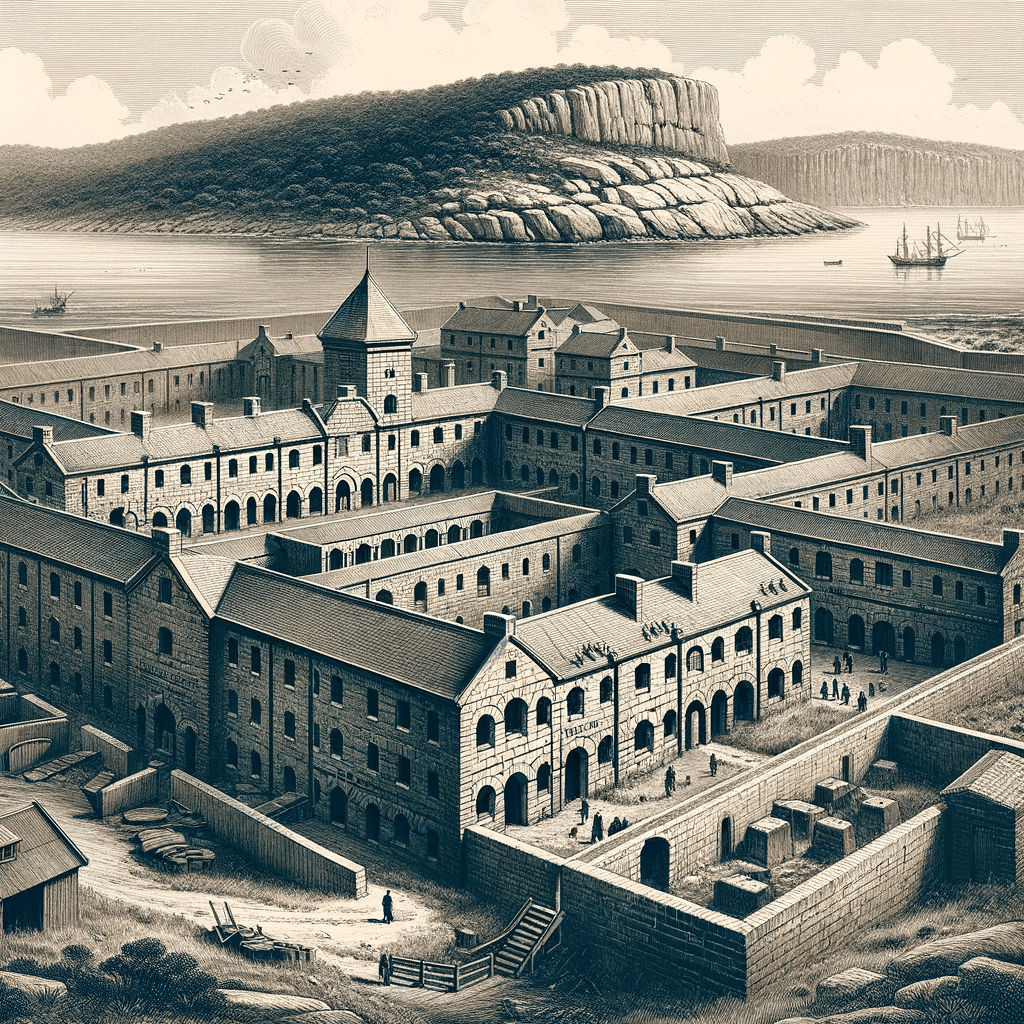
The Ghosts of Port Arthur serve as haunting reminders of one of Australia’s most notorious prison colonies, where the legacy of human suffering and colonial cruelty persists to this day. Port Arthur, which is located on the Tasman Peninsula of Tasmania, is one of the most important haunted sites in the nation due to its terrible past and alleged paranormal activity. It attracts both ghost seekers and historians.

Description
From 1833 until 1877, Port Arthur served as a prison settlement that housed the most seasoned criminals and repeat offenders in Britain. The property housed a prison, hospital, asylum, chapel, and the infamous Separate Prison, where sequestered prisoners suffered psychological harm. During its operation, over 1,000 individuals, including prisoners, troops, civilian employees, and their families, lost their lives within its walls. Many believe that the severe circumstances, numerous floggings, and mental torture still create a depressing environment today (Lennon, 2008).
Port Arthur’s spectral residents are as varied as its past. The Blue Lady, thought to be the ghost of a young woman who passed away in childbirth at the hospital in the 1870s, is the most commonly reported apparition. Witnesses report hearing infant cries and seeing a blue-tinted figure holding what looks to be a baby. Visitors and guards at the Separate Prison have reported hearing ghostly footsteps reverberating through the deserted cells and seeing shadowy figures in the hallways.
The ghostly inhabitants of Port Arthur exhibit a spectrum of behaviors, from unsettling to pleasant. Some apparitions interact with guests, while others simply appear and vanish. Reverend George Eastman, the chaplain of Port Arthur, is believed to haunt the church, occasionally playing organ music when the place is empty. Visitors to the Accountant’s House have reported experiencing unexpected decreases in temperature, objects moving mysteriously, and invisible hands caressing them (Waterton & Saul, 2021).
The origins of ghost legends about Port Arthur date back to the late nineteenth century, shortly after the prison’s closure. Locals and former guards began recounting eerie incidents that eluded explanation. The separate prison and the hospital, where the greatest suffering had taken place, were the main subjects of these early narratives. The devastating mass shooting in 1996, which claimed 35 lives, further enhanced Port Arthur’s reputation as a haunted place. Some tourists even claimed to have had experiences with more recent ghosts.
The ghost stories have changed throughout time from being straightforward accounts of apparitions to more intricate tales that combine historical study with contemporary paranormal investigative methods. Ghost hunting gear and scheduled paranormal tours introduced a more methodical technique to record paranormal events in the 1990s, but word of mouth and local newspapers frequently disseminated early reports. Thermal imaging, EVP recordings, and digital photos have expanded the site’s eerie history.
There are several different types of documented encounters at Port Arthur. Photographers have photographed enigmatic figures and inexplicable orbs, while tour guides claim hearing children laughing in the deserted playground close to the Parsonage. One particularly noteworthy instance happened in 2014 when, even though there were no historical reenactments happening that day, a visitor took a picture of what looked to be a human dressed in period attire standing in a doorway (Findlay, 2019).
The eerie reputation of Port Arthur has had a big impact on popular culture and local tourism in the current era. Regular ghost tours are available at the location, and they have grown to be one of Tasmania’s most visited tourist destinations. The site has filmed numerous episodes of television programs featuring paranormal investigators, and writers and researchers are constantly documenting new experiences and accounts. The management of the site strikes a careful balance between maintaining its historical relevance and embracing its status as a paranormal hotspot (Goc, 2002).

Skepticism
The purported paranormal activities at Port Arthur have a number of dubious explanations. Natural environmental elements are important; the site’s seaside position produces unusual acoustic effects, fog, and regular temperature variations. The ancient stones and building arrangement can produce wind tunnels and inexplicable noises. Frequent mist and odd light patterns that could be mistaken for apparitions are further consequences of the beach setting.
Another important component is the influence of priming and suggestion. Ghost tour participants are more prone to seeing everyday happenings as paranormal because they are already anticipating the unusual. People are naturally on edge because of the site’s gloomy past and gothic architecture.
Pareidolia, the human tendency to perceive faces and patterns where none exist, can explain many claimed sightings. In low light, people may mistake shadows and reflections in antique windows for faces or figures. This phenomenon, when combined with lens flare, camera artifacts, or long exposure effects, results in a significant number of ghost photographs.
Some of the guests’ claimed physical experiences have a scientific explanation thanks to infrasound. The site’s architecture and location may produce low-frequency sound waves, known to induce pressure sensations, uneasiness, and even visual hallucinations (Parsons, 2012). Confusion might arise from historical reenactments and tour groups; in certain instances, tourists have taken pictures of what they thought were ghosts, only to find out later that they were actually staff members dressed in period attire or distant tour groups.
Confirmation bias and memory contamination are additional factors. People prefer to ignore contradicting evidence while recalling and sharing experiences that support their opinions. Retelling embellishes stories, and over time, people may add or alter information without conscious thought.
The often-reported sightings at the Parsonage home are a prominent example of memory contamination at Port Arthur. During a ghost tour in the 1980s, a tour guide reported seeing a woman in a grey dress peering out from an upper window. Reports of a grey lady from tourists sharply rose over the ensuing years, and descriptions became more thorough and regular.
However, scholars searching through historical documents and visitor reports from before the 1980s found no references to a grey-dressed figure. The descriptions in previous ghost stories concerning the Parsonage were very different and mostly concentrated on cold areas and odd noises. The story of the grey lady appears to have emerged due to memory contamination.
-
The tour guides repeatedly recounted the narrative.
-
Visitors began to “expect” to encounter a woman dressed in grey.
-
People began to incorporate details from the story into their memories of their encounters.
-
Every recounting gave the story more realism.
-
It was the now-established tale that influenced the experiences of new guests.
This pattern shows how later information can retrospectively change initial observations, producing an apparently continuous sequence of sightings that actually came from a single source. The evolution of the description of the grey lady’s appearance over time is particularly striking, as details about her facial characteristics and haircut emerged years after the initial sighting, despite not being part of the original story.
Conclusion
Port Arthur is a reminder of Australia’s colonial past as well as the persistent human interest in the paranormal. The site’s sinister background and the innumerable accounts of paranormal activity continue to enthrall tourists from all over the world, regardless of whether they believe in ghosts or not. Real or imagined, Port Arthur’s ghosts ensure that the stories of individuals who lived, suffered, and perished there will always be remembered by acting as enduring reminders of the place’s complicated and sad past.
References
Findlay, J. (2019). Cinematic landscapes, dark tourism and the ghosts of Port Arthur. History Australia, 16(4), 678-694.
Goc, N. (2002). From convict prison to the Gothic ruins of tourist attraction. Historic Environment, 16(3), 22-26.
Lennon, J. (2008). Port Arthur, Norfolk Island, New Caledonia: convict prison islands in the antipodes. In Places of Pain and Shame (pp. 179-195). Routledge.
Parsons, S. (2012). Infrasound and the paranormal. Journal of the Society for Psychical Research, 76(908), 150-174.
Waterton, E., & Saul, H. (2021). Ghosts of the Anthropocene: spectral accretions at the Port Arthur historic site. Landscape Research, 46(3), 362-376.

Leave a Reply