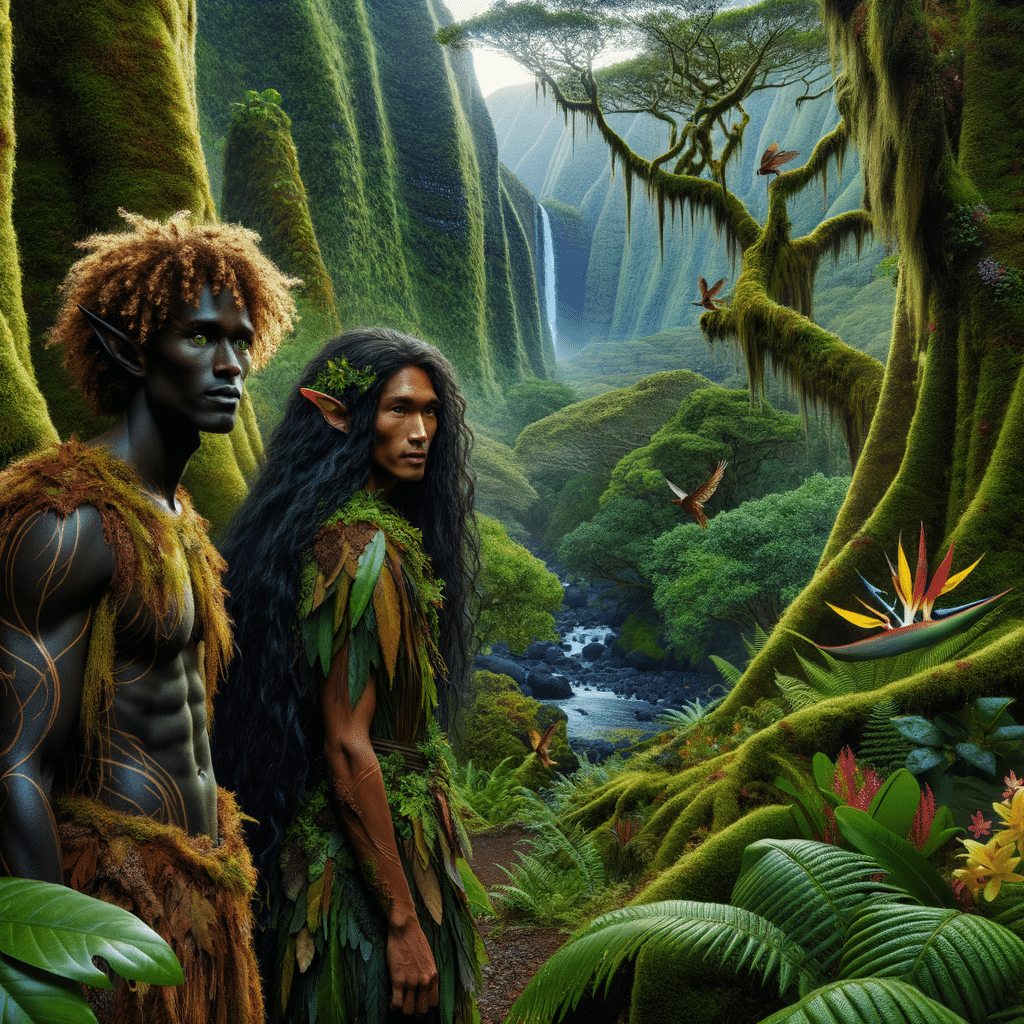
Deep within Hawaiian legend lies the fascinating story of the Menehune, enigmatic creatures believed to have lived in the Hawaiian Islands long before Polynesian immigrants arrived. By fusing aspects of historical narratives, mythological stories, and cultural beliefs, these amazing creatures have captivated the imagination of generations and continue to captivate both storytellers and historians. What are they?

Description
Traditionally, people described the Menehune as small, typically standing no taller than two to three feet. Their thick, dark features, round tummies, and stocky, muscular frames distinguished them. People frequently characterized them as having reddish-brown skin, bushy eyebrows, and exceptionally huge, protruding eyes. Traditional stories describe their attire as simple malo (loincloths) and garments fashioned from leaves (Dixon, 2004).
The exceptional engineering and construction skills of the Menehune were well known. According to legend, they exclusively worked at night and finished large-scale construction projects before daybreak. They were expert artisans who are said to have constructed water aqueducts, roadways, temples (heiau), and fishponds all over the Hawaiian Islands. The most well-known of their credited creations are the stone irrigation system known as the Kikiaola ditch and the Alekoko Fishpond on Kauai. According to reports, their work was so accurate that mortar was not necessary for the stones to fit together flawlessly.
Native Hawaiian oral traditions, down through generations of kahuna (priests) and kupuna (elders), contain the oldest known references to the Menehune. The Kumulipo, the Hawaiian creation chant, contains the term Menehune itself, indicating their profound incorporation into Hawaiian mythology. Early European explorers and missionaries recorded these tales in the 18th and 19th centuries, but their own cultural viewpoints unavoidably skewed their narratives.
The Menehune’s folklore has changed over the years. Modern interpretations have occasionally romanticized them as exclusively benevolent fairies or reduced them to tourist-friendly caricatures, although ancient reports depicted them as expert craftsmen who could be both helpful and malevolent. As significant preservers of historical memory and traditional values, modern Hawaiian cultural practitioners frequently highlight the Menehune stories’ deeper spiritual and historical relevance (Poirier, 1951).
Early Hawaiian Immigration
One of the strongest historical interpretations of the Menehune stories, backed by historical records and archaeological evidence, is the idea that the Menehune are the original inhabitants of Hawaii. This theory posits that the Menehune were not just mythological creatures but also real historical individuals who underwent gradual mythologization. The earliest immigrants came to Hawaii from the Marquesas Islands between 300 and 600 AD, according to archeological evidence, and there were further waves of migration. Around 1000–1300 AD, immigration from Tahiti followed these initial residents. The Tahitian newcomers established the ali’i (chief) system that existed before European settlers arrived, bringing a highly stratified social structure and ultimately taking over as the dominant culture (Suggs, 1960).
King Kaumualii’s Hawaiian Kingdom census of the island of Kauai in 1820 provides important support for this notion. According to this census, there were 65 Menehune residents in the Wainiha Valley district. Characterized as a distinct group apart from the broader population, it appears that these people retained their unique identity well into the 19th century. One of the most compelling historical pieces of evidence for the Menehune’s existence as a separate population group comes from this census.
Linguistic evidence also supports this theory. Tahitian’s Manahune word, which denotes commoners or lower-class people, may be the source of the phrase Menehune. This association may suggest that the initial Tahitian settlers called the native inhabitants Manahune, which later changed to Menehune in Hawaiian. This linguistic relationship allows us to better understand the social interactions between the two groups (Bucková, 2020).
The argument suggests that Tahitian settlers gradually gained dominance, driving the original Marquesian settlers into more marginal locations, particularly the mountains and isolated valleys. This displacement may explain the Menehune’s reputation for only appearing at night and their affinity with mountainous areas. The Menehune’s nocturnal lifestyle may reflect a historical pattern of the displaced population avoiding contact with the new dominant group.
The Menehune’s architectural accomplishments further support this notion. Numerous buildings attributed to them exhibit unique engineering approaches that diverge from later Hawaiian building practices. For instance, the Kikiaola ditch and Alekoko Fishpond exhibit advanced engineering skills that may be a holdover from a previous architectural history. These structures’ exact stone fittings point to a unique building method that existed before subsequent Hawaiian techniques.
Traditional Hawaiian tales frequently portray the Menehune as skilled artisans who constructed irrigation systems, fish ponds, and buildings out of stone. These narratives may preserve memories of the technological accomplishments of the initial settlers. The focus on their engineering abilities might be a reflection of the early Marquesian settlers’ historical achievements, whose methods might have been different from those of the Tahitian newcomers.
The Menehune’s physical attributes as a small but strong people may potentially have historical roots. Oral traditions over time may have emphasized the physical contrasts between the early Marquesian settlers and the later Tahitian arrivals. The depiction of them as short yet strong may represent how the dominant group viewed them, or it may reflect actual physical traits of the original population.
The Menehune’s slow transition from historical people to mythological creatures may be a reflection of their marginalization and cultural absorption. As the original inhabitants grew increasingly isolated and finally assimilated into the larger Hawaiian community, they mythologized their history. Many cultures progressively transform historical occurrences and individuals into legendary characters through a process known as mythologization.
This idea also explains the intricate relationship between Menehune and humans in Hawaiian folklore. Legends often depict them as both beneficial and distinct from the general population, potentially reflecting the historical connection between the early settlers and the later Tahitian arrivals. The focus on their avoidance of interpersonal interaction may help to preserve recollections of the real-life social interactions between these groups.
With the discovery of new archeological data and the closer examination of traditional oral histories, the scholarship underlying this thesis keeps changing. To learn more about the possible historical foundation of the Menehune stories, contemporary scholars are progressively integrating historical sources, linguistic studies, oral traditions, and archeological data. This interdisciplinary approach provides a more comprehensive picture of Hawaii’s complicated settlement history, aiding in bridging the gap between myth and history.
The Menehune stories may preserve the memory of an ancient small-statured hominid community, like the Homo floresiensis found in Indonesia, according to a more contentious theory. Proponents compare the physical traits of the Hobbits of Flores and the Menehune, but there is no archaeological proof for this in Hawaii. These hominids would also represent the original inhabitants of the islands but in a different context.

Menehune and Faeries
Despite their independent development in very different cultural contexts, the links between the faerie traditions of European folklore and Hawaii’s Menehune offer intriguing analogies that go beyond mere coincidence. Numerous similarities exist between the two mythological creatures, suggesting the adaptation of shared human perceptions and experiences into diverse cultural contexts. However, rather than a direct connection, the majority of experts explain these similarities as concurrent cultural development (Opanike, 2024).
Both traditions characterize these creatures as expert artisans with extraordinary powers. People credited European faeries with creating fairy circles, underground halls, and magical objects, while the Menehune were renowned for their overnight construction of spectacular stone structures. According to reports, both parties prefer to work covertly and avoid human interaction, usually at night. One element that unites both traditions is their nighttime nature.
Both creatures’ descriptions of size are strikingly similar. While European faeries, especially the artisan varieties like brownies, kobolds, and gnomes, are sometimes portrayed in the same size range, Menehune are usually characterized as being two to three feet tall. Both groups, despite their diminutive size, are known for their robust build, emphasizing their strength and ability to perform amazing physical feats.
Additionally, there are intriguing similarities in their interactions with humans. Faeries and Menehune were known to have complicated, frequently conflicting interactions with human societies. When respected, they may be helpful; when insulted, naughty, or vindictive. It was claimed that both groups had certain demands for their labor: Menehune needed complete seclusion and to finish their tasks before dawn, while faeries frequently needed tiny food or drink offerings and compliance with certain interaction guidelines.
Another thing they have in common is their affinity for nature. Both Menehune and faeries associated themselves with natural elements such as forests, mountains, and pools of water. People frequently referred to them as the keepers or guardians of natural areas due to their specialized understanding of the environment and its resources. According to both legends, as human civilization grew, these creatures retreated farther into untamed areas.
Both faiths mention the concept of a parallel world or hidden realm. While European mythology has faeries dwelling in an otherworld that exists alongside our own, accessible through specified locations or during specific periods, Hawaiian traditions describe Menehune living in distant mountain areas and deep valleys. A common motif in all faiths is the idea of an adjacent but distinct universe.
They play an especially significant role in technology and craftsmanship. People believed that both Menehune and faeries possessed superior knowledge and abilities compared to regular people. The Menehune were skilled engineers and stonecutters, while faeries were often associated with welding, mining, and other crafts. Historical interactions with more technologically savvy peoples may have contributed to the Menehune’s high technical understanding, or they may have preserved memories of obsolete technologies.
Additionally, there are similarities between the two traditions’ taboos and interactional regulations. People frequently banned looking directly at Menehune or faeries while they were working, believing that they would stop if caught or seen. Both customs involve the offering of food, though the details vary depending on the culture. According to some academics, these similarities may be a reflection of lost technologies, the psychological desire to explain remarkable historical structures, or universal human experiences with excluded communities. Others suggest that these parallels may reflect shared human methods for comprehending scientific processes or using mythological frameworks to preserve historical memory.
Modern times have witnessed similar trends in the development of both traditions. Both have been maintained as significant pieces of cultural history and are also being sold. Serious academics and cultural practitioners continue to research and protect the deeper relevance of these traditions, acknowledging them as intricate carriers of historical memory and cultural knowledge, despite the existence of tourist-friendly versions of both Menehune and faeries.
Understanding these parallels reveals how various cultures have created comparable frameworks for interpreting historical occurrences, natural phenomena, and the interaction between the human and non-human worlds. The parallels between the Menehune and faerie traditions, despite their unique development, point to shared human needs and experiences in the construction of mythological frameworks for cultural memory preservation and world explanation (Yu-ling, 2024).
Conclusion
The Menehune are a complex representation of Hawaiian cultural legacy that combines aspects of mythology, history, and social memory. Their legacy lives on in the remarkable archeological remains ascribed to them and in the rich cultural traditions of Hawaii, regardless of whether they were a unique historical people, a symbolic depiction of ancient builders, or something else entirely. The Menehune stories’ timeless appeal demonstrates their significance to Hawaiian cultural identity and their capacity to unite historical fact with mythological wonder, captivating audiences and conserving vital cultural knowledge for coming generations.
References
Bucková, M. (2020). Analysing the motif of “dwarf people” in Polynesian mythologies, their origin and characteristics. Part I. Asian & African Studies, 29(2).
Dixon, P. W. (2004). The Hawaiian Menehune in myth and paleontology. Human evolution, 19, 287-291.
Opanike, O. (2024). The Little Encyclopedia of Fairies: An A-to-Z Guide to Fae Magic. Running Press Adult.
Poirier, J. (1951). Luomala, Katharine. The Menehune of Polynesia and other mythical little people of Oceania. Journal de la Société des Océanistes, 7(7), 301-302.
Suggs, R. C. (1960). Historical traditions and archeology in Polynesia. American Anthropologist, 62(5), 764-773.
Yu-ling, L. (2024). A History of Research into the Little People. Seeking the koko’ta’ay: Investigating the Origins of Little People Myths in Taiwan and Beyond, 2, 158.



Leave a Reply