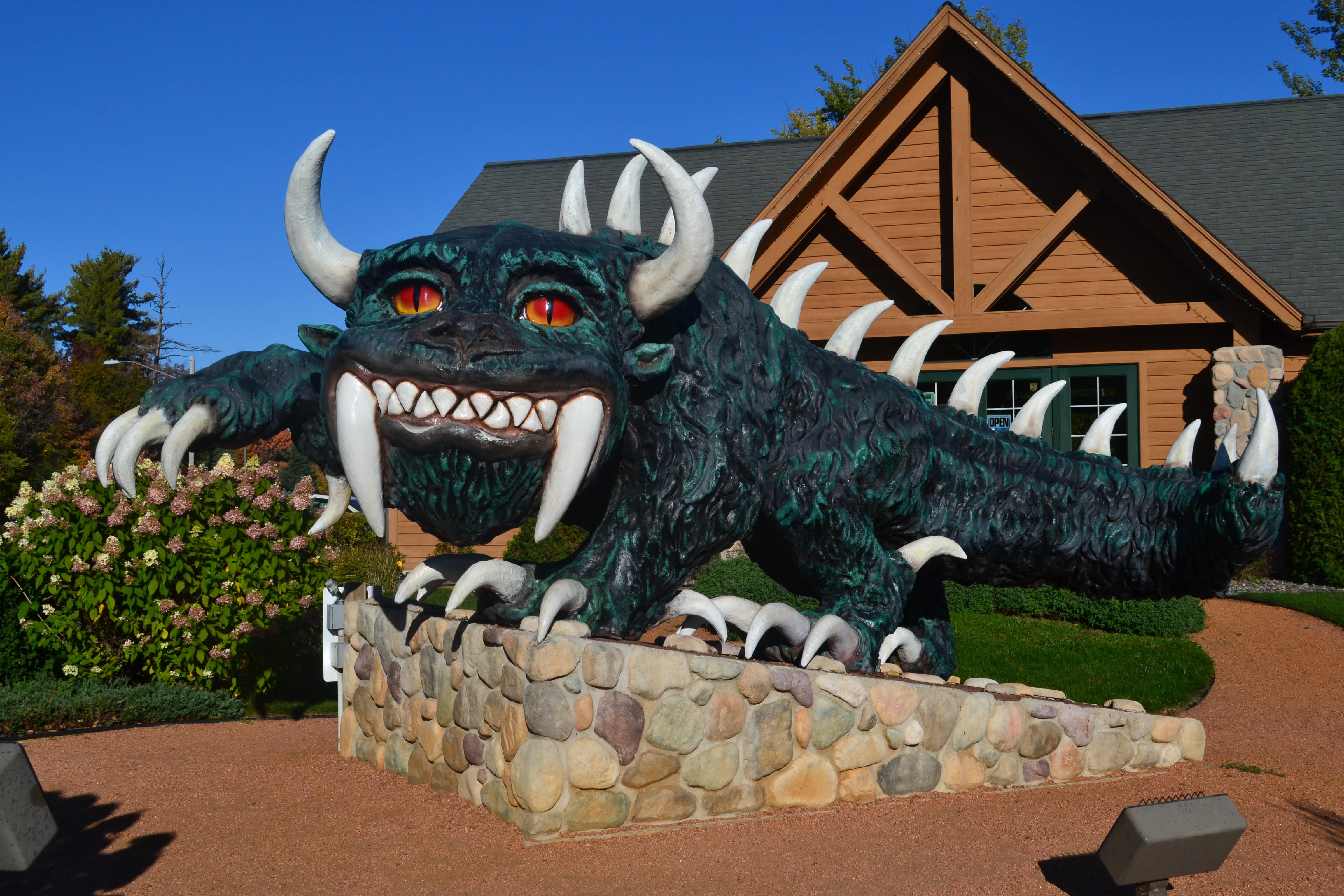
Though many secrets lie in the thick northern Wisconsin woods, maybe none are as lasting as the story of the Hodag. For over a century, the Hodag has captivated both locals and tourists, thereby becoming an integral part of Wisconsin’s legendary identity. The Hodag is more than simply a mythological creature; it captures the spirit of Wisconsin’s logging era, the inventiveness of its storytellers, and the persistent human need to believe in something exceptional hiding just outside the edge of society. The Hodag has guaranteed its position as Wisconsin’s most renowned cryptid and still shapes the cultural scene of the state by means of several versions and changing narratives. From scary campfire stories to happy city mascot, the Hodag’s path shows larger shifts in American culture as the frontier slowly gave way to industrialization and tourism while also proving the incredible tenacity of regional folklore in the face of modernity.

Description
Physically, the Hodag is a difficult-to-categorize mix of various creatures into one terrifying package. Traditionally described, it stands roughly seven feet tall on its hind legs with the overall build of a bull or huge carnivore clothed in dense black hair mixed with green accents. Among its most unique qualities are curving horns sticking from its frog-like head and a line of sharp spines down its back like dinosaur plates. Glowing green eyes, a terrible grin packed with needle-sharp teeth, and a horrible smell said to surpass even the most seasoned woodsmen all contribute to the creature’s uniquely terrifying visage. Its strong tail is tipped with spears that may supposedly pierce an unprepared traveler; its feet finish in strong claws. Some reports further describe the beast as having the facial features of an elephant, the head of an ox, thick short legs fitted with long claws, and the back of a dinosaur, forming a chimera monster that seems to blend the most terrifying aspects of different animals, both living and extinct. Early drawings highlighted its horrifying look; some showed extra characteristics, such as scales next to its hair or several rows of fangs meant to enhance its scary look (Neville, 2020).
With habits meant to scare anyone who goes too deep into Wisconsin’s woodlands, the Hodag’s observed behavior identifies it as a creature of both cunning and violence. According to lumberjack stories, the Hodag primarily hunts during the night for its peculiar prey, white bulldogs, which it eagerly devours. Said to employ several hunting strategies, the Hodag ambushed victims from trees, used its awful stink to confuse prey, and even imitated human voices to draw the unknowing into its grasp. Perhaps most disturbingly, the myth claimed that the Hodag possessed near-human intelligence and harbored a particular hatred for lumberjacks due to their destruction of its forest habitat, thus turning the creature into an ecological avenger against those who would harm the woods. Some tales recounted how the Hodag would especially target the camps of the most damaging logging operations, scaring workers and wrecking equipment before vanishing back into the depths of the forest. Other stories said that knowledge held by Native American tribes that had battled the beast for millennia before European settlement could only temporarily repel the monster by certain combinations of herbs and minerals.
The Hodag was also credited with mystical powers that helped to confirm its status in Wisconsin folklore. Many stories claim the animal could become invisible at will, therefore accounting for the rarity of certain sightings, despite its claimed large population in northern Wisconsin. Adding an agricultural aspect to the danger it presented, another prevalent myth believed that the Hodag’s howl could cause milk to curdle and crops to wither. Some tales said the Hodag was an entire species rather than one monster, with females protecting complex underground tunnels where they nursed their young on a diet of toxic plants and venomous snakes, which is maybe the most fascinating. These additions helped to define the Hodag as a supernatural rather than just a physical danger, so categorizing it with other American cryptids like the Jersey Devil or Mothman that crossed simple biological classification.

Folklore History
One charismatic person—Eugene Shepard of Rhinelander, Wisconsin—is indelibly linked to the mythological past of the Hodag. A forest cruiser, land surveyor, and infamous practical joke artist, Shepard said in 1893 that he had found and caught a Hodag employing a band of bear hunters equipped with rifles and poles tipped with explosives. Shepard’s detailed story explained how the beast was eventually tamed, and he then showed what were allegedly the burned remains of the creature. Shepard claimed to have caught another Hodag alive in 1896, building on his early success. Exhibiting this animal at the first Oneida County Fair, he charged inquisitive onlookers with entry to see the creature in a poorly lit tent. Actually an elaborate creation of wood, leather, bull horns, and concealed wires worked by Shepard’s sons from under the stage, the beast hissed at guests and moved occasionally. Even doubtful guests sometimes departed Shepard’s display with a seed of uncertainty about whether such a monster could really exist in the distant woods of northern Wisconsin (Gutowski, 1978).
Shepard’s invention of the Hodag was not spontaneous; it was based on pre-existing logging camp folklore and the legacy of tall stories that thrived in frontier areas. With thousands of men toiling in remote camps surrounded by apparently limitless woods, the late 19th century was the golden age of the lumber sector in Wisconsin. These circumstances were ideal for the creation of fanciful tales and mythical monsters that provided supernatural expression to the very real hazards of frontier life, so they helped pass the long winter nights. Shepard, knowing this cultural background, designed his Hodag to include features that would speak to logging communities—its loathing of lumbermen, its woodland environment, and its terrifying look all played into current concerns and narrative legacies. What distinguished Shepard’s work was his entrepreneurial drive to turn lumberjack folklore into a tourist draw and regional phenomenon, therefore resurrecting backwoods mythology into the public eye at a time when Americans were growing more interested in the vanishing frontier (Kearney, 1928).
The history of the Hodag myth shows how folklore keeps its fundamental attraction even as it changes with society. Rather than damaging the story, Shepard’s deception strengthened it; the Hodag was transformed from alleged actuality to recognized but cherished fiction. From a terrifying border monster to a more humorous emblem of local identity, the Hodag changed during the early 20th century. Postcards showing the Hodag became famous tourist attractions, usually showing a slightly less scary rendition of the creature. Local companies adopted the animal as their mascot, and guides and performers, catering to visitors seeking authentic northwoods experiences, regularly shared exaggerated stories of Hodag sightings. Urban people looking for recreational ties to nature were increasingly romanticizing the wilderness traditionally seen as dangerous; therefore, this transition coincided with more general American culture changes (Dorson, 1974).
The Hodag story also illustrates the intricate interaction between late 19th- and early 20th-century American journalism and folklore. Many newspapers published articles on Shepard’s find that blurred the line between news and fun, therefore helping to spread the Hodag. The Rhinelander Daily published several stories on Hodag sightings and catches, often winking to readers who got the humor while keeping enough clear seriousness to interest outsiders. Often as a kind of entertainment masquerading as news, newspapers would report about sea serpents, wild men, and other impossible animals, reflecting this trend of journalistic folklore that was prevalent at the time. This media landscape greatly helped the Hodag to reach people far outside Rhinelander via wire services and reproduced articles that regarded Shepard’s invention as a genuine zoological enigma. This early media coverage, which shaped the Hodag in the public consciousness before radio and television produced more centralized forms of entertainment, explains much of the legend’s endurance.
Modern Impact
As it became more commercialized and woven into Wisconsin’s tourist sector, the Hodag underwent significant change in the mid-twentieth century. Rhinelander declared itself the Home of the Hodag and put up posters and monuments to draw people heading to northern holiday spots as car tourism became more popular following World War II. From the Hodag Country Festival (founded in 1978) to innumerable souvenir stores, eateries, and motels, local companies included the creature in their names and branding. With less focus on its terrifying qualities and more on its individuality as a regional mascot, the image of the Hodag itself grew increasingly cartoonish and friendly during this time. Completing its transition from horrifying monster to popular character, this commercially acceptable form of the Hodag appeared on everything from children’s novels to beer labels. But local storytellers preserved some of the Hodag’s more conventional qualities even as it became more commercially focused, preserving the more complicated and scary versions of the mythology in oral tradition even as its public image got more sanitized.
The Hodag has evolved from a fearsome beast to a cherished cultural icon and marketing powerhouse in modern times. Rhinelander has fully embraced its link to the mythical beast, using it as the city’s official emblem and showcasing a big Hodag statue as a well-liked tourist draw. Proudly termed the Hodags, the local high school sports teams draw thousands to the area during an annual music event called Hodag Country Festival. Representing a playful homage to the area’s logging legacy and narrative traditions, the monster shows up on everything from coffee mugs to T-shirts. Originally a tall story intended to scare and entertain lumberjacks, what has developed is a multi-faceted cultural phenomenon driving tourism, giving regional identity, and linking modern Wisconsin people with their folkloric legacy. The Hodag has also appeared in popular culture outside Wisconsin in recent decades, including role-playing games, fantasy books, and even children’s television programs, so introducing new generations to this unique American cryptid and guaranteeing its ongoing cultural relevance in the digital era.
The academic study of the Hodag provides interesting new perspectives on how regional folklore operates in American society. As a reflection of frontier concerns about wilderness, as a case study in how local stories can be commercialized without losing their cultural relevance, and as an example of occupational folklore (arising from logging settlements), folklorists have studied the Hodag. The Hodag’s evolution mirrors that of other American cryptids like Bigfoot and the Mothman, entities that originated in particular geographic settings but gained more widespread cultural awareness. Unlike those cryptids, the Hodag has always kept its clear link to its place of origin, therefore acting as a symbol of Wisconsin identity instead of a broader universal mystery. This localized particularity has really helped to sustain the story since it got ingrained in local institutions and tourism rather than being absorbed into more homogenized cryptid tradition. Academic interest in the Hodag persists even now; scholars look at how digital communications and globalization influence traditional regional folklore and how communities preserve unique cultural traits in an ever more linked society.
Wisconsin schools have acknowledged the educational worth of the Hodag narrative, which they usually include in classes on state history, folklore, and critical thinking. Younger pupils find the Hodag to be a fascinating starting point for knowledge about Wisconsin’s logging period and the significance of forestry to the state’s growth. Examining the Hodag hoax offers older students chances to talk about media literacy, the character of evidence, and how narratives change with time. Some teachers base creative writing assignments on the Hodag, so they motivate pupils to create their own regional folklore or to picture how the Hodag story could change in the future. Hodag displays in museums all throughout northern Wisconsin mix amusement with education by showing the history of the species alongside facts on real animal protection and forest management. By means of these informative uses, the Hodag remains a cultural touchstone linking Wisconsinites to their state’s natural and folkloric legacy in significant ways.
Conclusion
The Hodag story shows how mythological monsters often mirror the civilizations that produce them, hence encoding cultural values, anxieties, and desires under the cover of horrific beings. From Shepard’s first prank to today’s corporate mascot, the Hodag has fulfilled several roles: entertaining logging camps, drawing visitors, building community identity, and maintaining ties to Wisconsin’s frontier past. The Hodag’s persistence in popular culture reflects our ongoing obsession with cryptids and strange creatures even in an age of scientific explanation and technological demystification. The legend of the Hodag will keep evolving as long as Wisconsin’s forests stay green and deep, amusing the next generations with its strange look, terrible behavior, and the clear appeal of a well-made tall story that has come to life. The Hodag is proof of the ongoing strength of regional folklore to forge deep ties between individuals, places, and the shared narratives that shape a community’s sense of itself over generations and through changing times.
References
Dorson, R. M. (1974). Folklore vs. Fakelore-Again and Again.
Gutowski, J. A. (1978). The Protofestival: Local Guide to American Folk Behavior. Journal of the Folklore Institute, 15(2), 113-132.
Kearney, L. S. (1928). The Hodag and other tales of the logging camps. LS Kearney.
Kortenhof, K. D. (2006). Long live the Hodag!: The life and legacy of Eugene Simeon Shepard, 1854-1923. Hodag Press.
Neville, S. (2020). Midwestern Strange: Hunting Monsters, Martians, and the Weird in Flyover Country by BJ Hollars. Indiana Magazine of History, 116(1), 87-88.


Leave a Reply