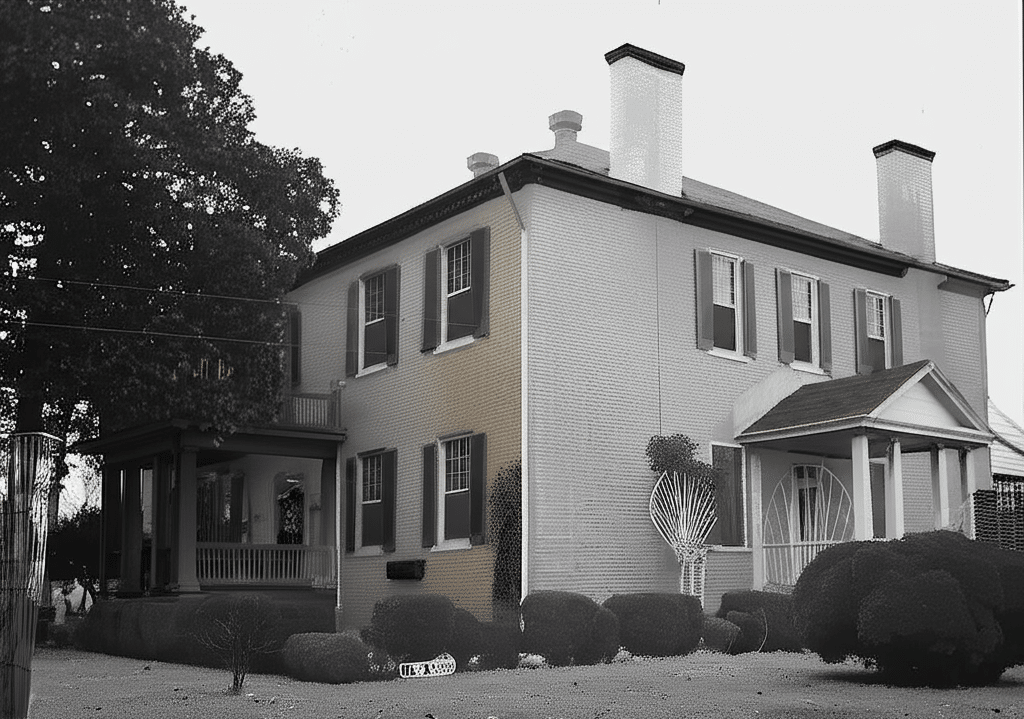
The lovely antebellum building called Sweetwater Mansion testifies in Florence, Alabama, to both architectural greatness and mysterious mystery. Built between 1828 and 1835, this ancient home has gathered almost two centuries of stories, from those of its notable initial residents to those of mysterious events still captivating tourists and paranormal fans. With unrelenting claims of strange events that contradict common wisdom, the mansion’s reputation as one of Alabama’s most haunted places has changed over centuries. From a simple historical site, Sweetwater Mansion’s ongoing tradition of paranormal activity has turned it into a center for people trying to grasp the line separating our world from whatever could lie beyond.

Overview
Standing two stories tall with its unique Greek Revival design that was popular during the antebellum era in the American South, Sweetwater Mansion has an amazing architectural profile. The estate boasts huge halls meant for the social events of its time, large symmetrical windows, and stately columns supporting a notable portico. Originally spanning 3,800 acres of prime Tennessee Valley land, the estate has experienced a reduction in size over time. Despite this, the home maintains a commanding presence with its eight rooms, which include formal parlors, dining areas, and bedrooms that have witnessed numerous historical events. The interior features period workmanship with detailed woodwork, opulent fireplaces in almost every room, and high ceilings that reflect the riches and prestige of its original owners, hence creating areas where both history and, according to many accounts, ghosts appear permanently embedded (Southall, 2015).
General John Brahan, a War of 1812 veteran, commissioned the construction of Sweetwater Mansion; he passed away before it was finished. Robert M. Patton, his son-in-law, bought the land and would go on to be the 20th Governor of Alabama during the difficult Reconstruction era following the Civil War. With Union General William Tecumseh Sherman allegedly utilizing it as a temporary center of operations, the mansion served as headquarters for both Union and Confederate forces throughout the Civil War, thereby witnessing notable historical events. Over the coming decades, the property changed hands several times, went through cycles of neglect and rebirth, and every new owner contributed to the deep history of the estate. The appropriate background for the paranormal events that would later be linked with the estate has been established by this chaotic past marked by war, political power, family tragedies, and shifting fortunes (Johnson, 1981).
Documented by inhabitants, visitors, and paranormal investigators over many decades, the recorded paranormal activity at Sweetwater Mansion covers a wide spectrum of occurrences. Common reports are of unexplainable footsteps reverberating down vacant corridors, doors opening and closing without human involvement, and extreme temperature changes happening even with heating and cooling systems remaining constant. Visitors have often reported seeing shadowy figures that vanish upon approach, especially on the second floor of the mansion and along the main staircase, where the ghost of a woman in period attire has been seen. The many electronic voice phenomena (EVP) recordings taken by paranormal research groups, which include whispers, names, and bits of speech inaudible to human hearing during the recording sessions, are even more interesting. These ongoing events have happened with such frequency that even cynical tourists have started to doubt their knowledge of what is feasible in the real world (Brown, 2017).
Among the most regularly encountered spirits at Sweetwater Mansion is thought to be that of Governor Patton himself, whose presence is usually felt in his former study, where items allegedly move without reason and where some visitors have claimed to feel watched by an invisible watcher. Another frequently mentioned spirit is a female figure thought to be Sally Patton, the governor’s wife, whose ghost has been observed roaming about the main parlor and sometimes appearing to arrange flowers or straighten items as if still running her home. Encounters with what witnesses call the spirits of children, whose laughter and running footsteps have been heard all over the house, especially in the upper bedrooms and the back stairway that would have been used by the housekeeping workers, are maybe most unsettling. Found to engage with toys or items left behind by investigators, these youthful beings have been found to move them quantifiable distances during nighttime investigations while no living human was present in those rooms (Langella, 2013).

Analysis
With historical trauma acting as a main explanation among paranormal researchers, several explanations have surfaced to account for the ongoing paranormal activity at Sweetwater Mansion. Many think the mansion’s function during the Civil War, when it acted as both a hospital and temporary military operations headquarters, created circumstances for spiritual residue to build up, with the pain of injured and dying soldiers possibly imprinting itself on the physical structure. Others cite unresolved family traumas, including untimely deaths that took place inside the estate, which produce the emotional states paranormal thinkers link with hauntings. Some studies suggest the mansion lies on a ley line or natural energy vortex that enables contact between several planes of reality, hence explaining the constant character of the events spanning many ownership periods and centuries. Although hypothetical, these ideas seek to build frameworks for comprehending events while challenging traditional scientific explanations.
Skeptics cite the mansion’s antiquity and structural features as possible causes for what witnesses see as supernatural events and provide other explanations for the stated phenomena. While the mansion’s intricate air circulation patterns could explain chilly patches and the feeling of being touched by invisible forces, the old wooden structure obviously creaks and settles, producing noises that could be misread as knocks or footsteps. Others also assert that the power of suggestion plays a significant role; guests arrive at the home, prepared by its reputation to interpret ordinary events through a supernatural lens. When assessing the paranormal claims connected to the home, historical inaccuracy woven into its ghostly mythology makes it even more difficult to distinguish fact from fiction. Notwithstanding these doubtful opinions, many events claimed at Sweetwater challenge such straightforward explanations, especially when several unrelated witnesses report the same events or when recording devices catch inexplicable sounds and pictures (Hendricks, 2020).
The paranormal reputation of Sweetwater Mansion has turned the property into a draw for ghost hunters and inquisitive visitors, hence generating both possibilities and obstacles for preservation activities. Equipped with particular tools meant to identify environmental anomalies and record proof of spectral activity, established study teams have held many formal paranormal investigations at the estate. These studies have generated intriguing videos, audio recordings, and personal testimony that keep driving attention to the supernatural features of the property. Local tour operators have included Sweetwater in ghost history tours of Florence, therefore earning money that has sometimes aided restoration attempts for the aged building. While sometimes downplaying its notable architectural and historical value with sensationalized ghost stories that may or may not reflect the actual nature of any supernatural presence that could exist within its walls, this paranormal tourism draws attention and resources to the historic property.
Conclusion
Sweetwater Mansion is a complicated crossroads of history, architecture, and inexplicable events that still fascinates local people as well as tourists to northern Alabama. From the early national era through the Civil War, Reconstruction, and beyond, its walls have seen the sweep of American history, maybe collecting emotional energy that some say shows up in the paranormal events so often described inside its rooms. The ongoing character of these reports over generations indicates that Sweetwater Mansion will probably keep its reputation as one of Alabama’s most haunted sites for years to come, whether one views these events as actual evidence of spirits clinging to their former home, as natural events misinterpreted through the prism of suggestion, or as something in between these two extremes. In this historic mansion where past and present appear to coexist, the borders between history and mystery, between the explicable and the unexplainable, stay tantalizingly hazy, beckoning every new generation to ponder what could really live inside the walls of this extraordinary Southern relic.
References
Brown, A. (2017). The Haunting of Alabama. Arcadia Publishing.
Hendricks, N. (2020). Haunted Histories in America: True Stories Behind the Nation’s Most Feared Places. Bloomsbury Publishing USA.
Johnson, K. R. (1981). Slavery and Racism in Florence, Alabama, 1841-1862. Civil War History, 27(2), 155-171.
Langella, D. (2013). Haunted Alabama Battlefields. Arcadia Publishing.
Southall, R. (2015). Haunted Plantations of the South. Llewellyn Worldwide.
Leave a Reply