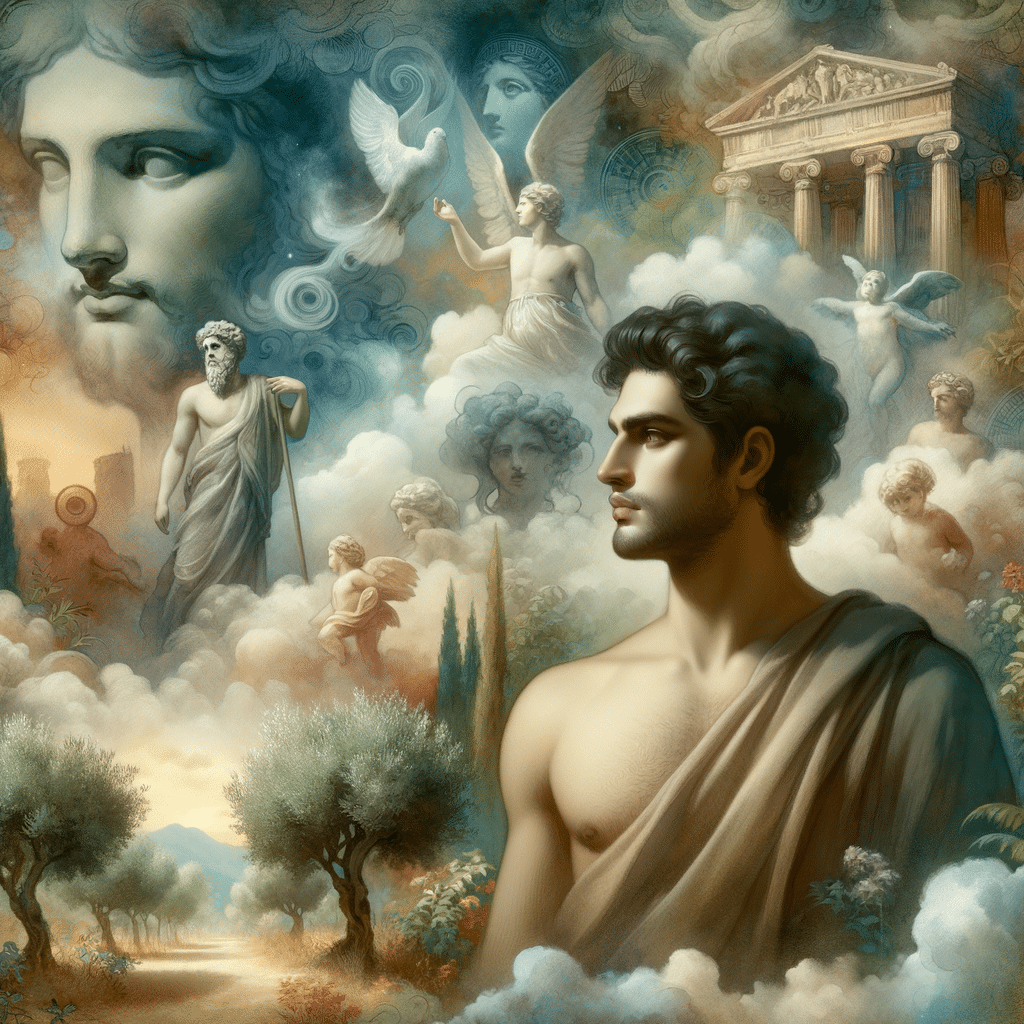
Dreams in Ancient Greece: Key Points
-
Ancient Greeks viewed dreams as divine communications and sacred bridges between mortals and gods, establishing them as profound spiritual experiences.
-
Paranormal theories suggest dreams allow consciousness to access telepathic communication and precognitive visions when the rational mind is reduced during sleep.
-
Greek society integrated dream interpretation into medicine and religion through temple practices and respected priest-interpreters who guided important decisions.
-
Greek mythology featured dream gods like Morpheus delivering divine messages, while epic literature showed prophetic dreams guiding heroic journeys.
-
Modern skeptics explain dreams through neuroscience and brain chemistry, attributing prophetic connections to confirmation bias and natural pattern-seeking behavior.
-
Greek dream beliefs profoundly influenced Western civilization and continue to shape our understanding of consciousness and mystery today.

Introduction
Dreams have always had a strange hold on our imaginations, taking us to places where reason doesn’t work and things that seem impossible come true. In ancient Greece, this nightly journey into the unconscious was considered more than just random brain activity; it was considered a deep connection to divine forces and secret knowledge. The Greeks thought that dreams were bridges between the world of the living and the world of gods, ancestors, and prophetic visions. They saw sleep as a sacred threshold where normal people could see extraordinary truths.
Overview
From a paranormal standpoint, dreams signify considerably more than the brain’s endeavor to assimilate daily experiences and emotions. Many people think that when we sleep, our minds are free from physical limits, which lets us access information that we can’t normally see or hear. This perspective posits that dreams may function as channels for telepathic communication, precognitive insights, and spiritual interactions with beings from alternate dimensions. When we sleep, our rational, analytical mind is less active, which is thought to make it easier for psychic phenomena to happen. This argument is why so many people say they have prophetic dreams, visits from dead loved ones, or supernatural experiences that feel very real.
People in ancient Greece really believed that dreams were messages from the gods and had prophetic meaning. The Greeks made a distinction between different kinds of dreams. Some were thought to be just reflections of everyday worries, while others were thought to be direct messages from the gods. People would sleep in sacred spaces in temples dedicated to Asclepius, the god of healing, hoping to receive healing visions or medical advice through their dreams. This viewpoint corresponds with ancient traditions such as Asclepian dream incubation, wherein individuals pursued healing and guidance through dreams thought to be influenced by Asclepius, the deity of medicine. Haselswerdt posits that this methodology embodies a societal conviction that dreams functioned as channels for divine enlightenment regarding health and wellness, a concept corroborated by ancient medical literature, including texts ascribed to Hippocrates, who regarded dreams as diagnostic instruments associated with an individual’s health (Haselswerdt, 2019; Mazandarani et al., 2018).
In ancient Greece, interpreting dreams was a complicated process that was often based on the idea that dreams could predict the future or show hidden truths. Artemidorus, a well-known dream interpreter, said that the richness of dreams could make them challenging to understand because they have so many different stories. Instead, he concentrated on symbolic elements that directly linked to the dreamer’s story (Downie, 2014). In contrast, Aristides welcomed the richness of narrative in divine dreams, proposing that they could convey messages that direct individual or societal trajectories (Downie, 2014). This distinct perspective exemplifies the diverse interpretations ascribed to dreams in ancient Greek culture.
In addition, dreams were used as a way to tell stories in Greek literature, such as Homer’s epics. Dreams in the Iliad and the Odyssey frequently signify a connection to the divine, wherein characters grapple with their destiny and ethical quandaries through dream imagery. Marques points out that the dreams in these epics are effective at persuading people to do things and make decisions (Marques, 2014). They serve as narrative devices and as reflections of the societal values and existential inquiries of the era. Literary analyses also examine the symbolic representation of dreams. The figures of Hypnos (Sleep) and Thanatos (Death) represent themes like the relationship between life, death, and the subconscious in mythology. The work shows a society that is struggling with complicated ideas about consciousness and the afterlife, which makes dreams even more important in ancient Greek culture (Solomi, 2025).
Greek mythology has many stories that show how important dreams are and where they come from. People believed that Morpheus, the god of dreams, could take on any human form and show up in dreams to send messages from the divine realm. The myth says that Morpheus, Icelus, and Phantasos were responsible for different parts of the dream experience. Morpheus was in charge of dreams of people, Icelus was responsible for dreams of animals, and Phantasos was responsible for dreams of things that aren’t alive. In many of Homer’s epic poems, heroes receive important advice or warnings in their dreams. For example, Athena shows up in their dreams to give them important information. These mythological frameworks were not merely narratives; they embodied authentic cultural convictions regarding the supernatural essence of dreaming.
The Oracle at Delphi is one of the most famous places in ancient Greece where dreams, prophecy, and divine communication came together. The Pythia, who was Apollo’s priestess, would go into trance-like states that many scholars think were like dreams. In these states, she would give cryptic prophecies that affected military campaigns and political decisions. Ancient texts discuss complicated rituals that people did before going to sleep and dreaming. These rituals included using certain herbs, sleeping in certain places, and following strict rules for cleaning up to make it more likely that they would have divine dreams. These customs show that the Greeks thought dreaming was a skill that could be learned and improved, not something that just happened to people.

Analysis
Contemporary paranormal theories regarding dreaming significantly derive from ancient Greek concepts while also integrating modern notions of consciousness and psychic phenomena. Some researchers suggest that dreams are a type of astral projection, in which the soul leaves the body for a short time to visit other places. Some people think that when you’re dreaming, you can access what Carl Jung called the collective unconscious, which is a shared storehouse of human experience and knowledge that goes beyond individual minds. Parapsychologists continue to investigate telepathic dreaming, wherein individuals assert the sharing of dream experiences or the reception of information regarding remote events, to ascertain whether consciousness can genuinely function autonomously from physical brain activity.
Skeptics of paranormal dreaming focus on how amazing the human brain is at making vivid, meaningful experiences without any help from the supernatural. Neuroscientists have pinpointed particular brain regions and neurotransmitter systems that activate during REM sleep, elucidating many of the peculiar and emotionally charged characteristics of dreams through strictly biological processes. The inclination of individuals to recall and highlight dreams perceived as prophetic, while neglecting numerous others that are ultimately inconsequential, exemplifies confirmation bias in practice. Sleep researchers note that the brain’s inherent propensity for pattern recognition can fabricate perceived correlations between dreams and subsequent occurrences, even in the absence of a causal link.
The beliefs of the ancient Greeks about dreams had a big effect on more than just their culture. They changed Roman culture, early Christianity, and eventually the way Westerners thought about dreams for hundreds of years. Medieval dream interpretation books often used Greek sources directly, and the idea of getting divine guidance through dreams became part of many religious traditions. Many people still believe in prophetic or spiritually important dreams that come from ancient Greece. Freud and Jung’s psychological theories, though secular, recognize dreams as significant phenomena that unveil concealed facets of the psyche, reflecting the ancient Greek notion that dreams grant access to esoteric knowledge.
Conclusion
The persistent intrigue surrounding dreams and their possible supernatural implications reveals a fundamental aspect of human nature and our connection to consciousness. Dreams, whether examined through the prism of ancient Greek mythology or contemporary paranormal theory, remain one of the final frontiers where mystery and awe endure in our progressively elucidated world. Although scientific comprehension of sleep and dreaming has significantly progressed, the subjective experience of dreaming continues to be as fascinating and mysterious as it was to the ancient Greeks, who initially examined its potential systematically. The true worth of dreams may not reside in their literal prophetic elements but in their capacity to connect us with the profound inquiries regarding consciousness, meaning, and the essence of reality that have fascinated humanity across all cultures and epochs.
References
Downie, J. A. (2014). Narrative and divination: artemidorus and aelius aristides. Archiv Für Religionsgeschichte, 15(1), 97-116. https://doi.org/10.1515/arege-2013-0008
Garofeanu, D. (2024). Crossing dreams: the neglected dreams of the homeric poems and the poetics of epic. Revista De Istorie Și Teorie Literară, 18, 240-254. https://doi.org/10.59277/ritl.2024.18.21
Gazis, G. A. (2018). Homer and the poetics of hades. Oxford Scholarship Online. https://doi.org/10.1093/oso/9780198787266.001.0001
Haselswerdt, E. (2019). The semiotics of the soul in ancient medical dream interpretation: perception and the poetics of dream production in hippocrates’ on regimen. Ramus, 48(01), 1-21. https://doi.org/10.1017/rmu.2019.8
Marques, S. H. (2014). Sonho e persuasão na épica homérica. Humanitas, 66, 23-33. https://doi.org/10.14195/2183-1718_66_2
Mazandarani, A. A., Aguilar‐Vafaie, M. E., & Domhoff, G. W. (2018). Iranians’ beliefs about dreams: developing and validating the my beliefs about dreams questionnaire. Dreaming, 28(3), 225-234. https://doi.org/10.1037/drm0000085
Solomi, L. A. (2025). Sleep, dreams and unconsciousness: understanding anaesthesia through ancient greek mythology. Anaesthesia and Intensive Care, 53(4_suppl), 27-35. https://doi.org/10.1177/0310057×251330656
Stewart, C. W. (2003). Dreams of treasure. Anthropological Theory, 3(4), 481-500. https://doi.org/10.1177/146349960334005




Leave a Reply